Category: Daily Dispatch

  • Jack Benny Violinist Comedian or Virtuoso?

    Jack Benny Violinist Comedian or Virtuoso?

    How good a violinist was Jack Benny? Allegedly a competent one, the owner of a Stradivarius, who mined the comedic potential of “bad playing.”

    Benny in duet with 12 year-old Talia Marcus:

    Later, he repeats the gag with a young Dylana Jenson, who went on to make that classic record of the Sibelius concerto with Ormandy and the Philadelphia Orchestra.

    https://www.youtube.com/watch?v=DdQa-TaQvPs

    Benny with Jascha Heifetz (radio):

    Benny episode (television) featuring Isaac Stern and “Man of 1000 Voices” Mel Blanc as Benny’s music teacher. Note how Blanc’s characterization morphs into Yosemite Sam in moments of pique.

    Benny and Stern play Bach at Carnegie Hall to raise money for American symphony orchestras:

    Jack Benny Fiddles with the Classics:

    Dylana Jenson plays the Sibelius concerto at the old Academy of Music in Philadelphia. Norman Carol is the concertmaster. Ormandy conducts. The RCA recording, made under studio conditions, was issued shortly after.

    https://www.youtube.com/watch?v=o7zwIFLY-vw

  • Explorers on Film Celebrate Discovery

    Explorers on Film Celebrate Discovery

    Conquest is so not in right now. Nonetheless, this week on “Picture Perfect,” in advance of Columbus Day, the focus will be on explorers and exploration.

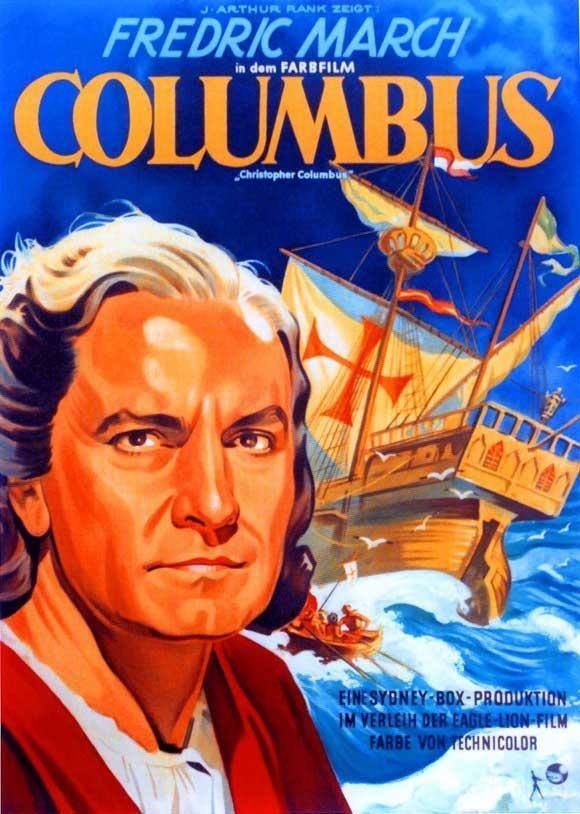
    Fredric March plays the title role in “Christopher Columbus” (1949), inspired by the novel of Rafael Sabatini, author of “Scaramouche” and “The Sea Hawk.” The film was released by Gainsborough Pictures, the British studio that produced Alfred Hitchcock’s “The Lady Vanishes” and “The Wicked Lady,” a wildly popular, saucy period melodrama that starred Margaret Lockwood and James Mason.

    Stewart Granger had originally been announced for the lead. Mason had also been considered. Replicas of the Nina and the Santa Maria were built especially for the film, and location shooting took place in Barbados. The Santa Maria was lost for two nights following a squall in the West Indies. Then it caught fire and had to be rebuilt. As far as March was concerned, all the effort was for naught. Reportedly, he was not very happy with the finished film.

    The music for “Christopher Columbus” was by Arthur Bliss, who in 1950 would receive his knighthood and, in 1953, his appointment as Master of the Queen’s Music.

    If you think March was a strange choice, just imagine Gary Cooper in “The Adventures of Marco Polo” (1938). Cooper assumes the role of the famed Venetian merchant who travels the Silk Road to China. Despite the ludicrous casting, the film yet manages to entertain, with Basil Rathbone, fine as always, as the villain.

    The music is by Hugo Friedhofer. Friedhofer was such a successful orchestrator, he remained largely in the shadows of the film score luminaries he assisted. He lent his distinctive touch to many now-classic scores by Max Steiner and Erich Wolfgang Korngold. “The Adventures of Marco Polo” was Freidhofer’s first big chance to step up and show what he could do as a composer. He would have to wait until 1942 for another. Four years later, he would win a much-deserved Academy Award for his score to “The Best Years of Our Lives.”

    The westward journey of Meriwether Lewis and William Clark has been a source of perpetual fascination for Americans. In 1997, Ken Burns directed a PBS documentary “Lewis and Clark: The Journey of the Corps of Discovery.” National Geographic climbed on board a few years later with “Lewis and Clark: Great Journey West” (2002). The 42-minute featurette was released in IMAX theaters, with narration by Jeff Bridges and music by Sam Cardon.

    Finally, Ralph Vaughan Williams wrote his most famous film score for the Ealing Studios docudrama “Scott of the Antarctic” (1948). John Mills plays explorer Robert Falcon Scott on his determined push to the reach the South Pole.

    Vaughan Williams’ work on the score became the basis for his Symphony No. 7, which bears the subtitle “Sinfonia Antartica.” (Note that the composer drops the first “c” from the title of his symphony, preferring the Italian and dooming the work to being constantly misspelled.) We’ll hear selections from an extended suite from “Scott of the Antarctic,” from the first of three CDs issued on the Chandos label that, collectively, offer an overview of Vaughan Williams’ work for the cinema.

    Corn and tomatoes from the New World! Spaghetti and fireworks from the Orient! Snow cones and frostbite from the Antarctic! Discover music from movies about explorers and exploration this week, on “Picture Perfect,” this Friday evening at 6:00 EDT, on WWFM – The Classical Network and wwfm.org.

  • Happy Feast Day Saint Francis of Assisi

    Happy Feast Day Saint Francis of Assisi

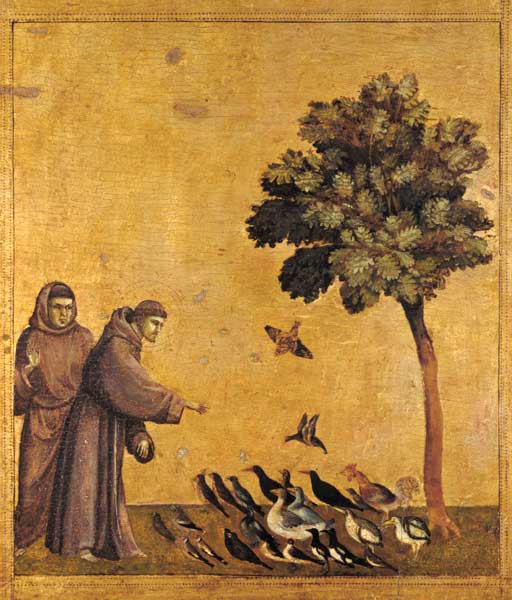
    Today is the Feast Day of Saint Francis of Assisi.

    If saints are your thing, you‘d be hard pressed to find one more beloved than St. Francis – unless you’ve misplaced your car keys, in which case St. Anthony is your man. I count myself fortunate in that I was able to visit Francis’ hometown before the devastating earthquakes of 1997.

    Be sure to take a moment today to kiss your pet. Bless all animals! Then enjoy some of the music below.


    Franz Liszt’s “Saint Francis of Assisi Preaching to the Birds” (piano)

    Liszt’s “Saint Francis of Assisi Preaching to the Birds” (orchestra)

    Francis Poulenc’s “Quatre petites prières de saint François d’Assise”

    Paul Hindemith’s “Nobilissima Visione” (suite, conducted by the composer)

    Hindemith’s “Nobilissima Visione” (rarely-heard complete version)

  • Berg, Mozart & Marlboro Zigzags on WWFM

    Berg, Mozart & Marlboro Zigzags on WWFM

    There are times when I suspect Alban Berg felt he zigged when he should have zagged.

    Berg, a pupil of Arnold Schoenberg, was always the Romantic among serialists – one critic described him as “the Puccini of twelve-tone music” – so it’s not difficult to divine a shimmering, unresolved longing common to the works of his Viennese contemporaries.

    On this week’s “Music from Marlboro,” we’ll hear Berg’s two-movement String Quartet of 1910. Like much of Berg’s music, the quartet is not really a strict adherent to any system. The music wafts spectrally, sharing tonal and atonal characteristics, a kind of fever dream of uncertainty.

    There will be no lack of commitment in the performance, which dates from 1984. We’ll experience Marlboro excellence in the form of Ida Levin and Felix Galimir, violins; Benjamin Simon, viola; and Sara Sant’Ambrogio, cello.

    Then we’ll emerge from the fin de siècle fog to find enlightenment with Wolfgang Amadeus Mozart. Mozart’s String Quintet No. 5 in D Major, K. 593, composed in 1790, adds a second viola to the mix. The work was recollected by the composer’s widow, Constanze, to have been written for a musical amateur, often speculated to be Johann Trost. Trost must have been quite the gifted dilettante. He also knew Haydn from Esterhaza, and Haydn dedicated some of his quartets to him.

    When Haydn and Mozart played through the D Major Quintet together before Haydn’s first visit to London, the two men took turns indulging in the first viola part. The work was known for centuries as the “Zigzag” because of an alteration to the original manuscript that modified what had been a descending chromatic figure in the final movement into something decidedly more humorous.

    We’ll hear a Marlboro performance from 2005, with Sarah Kapustin and Diana Cohen, violins; Mark Holloway and Sebastian Krunnies, violas; and David Soyer, cello.

    The music may be jagged, but the path to enjoyment is always straight. It’s another hour of superb chamber music making from the legendary Marlboro Music Festival, this Wednesday evening at 6:00 EDT, on WWFM – The Classical Network and wwfm.org.
    Marlboro School of Music and Festival: Official Page

  • Les Barocudas Baroque Concert NYC

    Les Barocudas Baroque Concert NYC

    On February 15, three musicians stand at the ready on the steps of St. Bart’s. The caption to the photo, posted on the group’s Facebook page, reads, “We are here! NYC! Less than 1 hour before the concert. Be here or be lame!!!” I can only reiterate.

    I hope you’ll tune in for today’s Noontime Concert on The Classical Network for the Baroque stylings of Les Barocudas. The Montreal-based trio describes itself thusly:

    “Les Barocudas est un groupe de musique ancienne sur instruments d’époque composé de 3 jeunes musiciens qui cherchent simplement à débrider leur créativité.”

    Ou en anglais: “Les Barocudas is an old-time group of period instrument performers composed of 3 young musicians who simply want to unleash their creativity.”

    And judging from their promotional material, that they certainly do.

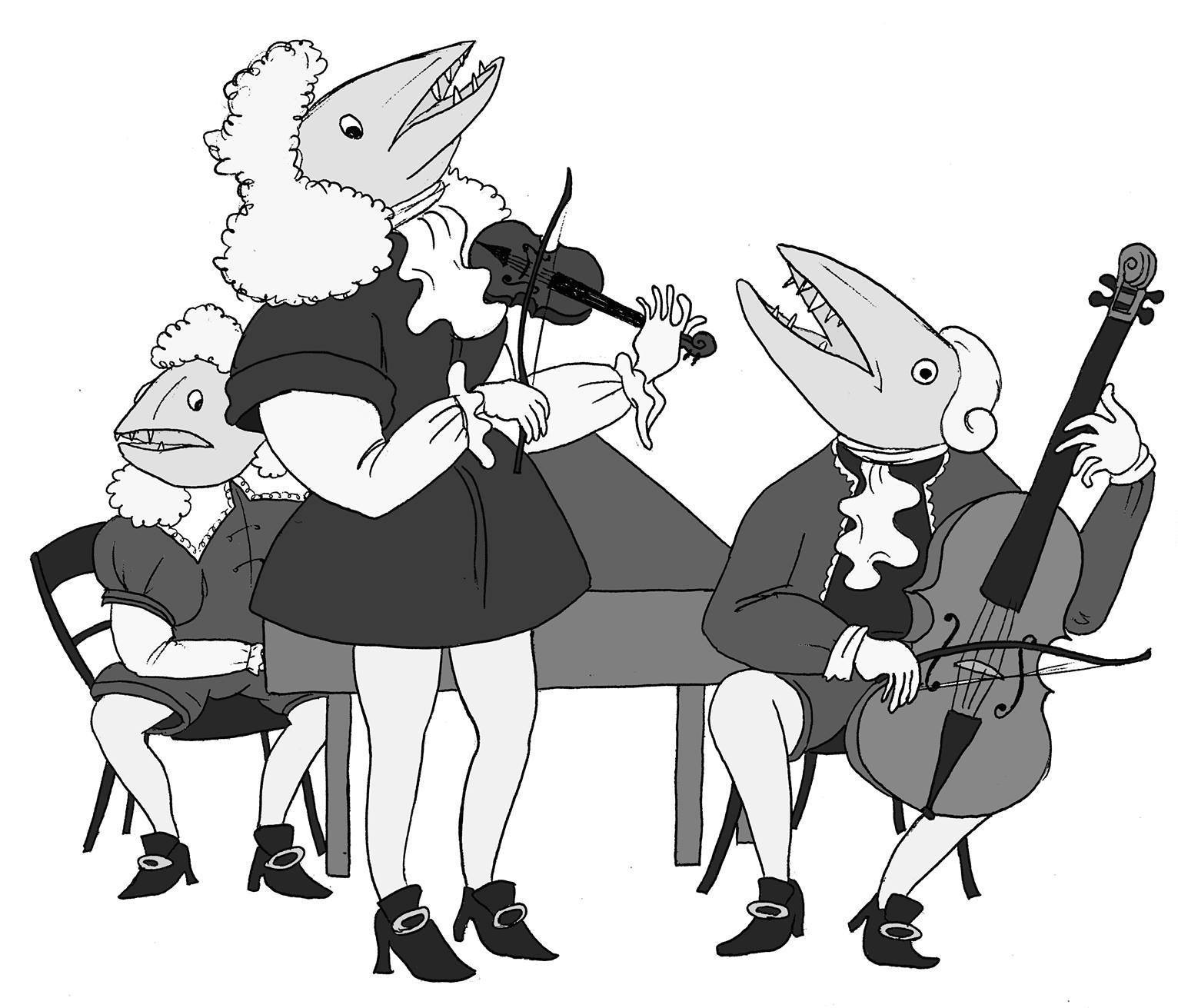
    Even their name, presumably, is a cryptozoological hybrid of the Italian “barocco” and the toothy “barracuda.”

    The ensemble, made up of Marie Nadeau-Tremblay, baroque violon, Ryan Gallagher, viola da gamba, and Nathan Mondry, harpsichord and voice, will present a program titled “Anonymous and Friends,” with music by Giovanni Battista Fontana, Johann Heinrich Schmelzer, Heinrich Ignaz Franz Biber, Claudio Monteverdi, Nathan Mondry, and Jehan Chardavoine.

    To get you in the mood, check out some of the group’s entertaining videos, including a Georges Méliès-style dramatization of a sonata by Schmelzer. Search under “video/audio” at the ensemble’s website, http://www.lesbarocudas.com.

    The concert was given at St. Bartholomew’s Church, 50th Street and Park Avenue, in Midtown Manhattan, yet another presented by Gotham Early Music Scene, or GEMS. GEMS is a non-profit corporation that supports and promotes artists and organizations in New York City devoted to Early Music. The free lunchtime series is offered at St. Bart’s on Thursdays at 1:15 p.m. To learn more about these midday events and other GEMS concerts, visit gemsny.org.

    Immediately following today’s noontime broadcast, stick around for Canadian-born violinist Lara St. John and one of her Bach performances. Then we’ll be on with the afternoon and, among other highlights, the Symphony No. 5, “The Gorilla,” by Richard Arnell.

    Join me in a paradise of barracudas and gorillas, from 12 to 4 p.m. EDT, on WWFM – The Classical Network and wwfm.org.
Tag Cloud

Aaron Copland (93) Beethoven (95) Composer (114) Film Music (137) Film Score (143) Film Scores (255) Halloween (94) John Williams (195) KWAX (229) Leonard Bernstein (103) Marlboro Music Festival (125) Movie Music (152) Mozart (88) Opera (208) Philadelphia Orchestra (89) Picture Perfect (174) Princeton Symphony Orchestra (108) Radio (88) Ross Amico (244) Roy's Tie-Dye Sci-Fi Corner (290) The Classical Network (101) The Lost Chord (268) Vaughan Williams (103) WPRB (396) WWFM (881)

DON’T MISS A BEAT

Receive a weekly digest every Sunday at noon by signing up here


RECENT POSTS