Category: Daily Dispatch

  • Viva Verdi Italy’s Musical Unification

    Viva Verdi Italy’s Musical Unification

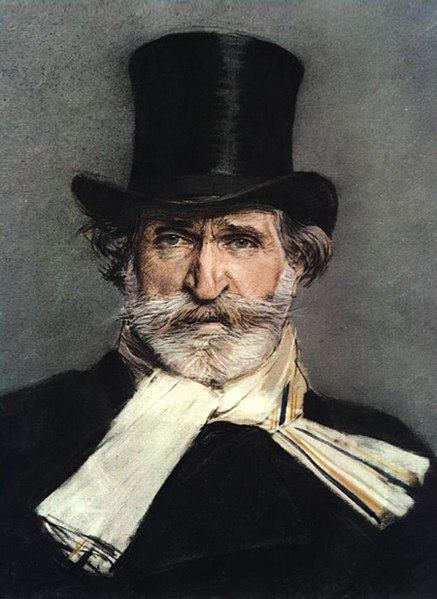
    “Viva VERDI!” – the cry of Italian patriots on the eve of unification.

    Italy of the 1850s was but a conglomerate of individual states, many of them still under foreign rule. The slogan “Viva VERDI!” was coined in 1859, following the premiere of the composer’s politically sensitive opera “Un ballo in maschera.”

    Verdi’s ongoing troubles with the censors are well-known. It’s a safe bet that when he undertook an opera about a political assassination, he had a pretty good idea what to expect. The name VERDI was taken up by firebrands of the Risorgimento as an acronym for “Vittorio Emanuele, Re D’Italia.” King Vittorio Emanuele II of Piedmont was seen by many as the best hope for a free and united Italy.

    This Sunday night on “The Lost Chord,” we’ll refrain for delving too much into Italy’s Second War for Independence, or of Garibaldi’s struggles with the Bourbons. Instead, we’ll enjoy examples of MUSICAL unification – various composers of Italian origin coming together to attempt cohesive works of art.

    There are those who believe the serenata “Andromeda Liberata” may have been composed entirely by Antonio Vivaldi – but perhaps not. The likely impetus for its creation was the return to Rome of one Cardinal Ottobone, who was also a patron of both Arcangelo Corelli and Alessandro Scarlatti.

    The story is that of Perseus and Andromeda. Andromeda has already been rescued from the sea serpent at the start of the piece, which mostly explores the ambiguous feelings of its characters, with a few extraneous love interests tossed into the mix to provide romantic conflict.

    The two-hour entertainment contains in its second part a single aria known definitively to have been composed by Vivaldi. The authorship of the rest remains in doubt. The long-lost manuscript, dating from 1726, was rediscovered as recently as 2002.

    In 1868, Verdi’s great operatic predecessor, the long-retired Gioachino Rossini, died. Rossini had completed his last opera nearly forty years before. Verdi undertook to bring together 12 of his contemporaries, now largely forgotten. The oldest, Carlo Coccia, at age 87, was actually a decade Rossini’s senior!

    Within the year, a collaborative mass was compiled in Rossini’s memory, for which Verdi provided the concluding “Libera me.” In fact, the music looks forward to Verdi’s own masterful Requiem. The completed work doesn’t attain anywhere near the lofty heights of Verdi’s solo run. However, it’s an interesting compendium of contemporary styles, and even the music of lesser talents serves to cast Verdi’s genius in a new light.

    Remarkably, the work lay unperformed in Verdi’s lifetime. Talk about politics! Here was Verdi, a Milanese, trying to kindle some sort of enthusiasm in Bologna (the location of Rossini’s earliest successes), for a project which was to bring together a bunch compositional dinosaurs, to salute a figure who, for all intents and purposes, had retired from public life some four decades earlier. Bologna at the time was in the process of becoming a stronghold of the musical avant-garde.

    All these factors, along with puzzling stipulations, such as the work being locked away after its first performance, to be trotted out only on special occasions, doomed the project virtually from the start. It remained unheard for another 120 years, resurrected only in 1988.

    I hope you’ll join me for “Viva VERDI!” – Italian unification through music – this Sunday night at 10:00 EDT, on WWFM – The Classical Network and wwfm.org.
  • Autumn Yardwork Great Composers

    Autumn Yardwork Great Composers

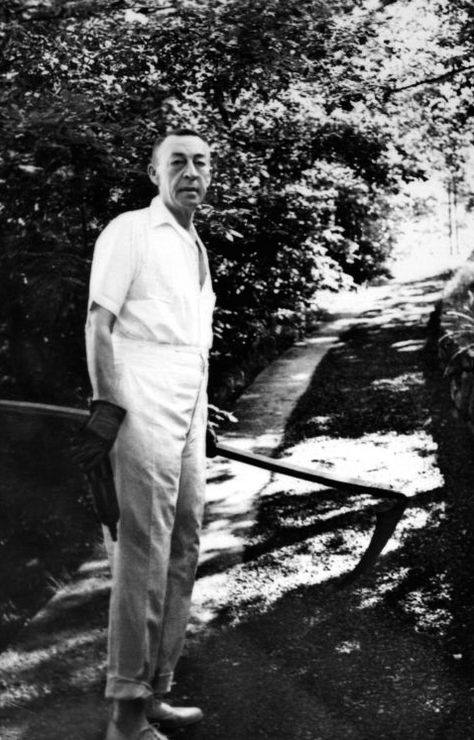
    Autumn: the great composers do yardwork.


    Clockwise from left: Rachmaninoff (with scythe), Copland (with rake), Vaughan Williams (with pitchfork), and Mahler (lollygagging?)

  • Vaughan Williams Birthday WWFM

    Vaughan Williams Birthday WWFM

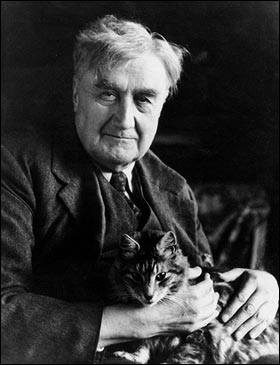
    If you like cats, you’d better like Vaughan Williams, and if you like Vaughan Williams, you’d better tune in today between 4 and 6 p.m. EDT, as I’ll be celebrating his birthday, on WWFM – The Classical Network and wwfm.org.
    ** Coming up at 6 p.m.: Spooky comedies for Hallowe’en on “Picture Perfect!” **

  • Spooky Comedy Film Scores for Halloween

    Spooky Comedy Film Scores for Halloween

    Spooky comedies. A seeming oxymoron. Perhaps in an attempt to subvert our fears, or to generate laughter from tension, filmmakers have frequently juxtaposed humor with the supernatural – or at any rate death.

    This week on “Picture Perfect,” we’ll conjure some Hallowe’en spirit with music from four macabre comedies.

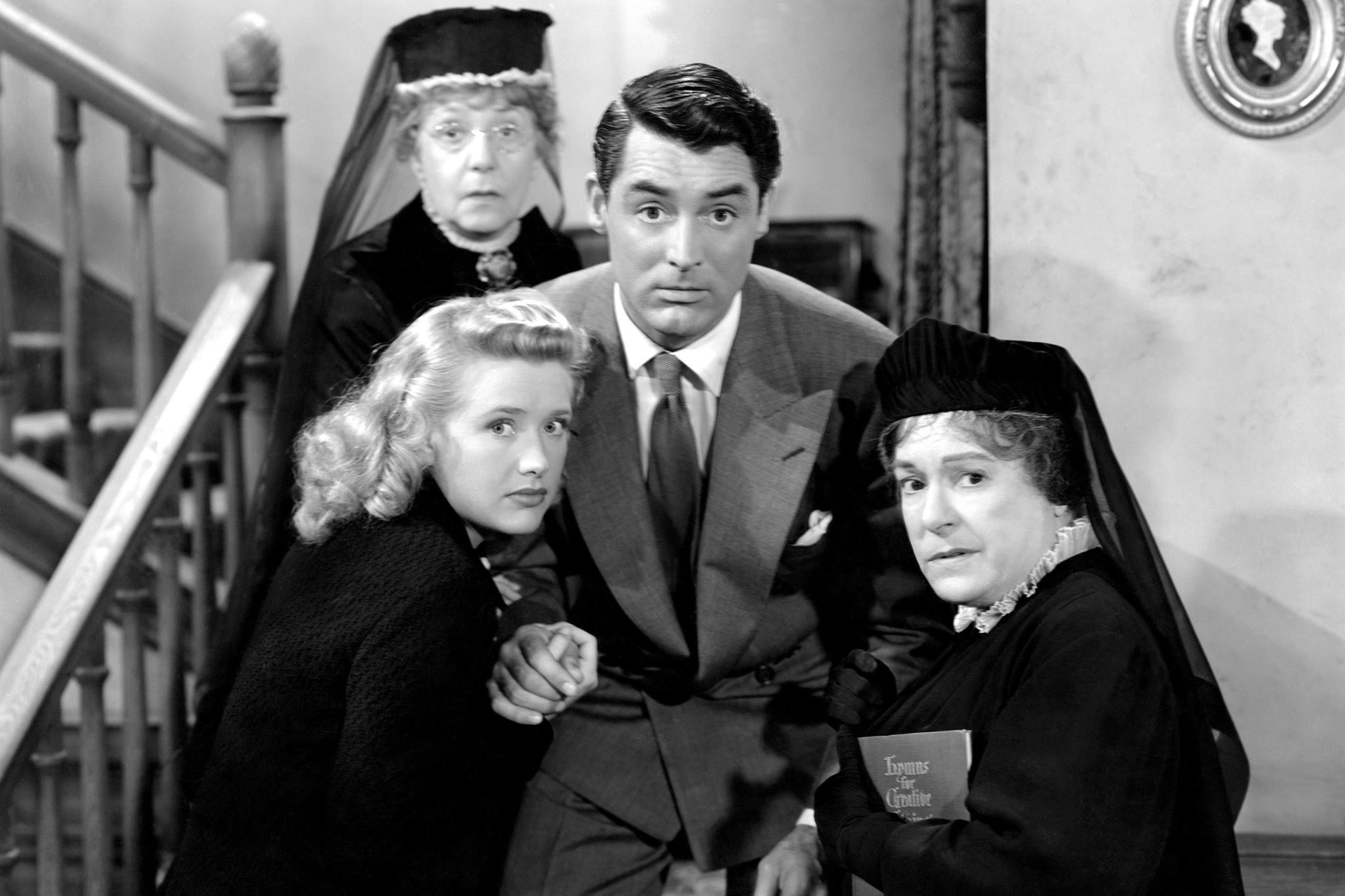
    Frank Capra’s screen adaptation of “Arsenic and Old Lace” (1944) was actually shot in 1941, but it could not be released until after the hit stage play, by Joseph Kesselring, had concluded its Broadway run.

    The film starred Cary Grant, Priscilla Lane, Raymond Massey, Peter Lorre, Jack Carson, and Capra favorites James Gleason and Edward Everett Horton.

    Two seemingly innocuous spinster aunts poison lonely old men and have them buried in their basement, by a family member who believes that he’s Teddy Roosevelt. (He thinks that he’s digging the Panama Canal.) Massey and Lorre play a murderer on the lam and his plastic surgeon, respectively, who hole up in the house, unaware that Massey’s body count pales next to that of his unwitting hosts.

    The score, by Max Steiner, is as manic as Grant’s performance – perhaps a mite overdone, with its breakneck allusions to familiar melodies – but it bears the same distinctive gloss as other Steiner classics like “Gone With the Wind” and “Casablanca.”

    Composer Bernard Herrmann will always be most closely associated with the films of Alfred Hitchcock. In particular, his music for the shower scene in “Psycho” has entered the popular consciousness as few other film scores have. Hitchcock and Herrmann collaborated on nine films in all. The first of these was a black comedy called “The Trouble with Harry” (1955), a droll farce about a corpse that materializes in a New England community and can’t seem to stay buried.

    Don Knotts and a haunted house – that’s the high concept behind “The Ghost and Mr. Chicken” (1966). How could it possibly miss? Knotts’ elastic-faced terror finds a goofy foil in Vic Mizzy’s score. Mizzy also wrote music for “The Addams Family.”

    Finally, in a kind of twist on “Topper,” Alec Baldwin and Geena Davis play a recently-deceased couple who try to scare off the inhabitants of their former home, in “Beetlejuice” (1988). In desperation, they enlist the services of a manic “bio-exorcist” (a loosy-goosy Michael Keaton) and things get seriously antic.

    The music is by Danny Elfman, as always a fan of Nino Rota, although he also pays homage to the Stravinsky of “The Soldier’s Tale” and frequently alludes to Raymond Scott. There’s even a touch of Bernard Herrmann in one of the tracks, as Elfman evokes the skeleton fight from “The Seventh Voyage of Sinbad.”

    I hope you’ll join me for a mishmash of horror and humor this week, on “Picture Perfect,” music for the movies, this Friday evening at 6:00 EDT, on WWFM – The Classical Network and wwfm.org.
  • George Antheil Futurist Radio Chat

    George Antheil Futurist Radio Chat

    He was a savage pianist. He was an avant-gardist. He was a patriotic symphonist, a film composer, a journalist, a mystery novelist, an advice columnist, an endocrinologist, and the prophet of Wi-Fi technology.

    Trenton’s George Antheil was a lot of things.

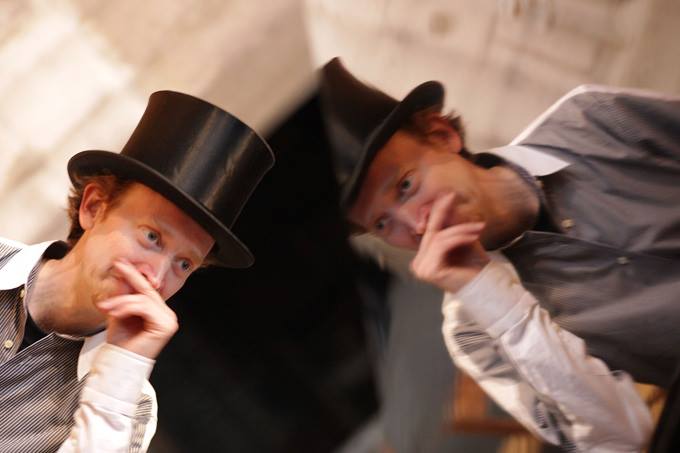
    Pianist Guy Livingston and I will talk about a few of them. Join me this afternoon at 4:00 EDT, as Livingston will chat with me by telephone from his home in The Hague. We’ll swap Antheil anecdotes in advance of Livingston’s upcoming recital, which will be presented next week in New York City.

    Dada at the Movies – Guy Livingston will take place at the Baruch Performing Arts Center, One Bernard Baruch Way (25th Street between Lexington & 3rd Avenues), on Wednesday, October 17, at 7:30 p.m. The multimedia event (with costumes) will recreate elements of a riot-inducing concert that was held in Paris on July 6, 1923. Included will be films by Man Ray and Hans Richter, with music by Antheil, Darius Milhaud, and Erik Satie.

    Flanking our conversation, I’ll share Livingston’s recordings of Antheil’s “Jazz Sonata” and “Airplane Sonata,” from his album “Antheil the Futurist.”

    Livingston is a world authority on the composer, having recorded all of his piano works. He also oversaw a landmark Antheil conference in Trenton in 2003.

    Learn more about “Dada at the Movies” here: http://guylivingston.com/dada/index.shtml

    Then stick around: between 4 and 6 p.m., we’ll enjoy music by Paul Creston, Johann Ludwig Krebs, Johann Sebastian Bach, Sergei Prokofiev, Vernon Duke, Giuseppe Verdi, and Gerónimo Giménez.

    At 6:00, it’s another “Music from Marlboro” – chamber music performances from the legendary Marlboro School of Music and Festival: Official Page – this week featuring works by Niccolò Paganini and Ildebrando Pizzetti. Performers will include a young Yo-Yo Ma and the venerable pianist Mieczyslaw Horszowski.

    Solfège will be augmented to accommodate “Dada” today, from 4 to 7 p.m. EDT, on WWFM – The Classical Network and wwfm.org.


    PHOTO: Tune in for reflections of Guy Livingston

Tag Cloud

Aaron Copland (93) Beethoven (95) Composer (114) Film Music (137) Film Score (143) Film Scores (255) Halloween (94) John Williams (195) KWAX (229) Leonard Bernstein (103) Marlboro Music Festival (125) Movie Music (152) Mozart (88) Opera (208) Philadelphia Orchestra (89) Picture Perfect (174) Princeton Symphony Orchestra (108) Radio (88) Ross Amico (244) Roy's Tie-Dye Sci-Fi Corner (290) The Classical Network (101) The Lost Chord (268) Vaughan Williams (103) WPRB (396) WWFM (881)

DON’T MISS A BEAT

Receive a weekly digest every Sunday at noon by signing up here


RECENT POSTS