Category: Daily Dispatch

  • William Kapell: America’s Lost Piano Genius

    William Kapell: America’s Lost Piano Genius

    Was William Kapell America’s greatest pianist? I realize that discounts a lot of our native talent, but if Leon Fleisher thinks so, then that’s good enough for me.

    Kapell was killed in a plane crash in 1953 at the age of 31. Until then, his light burned very brightly indeed. In 1944, he was signed to an exclusive contract with RCA Victor. All of his recordings were pre-stereo and many were issued on 78s, but reencountering a number of these 70 years later confirms that the interpretations still sing, including some stunning Rachmaninoff and a classic account of the Khachaturian Piano Concerto.

    Even so, by 1960, all of Kapell’s commercial recordings had gone out of print. With few exceptions – there was an LP reissue of some Beethoven and Prokofiev in the early ‘70s – Kapell’s reputation was kept alive mostly through bootlegs and unlicensed live recordings. In 1998, RCA finally did the right thing and reissued all of Kapell’s authorized recordings, making them accessible to a whole new generation of music lovers.

    Sadly, for all the enjoyment these still give, the brilliance of Kapell’s recorded legacy inevitably causes one to wonder what might have been. 31 is awfully soon to have lost one so talented.

    How good was he? Well, for one thing, he learned Richard Strauss’ “Burleske” in a week – by the command of Fritz Reiner, no less. You can find the complete story and listen to the live performance, not otherwise available, here:

    Publish or Perish?

    Join me this afternoon, from 4 to 7 p.m. EDT, for plenty more Strauss on his birthday, on WWFM – The Classical Network and wwfm.org.


    PHOTO: William Kapell with Leonard Bernstein in 1947, around the time he received Reiner’s order to perform Strauss
  • César Franck & His Belgian Legacy

    César Franck & His Belgian Legacy

    César Franck was a strangely charismatic outsider. A Belgian abroad, he was required to take French citizenship in order to teach at the Paris Conservatory. A renowned organist, his unexpected genius for composition blossomed late.

    His enduring fame rests on a handful of fairly late works. He managed to reinvigorate the French symphonic and chamber music traditions through his use of “cyclic form,” with themes throughout generated from a single motif. He also embraced the symphonic poem. In these regards he certainly bore the influence of Franz Liszt. In turn, he himself became highly influential among a generation of French and Belgian composers.

    This Sunday night on “The Lost Chord,” we’ll examine music by two Belgians who fell under his sway.

    Armand Marsick, born in 1877, trained as a violinist at the Liège Conservatory, before studying abroad in Nancy with Franck enthusiast Guy Ropartz. Then he moved to Paris, where he studied with another Franckian, Vincent d’Indy. His career led him to Athens, and then Bilbao, where he founded a conservatory and an orchestra. He returned to Liège at the age of 50, settling in to teach and direct the concert society there. He died in 1959. The bulk of Marsick’s compositional output, which consisted of some forty works, was written between the ages of 23 and 37. We’ll enjoy a symphonic poem from 1908, titled “La Source.”

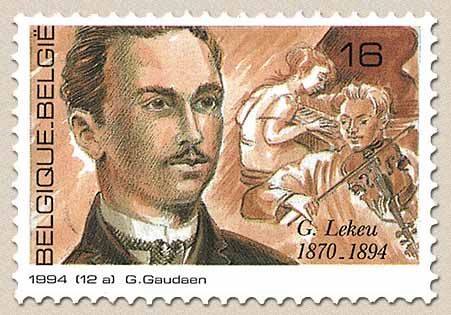
    Guillaume Lekeu was born in Verviers in 1870. He studied with Franck in Paris, then, like Marsick, with d’Indy following Franck’s death. Lekeu, unfortunately, is also remarkable for his very short life. He became ill with typhoid fever after consuming contaminated sherbet at a restaurant, and died in 1894, one day after his 24th birthday. Despite his sadly foreshortened existence, he managed to make important contacts and to write music of considerable promise. At the time of his death, he had already been composing for nine years, from the age of 15. In 1891 he was recipient of a second prize in the celebrated Prix de Rome competition.

    In all, Lekeu composed about 50 works. We’ll hear his Violin Sonata from 1892, written for the great Belgian virtuoso Eugene Ysaye, and his Adagio from 1891, originally composed for quartet and string orchestra. The score to the latter bears an epigraph from a poem by Georges Vanor, “The pale flowers of memory.”

    I hope you’ll join me for music by these Belgian followers of César Franck – “Franckly Belgian” –– this Sunday night at 10:00 EDT, on WWFM – The Classical Network and wwfm.org.

  • Albéric Magnard Fiery French Composer

    Albéric Magnard Fiery French Composer

    To say that French composer Albéric Magnard had a fiery personality stands the risk of skirting bad taste.

    Magnard was born in Paris on this date in 1865. His father, François Magnard, was a notable author and the editor of Le Figaro. His family being rather well off, the younger Magnard exhibited an early determination to make his own way. (As a boy, he had been taunted by cries of “Le fils du Figaro” – the son of Figaro.)

    Following military service, he acquired his law degree. However he was destined never to practice. Instead he made a fateful trip to Bayreuth, where he fell under the spell of Richard Wagner and determined to become a composer.

    He was accepted into the Paris Conservatory, where he studied with Théodore Dubois, Jules Massenet, and Vincent d’Indy. He became particularly close to d’Indy, though he abhorred the latter’s anti-Semitism. (Magnard was outspokenly pro-Dreyfus.)

    Despite his son’s insistence on self-reliance, François helped the young man in whatever way he could, which for the most part meant publishing favorable notices of his son’s music in his influential journal. Magnard “fils” somewhat resented this – but he was also kind of grateful – so that he and his father shared a complicated relationship.

    Like Paul Dukas, who was born the same year, Magnard was highly self-critical, so that his output consists of only 22 works with opus numbers. The publication of most of these he paid for himself. The observation has been made that his symphonies in some respects prefigure those of Gustav Mahler, though others have referred to him as “the French Bruckner.” It’s probably more realistic to say Magnard caught his love of cyclic form from César Franck.

    Incidentally, I’ll be presenting music by some followers of Franck tomorrow night at 10:00 EDT on “The Lost Chord, on WWFM – The Classical Network. Tune in for music by Armand Marsick and Guillaume Lekeu. Curiously, I didn’t think to include Magnard.

    Unfortunately, the most striking feature of Magnard’s life was the manner of his death. In 1914, the composer, aged 59 and a civilian, refused to surrender his property to invading German forces. After sending his wife and two daughters out the back door, he opened fire on some trespassing soldiers and instantly killed one of them. In retaliation, the Germans set fire to his house, and Magnard is assumed to have perished in the conflagration. That said, his body was never discovered.

    Might it be possible that he spent a secret retirement in the company of Ambrose Bierce – who, curiously enough, also disappeared in 1914?

    https://en.wikipedia.org/wiki/Ambrose_Bierce

    Classic Ross Amico, you dog, that is brilliant.


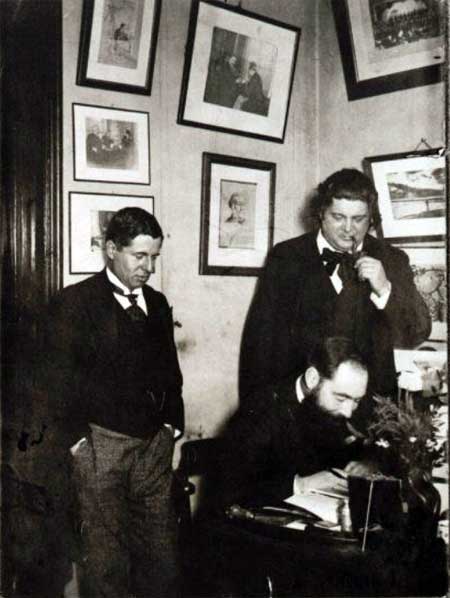
    PHOTO: Magnard (left) with famed Belgian violinist Eugène Ysaÿe (standing) and composer Guy Ropartz. Through a remarkable feat of memory, Ropartz, who had recently conducted Magnard’s opera, “Guercoeur,” was able to reconstruct the score, after it was partially destroyed in the fire that consumed Magnard’s home.

  • Dream Playlists Fuel a Classical Music Feast

    Dream Playlists Fuel a Classical Music Feast

    What began as an engaging idea for a fundraiser last week has become a real windfall for me, in terms of programming, as I have been living off all the delicious leftovers. Last week, The Classical Network solicited from its hosts, partners, and listeners “dream playlists” of their favorite music. We sampled from these during our membership campaign, “Play It Again,” with, I trust, a lot of shared interest and not a few moments of surprise.

    At the end of the week, as everyone staggered out of the studio, I spied the heavily thumbed reference list where it lay on the counter, and I just couldn’t bear to let it go. There were too many nuggets yet to be mined.

    Therefore, I devoted my Monday, Tuesday, and Wednesday shifts this week to sopping up what I could of your favorite music, which, frankly, has brought just about as much pleasure as finding my way to the bottom of a bowl of chowder with a nice, buttery biscuit.

    Through unforeseen circumstances, I was on the air again yesterday, so I was able to extend my mission. Now it turns out I will return to the air waves this afternoon for what will be the fifth and final installment in the series.

    If you were moved to make a contribution to the station last week, thank you for doing part of the heavy lifting in order to keep this beautiful music on the air. If you haven’t contributed in the past twelve months, and you’ve been enjoying the service right alongside those who have made a real commitment to make that enjoyment possible, please consider making a donation at our website, wwfm.org. It really will make a difference. We are still considerably short of where we need to be by the end of our fiscal year, which will arrive on June 30 at 11:59 pm.

    Time waits for no contribution. Give today, and know that you were essential in getting us over yet another hurdle. If not for the generosity of listeners like you, the programming would be directly impacted by deep cuts. It has happened before, so believe me when I say we are thankful for your support. Make your donation now; then join me from 12 to 4 p.m. EDT for more of your favorites, and ours, on WWFM – The Classical Network and wwfm.org.


    PROGRAMMING NOTE: Glenn Smith will be your host for a special concert from last year’s The Princeton Festival, featuring Concordia Chamber Players, in music by Beethoven, Richard Strauss, and Aaron Jay Kernis, at 4 p.m. I’ll return with “Picture Perfect” at 6, with selections from computer-animated adventures, including “The Incredibles,” “Up,” “Ice Age,” and “The Adventures of Tintin.” What a mix! Again, thanks for doing your part to help make it all possible.

  • Incredibles & Animated Film Scores on Picture Perfect

    Incredibles & Animated Film Scores on Picture Perfect

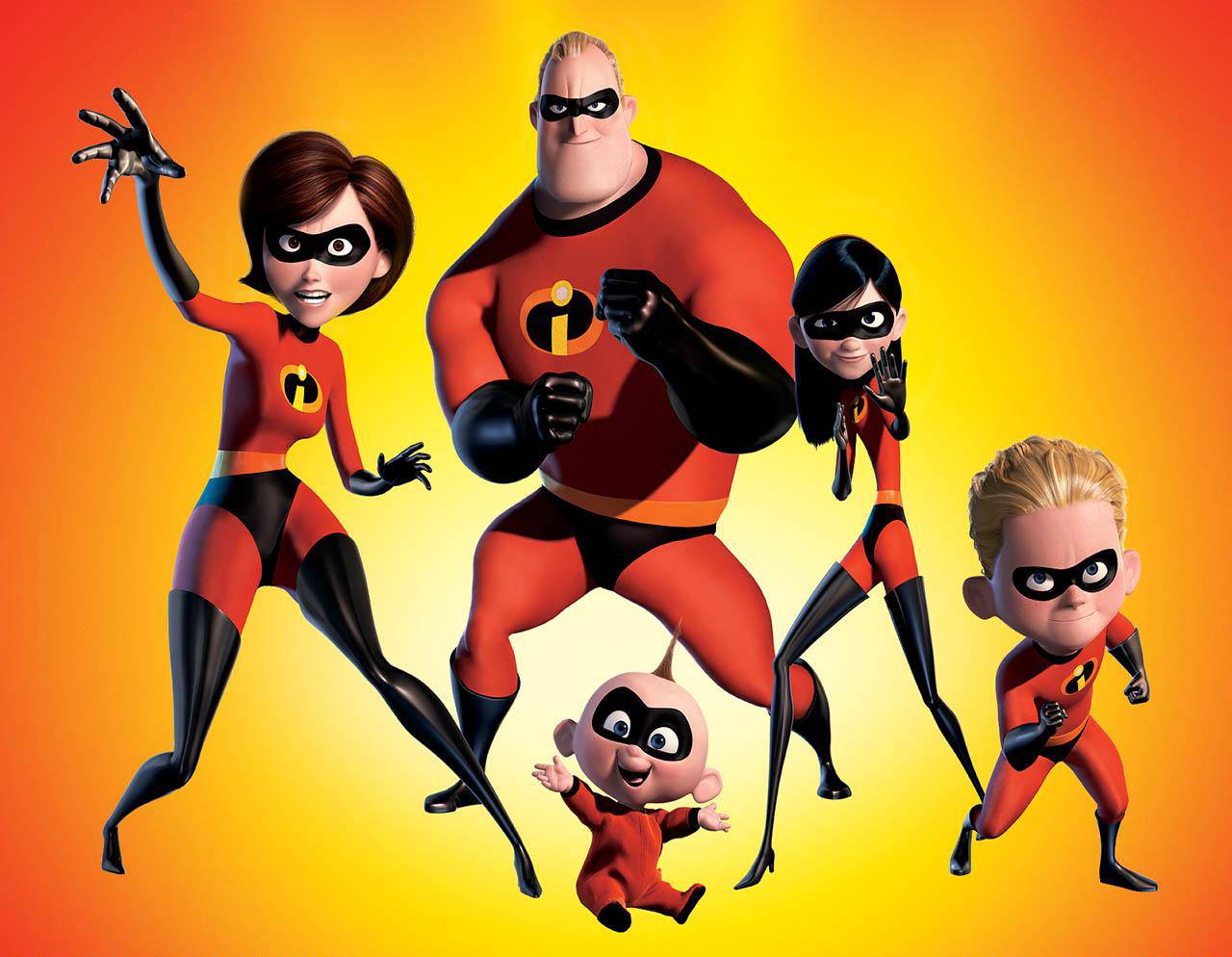
    With Elastigirl and family heading back to theaters next week, I thought now would be as good a time as any to get back into the “swing.”

    On the next “Picture Perfect,” we’ll sample from music from “The Incredibles” (2004), alongside that for three other computer-animated features.

    Pixar’s sly superhero satire was composer Michael Giacchino’s first major feature and his break-out success. The now much-in-demand Jersey native has gone on to write music for the “Jurassic Park,” “Mission: Impossible,” “Planet of the Apes,” “Star Trek,” and “Star Wars” series. But arguably his most charming and lyrical work has been for the Disney-owned animation studio.

    For “The Incredibles,” director Brad Bird had originally hoped to enlist John Barry, who popularized the swinging espionage “sound” through his work on the James Bond films. When the veteran composer demurred, insisting he had moved on and had no interest in looking back, Giacchino was hired to out-Barry Barry.

    As a nice counterbalance, we’ll also hear selections from Giacchino’s Academy Award-winning score to Pixar’s poignant adventure “Up” (2009). “Up” was nominated for Best Picture at the 82nd Academy Awards, only the second animated feature ever to be included in that category.

    We’ll continue in the realm of computer animation with music from “Ice Age” (2002). The score was composed by David Newman, son of Golden Age heavy-hitter Alfred Newman, brother of Thomas Newman, and cousin of Randy Newman.

    We’ll also hear some of John Williams’ music for “The Adventures of Tintin” (2011), after the comic book adventurer created by the Belgian artist and writer Hergé. Tintin’s popularity in Europe failed to translate into big domestic box office, comparatively speaking, but the score is Williams’ best of its kind – an exciting adventure piece full of leitmotifs and great action cues – since the first Harry Potter film.

    In a day when so many films sport scores made up of droning electronics, punctuated by colorless action cues, the computer-generated feature seems to attract composers who still understand how to write music.

    I hope you’ll join me for an hour of “animated” scores this week, on “Picture Perfect,” music for the movies, this Friday evening at 6:00 EDT, on WWFM – The Classical Network and wwfm.org.

Tag Cloud

Aaron Copland (93) Beethoven (95) Composer (114) Film Music (137) Film Score (143) Film Scores (255) Halloween (94) John Williams (195) KWAX (229) Leonard Bernstein (103) Marlboro Music Festival (125) Movie Music (152) Mozart (88) Opera (208) Philadelphia Orchestra (89) Picture Perfect (174) Princeton Symphony Orchestra (108) Radio (88) Ross Amico (244) Roy's Tie-Dye Sci-Fi Corner (290) The Classical Network (101) The Lost Chord (268) Vaughan Williams (103) WPRB (396) WWFM (881)

DON’T MISS A BEAT

Receive a weekly digest every Sunday at noon by signing up here


RECENT POSTS