Category: Daily Dispatch

  • Symphony or Concerto Genre Bending Music

    Symphony or Concerto Genre Bending Music

    Hector Berlioz’s “Harold in Italy” (viola and orchestra). Leonard Bernstein’s Symphony No. 2 “The Age of Anxiety” (piano and orchestra). Benjamin Britten’s Cello Symphony. These genre-bending works break all the rules. Are they symphonies or concertos?

    We won’t be hearing any of these this Thursday morning on WPRB, though we will be listening to a full playlist of “concertos” for orchestra and “symphonies” for orchestra with prominent part for solo instrumentalist.

    Generally speaking, the concerto for orchestra is a large-scale piece in which the various sections of an orchestra are each given an opportunity to shine. The symphonies with a prominent solo instrument? Well, there is really is no rule for that. Why Vincent d’Indy’s “Symphony on a French Mountain Air,” for piano and orchestra, is not a concerto is anyone’s guess, beyond the French custom, usually applied to organ works, of calling concertos symphonies. Call it Gallic contrarianism, if you will.

    Highlights of the morning will include music by one-time Classic Ross Amico guest Zhou Tian, whose Concerto for Orchestra has been nominated in the category of “Best Contemporary Classical Composition” for this year’s Grammy Awards; organ “symphonies” by Alexandre Guilmant and Aaron Copland; a concerto “symphonique” for piano and orchestra by Henry Charles Litolff; and a “symphony” for solo piano by Charles-Valentin Alkan.

    Prepare yourself for identity crises and plenty of disorientation, this Thursday morning from 6 to 11 EST, on WPRB 103.3 FM and wprb.com. Then, why should things be different this week from any other, on Classic Ross Amico?

  • Musical Hybrids on WPRB

    Musical Hybrids on WPRB

    Ah, humans… compelled to classify everything. The more confusing the world gets, the more we try to understand. But what’s the alternative?

    At a time when everything seems so fluid – language, mores, sexuality, and even gender – I thought we’d take a look at some equally perplexing musical hybrids this Thursday morning on WPRB.

    Concertos are usually understood to be works for solo instrument and orchestra. However, we’ll be focusing on concertos for orchestra alone. Likewise, symphonies are ordinarily purely orchestral endeavors. We’ll hear symphonies for orchestra and prominent instrumental soloist.

    Among our featured highlights will be the Concerto for Orchestra – now Grammy-nominated for “Best Contemporary Classical Composition” – by one-time Classic Ross Amico guest Zhou Tian; a symphony for solo piano by Charles-Valentin Alkan; an organ symphony by Aaron Copland, and a “concerto symphonique” for piano and orchestra by Henry Charles Litolff.

    We may not know whether it’s fish or fowl, but whatever it is I’ll be tossing it in the blender, this Thursday morning from 6 to 11 EST on WPRB 103.3 FM and wprb.com. It will be another breakfast of champions, on Classic Ross Amico.

  • Bach, Reger & Busch at Marlboro Music Festival

    Bach, Reger & Busch at Marlboro Music Festival

    On this week’s “Music from Marlboro,” after being put through the contrapuntal ringer by Max Reger, we’ll definitely be Busched – as in Adolf Busch, cofounder of the Marlboro Music Festival. Get ready to breathe a collective sigh of relief with Busch’s lighthearted “Divertimento for 13 Solo Instruments.”

    First, there are times when Reger’s music can be beyond rigorous. In fact, it might be better termed “Regerous.” Perhaps the craziest exemplar of vertiginous Teutonic counterpoint, he could write organ music of such density that the individual voices get lost in a tangle, deep inside a knot, somewhere in an impenetrable thicket.

    However, on two pianos, it all seems to make sense. We’ll hear a 1977 performance of Reger’s “Introduction, Passacaglia and Fugue,” Op, 96, performed by Marlboro stalwart Luis Batlle and a 19 year-old Yefim Bronfman.

    Reger composed a lot of fugues and sets of variations, seeing himself as the heir of Beethoven and Brahms. But it is the Baroque masters he most closely resembles, in his own gargantuan, overcooked way. Therefore, we’ll open the hour with one of the Brandenburg Concertos of Johann Sebastian Bach, conducted by Pablo Casals.

    Despite the fact that in most of his photos Reger looks like he’s got a mouth full of sauerkraut, he actually had a sharp sense of humor. His most famous retort to a critic came in the form of a letter written in 1906. It reads: “I am sitting in the smallest room of my house. I have your review in front of me. Soon it will be behind me.” Reger, you rascal. Why couldn’t you get more of that into your music?

    I hope you’ll join me for performances of works by Bach, Reger, and Busch, from the legendary Marlboro Music Festival, this Wednesday evening at 6:00, on WWFM – The Classical Network and wwfm.org.

    Marlboro School of Music and Festival: Official Page


    The many moods of Max Reger (1873-1916)

  • Elizabethan Lute Songs on The Classical Network

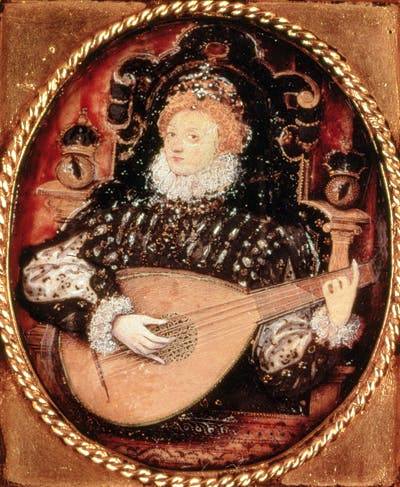
    Elizabethan Lute Songs on The Classical Network

    “And now, — instead of mounting barbed steeds,
    To fright the souls of fearful adversaries,—
    He capers nimbly in a lady’s chamber
    To the lascivious pleasing of a lute.”

    Oh Richard, Duke of Gloucester, enough with the wordplay already. You’re too clever by half. Maybe the rest of us just want to enjoy the music AS music.

    On today’s Noontime Concert on The Classical Network, we’ll hear a program of “Lute Songs from the Elizabethan Golden Age.” Soprano Abigail Chapman and lutenist Matthew Weinman will present music by Thomas Campion, Robert Jones, Thomas Morley, and Anonymous.

    It’s another Midtown Concert offered by Gotham Early Music Scene (GEMS). The program was recorded on June 15 at St. Bartholomew’s Church, 50th Street and Park Avenue, in Midtown Manhattan.

    The next Midtown Concert, “Treasure Laden,” will take place there this Thursday at 1:15 p.m. At the invitation of the New York Philharmonic, and in connection with its “New World Initiative” – which invites different interpretations of Dvorak’s “New World” Symphony – the Alba Consort will weave iconic themes from the symphony with early Sephardic, Iberian, French, Italian, Cypriot, Armenian, and North African music, to bridge the ancient and “brave New World.” You’ll find a complete schedule of free lunchtime performances at midtownconcerts.org.

    Gotham Early Music Scene is a non-profit organization that supports and promotes artists and organizations in New York City devoted to early music – music of the Middle Ages, Renaissance, Baroque, and early Classical periods. For more information and GEMS’ events calendar, look online at gemsny.org.

    Later, we’ll remember Philadelphia-born Anshel Brusilow. For seven years, Brusilow was concertmaster of the Philadelphia Orchestra under Eugene Ormandy. He was also founder of the Chamber Symphony of Philadelphia and music director of the Dallas Symphony Orchestra. His memoir, “Don’t Shoot the Conductor: Too Close to Monteux, Szell, and Ormandy,” describes his tempestuous career with humor and pathos. Brusilow died yesterday at the age of 89.

    Join me today for the lute, Brusilow, and more, from 12 to 4 p.m. EST, on WWFM – The Classical Network and wwfm.org.

  • MLK Day Rediscovering Schwantner’s Lost Masterpiece

    MLK Day Rediscovering Schwantner’s Lost Masterpiece

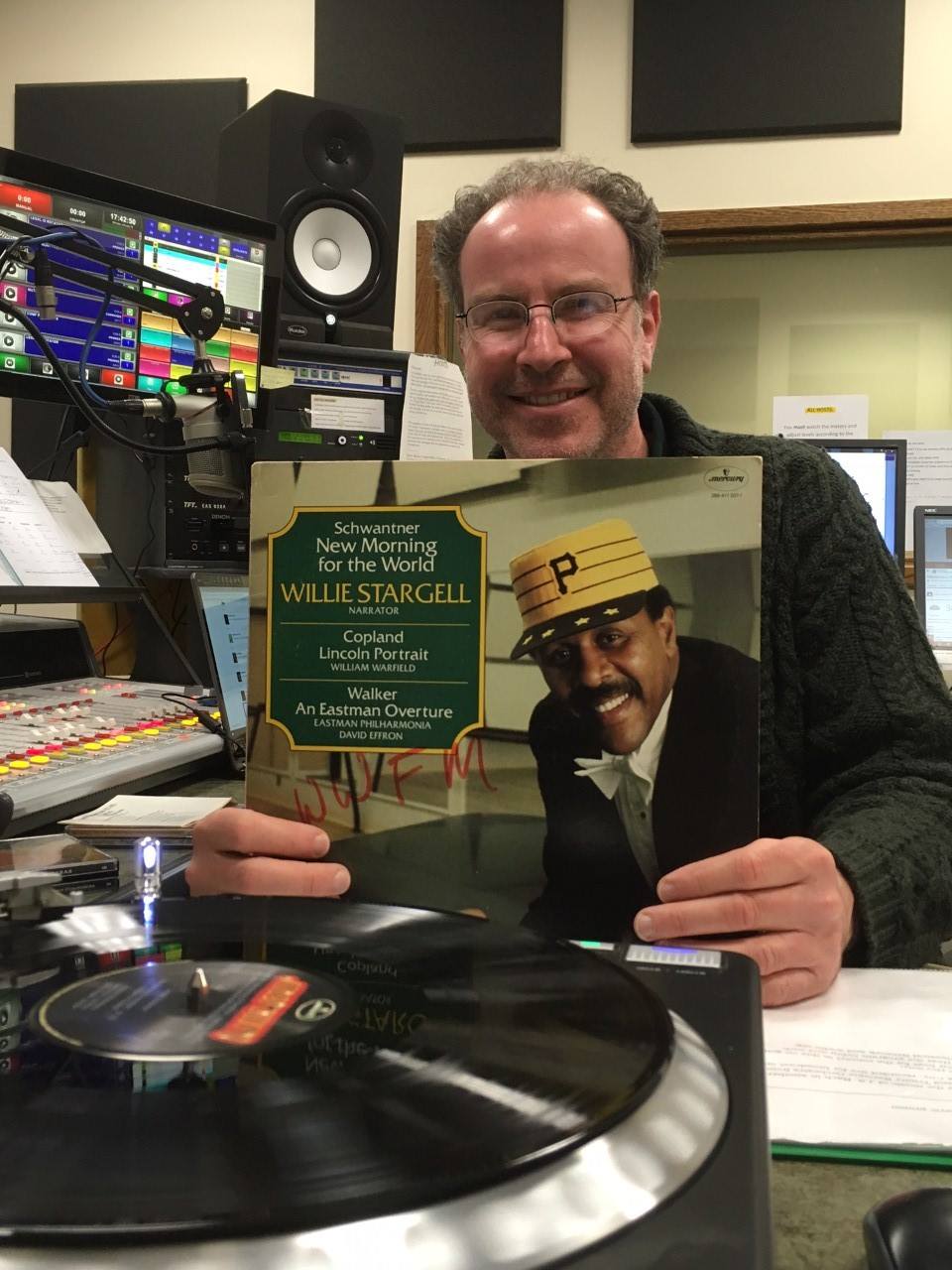
    On this Martin Luther King Jr. Day, once again I’ll be spinning this neglected contemporary classic from vinyl. This world premiere – and preferred – recording of “New Morning for the World: Daybreak of Freedom” has, inexplicably, never appeared on compact disc.

    These are the forces that introduced the piece on January 15, 1983 (King’s birthday), at the Kennedy Center in Washington, DC. The texts were compiled from King’s speeches. The narrator is former Pittsburgh Pirate Willie Stargell. Composer Joseph Schwantner was the recipient of the Pulitzer Prize for Music in 1979 for his work “Aftertones of Infinity.”

    You can learn more about Stargell here:

    https://en.wikipedia.org/wiki/Willie_Stargell

    That such a beloved figure would have been subjected to discrimination and harassment in the still recent past should make us realize how short history is, and how pertinent was King’s life’s work.

    Tune in today, between 4 and 7 p.m. EST to hear “New Morning for the World,” among my featured offerings, on WWFM – The Classical Network and wwfm.org.

Tag Cloud

Aaron Copland (93) Beethoven (95) Composer (114) Film Music (137) Film Score (143) Film Scores (255) Halloween (94) John Williams (195) KWAX (229) Leonard Bernstein (103) Marlboro Music Festival (125) Movie Music (152) Mozart (88) Opera (208) Philadelphia Orchestra (89) Picture Perfect (174) Princeton Symphony Orchestra (108) Radio (88) Ross Amico (244) Roy's Tie-Dye Sci-Fi Corner (290) The Classical Network (101) The Lost Chord (268) Vaughan Williams (103) WPRB (396) WWFM (881)

DON’T MISS A BEAT

Receive a weekly digest every Sunday at noon by signing up here


RECENT POSTS