
Category: Daily Dispatch

  • Australian Composers Brumby Sculthorpe Hill

    Australian Composers Brumby Sculthorpe Hill

    G’day! This Sunday night on “The Lost Chord,” in honor of composer Colin Brumby, who died on January 3rd at the age of 84, we’ll travel once again to the Land Down Under for an hour of music from Australia.

    Brumby was born in Melbourne in 1933. Like his internationally more recognized colleague, Peter Sculthorpe, he attended the Melbourne Conservatorium. He studied abroad in Spain and London, before joining the staff of the music faculty at the University of Queensland. There, he directed the Queensland Opera Company for a few years. He received his doctorate from the University of Melbourne, and then returned to the Continent for further studies in Rome. In 1981, Brumby received an Advance Australia Award for his services to music. He has written orchestral pieces, music for the stage, choral, chamber and instrumental works.

    If you love the concertos of Sergei Rachmaninoff, you owe it to yourself to hear Brumby’s Piano Concerto No. 1, from 1984. The work is written in the grand romantic style for a former classmate of some 30 years earlier, the pianist Wendy Pomroy. The piece certainly is a throwback to an earlier age and an unremitting delight.

    Naturally, we’ll also hear some of Sculthorpe’s music. Sculthorpe, born in Tasmania in 1929, also attended the Melbourne Conservatorium. Following a period of post-graduate struggles, he won a scholarship to study with Egon Wellesz at Oxford University. Unfortunately, he had to abandon the pursuit of his doctorate when his father became gravely ill. In 1963, Sculthorpe became a lecturer at the University of Sydney, where he remained, more or less, until his death in 2014.

    He attained the status of one of Australia’s most-honored composers. Much of his music is concerned with Australia and its South Seas environs. The focus of many of his pieces over the decades reveals an admiration for, and affinity with, Australia’s indigenous cultures. Major philosophical concerns include conservation and the preservation of the environment.

    We’ll listen to “Earth Cry,” an evocative piece from 1986. Scored for didgeridoo and orchestra, the work is a plea for balance, suggestive of the Aborigine mindset of living in accordance with natural law and the needs of the land.

    The hour will open with music by Alfred Hill. Hill was born in Melbourne in 1870, but spent much of his early life in New Zealand. He studied abroad, at the Leipzig Conservatory, and played second violin in the Gewandhaus Orchestra, under then-Kapellmeister Carl Reinecke. He also performed in concerts conducted by Brahms, Tchaikovsky, Grieg and Max Bruch.

    Throughout the course of his career, Hill founded and/or pushed for important institutions in both Australia and New Zealand, including one devoted to Maori studies. He composed more than 500 works, among them 12 symphonies, 8 operas, numerous concerti, a mass, 17 string quartets, two cantatas on Maori subjects, and 72 piano pieces. We’ll hear one of his brief though atmospheric tone pictures, titled “The Moon’s Golden Horn.”

    Slip another shrimp on the barbie, crack open a Foster’s, and join me for “Left Out Back,” neglected music from Australia, this Sunday night at 10:00 EST, on WWFM – The Classical Network and wwfm.org.

  • Epiphany Traditions Drums and Decorations

    Epiphany Traditions Drums and Decorations

    I can hardly hear myself think, with twelve drummers drumming!

    While I am generally all for extending Christmas as long as possible, we have come finally to the twelfth day, the Feast of the Epiphany, and the official close of the season. This is traditionally the day to take down the Christmas tree and all the festive decorations and to let the tree spirits go about their business. Our wise forebears believed that it is bad luck to take down the decorations earlier. Taking them down later is equally unlucky, so that if you miss the date, you’re supposed to leave everything up for the rest of the year. Ignore this advice at the peril of your crops!

    I hope La Befana, the Christmas witch, was good to you.

    The Feast of the Epiphany and Celebration of La Befana

    Photos of other Epiphany celebrations, including one that involves pounding a drum while standing in frigid water:

    http://blogs.pjstar.com/eye/2015/01/06/christians-around-the-world-celebrate-epiphany/

  • Soviet Cinema Scores A Winter Escape

    Soviet Cinema Scores A Winter Escape

    In the wake of yesterday’s “bomb cyclone,” we turn our thoughts to someplace you really don’t want to be in the winter – Russia.

    This week on “Picture Perfect,” we’ll have an hour of music from classic Soviet cinema. Alfred Schnittke, a name usually associated with the avant-garde, actually composed over 60 film scores. One of these was for “Agony” (1974) about Rasputin, his influence over the Tsar, and the conspiracy to murder him.

    Georgy Sviridov, a pupil of Shostakovich, wrote the music for “Time, Forward!” (1962), based on the novel of Valentin Kataev. Set in the 1930s, the film describes a day in the construction work of Magnitogorsk Iron and Steel Works. Some of the music was used during the opening ceremonies of the 2014 Winter Olympics in Sochi.

    Shostakovich, of course, is celebrated for his symphonies and string quartets, which are regarded as some of the most important of the 20th century. He also happened to write some 30 film scores, beginning all the way back in the silent era. Far and away his “greatest hit” composed for film, at least in the West, is the romance from “The Gadfly” (1955), based on the novel of Ethel Lillian Voynich.

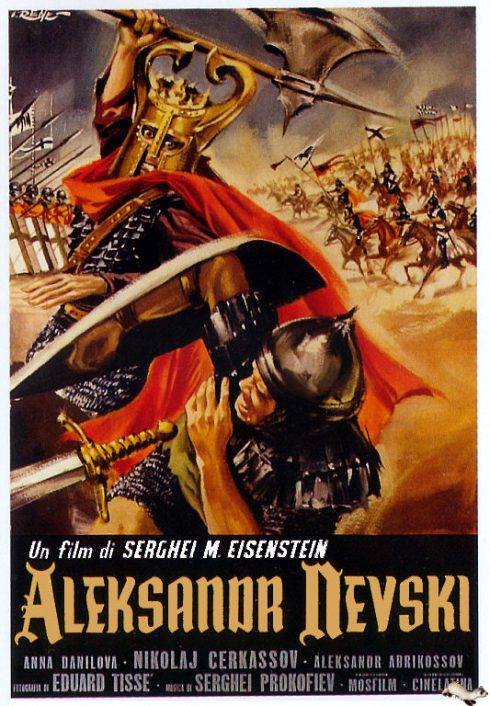
    Sergei Eisenstein’s “Alexander Nevsky” (1938) invariably turns up on lists of the greatest films ever made. Nevsky, the 13th century Russian prince, military leader and saint, thwarts the attempted invasion of Novgorod by Teutonic Knights of the Holy Roman Empire.

    Sergei Prokofiev arranged his masterful score into a concert piece, a cantata. However, these days, orchestras seem to be performing it more and more as it was originally heard, with the film. It’s a powerful piece of work. The marriage of music and visuals for the famous Battle on the Ice is one of the film’s great highlights.

    If you think we’ve got it bad, try facing down a patriotic Nevsky on a frozen lake! I hope you’ll join me for music from these classics of Soviet cinema, this Friday evening at 6:00 EST, on WWFM – The Classical Network and wwfm.org.

  • Colin Brumby RIP Australian Composer

    Colin Brumby RIP Australian Composer

    I learn with sadness of the passing of Australian composer Colin Brumby. Brumby died yesterday in Brisbane at the age of 84. He was the composer of symphonies, concertos, operas, ballets, film scores, musicals, chamber music, songs, and choral works. I’ve always been particularly fond of his Piano Concerto No. 1, which isn’t posted on YouTube. However, I did find the slow movement of his Flute Concerto, which sounds equally lovely. I really should have written to him when I had the chance. R.I.P.

  • 13 Winter Classics Perfect for a Snowy Day

    13 Winter Classics Perfect for a Snowy Day

    So, what to listen to on a day like today, with gravity-defying snow squalls and raging winds? Here’s a baker’s dozen worth of suggestions, with audio links, posted alphabetically by composer.

    Sir Edward Elgar – The Snow

    Howard Hanson – Symphony No. 1 “Nordic”

    Icelandic Traditional – Edda: Baldur’s Dream, rendered by Sequentia
    https://www.youtube.com/watch?v=l1qm–InMLQ

    David Lang – The Little Match Girl Passion

    Franz Liszt – Transcendental Etudes: Chasse-neige

    Sergei Prokofiev – Alexander Nevsky: Battle on the Ice

    Henry Purcell – King Arthur: Song of the Cold Genius

    Einojuhani Rautavaara – Cantus Arcticus (Concerto for Birds and Orchestra):

    Nikolai Rimsky-Korsakov – Christmas Eve

    Jean Sibelius – Symphony No. 2

    Georgy Sviridov – The Snow Storm

    Ralph Vaughan Williams – Sinfonia Antarctica

    Richard Wagner – Richard Wagner, Die Walküre: Act I, “Winterstürme”

    You’ll be able to hear some of “Alexander Nevsky,” as written for the film (as opposed to Prokofiev’s concert arrangement), along with another work by Sviridov, “Time Forward,” on “Picture Perfect,” this Friday evening at 6:00 EST, on WWFM – The Classical Network and wwfm.org.

Tag Cloud

Aaron Copland (93) Beethoven (95) Composer (114) Film Music (138) Film Score (143) Film Scores (255) Halloween (94) John Williams (195) KWAX (229) Leonard Bernstein (103) Marlboro Music Festival (125) Movie Music (153) Mozart (88) Opera (208) Philadelphia Orchestra (89) Picture Perfect (174) Princeton Symphony Orchestra (108) Radio (88) Ross Amico (244) Roy's Tie-Dye Sci-Fi Corner (290) The Classical Network (101) The Lost Chord (268) Vaughan Williams (103) WPRB (396) WWFM (881)

DON’T MISS A BEAT

Receive a weekly digest every Sunday at noon by signing up here


RECENT POSTS