Category: Daily Dispatch

  • Ravel, Les Six, and Marlboro’s French Trios

    Ravel, Les Six, and Marlboro’s French Trios

    Maurice Ravel’s Piano Trio in A minor had been gestating for at least six years before he finally sat down to write the work over the summer of 1914. At first, progress was slow, but when war was declared in August, Ravel put on a burst of speed to finish the piece so that he could he could do his patriotic duty and enlist in the French army. He was rejected from the infantry and the air force on account of his diminutive size and precarious health, but he learned to drive a truck and cared for the wounded at Verdun on the Western Front.

    We’ll hear Ravel’s Piano Trio on this week’s “Music from Marlboro,” alongside a couple of other trios by composers of the next generation – Francis Poulenc and Darius Milhaud – both of whom had complex reactions to Ravel’s music.

    Poulenc and Milhaud together formed one-third of Les Six, that collective of French composers who rose to prominence in Paris in the late ‘teens and 1920s. Each had his or her own distinctive style – the group’s other members included Arthur Honegger, Georges Auric, Germaine Tailleferre, and Louis Durey – but together they displayed a united front in resistance to the so-called Impressionists (Debussy and Ravel) and most of all Richard Wagner. Any trace of Wagnerian portentousness would be blown out between the tent flaps, as the spirit of the circus, café and cabaret came to dominate a new aesthetic.

    You’ll hear it embodied in Poulenc’s Trio for Oboe, Bassoon and Piano (1926), which begins very somberly indeed, before taking off with irrepressible joie de vivre. The central movement is both elegant and wistful in a manner characteristic of this composer, and the cheeky finale is presented with an ironic smile.

    Interestingly, Milhaud’s Suite for Clarinet, Violin and Piano (1936) revisits material from incidental music he composed for Jean Anouilh’s play “Le Voyageur sans bagages” (“The Traveler without Luggage”), about an amnesiac World War I soldier. The piece falls into four movements: “Ouverture;” “Divertissement;” “Jeu;” and “Introduction et Final.” As the titles suggest, much of the music is sassy and full of play, and it is to be wondered what Ravel, a veteran of the Great War would have thought of it.

    I hope you’ll join me for a trio of French trios, performed by musicians of the legendary Marlboro Music Festival, this Wednesday evening at 6 EDT, on WWFM – The Classical NetworkWWFM The Classical Network and wwfm.org.

    Marlboro School of Music and Festival: Official Page


    PHOTO: Ravel in uniform

  • Medieval Music on The Classical Network

    Medieval Music on The Classical Network

    On today’s Noontime Concert, we get medieval, as The Classical Network continues its partnership with Gotham Early Music Scene (GEMS). Join me for a recital from the Chapel at St. Bartholomew’s Church in midtown Manhattan, performed by Drew Minter, countertenor and harp; Mark Rimple, countertenor, lute, gittern, and citole; and Marcia Young, soprano and harp.

    The program will include works by Grazioso da Padova, Florentine Laudario, Francesco Landini, Guillaume Dufay, Johannes Ciconia, and Paolo da Fierenze. We’ll also hear one of the great anonymous hits of the Middle Ages, “Lamento di Tristano e Rotta.” Enjoy performances by the ensemble Trefoil, beginning at 12:00 EDT, on WWFM – The Classical Network and wwfm.org.

  • Richard III Leighton on The Classical Network

    Richard III Leighton on The Classical Network

    We’ll begin and conclude by putting a little English on it, on The Classical Network.

    At 4:00, we’ll mark the birthday today of Richard III with works by William Walton and Bedrich Smetana. Then at 6:00, we’ll honor English composer Kenneth Leighton.

    Leighton’s “Veris Gratia” (1950) betrays a spiritual kinship with the music of Ralph Vaughan Williams, Herbert Howells, and his champion and friend Gerald Finzi.

    Completed at the age of 21, the suite is scored for oboe, cello and orchestra. Though the musical language is in the tradition of the English pastoralists, gentle, tonal and melodic, Leighton’s yearning to be his own man is already evident in some of the harmonies. The work is based on an earlier cantata of the same name, a setting of Medieval Latin lyrics in English translation. Finzi conducted the suite several times, including its first performance. In gratitude, Leighton dedicated the work to his memory, following Finzi’s untimely death.

    Leighton emerged from a working class background in Yorkshire. He exhibited talent early as a chorister and pianist, before receiving a scholarship to study Classics at Queen’s College, Oxford. Simultaneously, he embarked on a degree in music. There, he studied with Bernard Rose. Finzi and Vaughan Williams interceded on his behalf, facilitating and attending performances of his works. Leopold Stokowski conducted the premiere of his “Primavera Romana” with the Royal Liverpool Philharmonic.

    Soon after, Leighton left for Rome to study with Goffredo Petrassi. This led to his exposure to a wider range of European composers and techniques. In some of his pieces, he even flirts with serialism. He certainly developed a more modern, though generally lyrical and always personal style.

    As a person, he enjoyed family and teaching. He was less fond of the administrative duties that were part of being a university professor. At his core, he was a shy and private man, who cherished peace and quiet.

    Leighton is often reductively referred to as a “church composer,” which is ironic, since he was not overly fond of church or even conventionally religious. He preferred the transcendent qualities of poetry and nature, and enjoyed taking long walks through the Scottish Highlands with his dog. Though he spent much of his adult life in Scotland, on the faculty of the University of Edinburgh, Leighton never forgot his origins. He always regarded himself as a down-to-earth Yorkshireman.

    Watch for Clarence in the malmsey butt, then kick back with the cows, from 4 to 7 p.m. EDT, on WWFM – The Classical Network and wwfm.org.

  • Russian Cello Concertos Davidoff & Weinberg

    Russian Cello Concertos Davidoff & Weinberg

    Cello, da!

    This Sunday night on “The Lost Chord,” we’ll hear two works for cello and orchestra, written by composers of Eastern European origin, both of whom attained fame in Russia.

    Carl Davidoff (sometimes spelled Karl Davydov) was born in Latvia in 1838. He became head of the St. Petersburg Conservatory, where Tchaikovsky was a colleague. Tchaikovsky dubbed him “The Tsar of the Cello.” Davidoff wrote four cello concertos, all of which have been recorded on the CPO label. We’ll be listening to the first of these, performed by Wen-Sinn Wang.

    Mieczyslaw Weinberg (also known as Moisei Vainberg) was of Polish-Jewish origin. Despite having suffered the loss of much of his family in the Holocaust and being singled out for persecution in the Soviet Union under Stalin, Weinberg was a dizzyingly productive composer. He wrote 22 symphonies, 7 operas, and an enormous amount of chamber and instrumental music, including 17 string quartets, 8 violin sonatas, 6 cello sonatas, and 6 piano sonatas, to say nothing of dozens of film scores. Yet Weinberg’s achievements were eclipsed by those of Shostakovich and Prokofiev.

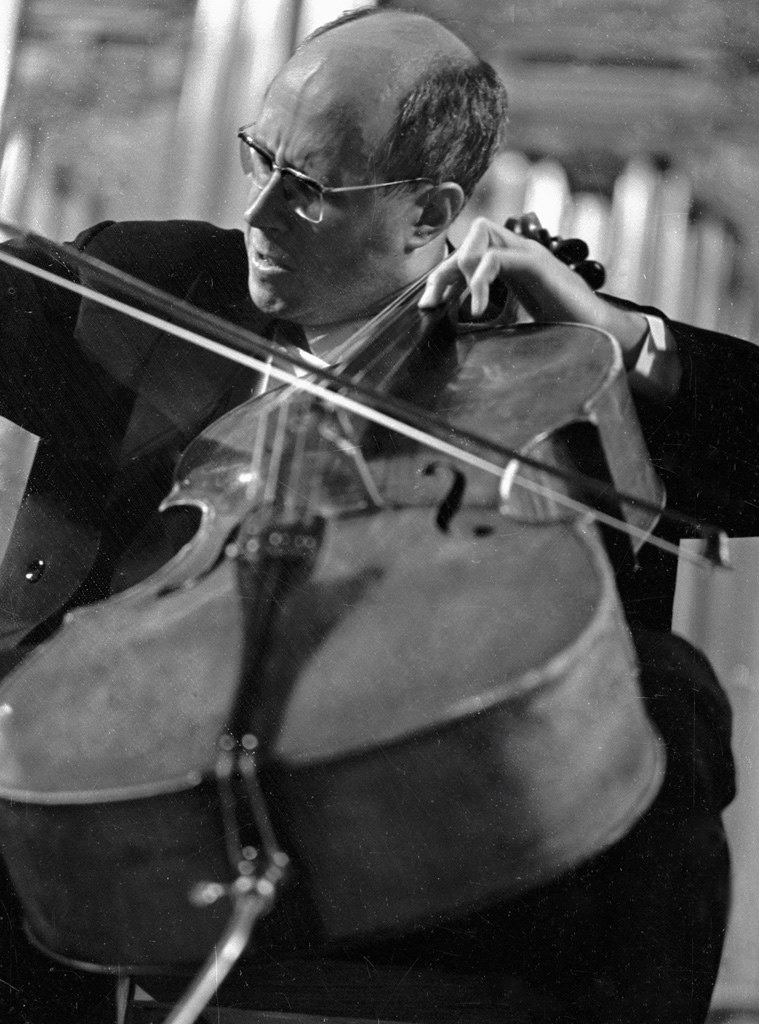
    Shostakovich took a special interest in the younger composer, frequently interceding on his behalf, and promoting him as “one of the most outstanding composers of the present day.” We’ll hear Weinberg’s Cello Concerto of 1948, performed by the work’s dedicatee, Mstislav Rostropovich.

    Join me for “A Russian Cellobration,” this Suunday night at 10:00 EDT, on WWFM – The Classical Network and wwfm.org.


    PHOTO: Slava rocks the cello

  • Arnie Plays Organ Dream Realized

    Arnie Plays Organ Dream Realized

    Interesting item from September 21: Arnold Schwarzenegger fulfills his childhood dream of playing the organ at St. Stephen’s Cathedral in Passau, Germany, located close to the border of his native Austria.

    https://www.youtube.com/watch?v=82pO07e466E

    You’ll find the complete story here:

    http://www.dailymail.co.uk/news/article-4906948/Arnold-Schwarzenegger-plays-organ-German-church.html

Tag Cloud

Aaron Copland (93) Beethoven (95) Composer (114) Film Music (139) Film Score (143) Film Scores (255) Halloween (94) John Williams (195) KWAX (229) Leonard Bernstein (103) Marlboro Music Festival (125) Movie Music (154) Mozart (88) Opera (208) Philadelphia Orchestra (89) Picture Perfect (174) Princeton Symphony Orchestra (108) Radio (88) Ross Amico (244) Roy's Tie-Dye Sci-Fi Corner (290) The Classical Network (101) The Lost Chord (268) Vaughan Williams (103) WPRB (396) WWFM (881)

DON’T MISS A BEAT

Receive a weekly digest every Sunday at noon by signing up here


RECENT POSTS