• Carlos Païta Rediscovered Firebrand Conductor

    Carlos Païta Rediscovered Firebrand Conductor

    by 

    in
    6 responses

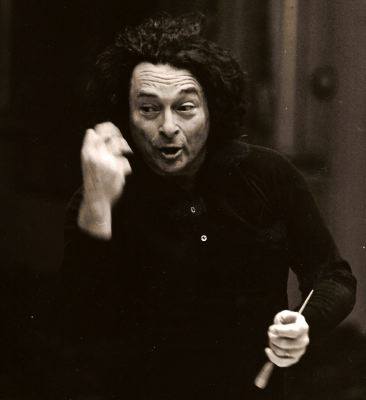
    Even somebody who knows a lot about a subject learns something new all the time. One of my latest “discoveries” is the conductor Carlos Païta (1932-2015), the Argentinean firebrand who made some breathtaking records during the era of London “Phase 4,” but has since largely fallen through the cracks.

    Païta settled in Switzerland, where he was attended to by Furtwängler’s widow, and a special label, Lodia, was founded to reissue both his studio-forged treasures and live concert recordings.

    His recordings of Wagner and Berlioz, which I discovered while sorting through a box of duplicates culled from donations to WWFM, knocked me back on my heels. Who is this guy? There is abundant evidence posted on YouTube. Païta’s conducting technique while rehearsing Beethoven’s 5th symphony is way, way over the top, but another video of his conducting Weber’s “Oberon Overture” suggests he may have dialed it down a bit during his actual concerts. His Janáček is stunning.

    In fact, everything I have sampled with him has been exceptional, yet somehow this musical colossus never settled in with a major orchestra. How could he not have enjoyed a major career?

    Païta would have been 85 this year. Head over to YouTube, search under his name, and prepare for a “wasted” Saturday.

    Or tune in to WWFM – The Classical Network on Monday, from 4 to 7 p.m. EDT, to hear his extraordinary Wagner recordings on Richard Wagner’s birthday. Really, he will spoil it for you when you try to return to many of your previous favorites.


    Carlos Païta, keeping the warhorses fresh:


  • Star Wars Soundtrack 40th Anniversary

    Star Wars Soundtrack 40th Anniversary

    by 

    in
    5 responses

    “Star Wars” – the original, as opposed to “Star Wars Episode IV: A New Hope,” as it has been known since its 1981 reissue – was released for the first time, in theaters, on May 25, 1977. Needless to say, the film became a pop cultural phenomenon that went on to assume mythological proportions.

    This week on “Picture Perfect,” we revisit a long time ago (40 years, to be exact) in a galaxy far, far away, as we listen to selections from John Williams’ classic score. In an era when pop music was threatening to swamp the movies, Williams’ paradoxically fresh-yet-retro heroic take was credited with singlehandedly reviving the fortunes of the orchestral film score. “Star Wars” went on to become the best-selling orchestral soundtrack of all-time.

    The fashion these days is to present a score note-complete and sequentially, as it appeared in the film. But there was an art to how the composer and supervising music editor (in this case, Kenneth Wannberg) used to arrange these soundtrack albums to create a special kind of listening experience.

    Buck the trend of digital complexity and note-complete soundtrack recordings by kicking back and listening to the music as you first enjoyed it at home in 1977, with selections from the original 2-record set. The exact contents of the double-LP album have been unavailable for years, until a quite recent vinyl reissue of the complete “Star Wars” soundtracks.

    The Force is strong with this one. Join me for 40 years of “Star Wars” on “Picture Perfect,” this Friday evening at 6 EDT, on WWFM – The Classical Network and wwfm.org.


  • Circus Music Farewell to Ringling Bros

    Circus Music Farewell to Ringling Bros

    by 

    in
    5 responses

    Ladies and gentlemen, boys and girls, children of all ages…

    As Ringling Bros. and Barnum & Bailey Circus prepares to take its final bow, we salute the circus this Thursday morning on WPRB.

    Join me to hear works such as Douglas Moore’s “The Pageant of P.T. Barnum,” Nino Rota’s “La Strada Ballet” and Rodion Shchedrin’s “Old Russian Circus Music.” I’ll also have snappy circus favorites like Julius Fucik’s “Entry of the Gladiators,” Juventino Rosas’ “Over the Waves” (a.k.a. the trapeze music), and Aram Khachaturian’s “Sabre Dance.” Perhaps there will even be a circus-oriented film score or two.

    The traveling circus’ roots reach back deep into the 19th century. Ringling Brothers will stream its final performance, from Uniondale, NY, on its Facebook page, Sunday evening at 7:00 EDT.

    For now, it will be a morning of pure nostalgia, a musical nod to a fading piece of Americana, from 6 to 11 EDT, on WPRB 103.3 FM and wprb.com. We’ll have more circus music than clowns in a clown car, on Classic Ross Amico.


  • Erik Satie Eccentric Genius

    Erik Satie Eccentric Genius

    by 

    in
    3 responses

    He maintained a filing cabinet filled with drawings of imaginary medieval buildings, the properties of which he would periodically put up for sale in local journals by way of anonymous ads.

    He founded his own church – Église Métropolitaine d’Art de Jésus Conducteur (Metropolitan Art Church of Jesus the Conductor) – of which he was the only member, and for which he promptly composed a mass.

    He ate only white food: eggs, sugar, shredded bones, the fat of dead animals, veal, salt, coconuts, chicken cooked in white water, moldy fruit, rice, turnips, sausages in camphor, pastry, cheese (only white varieties), cotton salad (whatever that is) and certain kinds of fish.

    When he died, his friends produced umbrella after umbrella after umbrella from his room.

    Join me this afternoon on The Classical Network, as we celebrate the birthday of Erik Satie (1866-1925), an artist whose life was full of enigmas and ambiguities. Satie is often misclassified as an Impressionist. He was viewed by some (including Maurice Ravel) as a precursor to Debussy, even as he felt a greater affinity with the younger generation of composers who made up Les Six.

    In practice, he elevated salon and cabaret music, of which he spoke slightingly. After he went back to school at mid-life in order to bone up on classical counterpoint, he stopped using bar lines in his manuscripts. He blazed trails later rediscovered by Morton Feldman and John Cage. He was a minimalist more than half a century before Minimalism.

    Satie rejected the concept of musical development, believing it to be an unconscionable imposition on the public’s time. For him, brevity was the soul of wit. He could be profoundly ironic. Many of his piano pieces bear titles like “Trois Morceaux en forme de poire” (“Three Pieces in the Shape of a Pear”), “Embryons desséchés” (“Desiccated Embryos”), and “Véritables préludes flasques pour un chien” (“Veritable Flabby Preludes for a Dog”).
    A friend of Jean Cocteau, the two collaborated on the surrealist curio “Parade,” written for the Ballets Russes, with choreography by Léonide Massine and costumes and set design by Picasso. The scenario involves three circus acts trying to attract an audience to an indoor performance.

    It was one of a number of works that were introduced in the ‘Teens that attempted to create a scandal through the incorporation of low-brow elements into what was perceived as a high-brow art form. Hoping for a strong reaction, Cocteau pushed for the inclusion of such provocative “instruments” as a typewriter, a foghorn, a siren, milk bottles, gunshots, and boots sloshing around in a wash tub. The work bore the subtitle “A Realist Ballet.” The opening night audience responded by rioting energetically.

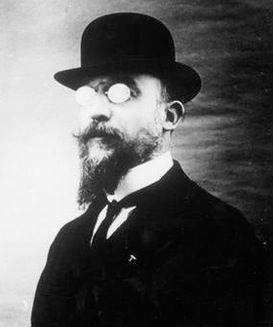
    Politically, Satie was a radical socialist, who eventually teetered over into Communism. For a time, his wardrobe consisted of seven identical grey suits. During his quasi-religious phase, he went about in a priest-like habit. Then he became a “velvet gentleman.” Finally, during his communist period, he assumed the appearance of a bourgeois functionary, never to be seen without a bowler and an umbrella.

    No one would have guessed that such an impeccable dresser would have lived out his life in clutter and squalor. When Satie died, his friends, who had never been invited back to his place in 27 years, were aghast at the piles of newspapers, the unending collection of umbrellas, and most of all the stacked grand pianos, the uppermost of which had been used by the composer as a repository for papers and parcels. Among these, and in the pockets of Satie’s wardrobe, were discovered a number of manuscripts which the composer had believed long lost.

    We’ll be listening to Satie’s ballet “The Adventures of Mercury,” alongside works of Francis Poulenc, Werner Egk, Louis Spohr, Giacomo Puccini, Jon Vincent, Peter Mennin, and others today, between 4 and 7 p.m. EDT, on WWFM – The Classical Network and wwfm.org.

  • Ringling Bros Circus Radio Tribute

    Ringling Bros Circus Radio Tribute

    by 

    in
    5 responses

    The Big Top will come down for the last time, metaphorically speaking, on May 21. Ringling Bros. and Barnum & Bailey Circus, an entertainment spectacle that has been part of the fabric of American life for 146 years, will tumble its last acrobat in Uniondale, NY, this weekend.

    To mark the end of the era of the traveling circus, a phenomenon with roots reaching back deep into the 19th century, I will be dusting off and refurbishing one of my most popular shows this Thursday morning on WPRB.

    Join me as we listen to such works as Douglas Moore’s “The Pageant of P.T. Barnum,” Walter Piston’s “The Incredible Flutist,” Nino Rota’s “La Strada Ballet,” Erik Satie’s “Parade,” and Rodion Shchedrin’s “Old Russian Circus Music.” I’ll also have snappy circus favorites like Julius Fucik’s “Entry of the Gladiators,” Juventino Rosas’ “Over the Waves” (a.k.a. the trapeze music), and Aram Khachaturian’s “Sabre Dance.” Perhaps there will even be a circus-oriented film score or two.

    I can’t claim that it will be the Greatest Show on Earth. All I know is that it was a big hit when the circus train first rolled into town, back in August of 2015. I’ll be sprucing up the spandex and spangles, this Thursday morning from 6 to 11 EDT, on WPRB 103.3 FM and at wprb.com. We’ll enjoy peanuts and cotton candy for breakfast, on Classic Ross Amico.


Tag Cloud

Aaron Copland (93) Beethoven (95) Composer (114) Film Music (144) Film Score (143) Film Scores (255) Halloween (94) John Williams (195) KWAX (229) Leonard Bernstein (104) Marlboro Music Festival (125) Movie Music (159) Mozart (91) Opera (213) Philadelphia Orchestra (89) Picture Perfect (174) Princeton Symphony Orchestra (109) Radio (88) Ross Amico (244) Roy's Tie-Dye Sci-Fi Corner (290) The Classical Network (101) The Lost Chord (269) Vaughan Williams (105) WPRB (397) WWFM (881)

DON’T MISS A BEAT

Receive a weekly digest every Sunday at noon by signing up here


RECENT POSTS