I think you’ll agree, there’s nothing slippery about this Slope.
Today’s edition of “The Classical Network in Concert” will feature performances guaranteed to stick to your ribs, as we travel to Saint John’s Episcopal Church in Park Slope, Brooklyn, for Concerts on the Slope. Concerts on the Slope was founded in 2012 to present top-notch chamber music concerts, featuring rising young artists from New York and around the world.
This afternoon’s broadcast will include a complete concert given on Oct. 23, 2016 – a program of clarinet trios by Jonathan Tunick, Ke-Chia Chen, and Beethoven – with clarinetist Eric Umble, cellist Benjamin Larsen, and pianist Jeong Hwa Park; and then, after a break, we’ll hear highlights from a concert given on Oct. 2, by Frank Morelli and his All-Star Bassoon Quartet. The program will include music by Gounod, Bach, Handel and Leonard Bernstein. You can find out more about the series at concertsontheslope.org.
Stick around after 2:00 EST for major works by Ralph Vaughan Williams and Bohuslav Martinu. I’ll be serving up the Slope for lunch at noon, and then spinning the platters until 4, on WWFM – The Classical Network and at wwfm.org.
Well, I missed it. I was off by one day. While I was busy lauding Ulysses Kay on the 100th anniversary of his birth, I failed to notice that January 8 was also the birthday of my friend, composer Robert Moran. And it was not just any birthday. It’s hard to believe that classical music’s merry prankster is now 80 years-old.
Bob has lived a lot in 80 years. Not only did he study twelve-tone music with Hans Erich Apostel in Vienna, he was accepted into a composition class of four at Mills College, where he was taught by Darius Milhaud and Luciano Berio. His classmates included Steve Reich, Phil Lesh and Tom Constanten. Lesh and Constanten went on to play for The Grateful Dead. And Reich? Who knows what happened to that guy.
Moran gained notoriety in the late 1960s and early ‘70s through a series of performance pieces that incorporated entire cities, including San Francisco, Bethlehem, Pa., and Graz, Austria. These involved tens of thousands of performers.
His many stage works include “Desert of Roses,” written for Houston Grand Opera, and, in 2011, “Alice” composed for the Scottish Ballet. Maurice Sendak introduced him to the Grimm fairy tale “The Juniper Tree,” which became an operatic collaboration with Philip Glass.
For the occasion of the tenth anniversary of the terrorist attacks on the World Trade Center, Moran was commissioned to write a work for the youth chorus of Trinity Wall Street, the so-called “Ground Zero” church in Lower Manhattan. “Trinity Requiem,” scored for children’s chorus, four cellos, harp and organ, offers a similar brand of solace to that conjured in the 19th century masterwork by Gabriel Fauré.
With Robert Moran, you never know what you’re going to get. In his more puckish moments, he might write for 39 autos, giant puppets or electric popcorn popper. But then there are times when his natural gift for lyricism will melt your heart.
Happy belated birthday, Bob. We’ll melt a few hearts this afternoon, between 4 and 7 EST, with at least one of his works, on WWFM – The Classical Network and at wwfm.org.
An aria from “Desert of Roses”:
Selections from “Trinity Requiem”:
“Obrigado” for Iowa Percussion:
Bob, looking groovy in merry prankster mode, introducing his “Lunchbag Opera” for the BBC:
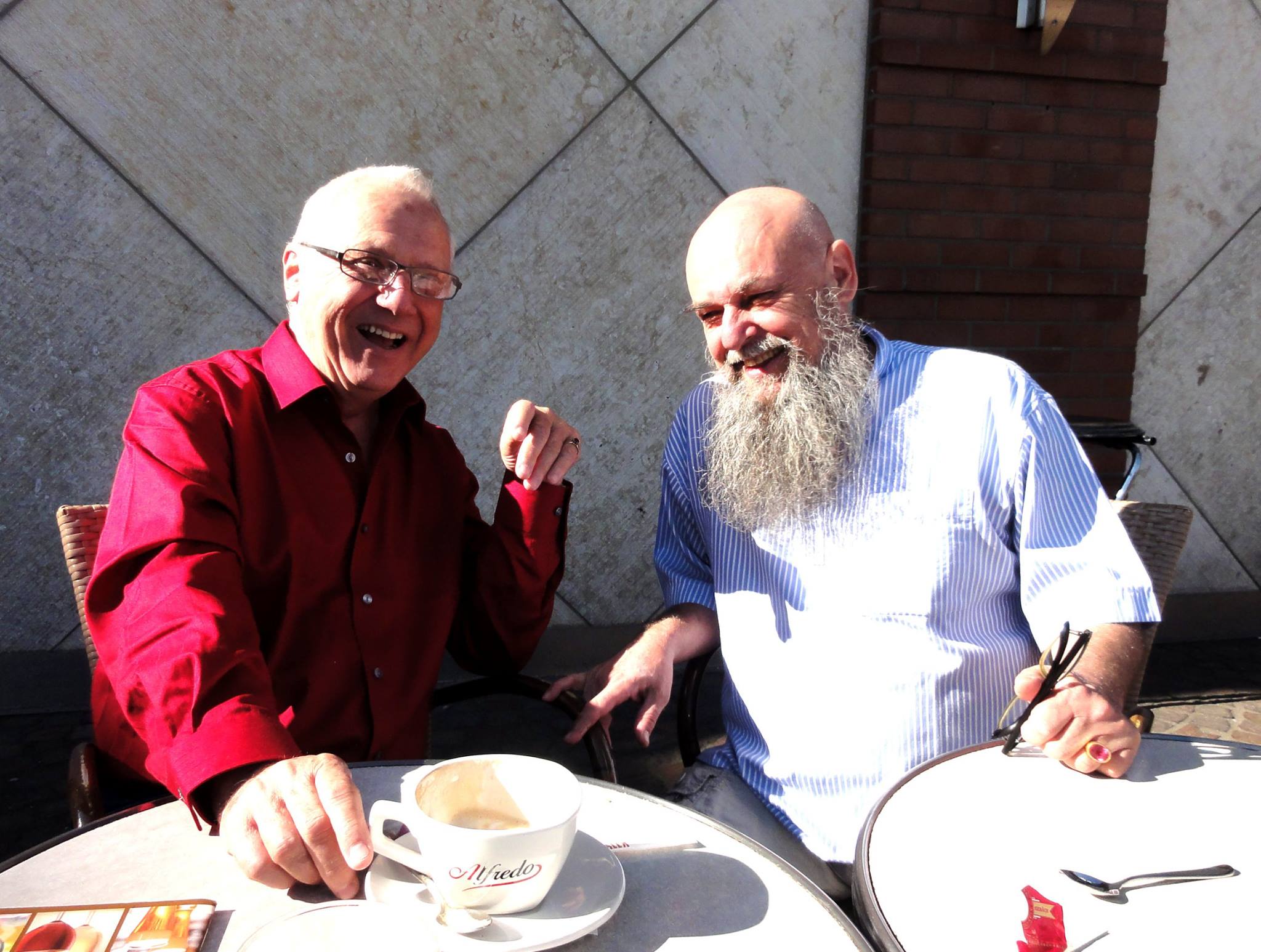
PHOTO: Bob (left) getting caffeinated with conductor, composer and performance artist Rupert Huber
Regrettably, the music of Ulysses Kay is under-represented in the current catalogue. His delightful “Six Dances for String Orchestra,” probably the lightest music he ever wrote, has been available sporadically on the Vox label, though always badly in need of a new recording. This Sunday night on “The Lost Chord,” we’ll hear two of those dances as part of an hour devoted to Kay’s music, as we celebrate the composer’s centenary. (He was born on January 7, 1917.)
We’ll hear his work for trumpet and piano, “Tromba,” from 1985; a long out-of-print LP of his “Concerto for Orchestra,” recorded in 1953; and a suite from his film score to “The Quiet One,” from 1947. A quasi-documentary about an abused African American child and his subsequent coming of age, “The Quiet One” received an Oscar nomination for Best Story and Screenplay, and was listed by the New York Times and the National Board of Review as one of the ten best movies of 1948.
I hope you’ll join me for “Giving Kay His Say,” Sunday night at 10:00 EST, on WWFM – The Classical Network and at wwfm.org.
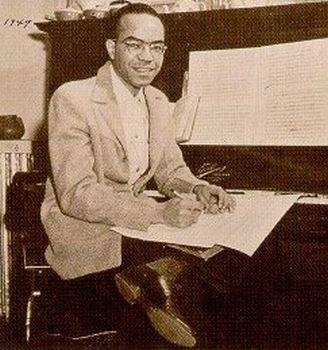
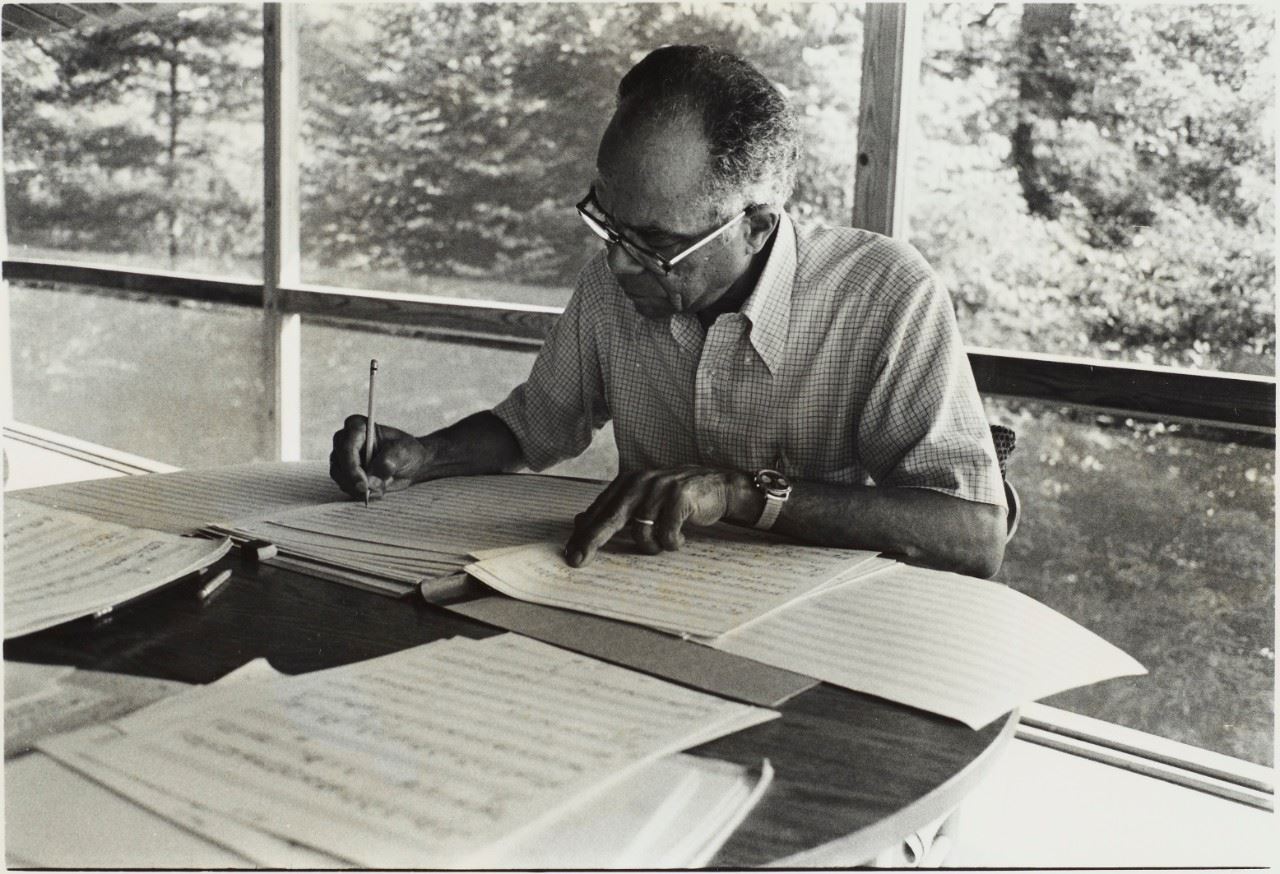
Ulysses Kay was born in Tuscon, AZ, on this date in 1917. A nephew of jazz musician King Oliver, his uncle encouraged him to study music formally. Likewise, he received encouragement from William Grant Still, then recognized as the “Dean of African-American Composers.” Kay attended the University of Arizona, before heading on to the Eastman-School, where he studied with Howard Hanson and Bernard Rogers. Also influential were studies with Paul Hindemith at the Berkshire Music Center, and then Yale.
Kay served in the United States Navy during World War II. He then continued his studies at Columbia with Otto Luening. A recipient of multiple scholarships, grants and awards, he was able to live and study abroad, in Rome, where he attended the American Academy, for several years.
From 1953 to 1968, he worked for BMI. He was then appointed professor at Lehman College of the City University of New York, where he remained until his retirement, two decades later. A longtime resident of Teaneck, NJ, he composed orchestral, chamber, choral and instrumental works, and five operas. He died in 1995 at the age of 88.
We’ll celebrate the 100th anniversary of Kay’s birth with an hour of his music, “Giving Kay His Say,” this Sunday night at 10:00 EST on “The Lost Chord,” on WWFM – The Classical Network and at wwfm.org.
5 responses