There is a Turkish proverb: “Coffee should be black as Hell, strong as death, and sweet as love.”
The music of Ahmed Adnan Saygun is very good coffee indeed. Saygun (pictured, right) rode a wave of Turkish nationalism to become his country’s foremost composer in the Western classical tradition. Perhaps best remembered abroad as an associate of Béla Bartók (pictured, left), Saygun was a prominent ethnomusicologist, but also an important educator and cultural administrator.
On this, the anniversary of his birth (in 1907), savor an hour of Saygun’s sometimes sweet, often astringent, always rewarding music, including a selection of “Etudes on Aksak Rhythms” (1964), his Suite for Violin and Piano (1956), and the Piano Concerto No. 1 (1951-57).
The refreshments are guaranteed to be aromatic, bold, and rich, on “Turkish Toughie” – this Saturday’s edition of “The Lost Chord” – now in syndication on KWAX, the radio station of the University of Oregon!
Clip and save the start times for all three of my recorded shows:
PICTURE PERFECT, the movie music show – Friday at 8:00 PM EDT/5:00 PM PDT
SWEETNESS AND LIGHT, the light music program – ALL NEW! – Saturday at 11:00 AM EDT/8:00 AM PDT
THE LOST CHORD, unusual and neglected rep – Saturday at 7:00 PM EDT/4:00 PM PDT
This week on “Sweetness and Light,” we’re headed back to school.
We’ll have frothy music on scholastic themes. None frothier than a head of beer, conjured perhaps by Emil Waldteufel’s “Estudiantina,” or “Band of Students.” Listeners of a certain age may associate this music with a popular jingle for Rheingold Beer. Clearly its inclusion suggests a double-significance – not that I condone riotous student behavior (unless, of course, I’m invited)!
I’ll also share one of my favorite lesser-heard works of Ralph Vaughan Williams: the “Charterhouse Suite,” a collection of light dances for strings, named for the public school the composer attended, beginning at the age of 15. Pendants will add that the work was actually arranged from an earlier “Suite of Six Short Pieces” for piano.
Franz Joseph Haydn’s Symphony No. 55 is often referred to as the “Schoolmaster.” Passages are said to be strikingly similar to those in a lost Haydn divertimento, identified as “The Schoolmaster in Love.” In particular, it’s been suggested that the dotted rhythm of the second movement of the symphony calls to mind a schoolmaster’s wagging finger – disrupted at intervals by musical sighs as he swoons with love.
Along the way, we’ll also enjoy music by Richard Addinsell, Gilbert & Sullivan, and Sigmund Romberg.
Put on your school clothes, boys and girls, and learn your lessons well. You’ll get a gold star when you join me for “Sweetness and Light,” this Saturday morning at 11:00 EDT/8:00 PDT, exclusively on KWAX, the radio station of the University of Oregon!
This week on “Picture Perfect,” get ready for an exercise in postmodern self-reflexivity, as we enjoy music from movies about music and musicians.
Federico Fellini’s “Orchestra Rehearsal” (1978) is a mock-documentary that presents the symphony orchestra as a metaphor for the human condition. Full of political overtones, the film explores the joys, sorrows, frustrations and triumphs of the musicians, who struggle with the concepts of individual liberty, tyranny and the collective good. The project would mark the final collaboration between Fellini and Nino Rota. The two artists first came together in 1952 on Fellini’s “The White Sheik.” They would go on to create such classics as “La Strada,” “Nights of Cabiria,” “La dolce vita” and “8 ½.”
We’ll also hear music from the Canadian art house hit “The Red Violin” (1998). The film traces the history of the fictional title instrument from its creation in 17th century Cremona to the present day. The violin passes through the hands of a child prodigy, into those of a romantic virtuoso in the Paganini mold; then to China during the Cultural Revolution; and finally to a Canadian auction house. John Corigliano wrote the Academy Award-winning music, which is performed on the soundtrack by violinist Joshua Bell.
Finally, we’ll turn to a classical music film noir from Hollywood’s Golden Age. “Deception” (1946) tells the tale of a dangerous love triangle between Bette Davis, Paul Henreid and Claude Rains. Much of the plot hinges on the premiere of a new cello concerto by a celebrated – though fictional – composer, played by Rains, who puts a fragile cellist, his rival in love, played by Henreid, through the psychological wringer. The music, which serves as both underscore and crux of the story, is by Erich Wolfgang Korngold. The composer subsequently published the on-screen concerto as his Op. 37.
All aboard the musical ouroboros! Join me for music from movies about music and musicians, on “Picture Perfect,” now in syndication on KWAX, the radio station of the University of Oregon!
Clip and save the start times for all three of my recorded shows:
PICTURE PERFECT, the movie music show – Friday at 8:00 PM EDT/5:00 PM PDT
SWEETNESS AND LIGHT, the light music program – ALL NEW! – Saturday at 11:00 AM EDT/8:00 AM PDT
THE LOST CHORD, unusual and neglected rep – Saturday at 7:00 PM EDT/4:00 PM PDT
PHOTO: Henreid wore a special jacket to accommodate the arms of two professional cellists who stood behind him as he emoted. On the film’s soundtrack the concerto was performed by Eleanor Aller Slatkin, mother of Leonard Slatkin.
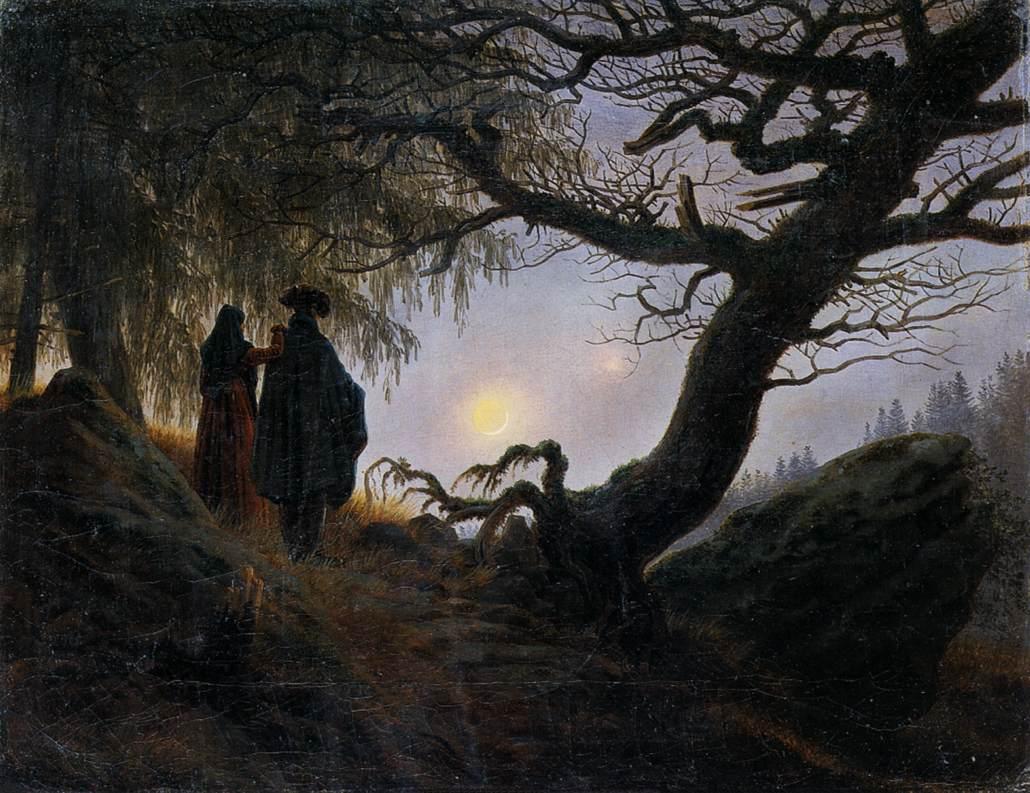
Anyone who collected classical music records during the golden age when great paintings were always used as cover art, or who has purchased his or her share of literary paperbacks, will surely recognize the work of Caspar David Friedrich. He’s an artist that’s always appealed to me, especially as I seem never to have developed beyond my Byronic teens, thank goodness. I’m very much looking forward to the upcoming exhibition of his works at the Metropolitan Museum of Art, February 8- May 11, billed as the first comprehensive display of the artist’s paintings in the United States. Today marks the 250th anniversary of his birth. Wishing a melancholy semiquincentennial to Caspar David Friedrich!
I remember the first time I encountered the music of Anton Bruckner. It was in the middle of the night in an attic bedroom in Easton, Pennsylvania.
While growing up in Easton in the 1970s and ‘80s, I always regarded it as a small town. Technically, it’s classified as a city, the third largest in the Lehigh Valley, but the downtown is not all that large and most of the population was distributed across what was then several semi-rural townships. A drifting snow would be enough to close the schools for days.
Easton is about 70 miles outside Philadelphia. In the car, WFLN, Philadelphia’s 24-hour classical music station, when it still existed, would sometimes cut in and out, depending on where you were driving. But I always had the radio antennae in the house trained to pick up 95.7 FM. And as a teenager, my brain was absorbent enough that I internalized most of the standard repertoire.
Back in the day, WFLN used to broadcast its overnights ad-free. So other than the distinctive voice of Henry Varlack, it was non-stop music from midnight to 6 a.m. This made it easy to sleep with the radio on, and I did so out of habit in those days, my consciousness rising to the surface now and again to take note of the music.
On one of those occasions, I emerged right in the middle of an insinuating, sinister scherzo. It made such an impression that I hung around to hear the back-announcement: Bruckner’s Symphony No. 9.
The word “scherzo” literally means “joke.” In Bruckner, there are no jokes. The early symphonies may flirt with folksy ländler. But once Bruckner knows what he’s about, these are transmogrified into supernatural gallops across moonless skies, Odin leading his warrior band in the Wild Hunt. The symphonies are often compared to “cathedrals in sound.” Bruckner was an organist; once you know that, it’s easy to imagine his structures and textures elucidated on the King of Instruments. But there is nothing sacred about the scherzos.
From that first encounter, I’ve always been fond of them. So ferocious can these become, so terrible in their sublimity, that it’s hard to associate them with the man who, on the one hand, aspired to convey the ineffable in his heavenly adagios, and on the other, could be so malleable as to allow anyone to make changes to “improve” his music. He was almost perversely humble. Because of this, there are multiple Bruckner performance traditions, with some conductors and scholars divided between the Haas and Nowak editions and others groping toward elusive Brucker urtexts.
For the Bruckner faithful, no matter how it’s been processed, the music transcends human tampering. With its hypnotic repeating cells, its punctuating silences, its spiritual depth, and its breathtaking grandeur, Bruckner’s art communicates with an unwavering clarity. But as with his instrument of choice, there’s always a lot going on behind the scenes and beneath the surface.
Still, I’m aware not everyone is a convert. I think wryly back on Simon Roberts, who stocked and held court in the basement of Nathan Muchnick’s (a Philadelphia audio store with a superb classical music compact disc selection), and his withering dismissal of “deranged Bruckner fanatics,” which I recall now, even decades after he uttered it.
Gustav Mahler, who took lessons with Bruckner at the Vienna Conservatory and considered him his precursor and friend, described him as “half simpleton, half God.”
Those who love Mahler don’t necessarily feel the same way about Bruckner, and vice versa. So if Grandpa loves his cycle of Bernstein Mahler symphonies (Sony or DG), don’t expect him to turn handsprings for your generous gift of Eugen Jochum’s Bruckner set (EMI or DG). Unless Grandpa happens to be me. I love all these recordings!
I can’t believe that today marks the 200th anniversary of Bruckner’s birth. I remember when 200 years ago meant powdered wigs.
In any case, thank you, WFLN, God rest Henry Varlack, and happy bicentennial, Anton Bruckner!
Bruno Walter conducts Bruckner’s 9th (my first Bruckner recording). The scherzo begins about 24 minutes in.




3 responses