• Shostakovich, Grief and Jewish Song

    Shostakovich, Grief and Jewish Song

    by 

    in
    3 responses

    When Shostakovich’s birthday elides with Yom Kippur, you get a very somber post indeed.

    Shostakovich always felt a special kinship with the Jewish people and, while he himself was not of the faith, he pushed back against antisemitism, either overtly, defending friends and colleagues, such as the composer Mieczyslaw Weinberg, from persecution, or more stealthily, by embracing Jewish influences in his own music.

    This took real courage, as Shostakovich’s own standing with the Soviet authorities was a precarious one. He would be condemned several times over the course of his career for “formalism,” an amorphous term that could be molded to suit anything that might be described as Western, modernist, or otherwise subversive to the cause of Socialist Realism – uncomplicated art of direct and inspirational nature, easily digestible to the proletariat.

    In 1943, having scored a great patriotic success with his Symphony No. 7, the “Leningrad Symphony,” performed in the city during the actual siege, Shostakovich set to work on the more profoundly introspective Piano Trio No. 2. This he dedicated to the memory of his close friend Ivan Sollertinsky. Like Shostakovich, Sollertinsky had been evacuated from Leningrad, but he died suddenly in Siberia, of a heart attack, at the age of 41.

    Shostakovich mourned as only he could. The Piano Trio shares in common with the later String Quartet No. 8 an inexorable, klezmer-influenced “danse macabre.” Among Sollertinsky’s many talents and pursuits – as a musicologist, a critic, a linguist, a professor, and the artistic director of the Leningrad Philharmonic – he was an ardent enthusiast of the music of Gustav Mahler.

    It was also a time, with the retreat of the Nazis from the Eastern Front, when the horrors of the camps at Majdanek and Treblinka were just becoming known. It’s been observed that the klezmer influence may also be an allusion to Sollertinsky’s birthplace of Vitebsk, where a Nazi massacre of Jews had taken place in 1941.

    Shostakovich’s political capital must have been high, because the work was awarded a Stalin State Prize in 1946.

    In 1948, things were considerably shakier, as Shostakovich had been denounced, under the Zhdanov decree, for the second time. Furthermore, it was a period of heightened antisemitism in the Soviet Union, as Stalin targeted Jewish intellectuals and artists. So it was at great personal risk to himself that Shostakovich conceived the song cycle “From Jewish Folk Poetry.” Unsurprisingly, the songs were not given their first public performance until 1955, two years after Stalin’s death. However, the first eight of them were performed at a private birthday celebration at the composer’s home in August of 1948.

    While Shostakovich’s on-again, off-again history with the Soviet authorities made him justifiably cautious, the String Quartet No. 4 grew out of a newfound confidence, the result of Stalin having personally selected him as a cultural ambassador to the West. He would travel to the United States for the first time, as part of a Soviet delegation to a “Cultural and Scientific Congress for World Peace,” on March 25, 1949. As always, the situation had to be navigated very carefully. A sign of favoritism from Papa Joe often had the effect of setting a recipient up for a very big fall.

    Still, Shostakovich was determined to leverage his new-found currency. He took the opportunity to persuade Stalin that if he were going to be sent out into the decadent West, then perhaps it would be a good idea to lift the ban on performances of his music at home. Otherwise, the situation might appear a little peculiar to outsiders. Stalin recognized the logic in this, and Shostakovich was rehabilitated.

    Shostakovich was not by any measure a stupid man. Yet the artistic impulse was not to be denied. He wasted no time in embarking on a new string quartet, which he loaded up with inscrutable subtexts, Jewish folk songs, and all sorts of things that had a history of angering the “wise leader and teacher.” Fortunately for the composer, after the quartet was played before a small audience of increasingly uneasy friends on May 15, 1950, they convinced him not to allow it to be performed publicly, and he prudently put it away in a drawer for another day. That other day would come on December 3, 1953 – nine months after Stalin was safely interred.

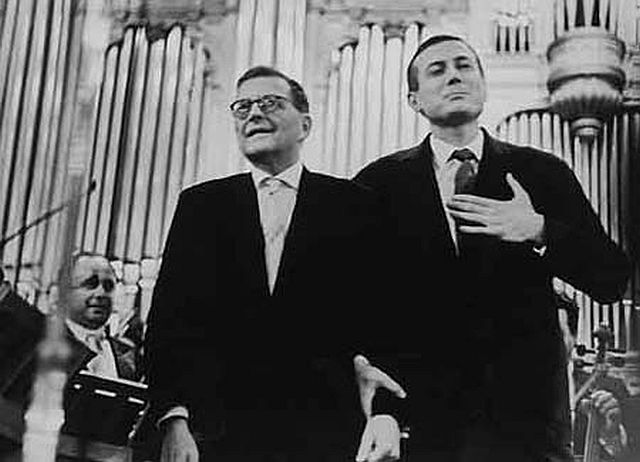
    Even with the death of Stalin, the skies did not entirely clear. As late as 1962, there was political blowback, when Shostakovich decided to set poetry by Yevgeny Yevtushenko in his Symphony No. 13, known as the “Babi Yar” – the site of another sustained massacre of Jews in 1941. Yevtushenko at the time had become the object of a campaign to discredit him for supposedly placing the suffering of the Jewish people above that of Russians. Khrushchev himself threatened to halt the symphony’s performance. In the event, the premiere was tense, but the audience was sympathetic and the occasion was a triumph. However, by the third performance, Yevtushenko had supplied revisions to the text for some of the more controversial passages.

    Whether as an act of solidarity or a gesture of subversion, Shostakovich would often incorporate Jewish music or treat Jewish subjects in his major works. How could he not empathize with a people who had endured such suffering, yet expressed themselves so poignantly in music?

    Happy Yom Kippur birthday, Dmitri Shostakovich.


    Piano Trio No. 2, with Shostakovich at the piano

    String Quartet No. 4

    “From Jewish Folk Poetry,” with Shostakovich at the piano

    Symphony No. 13 “Babi Yar,” with Yevtushenko’s original texts


    PHOTO: Shostakovich and Yevtushenko at the premiere of the Symphony No. 13 “Babi Yar”


  • Autumn Classical Music Crossword Puzzle Fun

    Autumn Classical Music Crossword Puzzle Fun

    by 

    in
    7 responses

    It’s ginger snaps for breakfast! For the first weekend of autumn, here’s the revival of another Classic Ross Amico crossword puzzle. The answers are all related in one way or another to classical music and the season.

    Of course, I wouldn’t ask you to do anything I wouldn’t do myself. When filling out the puzzle this morning, I was delighted to find among the answers my old favorite “VAUGHANWILLIAMS;” also “PANUFNIK,” whose birthday it happens to be today.

    Follow the link and select “solve online” at the bottom of the page. You’ll then be able to type directly into the squares. Once you feel you’ve exhausted the puzzle, you’ll find the solutions by clicking on “Answer Key PDF.”

    Take it or leaf it! Celebrate autumn by raking through 50 colorful clues here:

    https://www.armoredpenguin.com/crossword/Data/2020.09/2707/27072447.189.html


  • Yom Kippur Music The Lost Chord on KWAX

    Yom Kippur Music The Lost Chord on KWAX

    by 

    in
    2 responses

    Yom Kippur begins tomorrow night at sundown. The Day of Atonement marks the culmination of ten days of awe and repentance. Observed with fasting and prayer, it is the holiest day on the Jewish calendar.

    This week on “The Lost Chord,” we offer best wishes for a happy, healthy, and sweet new year with two complementary works inspired by the High Holidays.

    Jacob Weinberg’s String Quartet, Op. 55, of 1950, falls into three movements: “Rosh Hashana” (the Jewish New Year), “Yom Kippur,” and “Sukkot.” “Yom Kippur” is based on the cantorial chant “Kol Nidre.” You know, the same melody employed by Max Bruch in his famous cello piece.

    Ernest Bloch’s “Israel Symphony,” composed between 1912 and 1917, is more like an orchestral rhapsody in three sections – “Prayer in the Desert,” “Yom Kippur,” and “Succoth” [sic] – played continuously and culminating in parts for four vocal soloists.

    Sukkot, which follows Yom Kippur by only five days, is the harvest festival, during which temporary dwellings (or sukkot) are erected to commemorate the Jews’ 40 years wandering in the desert after the Exodus from Egypt. In modern times, these are decorated with fruits and vines. In contrast to the austerity and fasting of Yom Kippur, Sukkot is a celebration of life and abundance. But in ancient Israel, it was a solemn affair, with sacrifices offered at the temple.

    Welcome the year 5784, with musical reflections of the High Holidays, and then some, on “Totally Awesome,” on “The Lost Chord,” now in syndication on KWAX, the radio station of the University of Oregon.


    Remember, KWAX is on the West Coast, so there’s a three-hour difference for the Trenton-Princeton area. Here are the respective air-times of my recorded shows (with East Coast conversions in parentheses):

    PICTURE PERFECT, the movie music show – Friday on KWAX at 5:00 PACIFIC TIME (8:00 PM EDT)

    THE LOST CHORD, unusual and neglected rep – Saturday on KWAX at 4:00 PACIFIC TIME (7:00 PM EDT)

    Stream them here:

    https://kwax.uoregon.edu/


  • East Coast Autumn Cozy Delights

    East Coast Autumn Cozy Delights

    by 

    in
    3 responses

    A perfect start to autumn here on the East Coast, with plenty of rain and drear, and early enough in the season so as not to denude the trees, only starting to color up around their temples. At any rate, it is a great time for cozy. I’m looking forward to glutting myself on library book sales, black-and-white horror movies, introspective Romantic and energizing Baroque music from my record collection (because the radio stinks), bottomless cups of coffee, and cornucopias of Spiced Wafers and pie. Bring on the soups and the chili! Summon the wool and the flannel! After mentally pushing against the summer months, it’s time to throw on the air brakes and savor every moment between now and Thanksgiving. Halloween, full of opportunity and free of obligation, for me, is always the greatest of holidays. Welcome, Autumn, season of Cockaigne, Dionysian paradise, wonderland of revelry and solitude!


  • Airport Movie Music on “Picture Perfect” Radio

    Airport Movie Music on “Picture Perfect” Radio

    by 

    in
    2 responses

    This week on “Picture Perfect,” get ready to take flight, with music from movies about airports and airplanes.

    In the original “Airport” (1970), producer Irwin Allen established the prototype for disaster movies of all stripes by placing an all-star, aging cast in spectacular peril. Burt Lancaster! Dean Martin! George Kennedy! Jean Seberg! Jacqueline Bisset! Helen Hayes! The list goes on and on, longer than the longest runway. The bongo-laden theme is by veteran film composer Alfred Newman,” from the last of his over 200 scores.

    Another movie with something of the same feel is “The V.I.P.s” (1963), allegedly inspired by the real-life love-triangle of Vivien Leigh, Laurence Olivier, and Peter Finch. The story is set at London Heathrow Airport, where flights are delayed because of a dense fog. The film was written by Terrence Rattigan and the parts cast from another laundry list of stars, including Elizabeth Taylor, Richard Burton, Louis Jourdan, Maggie Smith, Rod Taylor, and Orson Welles, with Margaret Rutherford in an Academy Award-winning performance. The music is by Miklós Rózsa.

    By contrast, Steven Spielberg’s “The Terminal” (2004) is an (intentionally) comic take on the predicament of a hapless Eastern European who finds himself in a kind limbo, trapped in an international arrivals terminal in New York, after his country erupts into civil war, so that his passport and other documentation are no longer valid. His plight mirrors that of real-life Mehran Karimi Nasseri, an Iranian who lived for 17 years in a terminal at Charles de Gaulle Airport.

    Tom Hanks plays the unfortunate traveler, who makes the terminal his home, and Catherine Zeta-Jones the airline attendant with whom he strikes up a relationship. The music is by regular Spielberg collaborator John Williams, and I think you’ll find it quite different from the Williams known for his work on “Star Wars” and “Indiana Jones.”

    Finally, we’ll turn to the Alfred Hitchcock thriller “North by Northwest” (1959), a film in which Cary Grant encounters love and danger in, on, and from a variety of planes, trains, and automobiles. Planes are particularly significant. During the course of the film, it’s revealed that the title is in reference to a Northwest Airlines flight; Eve Kendall (Eva Marie Saint) must do all she can to avoid getting on a plane with Phillip Vandamm (James Mason); and of course, Roger Thornhill (Grant) flees from a strafing crop duster. Bernard Herrmann’s opening fandango propels us into the adventure.

    Rush more to Rushmore. Departure time below, for “Picture Perfect,” music for the movies, now in syndication on KWAX, the radio station of the University of Oregon!


    Remember, KWAX is on the West Coast, so there’s a three-hour difference for the Trenton-Princeton area. Here are the respective air-times of my recorded shows (with East Coast conversions in parentheses):

    PICTURE PERFECT, the movie music show – Friday on KWAX at 5:00 PACIFIC TIME (8:00 PM EDT)

    THE LOST CHORD, unusual and neglected rep – Saturday on KWAX at 4:00 PACIFIC TIME (7:00 PM EDT)

    Stream them here!

    https://kwax.uoregon.edu/


Tag Cloud

Aaron Copland (93) Beethoven (95) Composer (114) Film Music (144) Film Score (143) Film Scores (255) Halloween (94) John Williams (195) KWAX (229) Leonard Bernstein (104) Marlboro Music Festival (125) Movie Music (159) Mozart (91) Opera (213) Philadelphia Orchestra (89) Picture Perfect (174) Princeton Symphony Orchestra (109) Radio (88) Ross Amico (244) Roy's Tie-Dye Sci-Fi Corner (290) The Classical Network (101) The Lost Chord (269) Vaughan Williams (105) WPRB (397) WWFM (881)

DON’T MISS A BEAT

Receive a weekly digest every Sunday at noon by signing up here


RECENT POSTS