• Grandfather Clock Song NJ Exhibit & History

    Grandfather Clock Song NJ Exhibit & History

    by 

    in
    7 responses

    Did you know that the term “grandfather clock” entered the language as a result of a song by Henry Clay Work?

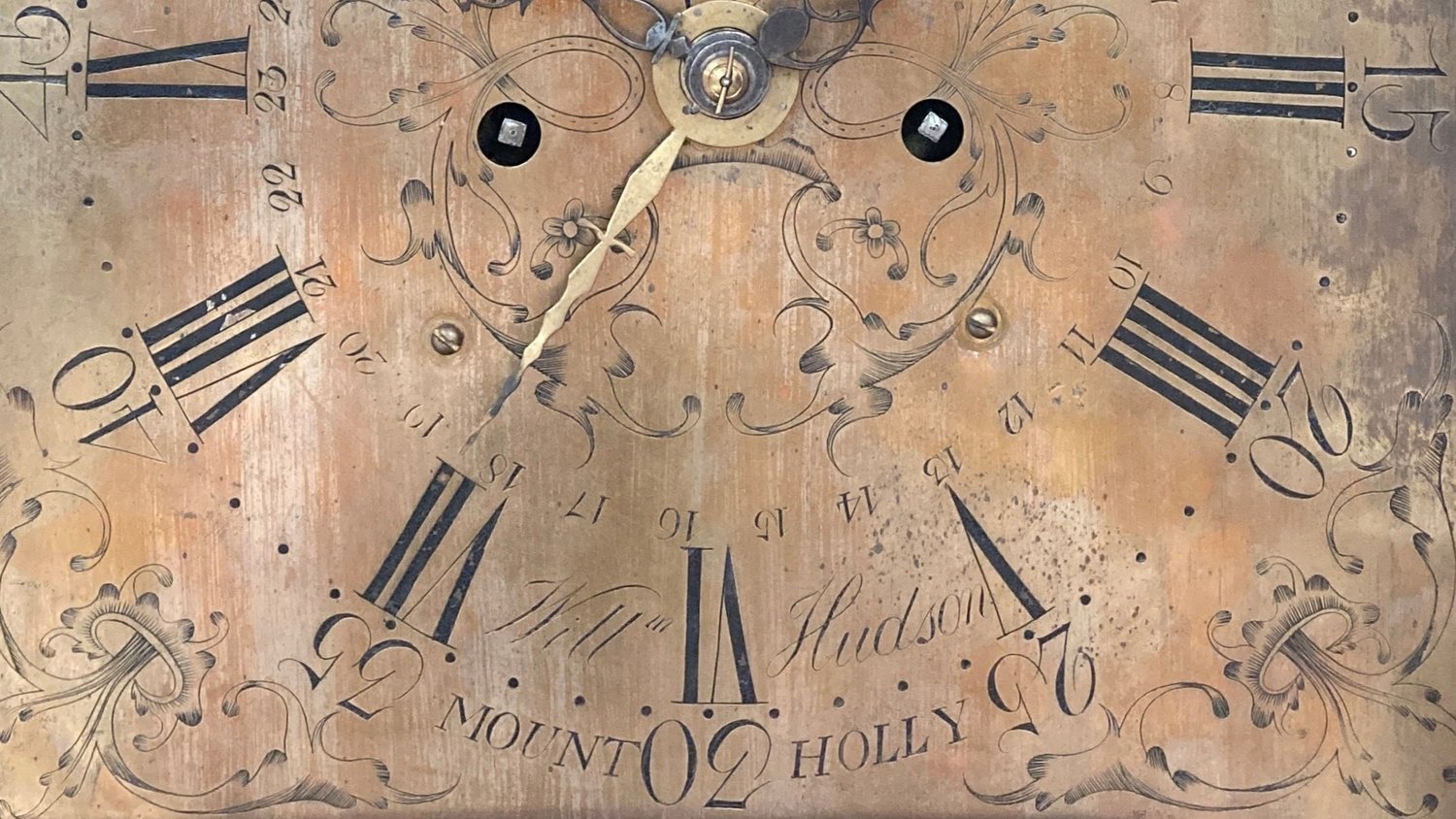
    This is something I learned on a visit to the exhibition “Striking Beauty: New Jersey Tall Case Clocks, 1730-1830,” now on display at Morven Museum & Garden in Princeton. I visited the show over the summer, but the installation will be in place through February 18, 2024.

    The reason I am thinking of it now is that today is Work’s birthday anniversary. Work lived from 1832 to 1884. Although he was born and died in Connecticut, in his 20s, he labored as a printer, setting type in Chicago. There he composed in his head, against a background of noisy machinery. He conceived his greatest songs during the American Civil War, achieving a popularity even greater than Stephen Foster’s. “My Grandfather’s Clock,” published in 1876, sold over a million copies of sheet music, and popularized the term “grandfather clock” to describe a longcase clock.

    Although his heart was in the right place, as a dyed-in-wool abolitionist (the family home was a stop on the Underground Railroad and his father was imprisoned for assisting runaway slaves), in common with other songwriters of his day, Work composed a number of songs that were used in minstrel shows. He also appropriated what he perceived as Irish dialect. It was a thing. People, like history, are complex.

    There’s certainly a lot of history on display in the Morven exhibit, billed as “the most comprehensive look ever given to the ingenious work of New Jersey clock makers.” No less than 50 tall case clocks are on view in five galleries.

    The former New Jersey Governor’s Mansion was originally built by Richard Stockton, signer of the Declaration of Independence.

    If you’re looking for something to do on a lovely autumn weekend, definitely consider checking it out. When the clocks begin to chime, it is quite the time machine indeed!

    https://www.morven.org/


    Henry Clay Work, “Grandfather’s Clock”


  • Paul Dukas Halloween Composer

    Paul Dukas Halloween Composer

    by 

    in
    3 responses

    How fortuitous that Paul Dukas would be born on October 1. What better way to start Halloween month than with the composer of “The Sorcerer’s Apprentice?”

    Though Dukas left a comparatively small output – he was a notorious perfectionist who destroyed much – what survives of his music is of very high quality. Of that, he lends to his Halloween street cred with two other works of a fantastical, potentially horrific nature: an opera about Bluebeard and his sixth wife, and a so-called dance poem, “La Péri,” about a fatal encounter with a Persian fairy.

    The music is fantastic in more ways than one. Happy birthday, Paul Dukas!


    “La Péri”

    His Bluebeard opera, “Ariane et Barbe-Bleue”

    Mickey learns that a little knowledge is a dangerous thing:

    https://video.disney.com/watch/sorcerer-s-apprentice-fantasia-4ea9ebc01a74ea59a5867853?fbclid=IwAR1t2jcPyKB8UArn4ypRSY5Y_P7ogK9AnMjq4r2Dv1IaK8OUPAtoUtyl-4M


  • Rediscovering Weingartner Composer and Conductor

    Rediscovering Weingartner Composer and Conductor

    by 

    in
    7 responses

    Felix Weingartner (1863-1942) is best-recognized as a conductor. However, he considered himself equally, if not more so, a composer. He was one of a number of prominent conductors of the day who fit the Mahler paradigm. However, the works of Wilhelm Furtwängler, Otto Klemperer, and most others of his profession are very seldom heard.

    This week on “The Lost Chord,” as we’ll have a chance to enjoy Weingartner’s Symphony No. 2, from 1901, a fascinating mix of old and new, evidently romantic in disposition, yet very much of its time. The recording will feature the Basel Symphony Orchestra, which he himself directed from 1927 to 1934.

    Weingartner held many conducting posts over the years. He succeeded Mahler as principal conductor of the Vienna Hofoper, from 1908 to 1911. He led the Vienna Philharmonic in an official capacity until 1927. He was later chief conductor of the Vienna Volksoper.

    He thought very deeply about the problem of the symphony. I remember reading a book he wrote in which he examined the strengths and weaknesses of all the major symphonies written in the shadow of Beethoven, down to the dawn of the 20th century.

    He himself composed seven symphonies, with other orchestral works, and thanks to the enterprising cpo.de – classic production osnabrück label (CPO for short), all of them have been recorded.

    As a conductor, Weingartner was particularly well-regarded as a Beethoven interpreter. He’d been conducting the Beethoven symphonies as a cycle since at least 1902, and he was the first to complete an integral set of recordings. To round out the hour, we’ll have time to sample the scherzo from the Symphony No. 9, from his superlative recording of 1935.

    I hope you’ll join me in raising a glass to Felix Weingartner. That’s “Wine from Weingartner,” on “The Lost Chord,” now in syndication on KWAX, the radio station of the University of Oregon!


    Remember, KWAX is on the West Coast, so there’s a three-hour difference for the Trenton-Princeton area. Here are the respective air-times of my recorded shows (with East Coast conversions in parentheses):

    PICTURE PERFECT, the movie music show – Friday on KWAX at 5:00 PACIFIC TIME (8:00 PM EDT)

    THE LOST CHORD, unusual and neglected rep – Saturday on KWAX at 4:00 PACIFIC TIME (7:00 PM EDT)

    Stream them here!

    https://kwax.uoregon.edu/


    PHOTO: Weingartner gets busted in Basel in 1927


  • Burnt Offerings Movie Review Haunted House Horrors

    Burnt Offerings Movie Review Haunted House Horrors

    by 

    in
    4 responses

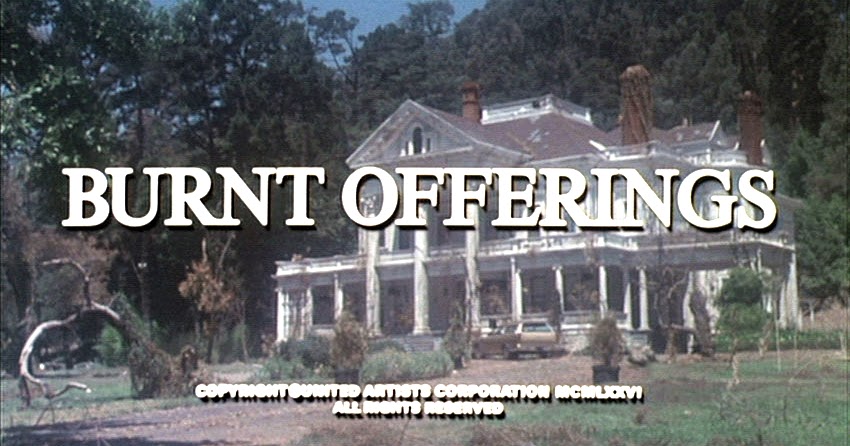
    Well, it ain’t exactly “The Haunting” (1963), but the house in “Burnt Offerings” (1976) is also up to no good. Unfortunately, that also happens to describe just about every aspect of the production.

    Opinions may vary. We’ll find out tomorrow night, when Roy and I commence our annual celebration of Halloween with an eerie discussion on Roy’s Tie-Dye Sci-Fi Corner.

    Karen Black, Oliver Reed, Burgess Meredith, and Bette Davis put their faith in Dan Curtis, whose “Dark Shadows” was notorious for getting things done efficiently – which is to say, fast and cheap. The screenplay was adapted by prolific sci-fi scribe William F. Nolan, who gave us “Logan’s Run.”

    “Burnt Offerings” was shot at the Dunsmuir House in Oakland, California, soon to be used in “Phantasm” (1979), a much less formulaic film – which I hope we’ll cover soon – that at least had some creativity and the courage to swing for the fences.

    The offerings won’t be the only things that are burned, when Roy and I convene for a lively discussion about a house that wants you dead. Bring your realtor to the comments section, when we livestream on Facebook, YouTube, etc., this Sunday evening at 7:30 EDT!

    https://www.facebook.com/roystiedyescificorner


    PHOTOS: The house (top), and Roy making me rewatch the film


  • Jacques Hotteterre The “Roman” Flute Master

    Jacques Hotteterre The “Roman” Flute Master

    by 

    in
    4 responses

    They called him “le Romain,” but not because he resembled a lettuce.

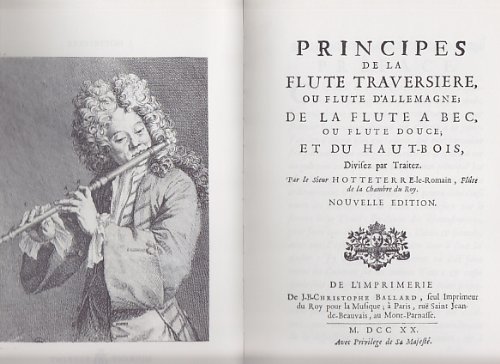
    Jacques Hotteterre, most celebrated of a dynasty of woodwind makers and players, received his nickname for his early period in Rome. There he studied and soon found employment with Prince Francesco Ruspoli. In 1708, he entered the court of Louis XIV, King of France, whom he served as Jouëur de Fluste de la musique de chambre. In addition to being a master of the transverse flute, Hotteterre also played bassoon, oboe, and musette (a kind of French bagpipe). He’s said to have made certain innovations to the design of the transverse flute and wrote several methods. His “L’Art de préluder sur la flûte traversière,” published in 1719, was Europe’s first flute manual and enjoyed great success.

    Today marks the 350th anniversary of his birth. Hotteterre died in Paris in 1763, a few months shy of his 90th birthday. Joyeux anniversaire!


Tag Cloud

Aaron Copland (93) Beethoven (95) Composer (114) Film Music (144) Film Score (143) Film Scores (255) Halloween (94) John Williams (195) KWAX (229) Leonard Bernstein (104) Marlboro Music Festival (125) Movie Music (159) Mozart (91) Opera (213) Philadelphia Orchestra (89) Picture Perfect (174) Princeton Symphony Orchestra (109) Radio (88) Ross Amico (244) Roy's Tie-Dye Sci-Fi Corner (290) The Classical Network (101) The Lost Chord (269) Vaughan Williams (105) WPRB (397) WWFM (881)

DON’T MISS A BEAT

Receive a weekly digest every Sunday at noon by signing up here


RECENT POSTS