• Antheil Talk Prep Food & Vincent Price

    Antheil Talk Prep Food & Vincent Price

    by 

    in
    6 responses

    How much food can you eat right before talking about George Antheil? That was the challenge I faced this afternoon, while setting up for my talk about Trenton’s greatest musical son. Thank you so much to the Rotary Club of Trenton, New Jersey for inviting of me. I’ve written a lot about the composer, both here and in actual print, and played more than my share of his music on the radio. I’d never been to a Rotary Club meeting before, and it was pure Americana. With a lot of food!

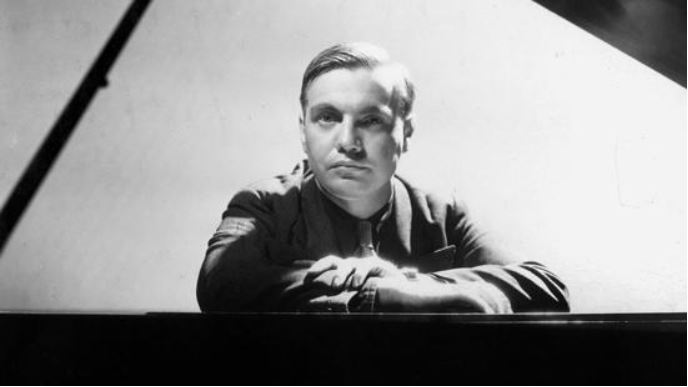
    Here’s something I forgot I had in my own collection. I came across it yesterday in the course of my preparations (having also reread Antheil’s flamboyant autobiography, “Bad Boy of Music”). “Two Odes of John Keats” is just about perfect for October, especially as the spoken part is taken by Vincent Price! Antheil himself is at the keyboard.

    Believe it or not, I also drove across the bridge at Washington’s Crossing yesterday while listening to Antheil’s overture “McKonkey’s Ferry” – a piece actually inspired by Washington’s crossing! No doubt, my crossing was infinitely more pleasurable than Washington’s.


  • Saint Francis Feast Day Celebrate Animals

    Saint Francis Feast Day Celebrate Animals

    by 

    in
    7 responses

    As an animal lover, I’ve always had a soft spot for St. Francis of Assisi. (Also, I was fortunate enough to visit his hometown before the devastating earthquakes of 1997.)

    Today is Saint Francis’ feast day. This is a saint who was never too busy to chat with the birds or to befriend a wolf. He introduced the crèche to Christmas, complete with livestock. He even lobbied for a special law so that people would provide for the birds and the beasts. How could you not love this guy?

    Regardless of one’s creed, no one, I should think, would take umbrage at the idea of love and respect for the natural world. Take a moment today to be kind to the animals. Hug your pet. Water the birds. Let a cricket out of the house. Bless all animals! Then enjoy some of the music below.


    Franz Liszt’s “Saint Francis of Assisi Preaching to the Birds” (piano)

    Liszt’s “Saint Francis of Assisi Preaching to the Birds” (orchestra)

    Francis Poulenc’s “Quatre petites prières de saint François d’Assise”

    Paul Hindemith’s “Nobilissima Visione” (suite, conducted by the composer)

    Hindemith’s “Nobilissima Visione” (rarely-heard complete version)

    Leo Sowerby’s “Canticle of the Sun” (1946 Pulitzer Prize winner)

    Kenneth Fuchs’ “Canticle to the Sun” for French horn and orchestra


  • Polish Music Legends: Skrowaczewski & Szymanowski

    Polish Music Legends: Skrowaczewski & Szymanowski

    by 

    in
    8 responses

    Big day in Polish music today, which marks the 100th anniversary of the birth of Stanislaw Skrowaczewski and, somewhat more randomly, the celebration via Google Doodle of the 141st birthday of Karol Szymanowski.

    Skrowaczewski, born in Lwów, was forced to abandon his dream to become a concert pianist after sustaining a hand injury during World War II. Nevertheless, music served him well. By 1946, he had already begun his conquest of the great Polish orchestras, becoming music director in turn of the Wrocław, Katowice, and Krakow Philharmonics. He also studied composition in Paris with Nadia Boulanger.

    He made his American debut conducting the Cleveland Orchestra at the invitation of George Szell. This led to a music directorship with the Minneapolis Symphony, beginning in 1960 (the organization was rebranded the Minnesota Orchestra during his tenure, against his protests). After 1979, he maintained a long relationship with the orchestra as conductor laureate. For many, it would have been considered an honorary title, but Skrowaczewski really did return just about every season to conduct.

    He was also principal conductor of the Hallé Orchestra from 1983 to 1992. He served as artistic adviser to the Milwaukee Symphony Orchestra from 1995 to 1997, and in 1988 he was composer-in-residence for the Philadelphia Orchestra’s summer season at Saratoga. His composition, “Passacaglia Immaginaria,” was nominated for the Pulitzer Prize for Music in 1997.

    As a budding record collector, I cut my teeth on a number of Skrowaczewski’s recordings that were issued on the Vox label. I still find his Ravel to be particularly fine. I am also partial to his recordings for Mercury, including an “Italian Symphony” framed by some unusually fleet outer movements. In concertos, he accompanied the label’s most distinguished soloists, artists such as Gina Bachauer, Byron Janis, and János Starker.

    Later, I discovered his Bruckner recordings with the Deutsche Radio Philharmonie Saarbrücken Kaiserslautern (now on Oehms Classics), interpretations that render the composer’s student symphonies with as much logic and dignity as his mature works.

    Skrowaczewski lived a long and productive life. He died in 2017 at the age of 93. He conducted his last series of concerts in Minnesota less than four months before his death. On the program was Bruckner’s grandest symphonic edifice, the Symphony No. 8, which clocks in, depending on performance, at around 80 or 90 minutes in length. While there are plenty of maestros who’ve conducted Bruckner into their 90s (I saw Herbert Blomstedt do so only last season), I venture to guess there are few who have been able to do it without the aid of chair. Skrowaczewski remained on his feet the entire time.

    Karol Szymanowski is regarded as the most important Polish composer between Chopin and the generation that yielded Witold Lutoslawski. He absorbed the musical influences of Richard Strauss, Alexander Scriabin, and Claude Debussy, but put them through his own creative refinery.

    Listening to Szymanowski can be a bit like submerging oneself too long in a hot bath – the same low blood-pressure, the increased heart rate, the wooziness. Though the harmonies and melodies suggest the familiar patterns of tonality, the traditional framework has been almost wholly eaten away by the hothouse atmosphere. The music is seductive and dangerous, and one risks being overcome by languor, even as one is overrun by fast-growing vegetation.

    It may be in poor taste to suggest that so much humidity was bad for the acute tuberculosis that eventually claimed him at the age 55. Find out more about him in this biographical sketch on Google’s website. You’ll note the “Doodle’s Reach” map at the bottom of the page indicates that the artwork is only visible in the U.K. and Poland!

    https://www.google.com/doodles/karol-szymanowskis-141st-birthday

    Parenthetically, I knew the composer’s nephew in Philadelphia.

    Wszystkiego najlepszego z okazji urodzin, boys!


    Szymanowski, Violin Concerto No. 1 (1916)

    The brigand ballet “Harnaisie” (1923-31)

    Symphony No. 3 “Song of the Night” (1914)


    Skrowaczewski conducts Bruckner’s 9th in Frankfurt

    Ravel, “Mother Goose” (transferred at a low level, so turn it up!)

    Mendelssohn, Symphony No. 4 “Italian”


  • Vaughan Williams Concerts US 2023-24

    Vaughan Williams Concerts US 2023-24

    by 

    in
    8 responses

    I know I’ve groused about the lack of Vaughan Williams performances in the United States, especially last year, surrounding the composer’s sesquicentenary, while seemingly the party never stopped – and continues – in the U.K.

    This year, things are looking a little better, with more Vaughan Williams performances across the U.S. I can’t make all of these, of course – it’s a big country, and I’ve got limited resources – but, if I am able to make arrangements, I am game for anything roughly down to the D.C area, possibly up to Boston, and as far west as Pittsburgh.

    In the U.S., you’re most likely to encounter the composer’s choral and vocal works. Beyond the “Fantasia on a Theme by Thomas Tallis” and “The Lark Ascending,” performances of the big orchestral pieces by major orchestras are rare.

    Here are some RVW performances that have come to my attention for the 2023-24 season, with a special emphasis on fairly local performances scheduled to take place over the next seven weeks or so.

    Wouldn’t you know it, my favorite of the symphonies, the Symphony No. 5, makes a strong showing this year. Unfortunately, I’ve got scheduling conflicts for both performances by the Baltimore Symphony Orchestra, which will take place this Thursday and Saturday. Sir Andrew Davis will conduct. If you’re in the Baltimore area, go!

    https://my.bsomusic.org/overview/18271

    Happily, there’s another performance this week, by the New Jersey Festival Orchestra, and it will be held only about an hour from where I live. The concert will take place on Friday at 7 p.m. at St. Helen’s Church, 1600 Rahway Ave., in Westfield, NJ. Also on the program will be Beethoven’s Fifth. David Wroe will conduct.

    https://www.njfestivalorchestra.org/concerts

    Then on November 4 at 7:30 p.m., the Southeastern Pennsylvania Symphony Orchestra will perform the Fifth at Calvary Baptist Church, 1380 S. Valley Forge Road, in Lansdale, PA – again, for me about an hour away. Also on the program will be Elgar’s “Enigma Variations.” Allan R. Scott will conduct.

    https://www.spso.info/concert-ii-elgars-enigma/

    Not to be outdone, the Main Line Symphony Orchestra will perform the Fifth on November 17 at 8 p.m., again about an hour away, at Valley Forge Middle School in Wayne, PA. The latter concert is especially attractive in that the Symphony No. 2 by Vaughan Williams pupil Ruth Gipps will also be performed. Ernest Bloch’s “Schelomo” will feature as soloist Philadelphia Orchestra cellist Yumi Kendall. The conductor will be Don Liuzzi, also of the Philadelphia Orchestra.

    https://www.mlso.org/concerts.htm

    That’s a lot of Fifths! With the exception of the Baltimore performances, which, as I say, I cannot make, I will do my best to attend the rest.

    More astonishingly, the Symphony No. 8 will be undertaken by the New Conductors Orchestra at Good Shepherd-Faith Church, 152 W. 66th St., in New York City, on Oct. 21 at 8 p.m. & Oct. 22 at 6 p.m. I say astonishingly, because the percussion section in this work is quite lavish, including tuned gongs, which makes me wonder if there will be substitutions. Also on the program will be works by Kabalevsky, Smetana, and Gershwin. The program’s conductors will include Eric R. Stewart, Hannah Nacheman, and Mark Powell.

    https://www.newconductorsorchestra.org/concerts

    Anyone know of any other Vaughan Williams concerts, between Boston and D.C.? If so, let me know!

    A cursory glance at 2023-24 concert schedules across the U.S. reveals the Utah Symphony will perform the Symphony No. 5 with Donald Runnicles on January 12 & 13; the Los Angeles Philharmonic will perform the Symphony No. 8 with Simone Young on April 4, 6 & 7; the Seattle Symphony will perform the “Sinfonia Antartica” with Gemma New on April 25, 27 & 28; the Charlotte Symphony will perform “A Sea Symphony” with Christopher Warren-Green on April 26 & 27; and the Colorado Symphony will perform “A Sea Symphony” with Peter Oundjian on May 18 & 19.

    Surely, there are others, especially among regional orchestras. The Oboe Concerto is being done with the Saint Louis Symphony Orchestra on December 1, the Illinois Symphony Orchestra on April 12 & 13, and the Fort Worth Symphony Orchestra on March 1-3. Perhaps elsewhere?

    I probably won’t be able to make these farther-flung concerts, but perhaps you can?

    EDIT: Sincere thanks to David Woodward for informing me that the Colorado Symphony Orchestra will also perform the “Serenade to Music,” with Duain Wolfe conducting, Nov. 17-19.

    And thanks also to Byron Adams for pointing out that “Serenade to Music” is also on this season’s concerts of the Portland Symphony Orchestra. It was performed there this past weekend.


    PHOTO: Harvesting a veritable bumper crop of Vaughan Williams

  • October Nightstand Reads Spooky Season Books

    October Nightstand Reads Spooky Season Books

    by 

    in
    3 responses

    Okay! It’s time! Belly up to bar for a glass of hot cider. And let’s hear it. What’s on your nightstand for the month of October?

    Me, it’s somewhat of a cliché, I know, but I’ll be reacquainting myself with the tales and poems of Edgar Allan Poe – hardly a curious volume of forgotten lore – as I’ll be in Richmond at a point, and I’ll want to visit The Poe Museum. (Seemingly, every town has one.) My copy is still a cherished one, put out by Philadelphia’s Running Press back in the 1980s. You may remember the cover. All the cool high school kids had one.

    This I will supplement with “Poe Pictures,” a lavishly illustrated hardback from Tomahawk Press that pays tribute to Poe’s film legacy. Bruce G. Hallenbeck is the author, with a foreword provided by none other than Roger Corman (who was responsible for American International Pictures’ Edgar Allan Poe cycle starring Vincent Price). I figured this would be a good book to flip through over my afternoon coffee.

    I’ve also been able to secure a copy of “A Night in the Lonesome October” by sci-fi/fantasy writer Roger Zelazny. This is one I have not read, but it appears Jack the Ripper meets Dr. Frankenstein, Count Dracula, Sherlock Holmes, and Rasputin, among others. And it’s narrated by Jack’s dog? There are 31 chapters to coincide with the 31 days of the month. This was recommended to me for the past two years by Bill Montgomery, who follows this page, so when I was able to locate an affordable copy, I figured I’d give it a shot. Mass market science fiction paperbacks of this era used to be much easier to find in used bookstores. Where did they all go? I came across a copy in a secondhand book shop in upstate New York, mylar-bagged, for $50! This is NOT the copy I purchased. Thank you, eBay.

    I’m thinking this is also a good time for me to finally read Rosemary Brown’s non-fiction(?) account “Unfinished Symphonies.” I know I’ve written about Brown here a couple of times before. Brown was the English spiritualist who claimed that the great composers were still very much active and dictating posthumous works to her. If you missed my most recent post on the subject, from October 2022, with links to some fascinating related info, you’ll find it here:

    https://www.facebook.com/photo/?fbid=963729637879433&set=a.883855802533484

    For variety’s sake, I may also extract a story or two from a collection of Richard Matheson’s short stories a friend gifted me for my birthday. Many of Matheson’s tales have been adapted for film and television. I’m sure you’ve encountered his work, even if you don’t recognize his name. He was responsible for some of the most memorable “Twilight Zone” episodes (including the one with the gremlin that taunts an airborne William Shatner), as well as the stories for what became “The Incredible Shrinking Man,” “The Legend of Hell House,” and “Trilogy of Terror,” among many, many others.

    I read his novel “I am Legend,” back in the 1990s – well before the Will Smith movie, but with two traumatizing adaptations starring Vincent Price (“The Last Man on Earth”) and Charlton Heston (“The Omega Man”) marring my childhood. Some of you may recall that my father took me to see “The Omega Man” at the drive-in when I was 5! Anyway, for me, the book was a pretty good ride for most of the way, until it crossed over from horror, with admittedly sci-fi underpinnings (plague-induced vampires), to a purely sci-fi ending, if memory serves, that didn’t quite satisfy. I’ll give a few of the shorter tales a whirl. Hopefully they’ll have enough meat on their bones so that I don’t feel like I’m floating away after all the heady atmosphere and rich vocabulary of Poe!

    It’s amazing to me that I used to have to pound the pavement in every town I ever visited in the hopes of discovering a used bookstore with even a single copy of anything by any of these cult horror writers I craved (Sheridan Le Fanu, M.R. James, Algernon Blackwood, Arthur Machen, H.P. Lovecraft) from having encountered a few stories in cheap anthologies, usually offered on remainder tables of the big chains, and now many of them are available as Penguin paperbacks. Of course, the paper is nowhere of the quality of most of the books I purchased 40 years ago. But at least they’re available.

    How about you? Any grimoires you’ll be poring over by flickering taper? If so, sound off below. It’s our month to howl!


Tag Cloud

Aaron Copland (93) Beethoven (95) Composer (114) Film Music (144) Film Score (143) Film Scores (255) Halloween (94) John Williams (195) KWAX (229) Leonard Bernstein (104) Marlboro Music Festival (125) Movie Music (159) Mozart (91) Opera (213) Philadelphia Orchestra (89) Picture Perfect (174) Princeton Symphony Orchestra (109) Radio (88) Ross Amico (244) Roy's Tie-Dye Sci-Fi Corner (290) The Classical Network (101) The Lost Chord (269) Vaughan Williams (105) WPRB (397) WWFM (881)

DON’T MISS A BEAT

Receive a weekly digest every Sunday at noon by signing up here


RECENT POSTS