• BBC Cuts: A Crisis of Arts & Culture Funding

    BBC Cuts: A Crisis of Arts & Culture Funding

    by 

    in
    4 responses

    It’s been a bad week for the British Broadcasting Corporation, which celebrated its 100th anniversary in grand, self-congratulatory fashion, beating its drum and trumpeting its accomplishments, with PR pennons hoisted high all through 2022. In the meantime, it has been doing its underhanded best in recent years to build its gallows high, dumbing down its programming, chasing the lowest common denominator, and instituting cuts across the board.

    Most flabbergasting was the recent announcement that it would disband the BBC Singers, the only full-time professional choir in the UK and one of the most respected ensembles of its kind. The outrage with which this decision was met, from musicians, listening public, and politicians alike, miraculously has caused the BBC (the organization, not the choir) to issue a reprieve, if not a mea culpa.

    Press releases issued by the organization have been disingenuous, ladling on the upbeat spin in an attempt to convince that all its boneheaded decisions are in the name of creating a more robust musical environment with greater educational opportunities. But this kind of talk fools no one. People aren’t buying it, and rightly so.

    In truth, the BBC has strayed so far from its founding principles to inform, educate, and entertain at this point that it will never be what it once was. Kind of like American PBS or any of our classical music stations. There’s very little integrity left in arts and educational media anywhere, it seems, which, like everything else, at the end of the day, is all about the $$$.

    Even now, the jobs of one-fifth of all musicians in BBC-managed orchestras remain on the chopping block. “Tough decisions” can be blamed on funding, of course. Even so, as is too often the case, most of those entrusted with steering the organization have no classical music background.

    The BBC Singers, founded in 1924, has worked with many of the great conductors and composers of the past century, has given notable premieres, and has recorded prolifically. A stay of execution for the ensemble is a battle won, but the war continues. The issue will be revisited in the coming years.

    The latest BBC annual report states that, within the last financial year, £25m was spent on orchestras and performing groups. If I’m not mistaken, that’s about $30.5m US. The average annual salary of a football player in the UK is £3m, more than $3.5m US. So the yearly budget of one of BBC’s live performance groups is less than the combined salaries of eight of England’s star football players. That’s infuriating.

    Aside from the hope and enrichment the arts bring to our existence in an increasingly bleak and unstable world, they also bring hope and enrichment to local economies, as people who attend performances and exhibitions tend to spend money. They eat out, they shop, they make it a day.

    Yet the income generated is frequently overlooked in favor of the flashier, often-televised gladiatorial thrills of sport. The roaring crowds may pack the stadiums, but those stadiums are self-sufficient organisms, largely segregated from area businesses. Revenue from sporting goods and broadcast are not doing the hometown all that much good.

    BBC orchestras, on the other hand, enrich the community on multiple levels, without the rioting and vomit in the streets.

    My love of English music is well known. I salute the BBC for its past efforts that have cultivated such a proud history and a rich literature. But really, I have very little faith in its current management.

    As cellist Julian Lloyd Webber (brother of composer Andrew) stated in an article that appeared this week in Radio Times, “The dereliction of its core principles has happened stealthily, over many years and with a lack of transparency that has eroded trust both inside and outside the organisation.”

    Be that as it may, let us enjoy the current victory. To conclude on a positive note: Vivat the BBC Singers!


    The BBC reports on the BBC

    https://www.bbc.com/news/entertainment-arts-65063238


  • RRR Movie Review Epic Bollywood Bromance

    RRR Movie Review Epic Bollywood Bromance

    by 

    in
    4 responses

    If you ever wondered what a David Lean film would look like if directed by Baz Luhrmann, look no further than “RRR.”

    Last night, I finally got around to watching this box office juggernaut – India’s most expensive film to date – now the second highest-grossing Teluga film in the world. You may recall, “RRR” took home an Academy Award for Best Original Song for “Naatu Naatu,” by two artists who go by the names M.M. Keeravani and Chandrabose.

    Keeravani also provided the film’s score. In his memorable acceptance speech, he cited John Williams as one of his inspirations, and then sang the rest of his sentiments to the tune of The Carpenters’ “Top of the World,” which he said he listened to as a boy growing up in India. The media back home, apparently, mistook Keeravani’s remark as his having listened to actual singing carpenters!

    From the disparate tones of the various clips I’d seen from the film, I couldn’t imagine what the picture could possibly be about. Let’s just say it’s an imagined epic bromance between two historical freedom fighters during the time of the British Raj. The film plays out like an Alexandre Dumas novel (“Queen Margot,” perhaps?) but with the over-the-top rhythms of Kung Fu Theater. And oh yes, seemingly out-of-nowhere Tollywood dance numbers.

    Ultimately, it’s as big and dumb as any Hollywood blockbuster, with worse CGI, but hilariously deployed. I can’t say I was ever bored for the film’s three-hour running time, and I was genuinely into the divided loyalties and emotional conflicts facing the two leads.

    The Brits are all mustache-twirling villainy, supercilious and brutal. Jason Isaacs missed a trick by not being in this one. If Sylvester Stallone met Arnold Schwarzenegger for an epic dance-off on the road to winning independence from King George III, this would pretty much be the film.

    I was expecting maybe a little more tragic grandeur at the end, but there’s something to be said for pleasing the crowd and sending everyone home with smiles on their faces.

    “RRR” is available for streaming on Netflix. This is the WTF dance number that has everyone talking.

    https://www.youtube.com/watch?v=OsU0CGZoV8E

    The trailer

    Keeravani’s Oscar acceptance

    https://www.youtube.com/watch?v=25utf_UaOPc


  • Marcel Marceau: Celebrating 100 Years of Silence & Art

    Marcel Marceau: Celebrating 100 Years of Silence & Art

    by 

    in
    5 responses

    Marcel Marceau would have been 100 today. But I’m not going to say anything about it. (He was a mime. Get it?)

    Except I will:

    In 1970, an album was released by MGM Records called “The Best of Marcel Marceao” [sic]. Whether this was a typo or a legal dodge is anybody’s guess. Both sides of the record consist of 19 minutes of silence followed by audience applause. Here’s my favorite bit:

    Michael Jackson, a longtime admirer, acknowledged Marceau as an influence on his own gracefully-executed moves. Would Jackson ever have moonwalked without Marceau? The two had been scheduled to appear together in a concert for HBO, but the event was cancelled after Jackson was hospitalized for exhaustion.

    Marceau may have performed in silence, but he was not totally without ears. A number of his routines were executed to music, included “La création du monde,” which he mimed to the second movement of Mozart’s Piano Concerto No. 21 (not Milhaud). Later, at Morceau’s request, the piece was played at his funeral, along with the Sarabande from Bach’s Cello Suite No. 5.

    https://fresques.ina.fr/en-scenes/fiche-media/Scenes00803/interpretation-de-marcel-marceau-sur-le-concerto-pour-piano-n-21-de-mozart.html

    Skating to Emile Waldteufel:

    Marceau was a worldwide celebrity, who appeared as a guest on “The Red Skelton Hour,” “Rowan & Martin’s Laugh-In,” “Flip” (with Flip Wilson), “Mr. Rogers Neighborhood,” “The Dick Cavett Show,” “The Merv Griffin Show,” “The Mike Douglas Show,” and many others. One of his most bizarre film appearances was in the cult classic “Barbarella” (in which he does not mime). He also appeared in “Paganini” with Klaus Kinski.

    Marceau “walking against the wind” in Mel Brooks’ “Silent Movie”:

    At five, Marceau’s mother took him to see a Charlie Chaplin film. It determined the course of his life.

    At 17, during the Nazi occupation of France, Marceau, who was Jewish (his birth name was Mangel, but he adopted Marceau in tribute to a general in the French Revolution), joined the Resistance and assisted in rescuing thousands. He was unable to save his father, however, who was killed at Auschwitz.

    With the liberation of Paris, Marceau joined the French army. Because of his fluency in English and German, he acted as a liaison officer with Patton’s Third Army.

    After the war, Marceau pursued a career in theater. In 1947, he created his trademark Bip the Clown.

    Marceau was the recipient of many honors in his native land. In the U.S., he was awarded a Primetime Emmy and bestowed with honorary degrees from institutions of higher learning – including Princeton University.

    In all, he enthralled audiences for 60 years.

    Joyeux 100e anniversaire, Marcel Marceau!


    To Bach: “Youth, Maturity, Old Age and Death”


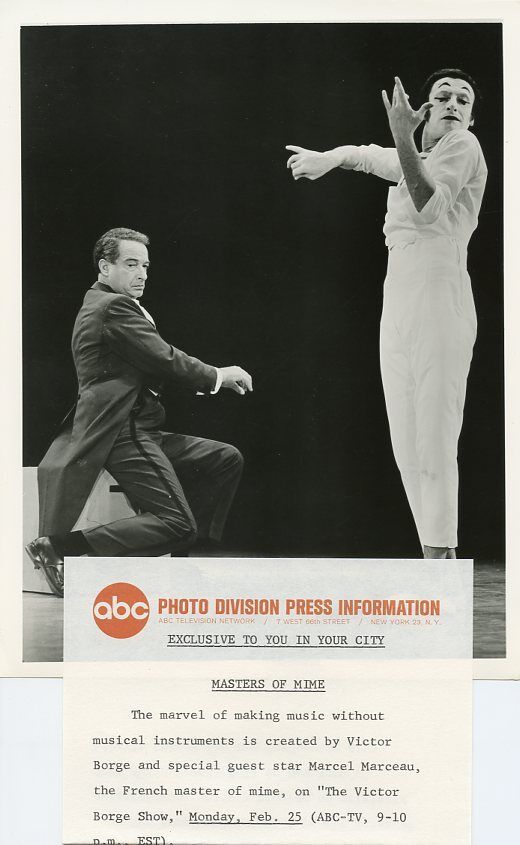
    PHOTOS: Marceau with Victor Borge in 1963


  • Beethoven’s Goat Hair DNA Mystery

    by 

    in
    4 responses

    Lest there be any doubt that Beethoven was the GOAT, check out this article in today’s Washington Post.

    “The year before Beethoven died, the wife of a colleague earnestly wanted a lock of his hair, but she became the victim of a prank. Beethoven and his secretary instead sent a coarse snip of a goat’s beard…”

    Makes it kind of awkward when scientists try to sequence your DNA.

    https://www.washingtonpost.com/science/2023/03/22/beethoven-genome-hair/?fbclid=IwAR2p4FXLOMxPc8avXJcVDdbWj8w_dOhiLEWwSpWQlYH-taNcBRe81o3Yrbs

    Incidentally, Ferdinand Hiller, whom the article cites, was more than just a teenager who collected hair, a notable pianist and composer in his own right. I’ve posted about him once or twice myself.


  • Celebrate Bach Support WWFM’s Bach 500

    Celebrate Bach Support WWFM’s Bach 500

    by 

    in
    7 responses

    Once again, the day is upon us – Johann Sebastian Bach’s birthday. WWFM – The Classical Network is heading into the homestretch on its annual “Bach 500.” Every year, it has been the station’s custom to celebrate Bach while amassing 500 listener donations IN ANY AMOUNT. You set the level. Once the 500 is achieved, the fundraising ends and we douse one another with champagne, metaphorically speaking. The bubbly is in the music.

    Please do your part to support classical music in your community and, by way of internet streaming, around the world. It’s contributions from listeners like you that provide a home for shows like “Picture Perfect” and “The Lost Chord.”

    How do you make it happen? It’s easy! Head on over to wwfm.org, and click on “Become a member of our Bach 500,” or follow the link below. Or do it the old-fashioned way and call 1-888-232-1212.

    Less than 250 laps left in this race! Thank you for your support, and go, JSB, go!

    https://wwwfm.secureallegiance.com/wwfm/WebModule/Donate.aspx?P=DEFAULT&PAGETYPE=PLG&CHECK=vOU2bz5JCWmgCDbf53nm9ezWDeZ%2beA1M


Tag Cloud

Aaron Copland (93) Beethoven (95) Composer (114) Film Music (145) Film Score (143) Film Scores (255) Halloween (94) John Williams (195) KWAX (229) Leonard Bernstein (104) Marlboro Music Festival (125) Movie Music (160) Mozart (91) Opera (213) Philadelphia Orchestra (89) Picture Perfect (174) Princeton Symphony Orchestra (109) Radio (88) Ross Amico (244) Roy's Tie-Dye Sci-Fi Corner (290) The Classical Network (101) The Lost Chord (269) Vaughan Williams (105) WPRB (397) WWFM (881)

DON’T MISS A BEAT

Receive a weekly digest every Sunday at noon by signing up here


RECENT POSTS