• NY Phil Concert a Czech Birthday Celebration

    NY Phil Concert a Czech Birthday Celebration

    by 

    in
    4 responses

    Yes, I am emerging from a cold, but I am very much on the mend, and I can’t help it, I bought my ticket in November, so damn it, I am on my way to hear the New York Philharmonic! Also, the weather is supposed to be fairly mild this afternoon, so I will dress sensibly, try not to overdo things, and hope for the best (and of course mask in the hall).

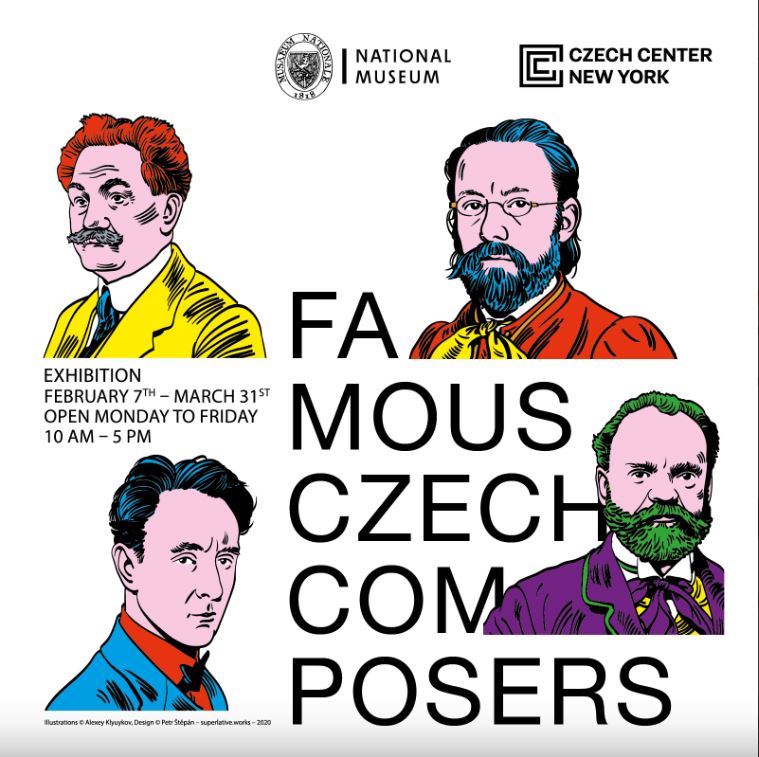
    First, I plan to swing by the Czech Center New York to take in their “Famous Czech Composers” exhibit – devoted to Bedřich Smetana, Antonin Dvořák, Leoš Janáček, and Bohuslav Martinů – which will run through March 31st. It’s only appropriate, since today happens to be Smetana’s birthday! (Total coincidence.) I confess I’ve been going back and forth on it, since I’m not sure that I buy into the exhibit’s apparent “graphic novel” approach, but supposedly there are also costumes from the first New York productions of some of the operas (including Smetana’s “The Bartered Bride”). And who knows what else I’ll see? It was at the Czech Center that I once shook the hand of Dvořák’s grandson!

    https://new-york.czechcentres.cz/en/program/slavni-cesti-skladatele

    Then I’ll grab dinner at some dive before heading over to the newly-renovated David Geffen Hall for a concert with the Philharmonic. The program will include William Grant Still’s Symphony No. 2 “Song of a New Race” – my second-favorite William Grant Still symphony (I’ll be hearing No. 1, the “Afro-American Symphony,” with Neeme Järvi and the New Jersey Symphony, later in the month) – but it is as icing on the cake next to the main attraction: Adolphus Hailstork’s stirring oratorio “Done Made My Vow.”

    I was bowled over by this piece from the first time I heard it as part of a concert broadcast over the radio, back in the 1980s. I finally stumbled across a recording with the Baltimore Symphony Orchestra in 2012. I never dreamed I would ever actually have a chance to hear it live! The work is scored for speaker, vocal soloists, and orchestra. Among tonight’s guest artists is Simon Estes, whose birthday it also is today. Estes having recently retired from opera, I am guessing he will be the narrator. The concert will be repeated on Saturday at 8 p.m.

    https://nyphil.org/concerts-tickets/2223/the-march-to-liberation?gclid=Cj0KCQiA6fafBhC1ARIsAIJjL8m7u-is9f2iViziNoKiBf9epbPytxuTSQJkgh82NT70zRBHByNyFbQaAqwiEALw_wcB&gclsrc=aw.ds

    With luck, I will be back in bed, reading the Kalevala, by 11:30.

    Happy birthday, Smetana and Simon Estes!


  • The Pianist Szpilman Chopin and Survival

    The Pianist Szpilman Chopin and Survival

    by 

    in
    10 responses

    You may recall “The Pianist.” The 2002 film was based on the autobiography of Władysław Szpilman, a Jewish musician who miraculously survived the Nazi occupation of Poland. His family was not so lucky. In 1942, they were deported to Treblinka. Szpilman was saved only by a friend in the Jewish Ghetto Police, who recognized him and pulled him out of line as his family boarded the train.

    Two years later, Szpilman was hiding in an abandoned house when he was discovered by a German officer. To his surprise, the officer did not harm him or have him arrested. Rather, after learning that he was a musician, he asked Szpilman play him something on the piano. Szpilman played the Nocturne in C-sharp minor by Frederic Chopin. The officer listened and afterward helped him to find a better hiding place and smuggled him food.

    If you haven’t seen the film, there’s a lot more to it than that. At the bottom of this post, you’ll find footage of the man upon whose life it was based. Adrien Brody played Szpilman in the movie, which was directed by Roman Polanski, who also lost family in the Holocaust. Both Brody and Polanski were recognized with Academy Awards.

    Ironically, Chopin, for all his gifts, was anti-Semitic – which, it should be acknowledged, was not uncommon for his time and place. (He also disliked Russians and “Huns.”) Chopin regarded himself an aristocrat, a descendant of Polish nobility and a superior soul, with plenty of grievances across the board.

    How fortunate for him that Jewish musicians have done so much down the years in looking past his shortcomings to celebrate his genius.

    We don’t know for sure when Chopin was born, but it is commonly held that it was on this date in 1810. After all, Chopin and his mom said so. However, his baptismal certificate, filled out on April 23, gives his natal day as February 22. The Chopin Society UK, in defiance of the composer and his family, is inclined to agree.

    Władysław Szpilman died in the year 2000 at the age of 88. He plays Chopin at the link.

    https://www.youtube.com/watch?v=n9oQEa-d5rU


  • Welsh Music for St. David’s Day Harp Concerto

    Welsh Music for St. David’s Day Harp Concerto

    by 

    in
    5 responses

    I’m sitting here thinking I could really use some William Mathias Harp Concerto. This webcast of “The Lost Chord” from a few years back is the very thing. Mathias’ concerto is the centerpiece of an hour of Welsh music. March 1st, St. David’s Day, has been celebrated in Wales since the Middle Ages. I honor the country’s patron saint with a playlist also featuring Grace Williams’ “Penillion” and John Thomas’ work for solo harp “Megan’s Daughter.” You’ll also hear Bryn Terfel sing a Welsh song with his former school mate, tenor John Eifion.

    There’s a giant leek in the fridge. Yes, you heard that correctly, and no, it’s not broken. Listen to “And God Created Great Wales” here:

    https://www.wwfm.org/webcasts/2020-02-27/the-lost-chord-march-1-and-god-created-great-wales

    Dydd Gŵyl Dewi Hapus!


  • Kalevala Day Finnish Epic & Culture

    Kalevala Day Finnish Epic & Culture

    by 

    in
    3 responses

    It’s Kalevala Day!

    Frequently referred to as “the Finnish national epic,” the Kalevala, a disparate collection of long narrative poems set down from oral tradition in the early 19th century, tells of the creation of the Earth, the loves, antagonisms, and retaliations of its peoples, and the forging, theft, and attempted recovery of a mysterious talisman called the Sampo. Its fantastic and heroic tales informed the work of Finland’s greatest artists at a time when the country began its surge toward independence, after 700 years of Swedish rule, and another century as a duchy of the Russian Empire.

    The Kalevala was instrumental in promoting a sense of Finnish national identity. Swedish had been the tongue of the country’s administration and education from time immemorial. Then Tsar Nicholas II attempted to instate Russian as the official language. The Kalevala became a lightning rod for Finnish nationalists. Cresting patriotic fervor led Finland to declare independence on the heels of the Russian Revolution in 1917.

    The Kalevala resonated in Finland to an extent it may be difficult for foreigners to comprehend. It has inspired holidays, the naming of cities and companies devoted to banking, insurance, jewelry, asphalting, icebreaking, and dairy, and innumerable paintings, books, and pieces of music.

    Finland celebrates its own separate Independence Day, on December 6, as it trumpets its freedom from the Russian Empire, but Kalevala Day, also known as Finnish Culture Day, is equally a time of deep national pride.

    Fun fact: In the United States, a community founded by Finnish immigrants in Michigan is called Kalevala, and many of its street names are drawn from the epic. Better known is the fact that the poet Henry Wadsworth Longfellow was inspired by a German translation of the Kalevala in the crafting of his own “The Song of Hiawatha.”

    The composer Jean Sibelius, fiercely patriotic, was Kalevala-crazy. A significant portion of his output was influenced by this fount of Finnish lore – “Four Legends from the Kalevala,” “Kullervo,” “Pohjola’s Daughter,” “Tapiola,” “The Origin of Fire,” and “Kyllikki,” to name a few. Some of the symphonic poems had their roots in a projected opera, “The Building of the Boat,” which was never completed.

    I’ve done several radio shows, over the years, programmed around themes from the Kalevala. This one, “Epic Finnish,” last aired on Sunday, on “The Lost Chord,” on WWFM – The Classical Network.

    https://www.wwfm.org/show/the-lost-chord-with-ross-amico/2023-02-24/the-lost-chord-february-26-epic-finnish

    The playlist includes “Aino” by Sibelius champion Robert Kajanus, the “Kalevala Suite” by Uuno Klami, and a Sibelius rarity, “A Song for Lemminkäinen.”

    I am also appending, as a bonus, Leonard Bernstein and the New York Philharmonic with Sibelius’ “Pohjola’s Daughter.” I’m a little mixed on Bernstein’s recordings of the symphonies, but here I think he really excels. The performance is a wonder. Steadfast old Väinämöinen, the wizard, attempts to woo the Daughter of the North, whom he espies seated atop a rainbow, weaving a cloth of gold. She agrees to marry him only if he is able to complete a series of impossible tasks. (My favorite is tying an egg into invisible knots!) Unfortunately, Väinämöinen, always unlucky in love, wounds himself grievously with an axe while attempting to construct a boat from fragments of her distaff.

    Also, quite simply, one of my favorite Sibelius recordings of all time: Eugene Ormandy conducts the Philadelphia Orchestra in “Four Legends from the Kalevala.” Its four movements are meant to evoke the swashbuckling Lemminkäinen and his adventures among the maidens of Saari; the Swan of Tuonela gliding through the realm of the dead; the resurrection of Lemminkäinen, treacherously slain; and finally, Lemminkäinen’s homeward journey.

    Here’s a live performance, with the Turku Philharmonic (a Finnish orchestra) conducted by Leif Segerstam

    The message to would-be occupiers: don’t start what you can’t Finnish! Happy Kalevala Day!


    “The Defense of the Sampo” (1896), by Akseli Gallén-Kallela. Väinämöinen the wizard faces off against the evil witch Louhi


  • John Williams Not Done Scoring Films

    John Williams Not Done Scoring Films

    by 

    in
    3 responses

    John Williams said “Indiana Jones and the Dial of Destiny” would be his final film project. He lied.

    Recording of his latest score was completed on February 10. He says it’s at least an hour and a half of new music.

    Entre nous: Williams is still taking offers.

    In the meantime, the 91-year-old composer will be at work on a piano concerto for Emanuel Ax.

    Some good anecdotes in this Variety article, involving Jacob Krachmalnick (Philadelphia Orchestra concertmaster from 1951-58) and Judd Hirsch (Academy Award nominee for Steven Spielberg’s “The Fabelmans”).

    https://variety.com/2023/artisans/news/indiana-jones-5-john-williams-score-1235534772/?fbclid=IwAR1Ywz6AUs00XYTx9AUGXHC5T-6B8eAFjPJQnkMxhV6_NRlUfPkGKQxtGkc


Tag Cloud

Aaron Copland (93) Beethoven (95) Composer (114) Film Music (145) Film Score (143) Film Scores (255) Halloween (94) John Williams (195) KWAX (229) Leonard Bernstein (104) Marlboro Music Festival (125) Movie Music (160) Mozart (91) Opera (213) Philadelphia Orchestra (89) Picture Perfect (174) Princeton Symphony Orchestra (109) Radio (88) Ross Amico (244) Roy's Tie-Dye Sci-Fi Corner (290) The Classical Network (101) The Lost Chord (269) Vaughan Williams (105) WPRB (397) WWFM (881)

DON’T MISS A BEAT

Receive a weekly digest every Sunday at noon by signing up here


RECENT POSTS