• Boito’s Devilish “Mefistofele”

    Boito’s Devilish “Mefistofele”

    by 

    in
    4 responses

    Richard Strauss’ final opera, “Capriccio,” is an extended, if lighthearted debate on the relative merits of words and music. But for Arrigo Boito, the two never really came into conflict.

    As one of the great librettists, Boito provided the texts for Verdi’s late masterpieces, “Otello” and “Falstaff.” He also worked up a revision of “Simon Boccanegra” and – under the anagram Tobia Gorrio – provided the libretto for Ponchielli’s “La Gioconda.” That should be enough to guarantee his place in music history, right?

    But Boito himself was also a composer of merit, if not a prolific one. Although he destroyed his first opera, “Ero e Leandro,” and his last, “Nerone,” was left incomplete at the time of his death (to be finished by Arturo Toscanini and Vincenzo Tommasini), he totally nailed it with “Mefistofele.”

    There may be those who look down their noses at Boito’s take on Goethe’s “Faust,” yet the work stubbornly clings to the outskirts of the standard repertoire. Audiences love it. For me it is much more entertaining than anything in Verdi (I know, them’s fightin’ words), and I personally find the melodic invention much richer than that in the more popular version by master melodist Charles Gounod.

    Sure, as narrative it’s a little clunky – it’s as if Boito presents the story as a series of tableaux that are just kind of stitched together – and the most hair-raising set piece, the prologue in Heaven, comes right at the beginning. How could it not be all downhill from there? But the composer has the good sense to bring it all back at the end.

    What the opera really demands is a strong personality at its core, someone who, through his magnetic stage presence and sheer force of will, can tow the circus parade of wonders, wagon after wagon, before our astonished eyes and ears.

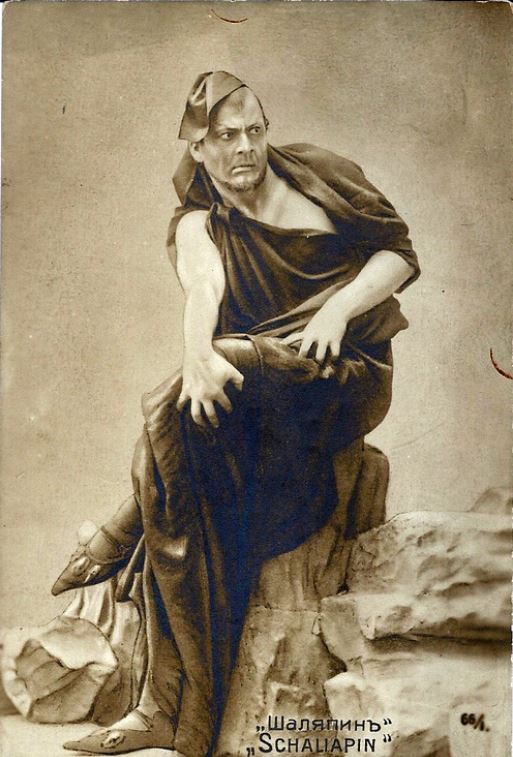
    Feodor Chaliapin, by all accounts, was just such a force. He gained wide notoriety in the title role, for his earthy interpretation and his insistence on playing it half-naked.

    In the recent past, Samuel Ramey owned the piece. He too preferred to show a fair amount of skin (though less than Chaliapin) – but really, couldn’t that be said for just about any of Ramey’s roles?

    Here’s the stunning – and cheeky – Robert Carson production first presented by San Francisco Opera in 1989, which I belatedly caught up with in New York, unfortunately after Ramey retired. The first 26 minutes will knock your socks off.

    Chaliapin in 1927

    https://www.youtube.com/watch?v=uVfjMHOeOVA

    Happy birthday, Arrigo Boito (1842-1918). Whether in words or in music, you gave the devil his due!


    DEVILED HAMS: Feodor Chaliapin (left) and Samuel Ramey


  • Laryngitis & Leonard Nimoy Sci-Fi Chat

    Laryngitis & Leonard Nimoy Sci-Fi Chat

    by 

    in
    One response

    For the second time in the past few weeks, I’ve had some kind of throat ailment. It starts out as a sore throat a couple of mornings, and then it never really develops into anything. Just a dry cough, periodically, and even that’s not consistent.

    After last Friday’s Roy’s Tie-Dye Sci-Fi Corner, I woke up Saturday with laryngitis, and every day since I have risked going raspy. In the mornings, I could be the next basso superstar. Great while singing in the shower, maybe, but hardly worth the dry throat the rest of the day.

    It’s fortunate, then, that Roy will have a special one-on-one this evening with Bonnie Moss, who will recall her special friendship with actor Leonard Nimoy. I’ll take the rest of the weekend to recuperate and we’ll reconvene on Sunday to flash our teeth in a conversation about the first of the “Alien” sequels – James Cameron’s “Aliens” (1986).

    Until then, I leave you in Roy’s very capable hands (undoubtedly giving the Vulcan salute). Share your extraterrestrial observations in the comments section when they – and then we – livestream on Facebook, YouTube, etc., this Friday and Sunday evenings at 7:30 EST!

    https://www.facebook.com/roystiedyescificorner


  • Lewis Spratlan Pulitzer Winner Dies at 82

    Lewis Spratlan Pulitzer Winner Dies at 82

    by 

    in
    7 responses

    If you’re going to throw your hat into the operatic arena, you’d better have the stomach for a long fight.

    Composer Lewis Spratlan was the recipient of the 2000 Pulitzer Prize for Music for a concert version of Act II of his three-act opera “Life Is a Dream.” Spratlan had actually composed the work between 1975 and 1978, on a commission from New Haven Opera. But while he was at work on the piece, New Haven Opera ceased to exist. It wasn’t until 2000 that Act II was first heard at Amherst College (where Spratlan taught) and then Harvard University. The complete opera would be heard at Santa Fe Opera for the first time only in 2010.

    Spratlan composed a second opera, “Earthrise” for San Francisco Opera. His third, “Architect,” a chamber opera about Louis I. Kahn, was released on Navona Records in 2013. There’s also a fourth opera, “Midi,” which transplants the Medea story to the French Caribbean.

    A recipient of a number of fellowships from Guggenheim, Rockefeller, Bogliasco, NEA, Massachusetts Cultural Council, and MacDowell, among others, Spratlan also produced significant orchestral, chamber, choral, and instrumental works.

    He is remembered by his students for his empathy and his generosity. Not one to impose his own aesthetic values, he allowed his pupils to develop their own compositional voices, but on a firm musical foundation, always with a consideration of structure and technique and an historical awareness of what came before.

    Spratlan died on February 9. He was 82 years-old. R.I.P.


    Spratlan on “Life Is a Dream”

    “Invasion,” his response to the war in Ukraine

    “Bangladesh”

    “When Crows Gather”

    Characteristically fine album from Boston Modern Orchestra Project (BMOP)

    “Vespers Cantata: Hesperus is Phosphorus,” a truly lovely work composed for The Crossing and Network for New Music

    In conversation with Frank J. Oteri

    Lewis Spratlan: Beyond the Pulitzer Prize

    His obituary on legacy.com

    https://www.legacy.com/us/obituaries/gazettenet/name/lewis-spratlan-obituary?id=47635861&fbclid=IwAR2jJxhKwGGcRhXXgYMf6BtJ1vHxKmMLZeznIT-QVFoEoPPPp-3Wxtz23N8


  • Handel: The Great Bear of Music

    Handel: The Great Bear of Music

    by 

    in
    3 responses

    With enormous appetites to rival his formidable musicianship, a larger-than-life reputation, and an eccentric, much remarked-upon manner of walking, George Frideric Handel was affectionately nicknamed “The Great Bear.”

    Handel is fondly remembered for his “Water Music” and “Music for the Royal Fireworks,” his epic oratorios, his florid operas, and his copious concertos and chamber music.

    Though by many accounts a kind-hearted man with a good sense of humor, he was also prone to an explosive, bear-like temper. I imagine this would have gone unnoted during the several years he spent in Italy, but in England people tended to take heed.

    Music historian Charles Burney recalled Handel berating a chorister during rehearsals for “Messiah.” “… Handel let loose his great bear upon him; and after swearing in four or five languages, cried out in broken English….”

    During rehearsals for the opera “Ottone,” he once grabbed the soprano Francesca Cuzzoni and threatened to toss her out a window. Cuzzoni, looking to make the best impression with her London debut, had roused “the Bear” by pressing him for a replacement aria, the better to showcase her unique talents.

    But Cuzzoni could give as good as she got. During a Handel production of Giovanni Bononcini’s opera “Astianatte,” she and her costar, Faustina Bordoni, flew at one another in a fury and began tearing at their costumes. They had to be dragged off stage.

    Some years earlier, as a young man of 19, Handel was filling in as conductor at the premiere of Johann Mattheson’s opera “Cleopatra.” Mattheson also sang the tenor role of Antony, so while he was on stage, Handel was to sit at the harpsichord and keep order among the musicians.

    Trouble arose when Mattheson returned to the orchestra and Handel refused to cede his place. A power struggle ensued, as Mattheson sought to regain control, but Handel insisted on continuing to conduct. The performance was interrupted when Mattheson suggested the two take the quarrel outside. Swords were drawn, and one of Mattheson’s thrusts glanced off a button near Handel’s heart. This had the effect of dousing the combatants with cold water, and the two reconciled to become lifelong friends.

    It wasn’t all claws and teeth, to be sure. Ursine Handel could also be a bit of a teddy bear, and a generous one. One of his more enduring works, “Messiah” – penned in a mere 24 days – was given its first performance in Dublin, on April 13, 1742, as a charitable event. It benefited two hospitals and liberated 142 men from debtor’s prison.

    Eight years later, Handel revived the work at London’s Foundling Hospital, a recently-instituted home for abandoned infants and children. He had already donated an organ to the hospital’s chapel, and the year before, recycled the “Hallelujah Chorus” as part of his “Foundling Hospital Anthem.” Again, Handel’s oratorio raised a ton of money. The charitable presentation became an annual event, with the composer returning every year for the rest of his life. Handel’s relationship to the institution was cemented with an honorary title. After his death, he left the rights to the oratorio to the hospital.

    When Handel finally did die, blind but rich, in 1759, at the age of 74, his funeral was attended by 3,000 people. He never married, but filled his hours with composing – leaving 30 oratorios and 50 operas – and of course living the good life, with plenty of beer and food. He was interred at Westminster Abbey, a very great honor indeed.

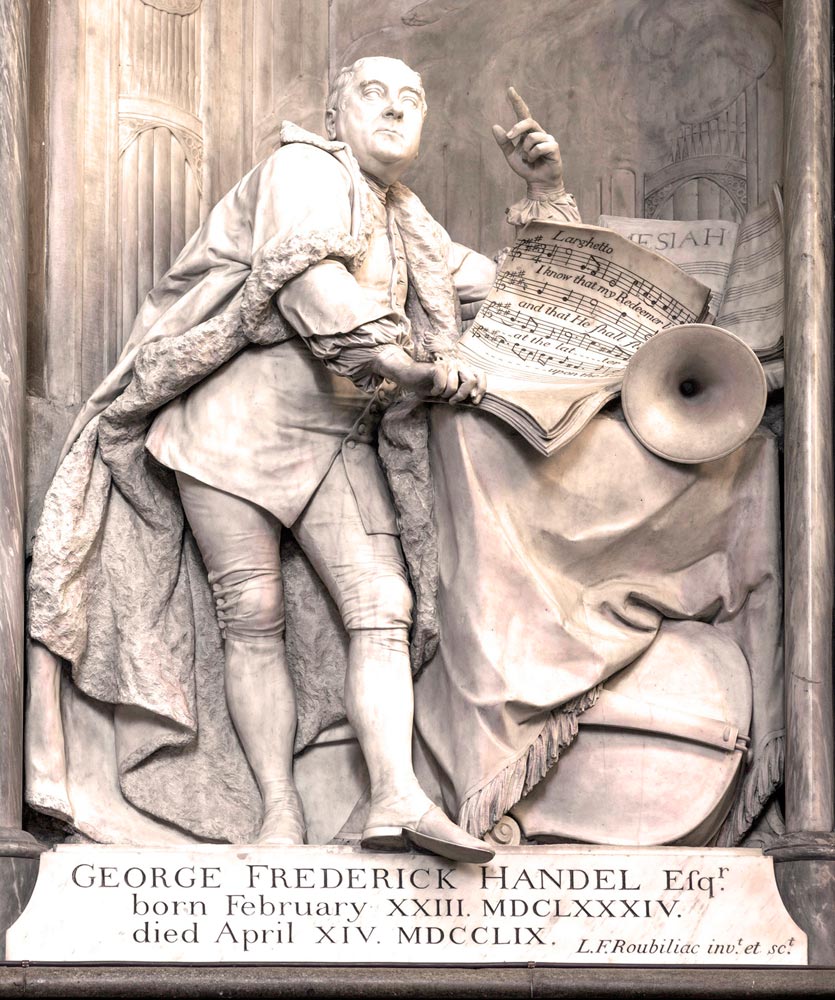
    Above his grave, there is a monument, a sculpture of Handel in the act of composing his cash cow, the oratorio “Messiah.” The bear may now be in hibernation, but every Christmas – and sometimes Lent – his music lives on.

    Happy birthday, Handel!


    CLOCKWISE FROM LEFT: Handel memorial at Westminster Abbey; unkind caricature of the composer as a fat boar (Joseph Goupy, “The Charming Brute,” 1743); Handel threatens to throw Francesca Cuzzoni out a window (Peter Jackson, “When They Were Young: Handel the Musician,” 1966); Handel crosses swords with Johann Mathesson (Andrew Howat, “Strange Tales,” 1977)


  • Birds in Music From Mozart to Eighth Blackbird

    Birds in Music From Mozart to Eighth Blackbird

    by 

    in
    3 responses

    This one goes out to all the red-winged blackbirds, grackles, starlings, and cowbirds that have been swarming my feeders for the past week.

    Jennifer Higdon’s “On a Wire,” named for the familiar sight of birds, well, hanging out on a wire, was composed for the contemporary music sextet eighth blackbird (which markets itself all in the lower-case). Interestingly the piano part includes passages that have adjacent musicians bow the strings inside the instrument. The technique is called (wait for it) “bowed piano.” You can identify the members of eighth blackbird by their instruments: flute, clarinet, piano, percussion, violin, and cello.

    eighth blackbird is named for Wallace Stevens’ “Thirteen Ways of Looking at a Blackbird,” a poem that’s been set by many composers. Lukas Foss’ response is one of the more frequently encountered.

    Starlings aren’t always an annoyance. Wolfgang Amadeus Mozart was so charmed by one during a visit to a Viennese pet shop that he brought him home to his family. From the evidence of one of the composer’s diary entries, we know that a theme used in his Piano Concerto No. 17 was inspired by a song that his fine feathered friend had sung to him. Admittedly, Mozart tidied it up a bit first. (Originally, there had been an out-of-place G-sharp.)

    I understand that everyone needs to eat, and I don’t begrudge a handful of any of these birds, but when it becomes a winged mob in leather jackets with chains, then I’m compelled to throw up the sash and trumpet through an old wrapping-paper tube.

    Gentle birds, be reasonable! Eat well, but then, please – go in peace!

    More about Mozart’s starling here

    https://interlude.hk/mozart-inspired-pet-starling/

    BONUS: From “Where’s Charley?” “My darling, my darling, I’ve fluttered and fled like a starling…”


Tag Cloud

Aaron Copland (93) Beethoven (95) Composer (114) Film Music (145) Film Score (143) Film Scores (255) Halloween (94) John Williams (195) KWAX (229) Leonard Bernstein (104) Marlboro Music Festival (125) Movie Music (160) Mozart (91) Opera (213) Philadelphia Orchestra (89) Picture Perfect (174) Princeton Symphony Orchestra (109) Radio (88) Ross Amico (244) Roy's Tie-Dye Sci-Fi Corner (290) The Classical Network (101) The Lost Chord (269) Vaughan Williams (105) WPRB (397) WWFM (881)

DON’T MISS A BEAT

Receive a weekly digest every Sunday at noon by signing up here


RECENT POSTS