• Fat Tuesday King Cake & Mardi Gras Music

    Fat Tuesday King Cake & Mardi Gras Music

    by 

    in
    6 responses

    Fat Tuesday! Just returned from my morning quest to secure a King Cake. Two bakeries sold-out, but the third time’s a charm. Also, this one actually has the little plastic baby inside, which I was warned at the register is a choking hazard. Bring it! If you’re going to observe tradition, you ought to be able to do it with authenticity!

    It’s all doughnuts, alcohol, and orgies today, as tomorrow the streets will be strewn with bottles and bodies for the start of Lent.

    In the meantime, indulge in a Classic Ross Amico Carnival/Mardis Gras playlist (which I’ll likely add to throughout the day).

    Laissez les bons temps rouler!


    “Mardi Gras” by Edward Joseph Collins

    Erich Wolfgang Korngold, Prelude and Carnival from “Violanta”

    Niccolò Paganini, “Variations on ‘Carnival of Venice’”

    Sviatoslav Richter plays Robert Schumann, “Faschingsschwank aus Wien” (“Carnival Jest from Vienna”)

    Nelson Freire plays Heitor Villa-Lobos, “Mômoprecóce” (“Carnival of the Brazilian Children”). Hold your nose through the BBC intro.

    Luiz Bonfá, “Manhã de Carnaval” on a Yamaha Silent Guitar

    Igor Stravinsky, “Petrouchka,” set during at a Shrovetide fair

    Creole composer Edmond Dédé, “Méphisto masque” (with kazoo choir)

    Charles Lucièn Lambert, “Bresiliana”

    Hershy Kay, “Cakewalk,” after Louis Moreau Gottschalk

    “Carnevale Veneziano: The Comic Faces of Giovanni Croce”

  • Presidents Day and the Oxford Comma Debate

    Presidents Day and the Oxford Comma Debate

    by 

    in
    One response

    It’s Presidents Day, so schools are closed. Even so, one should try to learn something, or at any rate, do a little thinking every day. In between practicing my arithmetic on the back of a coal shovel and hurling silver dollars across the Potomac (for physical fitness), I pause to contemplate the Oxford comma.

    Anyone who’s ever noted my exasperating fondness for punctuation of all sorts would assume that I’d be fallow ground for the Oxford comma. But the truth is it’s only been within the past couple of years that I actually started to use it, if not consistently.

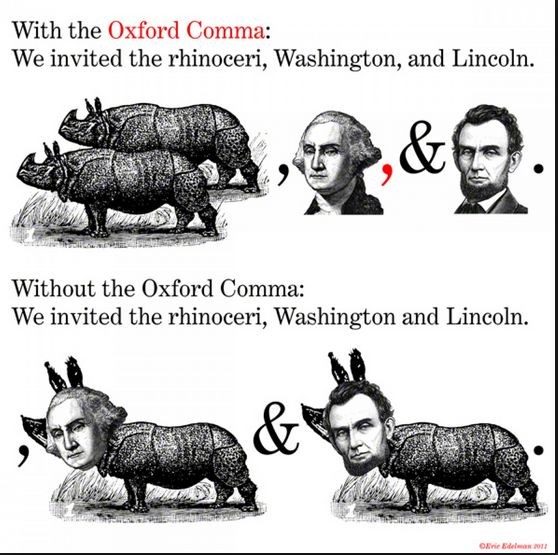
    If you have no idea what I’m talking about the “Oxford comma,” also referred to as the “serial comma,” is the comma you will sometimes encounter after the second item in a series of three (for example, “Manny, Moe, and Jack,” as opposed to “Manny, Moe and Jack”).

    To me, the insertion of an Oxford comma can wind up making the page look a little cluttered. It also creates an extra, annoying caesura in my head, interrupting the flow of a sentence. It does, however, to some extent, cut down on ambiguity. Of course, in some instances, it can also create ambiguity, as in “my father, Margaret Thatcher, and a plucked chicken.” Is my father indeed Margaret Thatcher?

    But, I think you’ll agree, the risk is negligible alongside “the rhinoceri, Washington and Lincoln.”

    Expressing myself in writing has always been as intuitive as it has been dictated by any formal guidelines. It’s as much about the “sound” of the words and the flow of a sentence, and how everything looks on the page, as it is about being absolutely correct.

    Which is why I don’t mind the occasional sentence fragment, the insertion of a dash where it feels appropriate – or two around what could very easily be a parenthetical phrase (as here) – if the curved brackets seem to be a little much.

    Fun fact: the serial comma is often called the Oxford comma because it is the standard promulgated by Oxford University Press and, by extension, the Oxford Style Manual. It’s been a while since I’ve been in school, but in American English it seems as if we can either take it or leave it.

    Wasn’t the whole reason the Founding Fathers wanted to toss out the British to begin with because of their confounded, pedantic Oxford commas?

    Friends, I think enough time has passed that we can now, in good conscience, distinguish my father from Margaret Thatcher and a plucked chicken.

    Happy Presidents Day!


  • Remembering Jimmy Carter a President of Integrity

    by 

    in
    5 responses

    On Presidents Day, my thoughts are with this man. Jimmy Carter entered hospice yesterday at the age of 98. It’s the rare person for whom the presidency would NOT wind up being the defining role of his life. Regardless of one’s personal politics, they shouldn’t color the fact that this guy always knew how to walk the walk.


  • Sibelius Symphony No 6 A Century of Enigmatic Beauty

    Sibelius Symphony No 6 A Century of Enigmatic Beauty

    by 

    in
    6 responses

    Jean Sibelius’ Symphony No. 6 was performed for the first time, in Helsinki under the composer’s baton, on this date 100 years ago. Kile Smith shares his thoughts on this gorgeous, enigmatic work (as might describe much of Sibelius’ greatest music), on this month’s “Fleisher Discoveries.”

    Sibelius noted that the symphony always reminded him of the first scent of snow. He also penned the descriptive phrase “When shadows lengthen.” It’s funny, I don’t find the work at all gloomy, but then I’ve always disliked the sun.

    The Symphony No. 6 is rarely encountered in U.S. concert halls. I think in my 40 years of attending orchestral concerts, I have heard it only once, on the same program with the equally underperformed Symphony No. 3 (with Osmo Vänskä, unsurprisingly, guest conducting in Philadelphia).

    Sibelius remarked, “Whereas most other modern composers are engaged in manufacturing cocktails of every hue and description, I offer the public cold spring water.” This from a man who knew a thing or two about libations! Listen to Sibelius’ Symphony No. 6, with Kile’s commentary, at the link.

    Fleisher Discoveries: Sibelius the Revolutionary


    PHOTO: Sibelius monument “Passio Musicae” (1967), located in Helsinki, by Elia Hiltunen


  • Adolphus Hailstork & “Done Made My Vow”

    Adolphus Hailstork & “Done Made My Vow”

    by 

    in
    3 responses

    I’ve been a fan of Adolphus Hailstork since the 1980s. That’s when I first heard “Done Made My Vow,” as part of a concert broadcast over the radio.

    “Done Made My Vow” (1985), often described as a gospel oratorio, was inspired in part by speeches of Martin Luther King, Jr. So uplifting was the marriage of words and music, I hoped for years that it would be recorded. Then one day I stumbled across a copy in the Baltimore Symphony Orchestra gift shop.

    This Sunday night on “The Lost Chord,” I hope you’ll join me for this extraordinary piece, scored for speaker, chorus and orchestra.

    Hailstork has been part of the fabric of American music since at least the 1970s. Born in Rochester, New York, in 1941, he earned his BA from Howard University, his MA from the Manhattan School of Music – where his teachers included Vittorio Giannini and David Diamond – and his doctorate from Michigan State, where his studied with H. Owen Reed. Then he was off, like so many of his great American forebears, to study at Fontainebleau with Nadia Boulanger.

    For many years, Hailstork was composer-in-residence at Old Dominion University in Norfolk, Virginia, where he taught. He is perhaps best known for his choral music, though it was the wistful slow movement of his Symphony No. 1, composed for a summer music festival in Ocean Grove, New Jersey, that next caught my ear.

    His brief but boisterous curtain-raiser “Celebration!” was included in Paul Freeman’s legendary “Black Composers Series,” recorded for Columbia Records back in the 1970s. Freeman remained a champion of Hailstork’s work for the rest of his career. I particularly recommend his recording of “Sonata da Chiesa,” a multi-movement work for string orchestra, inspired by Hailstork’s impressions as a boy chorister singing at the Cathedral of All Saints in Albany.

    As preamble to the oratorio, we’ll also enjoy Hailstork’s rhythmically exciting “Variations for Trumpet” (1981).

    The music is hale, but the sentiments are King. I hope you’ll join me for “Done Made My Vow,” on “All Hail Hailstork,” this Sunday night at 10:00 EST, on WWFM – The Classical Network and wwfm.

    AND, if you are as swept away by it as I was, you might be interested to know that the New York Philharmonic will be performing it on the same series of concerts with William Grant Still’s Symphony No. 2 “Song of a New Race,” March 2-4!


    Hailstork’s “Sonata da Chiesa” (1992)

    Symphony No. 1 (1988): Mov’t II, Lento ma non troppo

    “Motherless Child” (2002)

    “Celebration!” (1974)


Tag Cloud

Aaron Copland (93) Beethoven (95) Composer (114) Film Music (145) Film Score (143) Film Scores (255) Halloween (94) John Williams (195) KWAX (229) Leonard Bernstein (104) Marlboro Music Festival (125) Movie Music (160) Mozart (91) Opera (213) Philadelphia Orchestra (89) Picture Perfect (174) Princeton Symphony Orchestra (109) Radio (88) Ross Amico (244) Roy's Tie-Dye Sci-Fi Corner (290) The Classical Network (101) The Lost Chord (269) Vaughan Williams (105) WPRB (397) WWFM (881)

DON’T MISS A BEAT

Receive a weekly digest every Sunday at noon by signing up here


RECENT POSTS