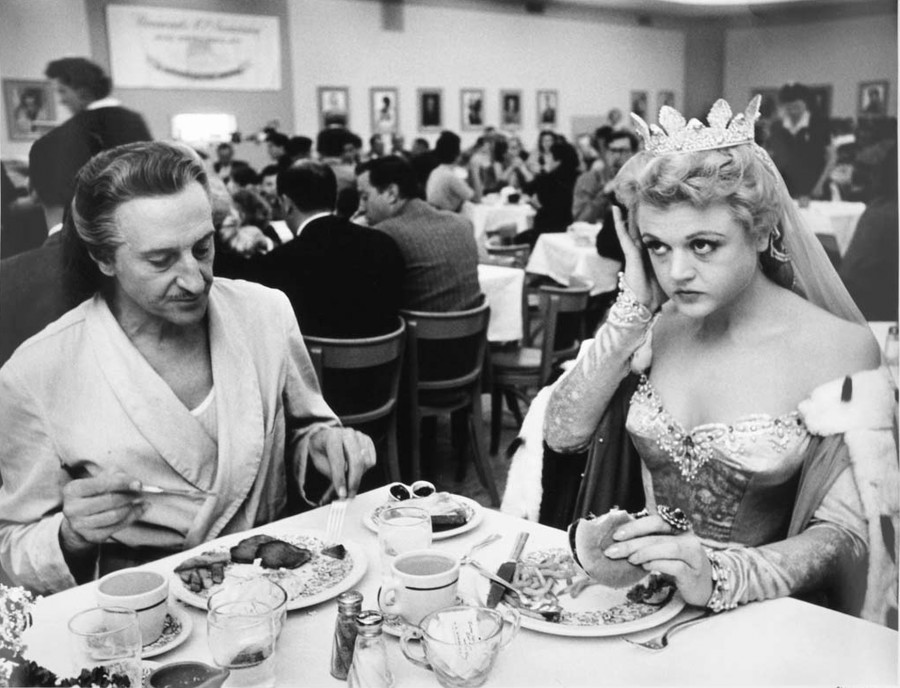
From “Gaslight” to “Mary Poppins Returns.” From “The Manchurian Candidate” to “Mame.” From Mrs. Lovett to Mrs. Potts. Angela Lansbury was a stalwart of stage and screen for over 70 years. The winner of seven Tony Awards. Nominated for three Oscars and a record 18 Emmys. She left quite a legacy. Who would have thought at the time she started “Murder, She Wrote” that she was only at mid-career. Lansbury died earlier today, five days shy of her 97th birthday. I always loved this photo of her having lunch with Basil Rathbone, during the making of “The Court Jester” with Danny Kaye. R.I.P.
-
Angela Lansbury A Legend Remembered
by
-
Vaughan Williams’ Wasps Premiere: Unassuming Start
by
5 responses
How unassuming was the premiere of Ralph Vaughan Williams’ incidental music for “The Wasps?”
Aristophanes’ comedy, a stinging commentary on the Athenian judicial system, was produced as the Cambridge Greek Play at Trinity College in 1909. The play itself was performed in Greek, with translations sold to the audience. As you can see, when you click through the gallery of photos at the link at the bottom of this post, the composer’s credit is buried midway down the third page of the printed program (as “R. Vaughan Williams”). The music is offered for sale, “price three shillings.”
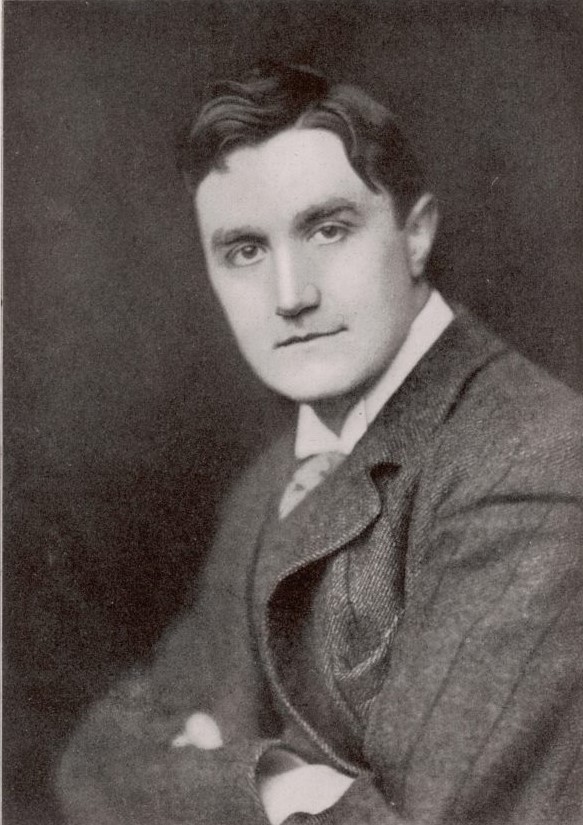
The year before, Vaughan Williams spent three months in Paris studying with Maurice Ravel, who was at first reluctant to take him on as a pupil. But RVW wouldn’t take no for an answer. Despite his earthy disposition (his response to Ravel’s assignment to write a minuet in the manner of Mozart was met with an unprintable response), Vaughan Williams quickly earned his teacher’s admiration and soon his friendship. Ravel later remarked that Vaughan Williams was “the only one of my pupils who does not write my music.” RVW, already in his mid-30s and three years older than his teacher, learned his lessons well (at least the ones he considered valid), assimilated what he found useful, and applied it to the achievement of his own objectives.
Ravel’s influence is most evident in the transitional moments of “The Wasps Overture” and in its dreamy central section. The opening, of course, is a musical joke, self-evident from the onomatopoeic buzzing around the orchestra, but the middle introduces one of those immediately endearing, big-hearted English melodies. The jolly, rollicking theme in the outer portions of the overture sounds equally homegrown.
Vaughan Williams’ complete incidental music runs to approximately 1 hour and 45 minutes. It was recorded for the first time, with English narration, in 2006. The overture has been a concert favorite since its introduction. Vaughan Williams himself recorded the jauntiest version on record, back in 1925, at a manic 7 minutes and 25 seconds. An average performance of the work is more in the ballpark of 9-10 minutes.
You’d think that more American orchestras would have taken it up as a guaranteed crowd-pleaser to open concerts during this RVW sesquicentennial year. But U.S. music directors and administrators – “The Lark Ascending” and the “Fantasia on a Theme by Thomas Tallis” aside – remain largely immune to the charms and allure, and certainly the versatility, of Ralph Vaughan Williams. For the composer’s enthusiasts, it’s a good year to live in the U.K.
“Gentlemen who are willing to be tried for the chorus are requested to state whether their voices are tenor or bass.” Stills from the 1909 Cambridge production.
https://www.cambridgegreekplay.com/plays/1909/wasps
The overture opens this 26-minute concert suite, which also includes the equally charming “March Past of the Kitchen Utensils” (at the 13-minute mark).
Vaughan Williams and Ravel
-
Milhaud & Honegger’s Controversial Columbus Finds
by
5 responses
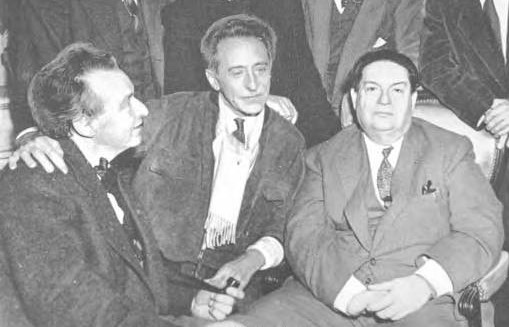
I know Christopher Columbus is anathema these days, but I can’t help but buy music inspired by him whenever I can find it on the cheap. Pictured are two recordings I acquired recently from Princeton Record Exchange. Both works are by members of Les Six, that loose collective of composers, brought together by Jean Cocteau, that flourished in Paris in the late ‘teens and 1920s.
The Milhaud is the more idiomatic and musically satisfying of the two, with an all-French cast, captured at the Théâtre des Champs-Élysées. The conductor is Manuel Rosenthal, a composer himself (and a Ravel pupil), best known for his arrangements of Offenbach for the ballet “Gaîté Parisienne.” Unfortunately, the sound is also idiomatic – which is to say, mid-1950s French, complete with tinny cymbal crashes and fillings-rattling climaxes. It‘s a live performance, as opposed to a studio recording.
The Honegger is a recorded premiere, a recreation of a radio drama in state-of-the-art digital sound. However, it’s delivered by actors in a manner and acoustic that suggest a theatrical performance. (It was actually recorded in a church.) Furthermore, the dialogue is in English.
Toward the beginning, someone shows up just long enough to do their best John Cleese-style impression of a Frenchman. Puzzlingly, for the remainder of the performance, all the Italian and Spanish parts are spoken in unaccented English. Well, unaccented in Italian and Spanish, anyway. The principals are all divided as to whether they should emulate English stage-speak or American high school drama club. Columbus himself sounds like a good approximation of 1940s Warner Bros.’ supercilious screen-villain Henry Daniell.
I wish the release had included as a bonus an isolated presentation of the music, without the spoken dialogue, since, unlike the historic Columbus, the actors are in imminent peril of dropping off a flat earth into the chasm of parody. The first few minutes, when it’s just the narrator, before the actual dramatization begins, is especially agonizing.
Be that as it may, I’m pleased to be able to add them both to my collection of Columbiana. There’s a surprising amount of it, composed by the likes of Leonardo Balada, Gaetano Donizetti, Manuel de Falla, Alberto Franchetti, Philip Glass, Victor Herbert, Richard Wagner, William Walton, and Kurt Weill, among others.
Fingers crossed that I can still get away with posting about it on Columbus Day, if only because of my Italian surname.
Selections from Rosenthal’s 1956 recording of Milhaud’s “Christophe Colomb” (1930)
A staging of the complete opera in a 1993 production
Arthur Honegger’s radio play “Christophe Colomb” (1940)
PHOTO: Honegger and Milhaud, flanking mentor Jean Cocteau
-
Verdi’s Aida Birthday and a Hater’s Refund

by
8 responses
Today is the birthday of Giuseppe Verdi – Italian for “Joe Green.”
One of his most famous works, of course, is that grandest of grand operas, “Aida.” Its first staging in Cairo in 1871 included a dozen pachyderms and fifteen camels into the bargain. A dramatic spectacle of star-crossed love in Ancient Egypt, it created a sensation among the opening night audience of dignitaries, politicians, and critics.
Verdi himself did not attend the premiere and disliked the fact that the performance was not open to the general public. He was much happier when it was presented for the Italian people on his native soil.
Of course, anyone who’s ever dealt with the public understands that no success is unalloyed.
One day Verdi received a letter, by way of his publisher, from a dissatisfied customer by the name of Prospero Bertani. Bertani had traveled to Parma to attend a production of “Aida” in 1872.
Bertani confided to the composer, “I admired the scenery… I listened with pleasure to the excellent singers, and took pains to let nothing escape me. After it was over, I asked myself whether I was satisfied. The answer was ‘no’.”
In fact, he disliked “Aida” so much, he felt compelled to sit through it a second time, just to make sure he wasn’t missing something.
The letter continues, “The opera contains absolutely nothing thrilling or electrifying. If it were not for the magnificent scenery, the audience would not sit through it.”
Bertani went on to include the cost of admission, travel expenses, and the price of his meals, and demanded a full refund from the composer.
This amused Verdi. After a moment’s reflection, he instructed his publisher to reimburse Bertani, but not to pay for his meals. Verdi responded, “…To pay for his dinner too? No! He could very well have eaten at home!”
Happy birthday, Mean Joe Green.
No elephants in this “Aida,” but certainly plenty of spectacle
-
Vaughan Williams Rare Recordings
by
3 responses
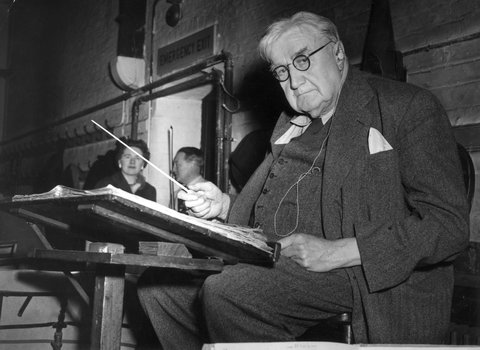
Unlike Sir Edward Elgar, who was given the opportunity to record most of his major output, Ralph Vaughan Williams was generally overlooked as a conductor by the major labels – which is a shame, because the few recordings he did make are superb.
This Sunday night on “The Lost Chord,” we’ll anticipate the 150th anniversary of the birth of one of England’s finest composers (October 12, 1872) by way of three rare recordings he made of his own music.
Among the acoustical documents, none match the hilarity of RVW’s 1925 performance of “The Wasps” overture. Vaughan Williams’ recording is by far the fastest – and jauntiest – “Wasps” on record, although I’m unsure whether it is due to the composer’s own preference, or because of the limitations of the technology. It’s hard not to smile at such manic high spirits.
By contrast, his 1937 recording of the Symphony No. 4 is a masterpiece of temperament and ferocity – all the more jarring in that the turbulence evoked in the work is not at all what most people associate with this composer. The urgency of the music is captured, eerily, at a time when the ink was still fresh on the page and the world was on the brink of chaos. It certainly belies the snide dismissal of much of the composer’s output as languid “cow-pat” music.
In all, Vaughan Willliams’ meager commercial discography as a conductor wouldn’t even fill two hours. It is most fortunate, then, that a few concert recordings have emerged over the years. We’ll conclude with of one of RVW’s loveliest pieces, the “Serenade to Music,” a work which, at its first performance, actually brought tears to the eyes of Sergei Rachmaninoff. (On the first half of the concert, Rachmaninoff was soloist in his own Piano Concerto No. 2.) The text is taken from Act V, Scene I, of Shakespeare’s “The Merchant of Venice.”
“How sweet the moonlight sleeps upon this bank!
Here will we sit and let the sounds of music
Creep in our ears: soft stillness and the night,
Become the touches of sweet harmony.”The recorded performance was captured at Royal Festival Hall on November 22, 1951. Vaughan Williams was 79 years old. What’s especially remarkable is that the recording features 11 of the 16 soloists who sang in the work’s 1938 premiere. We’ll hear it from a compact disc issued on Albion Records, the official label of the Ralph Vaughan Williams Society.
Vaughan Williams’ ashes are interred in Westminster Abbey alongside some of the nation’s greatest artists – yet, in some measure, the composer is still underestimated, especially by those outside the British Isles. I hope you’ll join me as we celebrate RVW for his sesquicentenary. That’s “Vaughan, But Not Forgotten,” this Sunday night at 10:00 EDT, on WWFM – The Classical Network and wwfm.org.
Tag Cloud
Aaron Copland (93) Beethoven (95) Composer (114) Film Music (145) Film Score (143) Film Scores (255) Halloween (94) John Williams (195) KWAX (229) Leonard Bernstein (104) Marlboro Music Festival (125) Movie Music (160) Mozart (91) Opera (213) Philadelphia Orchestra (89) Picture Perfect (174) Princeton Symphony Orchestra (109) Radio (88) Ross Amico (244) Roy's Tie-Dye Sci-Fi Corner (290) The Classical Network (101) The Lost Chord (269) Vaughan Williams (105) WPRB (397) WWFM (881)
One response