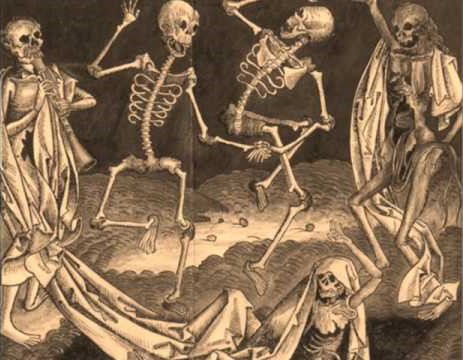
I’m going to be celebrating an awful lot of Vaughan Williams the next few days, but just so as not to completely snub Camille Saint-Saëns on his birthday (today), here’s a seasonal favorite.
“Danse Macabre” was originally conceived as a chanson for voice and piano. The composer made several other arrangements. Most famous is the more fully developed orchestral work, but he also wrote a version for voice and orchestra. Here it is performed by Nelson Eddy, of all people.
Still, it’s better than Nelson’s commercial recording, which is terrifying for all the wrong reasons.
Here’s a translation of the text, by Henri Cazalis:
Zig, zig, zig, Death in cadence
Striking a tomb with his heel
Death at midnight plays a dance-tune
Zig, zig, zag, on his violin
The winter wind blows, and the night is dark;
Moans are heard in the linden trees
White skeletons pass through the gloom
Running and leaping in their shrouds
Zig, zig, zig, each one is frisking
You can hear the cracking of the bones of the dancers
A lustful couple sits on the moss
So as to taste long lost delights
Zig zig, zig, Death continues
The unending scraping on his instrument
A veil has fallen! The dancer is naked
Her partner grasps her amorously
The lady, it’s said, is a marchioness or baroness
And her green gallant, a poor cartwright
Horror! Look how she gives herself to him
Like the rustic was a baron
Zig, zig, zig. What a saraband!
They all hold hands and dance in circles
Zig, zig, zag. You can see in the crowd
The king dancing among the peasants
But hist! All of a sudden, they leave the dance
They push forward, they fly; the cock has crowed
Oh what a beautiful night for the poor world!
Long live death and equality!
Happy birthday – and happy Halloween – Saint-Saëns!
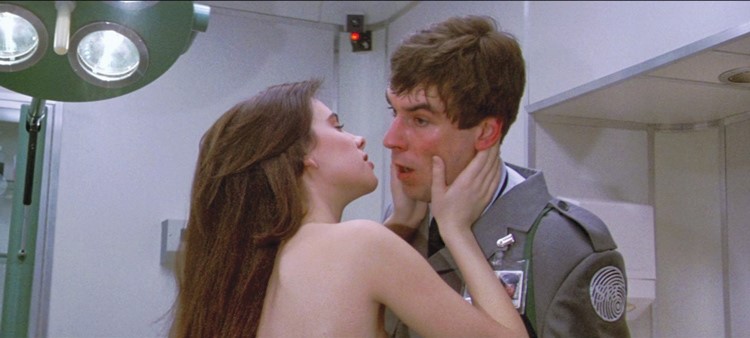
Full-frontal vampires from outer space? This is an existential threat that needs to be encountered head-on! And Roy and I are just the guys to do it. Our blather about “Lifeforce” (1985) has been posted here:
Is there anything creepier than creepy kids? Especially when they turn out to be the spawn of Satan? Next week, Halloween month continues with a Revelatory conversation about Richard Donner’s diabolical hit “The Omen” (1976).
Join us in a chorus of “Ave Satani” in the comments section – this is Jerry Goldsmith’s only Oscar-winning score – as we count to 666 on the next Roy’s Tie-Dye Sci-Fi Corner, when we livestream on Facebook, next Friday evening at 7:30 EDT!
It’s a Vaughan Williams weekend, as we anticipate the sesquicentennial of the composer’s birth on October 12, 1872!
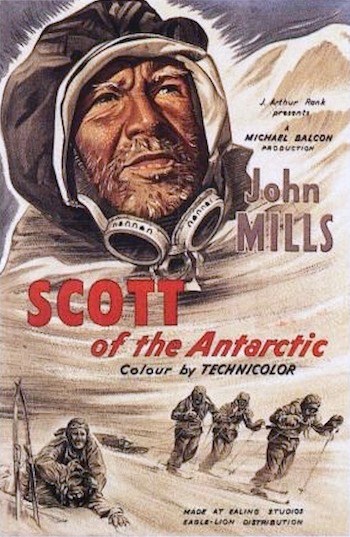
First, “Scott of the Antarctic” (1948) anchors an hour of music from movies about explorers and exploration on “Picture Perfect.”
John Mills plays explorer Robert Falcon Scott on his determined push to the reach the South Pole in this Ealing Studios docudrama.
Vaughan Williams’ classic score became the basis for his Symphony No. 7, which he called “Sinfonia Antartica.” (Note the Italian spelling; the composer dropped the first “c” from the title of his symphony, dooming the work to incessant misspelling.) We’ll hear selections from an extended suite from the film score, from the first of three CDs issued on the Chandos label that, collectively, offer an overview of Vaughan Williams’ work for the cinema.
The balance of the hour will be devoted to music from films about Christopher Columbus, Marco Polo, and Meriwether Lewis & William Clark.
Yeah, okay, so conquest is so not “in” right now. Nevertheless, as Monday is Columbus Day, we’ll hear a suite from “Christopher Columbus” (1949), a Gainsborough Pictures release. Fredric March plays the title role, in a film inspired by a novel of Rafael Sabatini (author of “Scaramouche” and “The Sea Hawk”).
The music is by Arthur Bliss, who in 1950 would receive his knighthood and, in 1953, his appointment as Master of the Queen’s Music.
If you think March a strange choice to play Columbus, just imagine Gary Cooper in “The Adventures of Marco Polo” (1938). Cooper assumes the role of the famed Venetian merchant who travels the Silk Road to China. Despite the ludicrous casting, the film yet manages to entertain, with Basil Rathbone, fine as always, as the villain.
The music is by Hugo Friedhofer. Friedhofer was such a successful orchestrator, he remained largely in the shadows of the film score luminaries he assisted. He lent his distinctive touch to many now-classic scores by Max Steiner and Erich Wolfgang Korngold. “The Adventures of Marco Polo” was Freidhofer’s first big chance to step up and show what he could do as a composer. He would have to wait until 1942 for another. It wasn’t until 1946 that he won a much-deserved Academy Award for his score to “The Best Years of Our Lives.”
The westward journey of Meriwether Lewis and William Clark has been a source of perpetual fascination for Americans. In 1997, Ken Burns directed a PBS documentary “Lewis and Clark: The Journey of the Corps of Discovery.” National Geographic climbed on board a few years later with “Lewis and Clark: Great Journey West” (2002). The 42-minute featurette was released in IMAX theaters, with narration by Jeff Bridges and music by Sam Cardon.
Corn and tomatoes from the New World! Spaghetti and fireworks from the Orient! Snow cones and frostbite from the Antarctic! Discover explorers and exploration this week, on “Picture Perfect,” music for the movies, this Saturday evening at 6:00 EDT, on WWFM – The Classical Network and wwfm.org.
Then tune in on Sunday night at 10:00 EDT, for more Vaughan Williams on “The Lost Chord,” as the composer conducts his own music in three rare recordings. I’ll post more about that tomorrow.
We’re gearing up for 150 years of RVW, on the silver screen and in the concert hall. Happy birthday, Ralph Vaughan Williams!
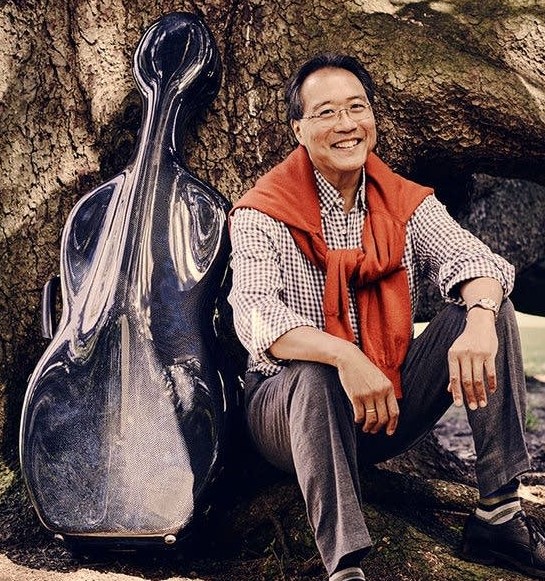
The years, they do fly by. How could Yo-Yo Ma be 67? It seems only yesterday we were celebrating his 60th birthday.
Arguably the most visible and charismatic cellist of his generation, Ma was born on October 7, 1955. He’s recorded more than 90 albums and been recognized with 19 Grammy Awards. In addition, among innumerable other honors, he has been the recipient of the National Medal of the Arts and the Presidential Medal of Freedom. As recently as 2020, he was included in Time Magazine’s “100 Most Influential People.”
Ma began playing cello at the age of 4. That’s when he “put away childish things” – that is to say, a juvenile pursuit of the violin, viola, and piano! At 5, he began performing in public, and at 7, played for Presidents Dwight D. Eisenhower and John F. Kennedy. At 8, he was introduced to American television audiences courtesy of Leonard Bernstein. The next year, Isaac Stern brought him along to “The Tonight Show with Johnny Carson.”
This was all before Ma attended Juilliard, where he studied with Leonard Rose. He dropped out of Columbia – only to attend Harvard. He spent four summers at the Marlboro Music Festival, where he played under the direction of legendary cellist and conductor Pablo Casals. He’s been friends with Emanuel Ax, a regular chamber music partner, since their student days.
Ma has long been acclaimed for his interpretations of the Bach Cello Suites, chamber music by Beethoven and Brahms, and most of the major concertos for cello and orchestra. However, his first commercial recording, believe it or not, was of the Cello Concerto by English composer Gerald Finzi. Ma recorded the piece while in his early 20s, with the Royal Philharmonic Orchestra conducted by Vernon Handley.
Later, having conquered the classical concert hall and established his mastery of the standard repertoire, Ma proved increasingly restless and exploratory, with forays into Baroque music on period instruments, American bluegrass, Argentinean tango, improvisatory duets with Bobby McFerrin, and several musical journeys along the Silk Road.
He’s also been active in film, contributing to the soundtracks of “Seven Years in Tibet” and “Memoirs of a Geisha” for John Williams and “Crouching Tiger, Hidden Dragon” (the recipient of an Academy Award for Best Original Score) for Tan Dun. And of course his album of arrangements of Ennio Morricone themes sold faster than a tray full of cannoli.
Ma’s friendship with Williams also yielded a cello concerto, which they first recorded together in 1994. My most recent Ma acquisition is his recording of the concerto in its revised version, released earlier this year on Sony Classical, and of course it’s wonderful. However, the earlier release has an alluring bonus in Williams’ “Elegy,” reworked from material originally conceived for “Seven Years in Tibet” – six transporting minutes of unalloyed loveliness.
Ma is one of classical music’s last media celebrities, whether introducing kids to the cello on PBS’ “Arthur,” “Sesame Street,” or “Mr. Rogers’ Neighborhood,” or playing Bach in support of dancer Misty Copeland and sitting in with the band on “The Late Show with Stephen Colbert.”
I’ve been privileged to see him in concert several times. His love for music is such that it is not unusual for him to return after intermission, following a star turn in a big concerto, to modestly sit with the rest of the cello section and play in a symphony on the second half.
All in all, I suspect he’s a really good guy. Happy birthday, and thanks for everything, Yo-Yo Ma!
John Williams’ “Elegy”
On Colbert with Misty Copeland
At the age of 7, presented by Leonard Bernstein
“Crouching Tiger, Hidden Dragon”
Ma with saxophonist Joshua Redman, playing “Crazy Bus” on “Arthur”
What do you get when you team the director of “The Texas Chainsaw Massacre” with the writer of “Alien,” the special effects supervisor of “Star Wars,” and the composer of “The Pink Panther?”
Why, an apocalyptic science fiction horror movie about naked French vampires from outer space, of course!
Expect no less from The Cannon Group, which, in the 1980s, under the guidance of the stunningly prolific Menahem Golan and Yoram Globus, kept our cinemas supplied with a steady stream of low-budget candidates for some of worst movies ever made.
Oddly, “Lifeforce” (1985) actually had a respectable budget, a creative team with an impressive track record (“Poltergeist,” released two years earlier, was the biggest hit of director Tobe Hooper’s career), and Mathilda May in all her glory, more special than any special effect in the entire movie.
Yes, I saw it in the theater. Which means 30-foot-high naked French vampires from space!
For all May’s considerable charms, “Lifeforce” turned out to be a draining experience – less from harrowing suspense, unfortunately, than from numbing ennui. But returning to the film now, nearly 40 years later, I find more appreciation of its goofy retro vibe. It’s the kind of film that, 60 or 70 years ago, would have had Bernard Quatermass staving off extraterrestrial threats to humanity.
One miscalculation was in changing the film’s original title from “The Space Vampires,” the name of Colin Wilson’s novel, upon which it was based. It would only have lent to the pulpy tone and perhaps prepared audiences for a nostalgic mélange of B-movie exploitation.
As it was, a would-be blockbuster that should have had everything going for it, “Lifeforce” was a box-office flop. Who knew the world wasn’t ready for naked French vampires from outer space?
All will be revealed when Roy and I unveil the secrets of “Lifeforce,” on the next Roy’s Tie-Dye Sci-Fi Corner. Leave your bald assessments in the comments section, when we livestream on Facebook, this Friday evening at 7:30 EDT!

5 responses