February 22. Washington’s birthday. Not the contemporary holiday (a.k.a. Presidents Day), mind you, but the actual anniversary of his birth.
Anybody else a fan of “Holiday Inn” (1942), with Bing Crosby and Fred Astaire? Irving Berlin astounds with a dozen songs constructed on holidays from the American calendar. Some have earned their immortality (“White Christmas” and “Easter Parade”). Others are completely forgettable. The song celebrating Washington’s Birthday falls soundly into the latter category – which, I argue, only makes it all the more enjoyable.
I find “Holiday Inn” vastly superior to its remake-of-sorts, “White Christmas” (1954), which pairs Crosby with Danny Kaye. Unfortunately Berlin’s celebration of Lincoln’s Birthday as a jaw-dropping black face number hasn’t aged particularly well. (At one point, Bing actually interjects, “Who dat?”) This number, more than anything, is probably what damns “Holiday Inn” to comparative obscurity – except for “White Christmas,” anyway – which is a shame, because the movie is very entertaining. These days, the segment is edited out of most television airings of the film, with the exception of those broadcast on TCM, which doesn’t attempt to whitewash history.
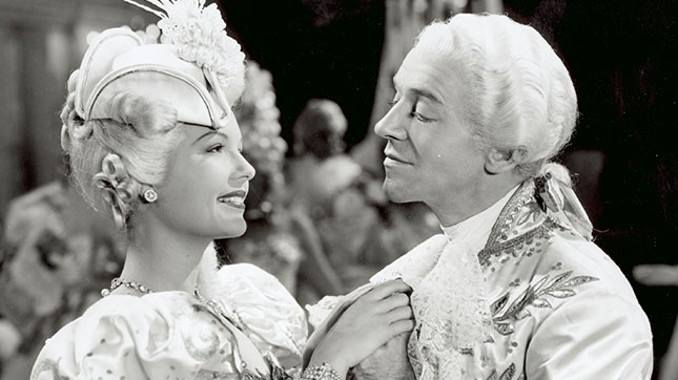
Washington’s Birthday is represented by “I Can’t Tell a Lie.” The number features Bing in a disheveled powdered wig, attempting to undermine Astaire, his rival in love, with a schizophrenic musical accompaniment that ping-pongs wildly (in the film) between 18th century minuet and 1940s big band.
Get a load of Berlin’s excruciatingly contrived lyrics. They can’t all be “White Christmas,” you know.
https://www.youtube.com/watch?v=Bxh52CY7EsU
-
Irving Berlin and Fred Astaire Contort on Washington’s Birthday
by
-
Samuel Coleridge-Taylor on “The Lost Chord”

by
One response
Afro-British composer Samuel Coleridge-Taylor (1875-1912) achieved much in his comparatively short life, attracting the attention and advocacy of Sir Charles Villiers Stanford, Sir Edward Elgar, and Sir Malcolm Sargent.
His cantata “Hiawatha’s Wedding Feast” became a cultural phenomenon between the wars. Sargent conducted the piece annually, from 1928 to 1939, in a costumed, semi-ballet version, featuring close to a thousand performers. Unfortunately, this was among the works the composer had sold outright, his heirs thereby missing out on the royalties. By the time of Sargent’s advocacy, the short-lived Coleridge-Taylor had already been dead for 16 years.
This week on “The Lost Chord,” we’ll hear selections from a complete recording of “Scenes from ‘The Song of Hiawatha,’” one of the earliest to feature rising star Bryn Terfel, released on the Argo label back in 1991. We’ll also hear Sargent’s 1932 recording of Coleridge-Taylor’s “Othello Suite.” The hour will conclude with one of the composer’s musical explorations of his African heritage, the “Symphonic Variations on an African Air,” in a performance conducted by Grant Llewellyn, released on Argo in 1993.
I hope you’ll join me for “Taylor-Made,” music of Samuel Coleridge-Taylor, on “The Lost Chord,” now in syndication on KWAX, the radio station of the University of Oregon!
——–
Clip and save the start times for all three of my recorded shows:
PICTURE PERFECT, the movie music show – Friday at 8:00 PM EST/5:00 PM PST
SWEETNESS AND LIGHT, the light music program – Saturday at 11:00 AM EST/8:00 AM PST
THE LOST CHORD, unusual and neglected rep – Saturday at 7:00 PM EST/4:00 PM PST
Stream them, wherever you are, at the link!
https://kwax.uoregon.edu
-
Enjoy Your Coffee Black on “Sweetness and Light”
by
2 responses
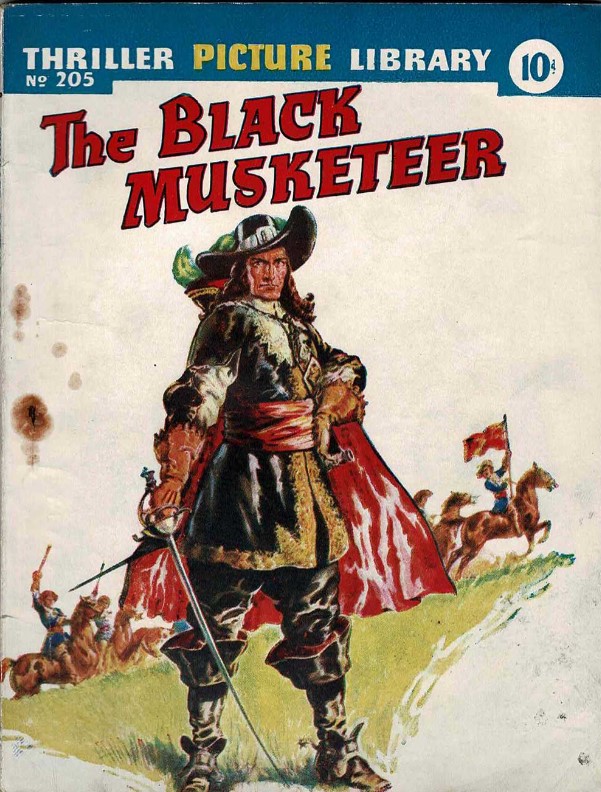
Very little is known about the Chevalier de Meude-Monpas. Among what we DO know is that he was a musketeer in the service of Louis XVI, who went into exile with the onset of the French Revolution. He also studied music in Paris and published six concertos for violin in 1786. In 1997, violinist Rachel Barton (now Rachel Barton Pine) put together a revelatory album for Cedille Records, “Violin Concertos by Black Composers of the 18th and 19th Centuries.” Meude-Monpas’ Violin Concerto No. 4 will be among the featured works this morning on “Sweetness and Light,” cumulatively guaranteed to put a smile on your face.*
Much better known, William Grant Still was regarded in his day as the “Dean of Afro-American Composers.” He the first composer of color to have a symphony performed by a major orchestra, the first to have a symphony widely performed, the first to conduct a major orchestra, and the first to have an opera televised nationally. A pupil of both George Whitefield Chadwick and Edgard Varèse, Still certainly had “serious” credentials, but he also worked in pit bands and wrote arrangements for Hollywood musicals. In many senses, he was the quintessential American composer. Also, he always knew how to write a good tune. This morning we’ll enjoy his “Danzas de Panama,” performed by the Oregon String Quartet.
It took nearly 90 years for Florence Price to become an overnight success. Price was the first African American woman to have a symphony performed by a major orchestra. Her Symphony No. 1 was played by the Chicago Symphony, conducted by Frederick Stock, in 1933. But it’s only fairly recently, after decades of comparative neglect, that her music has finally begun to gain traction. From a 2-disc set devoted to her piano works on the Guild label, we’ll hear Kirsten Johnson play “Dreamboat.”
Duke Ellington requires little introduction. He was a major figure in American music, especially in the field of jazz. But for the past hundred years or so, there has been quite a bit of “blurring of the lines” between genres of art music. In 1943, Ellington composed “New World a-Comin’,” a work for piano and 15-piece band. He never wrote down the piano part, so it was reconstructed by ear by Maurice Peress from a recording made of an Ellington concert at Carnegie Hall in 1943. Subsequently, Peress expanded the jazz band to full orchestra. The soloist on the recording we’ll hear, Jeffrey Biegel, obtained permission from Sir Roland Hanna to transcribe the improvised final cadenza from a recording Hanna made with the American Symphony Orchestra under Peress’ baton.
We’ll be enjoying our coffee black on “Sweetness and Light,” this Saturday morning at 11:00 EST/8:00 PST, exclusively on KWAX Classical Oregon!
Stream it, wherever you are, at the link:
https://kwax.uoregon.edu/
——–
* Please note: Meude-Monpas is not to be confused with that other swashbuckling composer, the Chevalier de Saint-Georges, whose music also appears on Barton Pine’s record.
-
Himalayan Adventures on “Picture Perfect”
by
4 responses
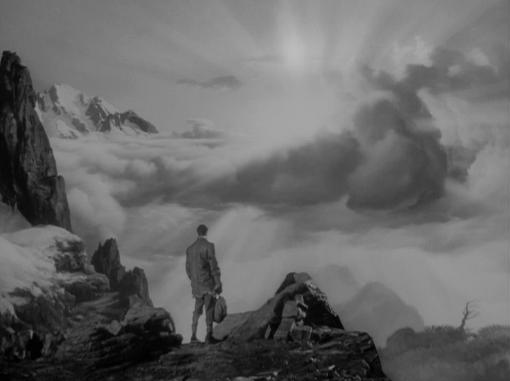
This week on “Picture Perfect,” we journey through the awe-inspiring landscapes of India and Tibet, even as we feel our way to the inner realms of spirit and psyche, with an hour of Himalayan adventures.
The Himalayas, in film, have frequently been the source of enlightenment; though occasionally their overwhelming influence has also led to madness. Intriguingly, the latter is the case in the Powell-Pressburger classic, “Black Narcissus” (1947). Psychological and emotional tensions abound in this tale of repressed nuns struggling to maintain their composure in a voluptuous Himalayan valley.
The stunning cinematography was by Jack Cardiff, and Brian Easdale (of “The Red Shoes” fame) wrote the music. Incredibly, the entire film was shot in England, mostly at Pinewood Studios. From a purely visual standpoint, “Black Narcissus” must be one of the most beautiful films ever made. It’s also one of the craziest, with unlikely object-of-desire Mr. Dean driving the sisters to the brink.
The Himalayas also form the backdrop to “Seven Years in Tibet” (1997), based on a memoir of Austrian mountaineer Heinrich Harrer. Harrer escapes from a British internment camp in India during the Second World War. He travels across Tibet to its capital, Lhasa, where he eventually becomes the tutor of the 14th Dalai Lama. In the film, Brad Pitt plays Harrer. John Williams wrote the music, and Yo-Yo Ma performs the cello solos.
“The Razor’s Edge” (1946) tells the story of a traumatized World War I veteran, who sets off in search of some kind of transcendent meaning to his existence. He finds it in India, at a Himalayan monastery. The 1946 adaptation of W. Somerset Maugham’s novel (which he claimed was thinly-veiled fact) features Tyrone Power, Gene Tierney, and Ann Baxter. The music is by Alfred Newman, who will conduct a selection from his score.
Finally, we’ll hear a suite from the Frank Capra classic, “Lost Horizon” (1937). Based on the book by James Hilton, the film stars Ronald Colman and an outstanding supporting cast, including Jane Wyatt, Thomas Mitchell, Edward Everett Horton, H.B. Warner, and Sam Jaffe. The novel, and the film, brought the term “Shangri-La” into popular usage, a Utopian paradise hidden in a secluded Himalayan valley, a place of ageless beauty and serenity.
“Lost Horizon” provided composer Dimitri Tiomkin (a pupil of Alexander Glazunov) with his first major project. The result is one of his most colorful scores. The recording is one of the gems of RCA’s Classic Film Scores series, originally issued in the early 1970s. Made in the presence of the composer, it features 157 performers, with the chorus standing on a platform behind the conductor, Charles Gerhardt, and the various percussionists stationed in the encircling balcony.
I can’t guarantee that you’ll find enlightenment, but there will be plenty to awe and inspire in these Himalayan adventures, on “Picture Perfect,” music for the movies, now in syndication on KWAX Classical Oregon!
——–
Clip and save the start times for all three of my recorded shows:
PICTURE PERFECT, the movie music show – Friday at 8:00 PM EST/5:00 PM PST
SWEETNESS AND LIGHT, the light music program – Saturday at 11:00 AM EST/8:00 AM PST
THE LOST CHORD, unusual and neglected rep – Saturday at 7:00 PM EST/4:00 PM PST
Stream them, wherever you are, at the link!
https://kwax.uoregon.edu
-
Long Life for Miniaturist György Kurtág
by
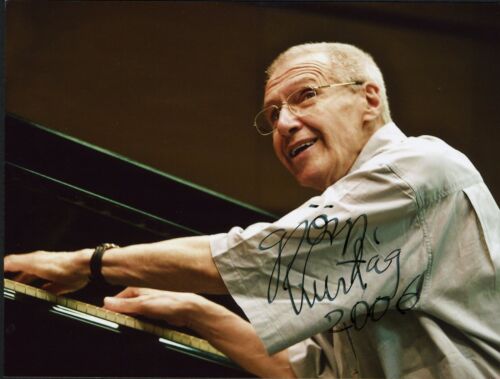
It is fortunate that György Kurtág has been so long-lived, since it wasn’t until his 60s, an age when most people contemplate retirement, that his international reputation really began to take off. But Kurtág was in it for the long haul. The aphoristic Hungarian master, still with us, was born on this date 100 years ago.
Kurtág forged a lifelong friendship with György Ligeti, while studying at Budapest’s Franz Liszt Academy, where he also met the woman who would become his wife. Márta, a pianist, died in 2019 at the age of 92.
Following the Hungarian uprising of 1956, Kurtág spent an extended period in Paris, where he studied with Olivier Messiaen, Darius Milhaud, and Schoenberg pupil Max Deutsch. It was also during this time that he was introduced to the music of Anton Webern and the plays of Samuel Beckett. When Ligeti directed him to a performance of Beckett’s “Endgame,” Kurtág described it as one of the strongest experiences of his life.
He returned to Budapest, where eventually he wound up teaching at his alma mater for 26 years. Gradually, he built a reputation as one of the most respected composers of his time. A meticulous artist, Kurtág’s works are like finely honed miniatures. But these are not pieces for display in the curio cabinet. Rather they are exquisitely crafted microcosms, notable for their poetry and flashes of expressive intensity.
It was surprising that a composer renowned for his work in smaller forms should turn to opera, especially at such a venerable age. Even so, “Fin de partie,” after “Endgame,” was enthusiastically received following its debut at La Scala in 2018.
Sadly, the U.S. premiere, which was to have taken place with the New York Philharmonic in 2021, was cancelled because of Covid. To my knowledge, it has yet to be performed in this country. Hopefully it will be rescheduled soon.
For now, raise a glass of pálinka to György Kurtág on his 100th birthday!
———
Zoltán Kocsis playing Kurtág in recital
https://www.youtube.com/watch?v=KHN58vAf3Y8
Wind Quintet, Op. 2
https://www.youtube.com/watch?v=FIFSR-1Af38
Six Short Pieces for Guitar
https://www.youtube.com/watch?v=9ZseIPZPFro
Interview with Kurtág
https://www.youtube.com/watch?v=F2p_R2m67Ys
“Fin de partie” (click closed caption for English titles)
https://www.youtube.com/watch?v=Bel9Sjfe2MA&t
Kurtág plays Mozart
https://www.youtube.com/watch?v=O5j9I4CauN0
Playing Bach with Márta
https://www.youtube.com/watch?v=Z8lTh58jhA8
Alas, some delectable videos have slipped away since the composer’s 95th birthday, including one of a performance of “Játékok” (“Games”), with Kurtág, Márta, and Kocsis, and another of “Seven Songs for Soprano and Cimbalom,” with Barbara Hannigan.
Tag Cloud
Aaron Copland (93) Beethoven (95) Composer (114) Film Music (144) Film Score (143) Film Scores (255) Halloween (94) John Williams (195) KWAX (229) Leonard Bernstein (104) Marlboro Music Festival (125) Movie Music (159) Mozart (91) Opera (212) Philadelphia Orchestra (89) Picture Perfect (174) Princeton Symphony Orchestra (109) Radio (88) Ross Amico (244) Roy's Tie-Dye Sci-Fi Corner (290) The Classical Network (101) The Lost Chord (269) Vaughan Williams (105) WPRB (397) WWFM (881)
4 responses