This week on “Picture Perfect,” we take flight with music from movies about airports and airplanes.
In the original “Airport” (1970), producer Irwin Allen established the prototype for disaster movies of all stripes by placing an all-star, aging cast in spectacular peril. Burt Lancaster! Dean Martin! George Kennedy! Jean Seberg! Jacqueline Bisset! Helen Hayes! The list goes on and on, longer than the longest runway. The bongo-laden theme is by veteran film composer Alfred Newman,” from the last of his over 200 scores.
Another movie with something of the same feel is “The V.I.P.s” (1963), allegedly inspired by the real-life love-triangle of Vivien Leigh, Laurence Olivier, and Peter Finch. The story is set at London Heathrow Airport, where flights are delayed because of a dense fog. The film was written by Terrence Rattigan and the parts cast from another laundry list of stars, including Elizabeth Taylor, Richard Burton, Louis Jourdan, Maggie Smith, Rod Taylor, and Orson Welles, with Margaret Rutherford in an Academy Award-winning performance. The music is by Miklós Rózsa.
By contrast, Steven Spielberg’s “The Terminal” (2004) is an (intentionally) comic take on the predicament of a hapless Eastern European who finds himself in a kind limbo, trapped in an international arrivals terminal in New York, after his country erupts into civil war, so that his passport and other documentation are no longer valid. His plight mirrors that of real-life Mehran Karimi Nasseri, an Iranian who lived for 17 years in a terminal at Charles de Gaulle Airport.
Tom Hanks plays the unfortunate traveler, who makes the terminal his home, and Catherine Zeta-Jones the airline attendant with whom he strikes up a relationship. The music is by regular Spielberg collaborator John Williams (whose 94th birthday it is on Sunday), and I think you’ll find it quite different from the Williams known for his work on “Star Wars” and “Indiana Jones.”
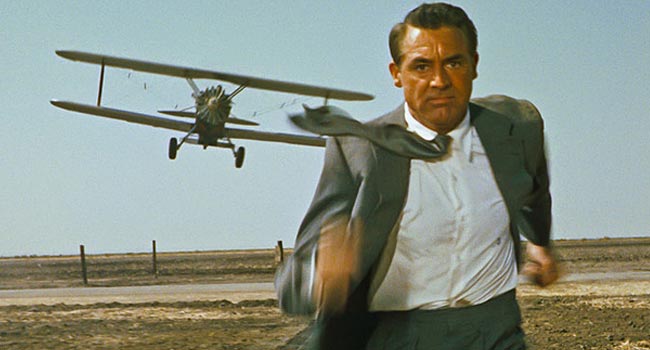
Finally, we’ll turn to the Alfred Hitchcock thriller “North by Northwest” (1959), a film in which Cary Grant encounters love and danger in, on, and from a variety of planes, trains, and automobiles. Planes are particularly significant. During the course of the film, it’s revealed that the title is in reference to a Northwest Airlines flight; Eve Kendall (Eva Marie Saint) must do all she can to avoid getting on a plane with Phillip Vandamm (James Mason); and of course, Roger Thornhill (Grant) flees from a strafing crop duster. Bernard Herrmann’s opening fandango propels us into the adventure.
FUN FACT: The film’s most iconic scene (pictured) is actually played without music.
Rush more to Rushmore! Music propels the action on “Picture Perfect,” music for the movies, now in syndication on KWAX Classical Oregon!
——–
Clip and save the start times for all three of my recorded shows:
PICTURE PERFECT, the movie music show – Friday at 8:00 PM EST/5:00 PM PST
SWEETNESS AND LIGHT, the light music program – Saturday at 11:00 AM EST/8:00 AM PST
THE LOST CHORD, unusual and neglected rep – Saturday at 7:00 PM EST/4:00 PM PST
Stream them, wherever you are, at the link!
https://kwax.uoregon.edu
-
Music Propels the Action on “Picture Perfect”
by
-
The Prodigal Sons Return

by
17 responses
When I was in college, I was a Prokofiev nut. To the point that I would say he was probably my favorite composer. I was astonished by his melodic fecundity, and his language was just modern enough to lend a little tang.
And thanks to my love of film scores, it was comfortingly familiar, as movie composers have made frequent restorative journeys to the Russian master’s well of inspiration to lend some zing to their own compositions. Listen to “The Battle on the Ice” from “Alexander Nevsky,” the March from “The Love for Three Oranges,” and perhaps “The Death of Tybalt” from “Romeo and Juliet,” and you pretty much have yourself a film music Rosetta Stone.
During the period when I was first really getting to know this composer, beyond a childhood familiarity with “Peter and the Wolf,” I snapped up any recording of a Prokofiev piece I didn’t already own. Of course, being a student, this often involved a degree of deferred gratification.
I got around that by getting a job as a record clerk at Sam Goody’s, then (before the arrival of Tower Records) sporting the largest classical music section in Philadelphia. There, I basically signed my paycheck back over to the company, as I acquired (piecemeal) my first cycles of the symphonies of Vaughan Williams (Boult), Shostakovich (Haitink), and Prokofiev (Järvi).
After Prokofiev’s Symphony No. 1 (a.k.a. the “Classical Symphony”), No. 5 is the most popular. No. 6 also makes a great effect in concert. But I also felt an instant affinity with No. 4, which is tied up with Prokofiev’s ballet “The Prodigal Son” (choreographed by Balanchine and performed by the Ballets Russes). Prokofiev took some of the themes and episodes from the dance work and developed them into a symphony. And then he returned to it to revise it. I don’t know that it’s the strongest symphony, necessarily, but I found the music strangely compelling. And it wound up having a transformative effect on my life.
It was my whim in those days, when returning to the ancestral home (not too much a prodigal son myself, I hope) to periodically scan the radio frequencies to check if there were any classical music options I may not have known about. On one such occasion, I happened across a classical music broadcast from Allentown, PA. WMUH, based at Muhlenberg College, as a matter of fact. It was a request show, and the host put out the telephone number, so I called in and asked if I could hear Prokofiev’s Symphony No. 4.
A short while later, she came back on the air and said, “To the person who phoned in and requested the Prokofiev symphony, we don’t have it in the library, but if you want to call back, you can ask for something else.”
So I did. They didn’t have that either.
It was then that I learned that the person I was speaking with was not only the host, she was the classical director, and she said, “Look, you know more about this stuff than I do. How would you like to come in and do a show?” That’s how I fell in with the Lehigh Valley Community Broadcasters Association and came to helm my first broadcast in the summer of 1986. Little did I realize the ramifications it would have on the rest of my life.
It stuns me to consider that I have been doing radio now for 40 years. Professionally, for the past 31. I mean, I’m not that old, am I?
It helps that I got an early start. I was only 19 at the time. And it turned out I had a knack for it. Knowledge and enthusiasm can take you a long way. In my experience, they have spackled over many imperfections.
By now, I have strayed very far from my objective, which is to let you know that the New York Repertory Orchestra will be performing Prokofiev’s Symphony No. 4 this weekend. I’m not sure which version. Does it matter? It’s hardly ever done.
At some point I figured out that the Prokofiev works that communicated most directly were from a certain period of his artistic development. The earlier stuff could be a little more acerbic. Not just for the purposes of tang.
You see, Prokofiev was bit of prodigal son himself, an enfant terrible who drank deeply of the decadent West, before returning to Soviet Russia and all that would entail.
So the program, cleverly conceived by the music director David Leibowitz, works on multiple levels.
You see, you get not only Prokofiev’s “Prodigal Son” symphony, but also, by way of introduction, Claude Debussy’s early Prix de Rome winner, “L’enfant prodigue” (“The Prodigal Son”). When’s the last time you heard THAT?
Debussy originally scored the work for soprano, baritone, tenor, and piano. It was his friend, André Caplet, who provided the orchestration. (Caplet also orchestrated Debussy’s “Clair de lune” and “Children’s Corner,” among others.)
This Saturday at 8:00, both prodigals will be revived in performance by the New York Repertory Orchestra, conducted by Leibowitz, at the Church of St. Mary the Virgin, 145 West 46th Street, between 6th & 7th Avenues. Soloists in the Debussy will include soprano Sarah Cambridge, baritone Kyle Oliver, and tenor Kyle van Schoonhoven.
If you’re not enticed at the prospect, probably nothing will sway you, not even the fact that ADMISSION IS FREE (with a recommended donation of $15).
Seriously? What are you waiting for?
Of course, I’ve got a conflict this weekend (again)… But I vow, one of these days, New York Repertory Orchestra, I am coming for you!
For more information, visit https://www.nyro.org/
Clip of the orchestra rehearsing Prokofiev’s Symphony No. 4
https://www.facebook.com/reel/830354070051178——
PHOTO: Prodigal Prokofiev
-
Woody Allen and Felix Mendelssohn, Enjoyments Out of Season

by
22 responses
Anyone else remember this movie? It was not a runaway hit – in fact box office receipts were poor – but it dates from a time when films like this were still shown at the local theater. It sprang to mind yesterday, as it always does, on Felix Mendelssohn’s birthday.
Woody Allen has always had a good ear for music. In fact, from “Love and Death” (with its wall-to-wall Prokofiev) on, with few exceptions, he’s basically dipped into his own record collection to gussy up the soundtracks of his films. “A Midsummer Night’s Sex Comedy,” unsurprisingly, draws on a lot of Mendelssohn.
Often on composer birthdays, if I have the time and the opportunity, I’ll “celebrate” by pulling some of his or her music from the shelf. Yesterday, since I was in the car for a bit, I had a chance to listen to Mendelssohn’s Cello Sonata No. 2 (with Lynn Harrell and Bruno Canino) and the Piano Concerto 2 (with Rudolf Serkin and the Philadelphia Orchestra, conducted by Eugene Ormandy). The slow movement of the latter is used to evocative effect in Woody’s film. I still think of Woody and Mia in period costume sweetly kissing by a brook whenever I hear it.
The soundtrack also sports needle-drops of the “Scottish” Symphony (for an enchanting wildlife montage), the Violin Concerto (a rampage with a bow and arrow), and, of course, the overture and incidental music to “A Midsummer Night’s Dream” (the scherzo supporting Woody on a flying bicycle!), all brilliantly employed.
The film is set in Upstate New York at the turn of last century. The plot is a farcical one, with love and desire sowing chaos among three couples who meet for a summer getaway in the country. Clearly, Woody draws on his affection for foreign films (especially, but not exclusively, Ingmar Bergman’s “Smiles of a Summer Night”). Our omniscient viewpoint allows us to chuckle at the havoc and heartache. What fools these mortals be!
I remember critics were largely underwhelmed by it, appearing as it did post-“Annie Hall” and “Manhattan,” which resulted in middling reviews. “Stardust Memories” already had everyone feeling a little disoriented. Where were the rapid-fire jokes and slapstick situations of the earlier films?
“A Midsummer Night’s Sex Comedy” is no knee-slapper, but it is consistently entertaining, a little thought provoking (but not too much), and my, is it gorgeous to look at. (The cinematography is by Gordon Willis and the costumes by Santo Loquasto, who hailed from my hometown of Easton, PA.) It also provides the great José Ferrer for once with a role worthy of his talents at a time when he was doing a lot of guest shots on television and films like “Zoltan… Hound of Dracula.”
I was 16 when “A Midsummer Night’s Sex Comedy” was released in 1982, and I loved it. But I loved everything Woody back then, from repeated viewings of the earlier films (“Take the Money and Run,” “Bananas,” and “Sleeper”) on television to every new release. Up through the turn of the 21st century, he was surprisingly consistent, although I would argue that his last “masterpiece” was “Crimes and Misdemeanors” in 1989.
That’s not to say I don’t find at least some enjoyment in some of his later movies, but they often seem to retread the themes he already explored so satisfyingly in better films, and the Woody surrogate – a younger actor clearly imitating Allen – gets old pretty quickly. It requires an enormous suspension of disbelief to accept that 20 year-olds listen to Harry James anymore.
And then there’s the whole drama of his personal life, with its elements of sideshow freakery and tabloid sordidness, that’s colored everything. It’s dispiriting. There was a time when Woody Allen was one of our great American filmmakers. I don’t want to be yanked out of the experience of enjoying “Manhattan” by something that flips the “ick” switch in a way it might not have in 1979.
The heart wants what it wants. And mine wants to continue to be able to enjoy early and middle-period Woody Allen movies.
There were two films I remember watching whenever they turned up on HBO. One was “Excalibur,” and the other was “A Midsummer Night’s Sex Comedy.” A true brawn-and-brains double feature! To know this about me is to gain a window into the kind of truly peculiar teenager I was.
Woody Allen and Felix Mendelssohn, enjoyments out of season. “A Midsummer Night’s Sex Comedy” streams free, with commercials, on Tubi.
https://tubitv.com/movies/306937/a-midsummer-night-s-sex-comedy
-
Felix Mendelssohn: Criminally Underrated?
by
11 responses
I am starting to get just a little bit tired of hearing that if Felix Mendelssohn had never lived, music history would not have turned out any differently. He’s second-rate, he’s sentimental, he’s an academician, blah blah blah. When are these pompous idiots going to open their ears and acknowledge the fact that he was only one of the most influential composers of the 19th century? Especially in Germany, England and America, did any serious musician escape his sway?
Mendelssohn was essentially adopted as England’s national composer. Figures from William Sterndale Bennett through Sir Arthur Sullivan gleefully played in his shadow. In fact, Mendelssohn was the hottest composer in England since Handel. Such a stranglehold did Handel and Mendelssohn have on English concertgoers’ affections that, in Germany, England was mocked as “Das Land ohne Musik” – The Land without Music. The best English composers were all German.
But if the Germans were to be at all honest with themselves, they would have realized that all the best German composers were also followers of Mendelssohn. What about Wagner, you say, surely one of the most progressive composers who ever lived? There’s plenty of Mendelssohn in early Wagner. Ditto for Richard Strauss. As for the “second rank,” the more conservative school, just about everyone emulated Mendelssohn.
Of himself, of course, Mendelssohn was one of the most astonishing of musical prodigies. He composed two of the most enduring masterpieces in the repertoire, the overture to a “Midsummer Night’s Dream” and the Octet for Strings, at 16 and 17 respectively. In terms of maturity and polish, these were certainly on a par with anything written by the teenaged Mozart.
Yes, Mendelssohn was a traditionalist. He structured his music on foundations laid in the past. Even so, he cautiously ventured into the mists of Romanticism. Occasionally, he even subverted expectations, in works like his famous Violin Concerto. Furthermore, he was respectful, if not kind, to everyone, even those of whose music he disapproved.
As a conductor, there’s no question he was one of the most influential musicians in Europe, if not the world. For twelve years, he led the Leipzig Gewandhaus Orchestra, an ensemble full of players who went on to distinction in their own right. He was admired for the precision of his performances. He was also the one who essentially drew up the blueprint for modern orchestras in developing a musical “canon.” He gave important premieres of music by his contemporaries, while also reviving works of Bach, Mozart, and Beethoven.
In particular, he is credited with resuscitating the reputation of Johann Sebastian Bach, not only through his resurrection of the “St. Matthew Passion,” but in overseeing an edition of Bach’s organ works, along with an edition of Handel’s oratorios, both of which were published in England.
So music history would have been quite different if not for Mendelssohn, thank you very much. He may not have been the most seismic of innovators, but there’s something to be said for being a master of one’s craft.
Mendelssohn died in Leipzig, after a series of strokes, at the age of 38. Did he live up to his potential? Who among us is really qualified to judge? How much is one man expected to accomplish, anyway?
No radio station in the world is going to devote a full day to Mendelssohn’s music. Since the death of Victoria, I don’t think Mendelssohn has ever really been fashionable, except perhaps at weddings. But who doesn’t love the overture to “A Midsummer Night’s Dream,” the Octet for Strings, the “Hebrides Overture,” the “Italian” Symphony, or the Violin Concerto in E minor?
Morton Feldman once said, “The people you think are radicals might really be conservative. The people who you think are conservative might really be radical.”
I don’t know that I would ever go so far as to label Mendelssohn a radical, but he most certainly did change the world, and those of us who love music would have been a lot poorer without him.
Happy birthday, Felix Mendelssohn!
———
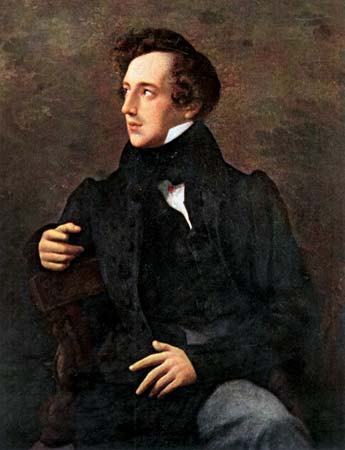
IMAGE: Another view of Mendelssohn
-
If You Can’t Beat ‘Em, Close It

by
16 responses
More territorial wolf urine sprays around Washington, as it was announced Sunday night, via social media, that the Kennedy Center will be shut down for two years for extensive renovations and remodeling. The proclamation comes at a time of escalating artist cancellations and dwindling ticket sales, spurred by the flabbergasting politicization and illegitimate renaming of the performing arts institution. According to the statement, funding is already in place for the upheaval, even though the plan and budget have yet to be authorized by Congress.
The timing is especially precarious for the National Symphony Orchestra, which makes the Kennedy Center its home, falling as it does at a time when orchestras are already in the process of announcing their 2026-27 seasons. Hopefully the organization hasn’t already printed and mailed out its brochures. In the scheme of things, it would actually be the least of its worries, as the NSO is now poised to go down with the ship unless it can find a life raft – alternative performance venues – pronto.
Such an announcement might be regarded as impulsive and reactionary, coming as it does on a Sunday evening on social media. The text is full of serpentine sentences and random capitalizations. It appears following a month of high-profile artist cancellations, including most recently that of Philip Glass, perhaps America’s most-recognized living composer of music in the classical tradition, who elected to withdraw his Symphony No. 15 from its scheduled premiere. The work was inspired by writings of Abraham Lincoln. Glass joins Renée Fleming, Béla Fleck, and Stephen Schwartz, among those who stepped away in recent weeks. Next season, cancellation will no longer be an option, because the center will be closed.
An unfortunate lack of notice for such a major disruption might lead some to question whether the decision was made out of thoughtlessness, at best, or perhaps to save face, or more troublingly, out of retribution or with intent to sabotage. The timing – construction set to begin on July 4th, the 250th anniversary of the founding of our nation – is convenient for no one save those embarrassed by the institution’s recent virtual collapse.
In the meantime, the White House is torn apart, the East Wing demolished (without going through proper channels) to prepare for the construction of a 90,000 square-foot ballroom, the Oval Office is gilded, the Lincoln Bathroom a marbled tomb.
Yet to come: a proposed 250-foot triumphal arch (for a sense of scale, the Capitol building is 288 feet), to be erected at Memorial Circle in Arlington, VA. The structure would overlook the Potomac River at the solemn site of the Arlington Memorial Bridge. The bridge was conceived to symbolically link North and South following the American Civil War. For generations, memorials to Lincoln and Robert E. Lee have been visible from either side of the bridge. Going forward, they may have to communicate like Pyramus and Thisbe, through a chink in the arch.
“I have determined that The Trump Kennedy Center [sic], if temporarily closed for Construction, Revitalization, and Complete Rebuilding, can be, without question, the finest Performing Arts Facility of its kind, anywhere in the World,” the announcement says. (Note random capitalization.) The proclamation fails to mention that the Kennedy Center underwent a $250 million renovation and expansion in 2019.
The John F. Kennedy Center for the Performing Arts opened in 1971. Intended as a living memorial to the fallen U.S. president, for over half a century, the venue has presented countless musical, theatrical, and educational events, to honor Kennedy’s legacy in contributing to a better, more hopeful, and enlightened citizenry, country, and world. The structure encompasses three principal auditoriums – the Concert Hall, the Opera House, and the Eisenhower Theater – and a dozen other performing arts spaces.
This news preempts my annual, apolitical post celebrating the dual birthdays of Jascha Heifetz and Fritz Kreisler. Somebody wake me when we’re great again.
Tag Cloud
Aaron Copland (93) Beethoven (95) Composer (114) Film Music (144) Film Score (143) Film Scores (255) Halloween (94) John Williams (195) KWAX (229) Leonard Bernstein (104) Marlboro Music Festival (125) Movie Music (159) Mozart (91) Opera (212) Philadelphia Orchestra (89) Picture Perfect (174) Princeton Symphony Orchestra (109) Radio (88) Ross Amico (244) Roy's Tie-Dye Sci-Fi Corner (290) The Classical Network (101) The Lost Chord (269) Vaughan Williams (105) WPRB (397) WWFM (881)
One response