It’s funny, when you’re a kid, there’s nothing more exciting than snow. You stay up half the night, waiting for the first flake, and then in the morning you’re out the door making snowballs and building forts until your mom calls you back for lunch (grilled cheese sandwiches and tomato soup), and your gloves are wet and your fingers are frozen and you’re half-blind as you knock the snow out of the wales of your corduroys, and Mom tells you to take off your boots and not get snow on the carpet.
When you’re an adult, you put away childish things, and freak out.
This week on “Sweetness and Light,” we’ll keep calm and carry on, with a program designed to boost your serotonin and minimize your chionophobia (snow anxiety). We’ll welcome what comes with a playlist of snow-inspired works by Ronald Binge, Frederick Delius, Georgy Sviridov, Sergei Prokofiev, Angela Morley, Edward Elgar, Nikolai Rimsky-Korsakov, and Adam Saunders.
Tune in and drop out – in front of the fireplace with a hot beverage of your choice. There’s no music like snow music, on “Sweetness and Light,” this Saturday morning at 11:00 EST/8:00 PST, exclusively on KWAX Classical Oregon!
Stream it, wherever you are, at the link:
https://kwax.uoregon.edu/
———
IMAGE: Princeton’s own Patrick McDonnell tells it like it is
-
Let It Snow on “Sweetness and Light”

by
-
Fantastic Adventures in the 18th Century on “Sweetness and Light”

by
7 responses
The Enlightenment isn’t exactly remembered for its flights of fancy. If the odd novel embraced a fantastic tone, it was frequently in the service of satire, an entertaining means to send-up contemporary mores and pursuits or to mock authority figures and good old reliable human frailty. This week on “Picture Perfect,” we’ll explore a few of these fantastic adventures of the 18th century.
“The Surprising Adventures of Baron Munchausen” (1785) pokes fun at one Hieronymus Karl Friedrich, Freiherr von Münchhausen, a German nobleman and veteran of the Russo-Turkish War, whose reputation for telling outrageous tall tales is lampooned by Rudolf Erich Raspe. Raspe, looking to avoid a libel suit, published the work anonymously, with the result that it was commonly believed that the Baron actually dictated the tales himself. Naturally, the real-life Munchausen was upset by the unwanted attention. Thanks to Raspe, his very name came to be associated with feigned illness and pathological lying.
The book has been adapted to film several times, beginning with a silent version by Georges Méliès, all the way back in 1911. We’ll be listening to music from two subsequent adaptations. The first, “Münchhausen” (1943), is undeniably entertaining and exceptionally well-made. However, undermining one’s enjoyment is a sense of unease in the knowledge that the film was a pet project of Joseph Goebbels, who wanted to celebrate the 25th anniversary of the UFA film studio by producing a lavish spectacle worthy to stand toe-to-toe with foreign efforts like “The Wizard of Oz” and “The Thief of Bagdad.”
Considering the source, one would have to look awfully hard to come up with anything resembling Nazi propaganda. The entire exercise comes across as a pastoral escape from the horrors of totalitarianism, total war, and the Final Solution. The elegant music, by Georg Haentzschel, would not be out of place in the concert hall. Haentzschel is regarded as perhaps the last representative of a generation of Middle European light music composers.
More than 40 years later, director Terry Gilliam undertook another production design-driven adaptation that resembles nothing if not a series of Doré illustrations brought to life. Contrary to received wisdom, “The Adventures of Baron Munchausen” (1988) managed to pull in a respectable amount of per-screen capital. The film was a casualty of a management turnover at Columbia Pictures, with the new regime eager to bury the projects of the old. Hence, it was never seen theatrically beyond a very limited release. The score, by Michael Kamen, while in a romantic heroic style, wittily contains abundant allusions to music of the 18th century.
“The Manuscript Found in Saragossa” (1805) is a transitional work, with its ecstatically lurid opening chapter – replete with gypsy storytellers, highwaymen, dueling skeletons, lesbian vampires, and a couple of corpses dangling in a gibbet – dragging the Enlightenment kicking and screaming into the Romantic age. It starts out as a masterpiece of surrealism, by way of Gothic convention, but the spell is eventually broken, sadly, by a large, cold bucket of Enlightenment water, in the form of a perfectly rational explanation at the end. But until then, the author, Jan Potocki, gets an A for effort. The interlocking structure, with stories inside stories inside stories looks ahead to postmodern experiments by writers like Italo Calvino and John Barth, to say nothing of Jorge Luis Borges.
The book was made into an acclaimed Polish film, “The Saragossa Manuscript,” in 1965. Its cult status led to a restoration financed by Jerry Garcia, Martin Scorsese, and Francis Ford Coppola that was released on VHS and DVD in 2001.
Who else could provide the perfect soundtrack to such a hallucinogenic experience but Krzysztof Penderecki? Penderecki intersperses spooky passages with neo-classical and baroque interludes.
Finally, we’ll hear music from one of the many adaptations of Jonathan Swift’s “Gulliver’s Travels” (1726). “The Three Worlds of Gulliver” (1960) simplifies the book’s narrative and dispenses with a great deal of the misanthropic humor in favor of children’s fantasy. You won’t catch Gulliver extinguishing a fire in the Lilliputian Emperor’s palace with his urine in this version. What you will find is a good deal of technical wizardry and a delightful score by Bernard Herrmann.
What, you doubt my veracity? Then surely the music must speak for itself. Join me for fantastic adventures in the 18th century, now in syndication on KWAX Classical Oregon!
——–
Clip and save the start times for all three of my recorded shows:
PICTURE PERFECT, the movie music show – Friday at 8:00 PM EST/5:00 PM PST
SWEETNESS AND LIGHT, the light music program – Saturday at 11:00 AM EST/8:00 AM PST
THE LOST CHORD, unusual and neglected rep – Saturday at 7:00 PM EST/4:00 PM PST
Stream them, wherever you are, at the link!
https://kwax.uoregon.edu
——–
PHOTO: A fancy flight with Baron Munchausen
-
Aural Enjoyment with Aurèle Nicolet

by
One response
The great Swiss flutist Aurèle Nicolet was born 100 years ago today. Nicolet served as principal flute of the Berlin Philharmonic during the 1950s. He was appointed by Wilhelm Furtwängler and remained through the early Karajan years, before striking out to become a renowned soloist and an influential teacher. Composers who dedicated music to him include Toru Takemitsu, Josef Tal, György Ligeti, Aribert Reimann, and Edison Denisov. Among his pupils was the Berlin Philharmonic’s current principal flute, Emmanuel Pahud. Nicolet died in 2016 at the age of 90.
Remember him and put a spring in your step with some C.P.E. Bach.
-
With Washington National Opera Out, I’m In

by
3 responses
When I heard that Washington National Opera would be performing Robert Ward’s “The Crucible” this season, my ears pricked up. Ward’s opera was awarded the Pulitzer Prize for Music in 1962.
At the time of the work’s premiere at New York City Opera in 1961, Ward’s musical language, unabashedly accessible and melodic, must have seemed awfully old fashioned to the academic Rapunzels walled up in their towers girded by thorns. But the powerful subject matter cries out for directness of expression.
Bernard Stambler’s libretto is based on Arthur Miller’s play, a dramatic response to the climate of fear, abuse, and hysteria shaped by Senator Joseph McCarthy in the early 1950s, in his zeal to stamp out what he characterized as an internal communist threat. The metaphorical witch hunts, during which civil liberties were suspended, lives destroyed, and basic human decency corroded, are now a not-so-distant mirror. In 1953, Miller’s play practically wrote itself. I mean, where are you going to look, when you’re in the middle of a witch hunt, but Salem in 1692?
Alas, everything old is new again. With demagoguery, extraordinary popular delusions, and “justified” atrocities back in style, the time is ripe to put “The Crucible” back in opera houses.
Maybe so, but I wasn’t exactly eager to walk into the Kennedy Center. My interest in the opera is musical, not political, but somewhere along the way somebody got the bright idea to politicize everything. Well before the “renaming” controversy, my inclination had already been to stay the hell away. For as much as I would have loved to have seen it, Washington’s “The Crucible” was out.
Then all out once, so was Washington National Opera.
With the intensifying flow of talent away from what clearly had become a toxic waste dump, the WNO, in the most gracious, diplomatically worded statement imaginable, announced it would be departing the Kennedy Center. The Opera had been affiliated with the center SINCE ITS OPENING IN 1971. The statement was conciliatory (the move characterized as an “amicable transition”), the writer bending over backwards to extend well-wishes to the center’s administrators.Not long after, Kennedy’s executive director issued his own statement, acting as if it was not the Opera’s decision, but rather that of the Kennedy regime. That’s right: the WNO hadn’t quit; they were fired. Pure class, but would anyone expect anything less? Then he put on a happy face and tried to persuade everyone that it was a GOOD thing WNO was leaving. Patrons “clearly wanted a refresh,” he wrote, and now the center can bring in visiting companies. Yeah, good luck with that. The post was subsequently deleted.
At any rate, now that WNO has extricated itself from a bad situation, I am happy to support them. So I’ll be joining my friend, Mather Pfeiffenberger, to see “The Crucible” at George Washington University’s Lisner Auditorium in March. Mezzo-soprano J’Nai Bridges and bass-baritone Ryan McKinny will head the cast.
I would also consider seeing Scott Joplin’s “Treemonisha” (March 7, 8 & 15) had I not scheduling conflicts. Yet to come: a revival of Leonard Bernstein’s “West Side Story” with Marin Alsop conducting (dates and venue TBA).
In a more recent statement, Francesca Zambello, WNO’s artistic director of 14 years, had this to say about the season’s offerings:
“We will present three American works that explore themes at the heart of what makes our country great. ‘Treemonisha’ celebrates the triumph of education over ignorance, while ‘The Crucible’ is a cautionary tale about a righteous mob that murders innocent women and tears families apart. We close with ‘West Side Story’, a modern spin on the Shakespeare play that Leonard Bernstein called ‘an out and out plea for racial tolerance.’”
The arts are so woke! /s
Viva Washington National Opera!——–
Washington National Opera website
More about “The Crucible”
-
The Return of “Kavalier & Clay” – to the Met and at the Movies
by
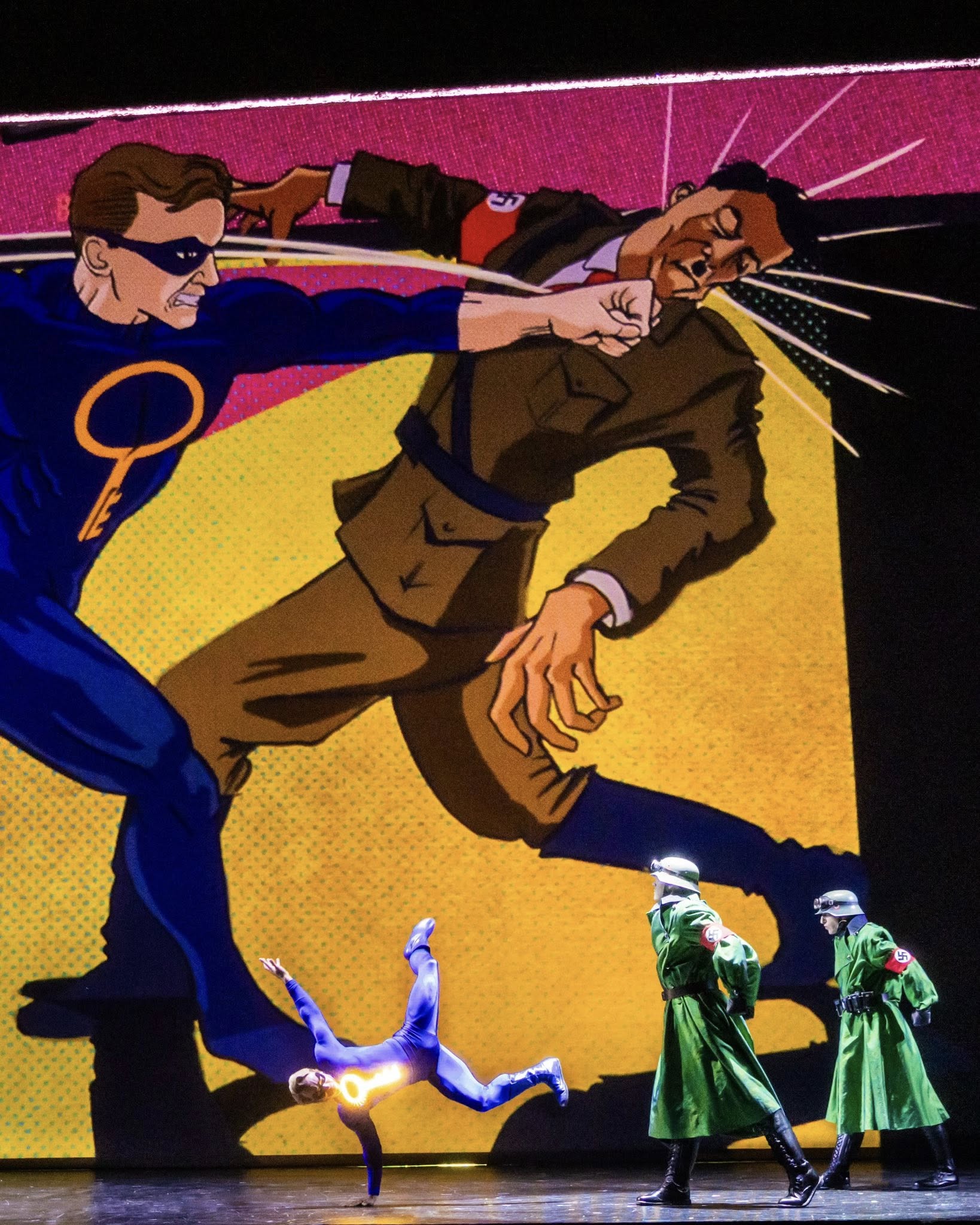
“The Amazing Adventures of Kavalier & Clay” is the first opera I’ve seen that plays more like a movie. A triumph of production design, in some respects it realizes the Wagnerian ideal of Gesamkuntswerk, the synthesis of disparate elements into a “total work of art,” here employing technology of a sort Wagner couldn’t possibly have imagined. That’s not to say Mason Bates’ music is anywhere near the same exalted level, which probably, in this case, is not such a bad thing. As a piece of pop art, “Kavalier & Clay” works. Mostly.
The inspiring story of two Jewish cousins – one a Brooklyn native, the other a refugee from Nazi-occupied Czechoslovakia – who channel their hopes, heartbreaks, and thirst for justice into the creation one of the comic’s bestselling superheroes – is back at New York’s Metropolitan Opera with all its whiz-bang dazzle. I caught it earlier in the season, in the fall, but The Met had a special on tickets around the holidays, so I’m going to see it again with a friend next month. The production will run through February 21.
Can’t make it to New York? You’ll have a chance to experience it at select movie theaters this Saturday, January 24, and next Wednesday, January 28, as part of “The Met: Live in HD” series, presented through Fathom Entertainment. (Look for the link below.)
As a fan of Michael Chabon’s Pulitzer Prize winning novel, I knew going in that concessions would have to be made. Even at its most surfacy, Chabon’s book (which I read for a second time to prep for the opera) is simply too grand – even with the Met’s stagecraft being as wondrously vertiginous as it is – and too epic to be conveyed even on the boards of the world’s largest opera palace. It also happens to be beautifully and characterfully written. There is only so much of that (the story is told from a third person omniscient perspective) that is going to survive translation to the theater.
In the end, this panegyric to the power of comic books and the role of popular culture in the American Dream at an especially dynamic time in this nation’s history – while simultaneously exploring comics as an outlet through which the artists grapple with their personal demons and grasp for redemption – can never hope to serve as more than “Classics Illustrated.” So definitely read the book.
But the opera recreates a great escape from the bottom of the Moldau, a superhero, called The Escapist, punching out Nazis in the best Jack Kirby tradition, Salvador Dali in a diving suit, a thunderstorm over the observation deck of the Empire State Building, and a final act, with the stage in its full, mechanized glory, that departs significantly from the action of the book, but contains a touch of poetry and grace courtesy of another one of the cousin’s heroic creations. I do miss the business with the Golem, the World’s Fair, the entire Antarctica segment, the cameo by Orson Welles, and the recurring allusions to Polish composer Karol Szymanowski. Only Chabon could have written it. (Gene Scheer is the opera’s librettist.)
Opera as a genre rises and falls on its writing for voice, at its most powerful, arousing overwhelming emotions. At its most magnificent, there really is nothing else like it. From a purely musical standpoint, “Kavalier & Clay” never achieves that level of irrational grandeur, but as I indicated at the start, this may be the rare instance in which that’s okay. It would have been nice had it cracked the extraordinary, but the music does actually serve as but one component, and an equal one, in the three-hour entertainment. It’s almost like underscore, breezy in the New York street scenes and rhythmically driving in flights from the Nazis. There’s a spiritual kinship to film music. The emotional moments are lower-voltage than I would have liked – pretty, but hardly indelible – and the hard-driving action scenes and scenery changes sound like John Williams with a bit of a John Adams gloss.
Manhattan street and office scenes sport “jazz” inflections of a Gershwinesque variety, there’s a bawdy dance party that bristles with Bernstein, and at times in the European scenes, you could make out the inclusion of a mandolin – not necessarily the first instrument I associate with either Czechoslovakia or Jewry, but it is an instrument with a long folk tradition that reaches across the continent. I concede, this particular observation could simply reveal a blind spot in my own education.
Bates’ much-vaunted electronic additions (he experiments with electronica and even DJs on the side) really don’t add up to very much. That element of the score barely registers in the opera’s first act. In the second, it could just as easily not have been there. It’s just another element of seasoning.
The work’s real energy comes in its frequent, dizzying set changes and eyepopping set pieces, propelled by technical/technological wizardry. A great escape at the opera’s start prepares the audience for the synthesis of opera, movie, and even comic book, to come. There are entire montages that conjure the layout and dynamism of a comic’s page.
It’s insane to even consider that “The Amazing Adventures of Kavalier & Clay” could be made into an opera, and I’m not sure that it actually succeeds as one. But I am unshakeable in my conviction that it is a hell of a good show.
See it at the Met, February 17-21
https://www.metopera.org/season/2025-26-season/the-amazing-adventures-of-kavalier–clay/
Or at the movies, January 24 & 28
https://www.fathomentertainment.com/releases/the-metropolitan-opera-the-amazing-adventures-of-kavalier-clay/
Tag Cloud
Aaron Copland (93) Beethoven (95) Composer (114) Film Music (144) Film Score (143) Film Scores (255) Halloween (94) John Williams (195) KWAX (229) Leonard Bernstein (104) Marlboro Music Festival (125) Movie Music (159) Mozart (91) Opera (212) Philadelphia Orchestra (89) Picture Perfect (174) Princeton Symphony Orchestra (109) Radio (88) Ross Amico (244) Roy's Tie-Dye Sci-Fi Corner (290) The Classical Network (101) The Lost Chord (269) Vaughan Williams (105) WPRB (397) WWFM (881)
7 responses