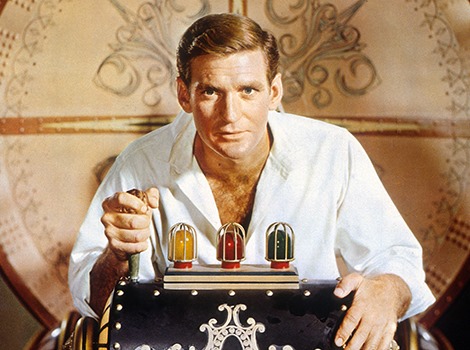
H. George Wells travels to the future, only to discover mankind divided into two factions and a civilization on the brink of collapse! Fortunately, we all know that could never happen…
This week on “Picture Perfect,” put aside your cares for an hour and begin the new year with an escapist program of time travel adventures.
Look forward – and back – to selections from “The Time Machine” (1960) by Russell Garcia, “Time After Time” (1979) by Miklós Rózsa, “Somewhere in Time” (1980) by John Barry, and “Back to the Future” (1985) by Alan Silvestri.
It’s about time, on “Picture Perfect,” music for the movies, now in syndication on KWAX Classical Oregon!
——–
Clip and save the start times for all three of my recorded shows:
PICTURE PERFECT, the movie music show – Friday at 8:00 PM EST/5:00 PM PST
SWEETNESS AND LIGHT, the light music program – Saturday at 11:00 AM EST/8:00 AM PST
THE LOST CHORD, unusual and neglected rep – Saturday at 7:00 PM EST/4:00 PM PST
Stream them, wherever you are, at the link!
https://kwax.uoregon.edu
-
A Time Travel Toddy for the New Year on “Picture Perfect”
by
-
“Old” Lang Syne

by
2 responses
In this year of America 250 observations, naturally I would be inclined to look back to the 18th century. While a frigid New Year’s Day at the Philadelphia Mummers Parade is the big New Year’s tradition around here (it’s a regional thing; if you don’t know it, look it up), I’ll welcome 2026 in a more civilized manner: in my periwig, seated at the harpsichord, pecking out these “Auld Lang Syne Variations.”
It’s a new discovery for me, by a composer named… Ross!Happy New Year, everyone!
-
Waxman and Heifetz Toast the New Year

by
9 responses
Franz Waxman, of course, was one of the great film composers. His music can be heard in “The Bride of Frankenstein,” “Rebecca,” “The Philadelphia Story,” “Sunset Boulevard,” “A Place in the Sun,” “Rear Window,” “Peyton Place,” “The Spirit of St. Louis,” and dozens of others.
It was customary that Waxman and his family would get together with their neighbors, the Jascha Heifetzes, to welcome the new year with an evening of chamber music. Other guests on these occasions would include violist William Primrose and cellist Gregor Piatigorsky.
Mainstream classical fare would dominate the festivities until the countdown to midnight. With the turn of the year, the musical selections would become a bit more frivolous.
Waxman composed his “Auld Lang Syne Variations” in 1947, for one such gathering. This party piece sends up the traditional New Year’s anthem in the styles of several well-known composers.
Feel free to play along and test your musical knowledge. You’ll find further clues in the work’s subtitles, listed below the video on YouTube. One can only imagine Heifetz stepping out in “Chaconne à Son Gout.”
Happy New Year!
-
These Are a Few of My Favorite Things

by
14 responses
I hope you’ve been enjoying a warm and meaningful holiday season. Christmas isn’t supposed to be about the loot, but it’s always welcome to receive an exciting gift. Yes, it’s the thought that counts, and with the winter winds howling, we can all use socks, sweaters, gloves, scarves, etc. But when a gift hits the bull’s-eye, it can light you up like a string of Christmas bulbs. You know, like the ones at your grandparents’ house that were so magical and emitted uncanny odors and threatened at any moment to burst into flame. Ah, the nostalgia of Christmases past!
With the family so fragmented at this point and friends scattered willy-nilly, there is no centralized “Christmas” for me anymore. The Christmas season really is the Christmas SEASON. So the revelry and gift-gifting will continue into the New Year. Here, up to this point, are some of the winners that have appeared in my mailbox and under the tree. The bar must have been set mighty low for me to rank so highly on the “nice” list this year, since, if I haven’t exactly been naughty, I’m still not sure I’ve been exceptionally deserving of such munificence. So thanks to all you miscreants who dragged down the mean, because Santa was obviously grading on a curve!
I learned about the Copland disc of pre-LP recordings on Mather Pfeiffenberger’s breathtakingly exhaustive Copland marathon earlier this month on WHRB. It went right on my wish list. What must it have been like to have been an artist of Copland’s caliber whose career spanned the piano roll to the digital age?
The John Williams biography, the first in English issued by a reputable publisher (Oxford University Press), will probably be the book I’ll read to kick off the new year (as soon as I finish Jane Austen’s “Persuasion,” which I’ve been reading for her 250th anniversary, with interruptions to dip into a Christmas anthology). I read Steven C. Smith’s biographies of Bernard Herrmann and Max Steiner, so naturally his exploration of the Herrmann-Hitchcock relationship will be of interest to me. The Edward Gorey book, published for his centenary was an out-of-nowhere, post-Christmas surprise. It is quite the handsome tome – so beautiful, I am almost afraid to touch it!
Despite my interests in music, the Faust legend, and German literature, I have never read Thomas Mann’s “Doctor Faustus.” Much has been made of the book’s allegorical significance, mirroring the collapse of German culture and morality and the rise of Nazism, but I expect it will be especially absorbing for me in light of the musical dust-up it caused with Arnold Schoenberg (who, to be clear, was vehemently anti-Nazi), as the novel’s antihero embraces the composer’s twelve-tone technique, which Mann clearly found to be harmful to German art and culture. Also, one of the concerts depicted in the book allegedly mirrors a passage in George Antheil’s autobiography, which, according to an interview I once conducted with a representative of the Composers Guild of New Jersey, Mann clearly read. Both Thomas Mann (who lectured at Princeton) and George Antheil (born in Trenton) had local connections.
The Franco Alfano DVD has been on my Amazon wish list since 2007. Alfano is probably best known for having completed Puccini’s “Turandot.” The swagger and doomed romance of “Cyrano de Bergerac” have always very much appealed to me, but I can’t say I’m all that familiar with the opera. Perhaps I’ll watch this one, with Roberto Alagna, and the one I already own (which I’ve yet to watch), with Placido Domingo, back-to-back. I can’t think of a better way to begin a new year than with plumes and panache!
I receive all these gifts with thanks and great humility. Don’t think for a moment that I don’t know how lucky I am. By any standard, it’s been quite a Christmas!
-
It Must Be Cello, ’Cause Jam Don’t Shake Like That

by
7 responses
For International Cello Day, here’s an 1867 “pantomime comic” by Gustave Doré, a whimsical series of caricatures of Jacques Offenbach to illustrate the influence and increased popularity of the instrument. In 1858, Offenbach engaged Doré to provide scenic designs for his operetta, “Orpheus in the Underworld.” Doré rendered a “serious” engraved portrait of the cellist and composer in 1860.
One of Offenbach’s cello duets here:
Tag Cloud
Aaron Copland (93) Beethoven (95) Composer (114) Film Music (144) Film Score (143) Film Scores (255) Halloween (94) John Williams (195) KWAX (229) Leonard Bernstein (104) Marlboro Music Festival (125) Movie Music (159) Mozart (91) Opera (212) Philadelphia Orchestra (89) Picture Perfect (174) Princeton Symphony Orchestra (109) Radio (88) Ross Amico (244) Roy's Tie-Dye Sci-Fi Corner (290) The Classical Network (101) The Lost Chord (269) Vaughan Williams (105) WPRB (397) WWFM (881)
9 responses