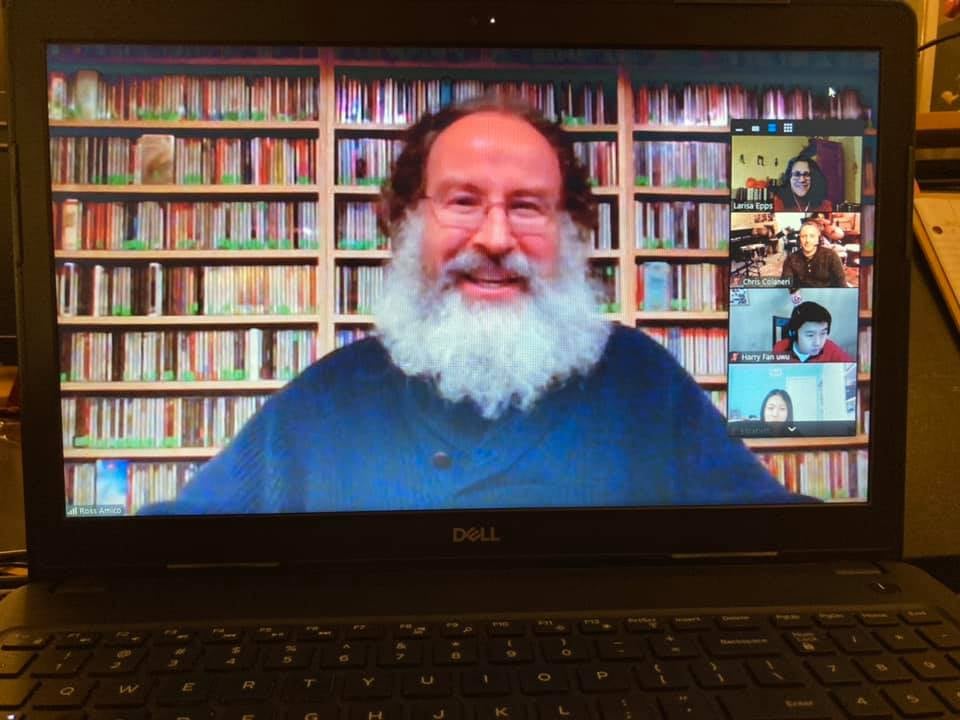
Radio superstar or cautionary tale? I talk about my years behind the microphone, and my beard, with musicians of Youth Orchestra of Central Jersey on Tuesday, as part of a Music Business & Careers Course hosted by Chris Colaneri. Thank you, YOCJ!
-
Radio Days Youth Orchestra Career Talk
by
-
Barbarella Acid Flashback Roy’s Tie-Dye Sci-Fi
by
5 responses
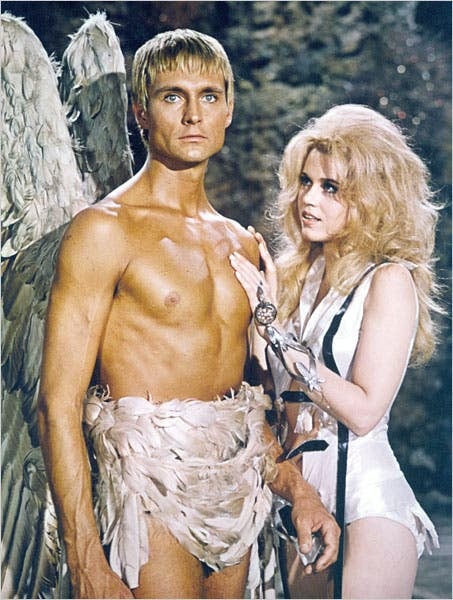
“An angel has no memory,” remarks Pygar at the end of “Barbarella” (1968). Sweet Jehoshaphat, would that I could say the same!
Roger Vadim’s sci-fi sex fantasy manages to distill everything that was horrible about the ’60s into an excruciating 98-minutes: shag-carpeted spaceships, lava lamp special effects, Rolling Stones “It Girl” Anita Pallenberg, trippy music performed by the Bob Crewe Generation Orchestra, and a Bardot-bouffanted Jane Fonda in kinky fetish boots (if little else). I have to hand it to Fonda. She’s certainly game.
Join us, if you dare, on the next Roy’s Tie-Dye Sci-Fi Corner, for a con-heavy conversation worthy of Marcel Marceau. I’ll be struggling against an acid flashback, as we livestream on Facebook. Leave your comments on this cult “classic,” this Friday evening at 7:00 EST.
-
Lee Hoiby at 95 Opera Broadway Shrew

by
2 responses
I note that today would have been the 95th birthday of American composer Lee Hoiby. Hoiby, a disciple of Gian Carlo Menotti, wrote a lot of vocal music and received particular acclaim for his operas. However, I first discovered him through an old recording of his Piano Concerto on the CRI label.
Hoiby, born in Madison, Wisconsin, in 1926, studied at the University of Wisconsin with pianists Gunnar Johansen and Egon Petri. (His early ambition had been to become a concert pianist.) Then he struck out for California, where he studied at Mills College with Darius Milhaud. In San Francisco, he worked with a number of musicians whose thinking was decidedly outside-the-box, including Rudolf Kolisch, brother-in-law of Arnold Schoenberg, and Harry Partch.
It’s interesting, therefore, that his own music would wind up being so traditional. Chalk it up to further studies with Menotti at the Curtis Institute of Music in Philadelphia. It was Menotti who introduced Hoiby to opera, instilling in him a life-long love of the human voice. Hoiby was employed as an assistant on the Broadway debut productions of Menotti’s “The Consul” and “The Saint of Bleecker Street” (the latter of which earned his teacher a Pulitzer Prize). Menotti would produce Hoiby’s first opera, “The Scarf” (1958). Eight more would follow. The most highly-regarded of these is perhaps his Tennessee Williams adaptation, “Summer and Smoke” (1971).
Hoiby also had a powerful champion in Leontyne Price, who introduced many of his best-known arias and songs. He claimed Franz Schubert as an important influence. “What I learned from Schubert came from a long, deep and loving exposure to his songs. A lot happens on a subconscious level, so it’s hard to verbalize, but what I think his songs taught me have to do primarily with the line, the phrasing, the tessitura, the accentuations of speech, the careful consideration of vowels, the breathing required, and an extremely economical use of accompaniment material, often the same figure going through the whole song.”
Interestingly, Hoiby’s Julia Child opera – or perhaps monodrama – “Bon Appetit!” (1986) was streamed only weeks ago by Opera Philadelphia, with Jamie Barton as “The French Chef.”
Then this week, wholly by coincidence, I happened to revisit a DVD I had picked up perhaps 15 years ago of a production of “The Taming of the Shrew,” performed by the American Conservatory Theater of San Francisco in 1976. Lo and behold, the incidental music is by Lee Hoiby!
The production is robust, Rabelaisian (influenced by commedia dell’arte, actually), and it moves like lightning. In this season of perpetually inclement weather, perhaps it would make for a pleasant diversion. I guarantee it will charm your socks off. And it is introduced by the late Hal Holbrook (with cigarette, no less).
Furthermore, it features Mark Singer as Petruchio, in a performance of astounding physicality. Indeed, it’s a wonder that any of the actors have enough breath to speak their lines. Singer went on to notoriety in the 1980s, when he singlehandedly sustained cable TV through incessant repeats of his breakout feature, “The Beastmaster.”
Watch “The Taming of the Shrew” here, and see if you don’t owe me a debt of thanks. And note Hoiby’s contribution.
Leontyne Price sings “Winter Song” (1950)
Schubert Variations (1981)
Hoiby Piano Concerto (1957)
Jamie Barton as Julia Child
https://www.operaphila.org/about/news-press/pressroom/2020/bon-appetit/
All roads lead to Lee Hoiby! Happy birthday.
Hoiby at the keyboard, and (left to right) with Jean Stapleton; Jamie Barton as Julia Child; and Mark Singer taming the shrew
-
Happy Fasnacht Day Grandma’s Fried Doughnut Recipe

by
3 responses
Happy Fasnacht Day! That happy day when I’d blow in after school, an oblivious cyclone, to find the air heavy with the scent of freshly-made doughnuts. I never knew when it would happen or understood the significance. All I knew is that I’d rush in one afternoon and my grandmother would be serving up heaven from an electric fryer.
Why fasnacht? When I asked, my grandmother had no answer. Or if she did, she didn’t bother to explain. She’d had to deal with so many “whys” from me. But go ahead and look it up on the internet.
A fasnacht – which we pronounced “fosh-knot” (you’ll also see it spelled fastnacht, faschnaut, or faschnacht) – is a fried doughnut made on Shrove Tuesday – or Fat Tuesday, if you prefer – the last day before Lent. Traditionally, the making of doughnuts was a way to clear out all the tasties a good Christian is not supposed to eat again until Easter. Be that as it may, one could use a good fast after so much fried lard!
Now THOSE were doughnuts. The closest I’ve been able to find out in the real world are Italian zeppoli. Not quite the same, but they share a similar, unhealthy, fried, powdered-sugary goodness. However, zeppoli, like fasnachts, can vary. A light and puffy zeppola would bear little resemblance to my grandmother’s fasnachts, which were always cakey.
I miss those doughnuts. My grandmother was an undistinguished cook, but boy could she make fasnachts.
During covid-19, it’s unlikely that I will be hitting the road today, in search of the ideal fasnacht. In any case, I think the safest bet in this area (Central Jersey) would be the farmers’ markets, which are generally only open on the weekends.
I would be appalled by some “authentic” Pennsylvania Dutch fasnachts, which look too soft and are served with butter and maple syrup. I need an austere fistful of stodgy dough that I can enjoy with a cup of coffee.
Music for fasnachts (announcing it on the radio requires a nimble mouth and nerves of steel): Robert Schumann’s “Faschingsschwank auf Wien” (“Carnival Jest from Vienna”):
Not my idea of a fasnacht:
https://www.webstaurantstore.com/blog/116/fastnacht-day.html
The many faces of the fasnacht:
PHOTO: These best resemble my grandmother’s recipe
-
Lincoln Liberty Song Presidents Day
by
3 responses
Happy Presidents Day.
Paul Turok composed his “Variations on an American Song: Lincoln and Liberty” in 1963. The melody is based on a traditional Irish fiddle tune, “Rosin the Bow,” which was outfitted with new lyrics for use in Lincoln’s 1859 presidential campaign.
“Then up with our banner so glorious,
The star-spangled red-white-and-blue,
We’ll fight till our Cause is victorious,
For Lincoln and Liberty, too!”
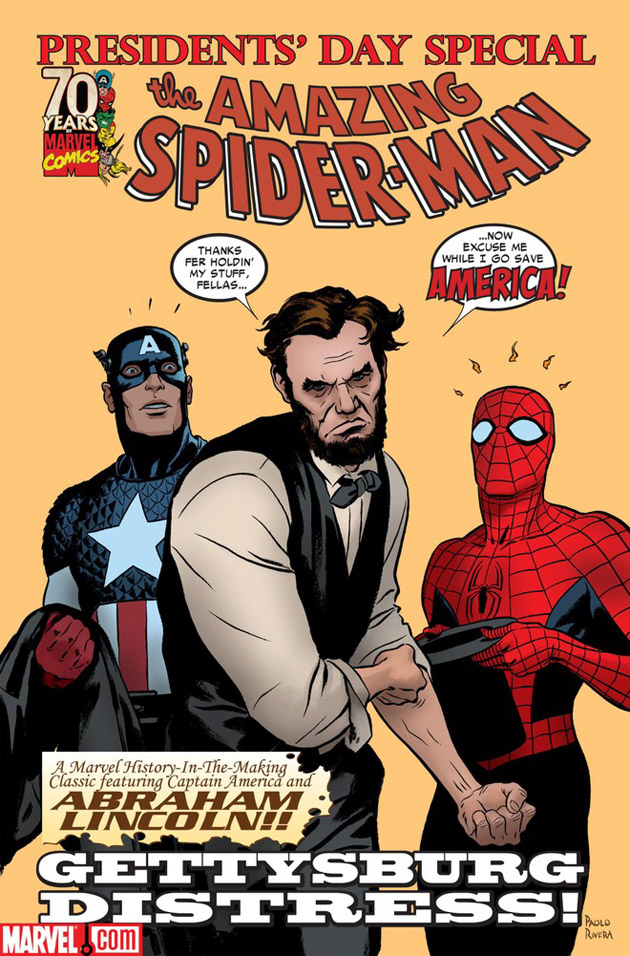
IMAGE: With Marvel malice toward all! If only…
Tag Cloud
Aaron Copland (93) Beethoven (95) Composer (114) Film Music (145) Film Score (143) Film Scores (255) Halloween (94) John Williams (195) KWAX (229) Leonard Bernstein (104) Marlboro Music Festival (125) Movie Music (160) Mozart (91) Opera (213) Philadelphia Orchestra (89) Picture Perfect (174) Princeton Symphony Orchestra (109) Radio (88) Ross Amico (244) Roy's Tie-Dye Sci-Fi Corner (290) The Classical Network (101) The Lost Chord (269) Vaughan Williams (105) WPRB (397) WWFM (881)
8 responses