• Conlon Nancarrow’s Haunting Player Pianos

    Conlon Nancarrow’s Haunting Player Pianos

    by 

    in
    11 responses

    Automatons are always a little unnerving.

    Conlon Nancarrow was one of the first composers to treat musical instruments as if they were machines, rigging them so that they could perform in a manner far beyond human capability. He worked his experiments in virtual isolation, living in Mexico (where he fled to escape harassment for his political leanings) since the 1940s.

    He remained largely unrecognized until the late ‘60s, when Columbia Records released an album of his music. Indeed, it could be said he wasn’t terribly well known until recordings of his player piano pieces began to appear, on the 1750 Arch label, about ten years later. György Ligeti lauded Nancarrow as “the greatest discovery since Webern or Ives… the best of any composer living today.”

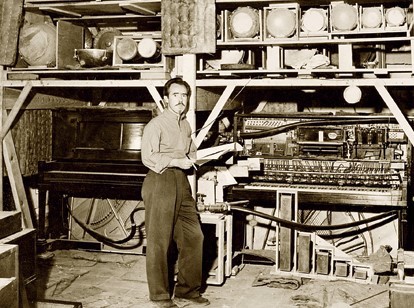
    In 1947, Nancarrow acquired a custom-built, manual punching machine, which enabled him to create his own piano rolls. It was very meticulous work, and time-consuming. He also souped-up his player pianos, increasing their dynamic range, and covering the hammers with materials like leather and metal to create a more percussive sound.

    While his later pieces tend to be abstract, a lot of them extremely intricate canons, his early experiments emulate jazz and blues. This is haunted funhouse music, if there ever was any. Make your breakfast batty with Conlon Nancarrow, on his birthday.

    Study for Player Piano No. 21 (Canon X):

    But when the ghosts really feel like letting their hair down and cutting a rug, they listen to the “Boogie-Woogie Suite”:

    PHOTO: Nancarrow with two player pianos and “percussion orchestra,” Mexico City, 1955


  • Support WWFM Classical Network’s Fundraiser

    Support WWFM Classical Network’s Fundraiser

    by 

    in
    4 responses

    If you think raising money during a pandemic is easy, imagine what it’s like to conduct a fundraiser with no staff!

    WWFM The Classical Network is pulling hard to reach $70,000 by October 31. If classical music on the air waves is important to you, or if you enjoy our webcasts of locally-produced specialty programs, I hope you will consider doing what you can to help support us.

    Hours of on-air pitching are necessarily limited this time around, due to our skeletal staff. Please call 1-888-232-1212, or donate online at wwfm.org:

    https://wwwfm.secureallegiance.com/wwfm/WebModule/Donate.aspx?P=DEFAULT&PAGETYPE=PLG&CHECK=vOU2bz5JCWmgCDbf53nm9ezWDeZ%2BeA1M&fbclid=IwAR11sBx9UcxzlP4TuJWnQ8MRJsWZLt9ejzeAPuMPEKR0Wx1OPTnebdGl-os

    Right now, we are just shy of the halfway mark. Operators (Win, Marcia & Rachel) are standing by to accept your contributions, answering your calls from the safety of their own homes.

    At a time when Halloween horrors aren’t always limited to the imagination, there’s comfort and commonality to be found in great music. From our homes to yours, we thank you for your support of WWFM – The Classical Network!


    Thomas S. Allen, “Dance of the Skeletons” (1901):


  • Christopher Lee Opera Secret Revealed

    Christopher Lee Opera Secret Revealed

    by 

    in
    4 responses

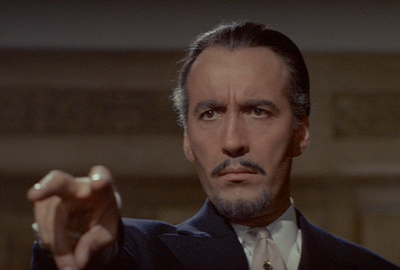
    During the course of our discussion of “The Devil Rides Out,” last night on Roy’s Tie-Dye Sci-Fi Corner, Roy and I touched upon the fact that Christopher Lee’s great regret in life was not pursuing a career as a professional opera singer.

    In his autobiography, “Tall, Dark and Gruesome” (later reissued as “Lord of Misrule”), Lee talks about how, whenever he was Sweden, he would make it a point, in his downtime, to slip off with amateur opera companies and tour with them incognito. He filmed “Tales of Hans Christian Andersen” in Sweden, and for a time he was engaged to Henriette von Rosen. His Swedish connections were such that when Von Rosen’s father threw up a final impediment, that he would allow Lee to marry his daughter only if he could obtain permission from the King of Sweden, Lee was able to so – like something out of a fairy tale in itself!

    Ultimately, Lee did not marry Von Rosen (the situation seemed very high-maintenance), but he did attract the attention of tenor Jussi Björling. He recounts the story, as well as his family history in the opera, in one of the videos linked below.

    First, here’s Lee in an off-the-cuff demonstration of his singing ability, with selections from “The Flying Dutchman” and “The Damnation of Faust;” and then, to keep it seasonal, he recites Edgar Allan Poe’s “The Raven”:

    Much later, he shares an anecdote and proves that he’s still got the pipes:

    Finally, Lee recounts his experience with Björling and his family’s role in bringing opera to Australia:

    Of course, as he points out, if he had, after all, become a professional opera singer, his career would have ended decades earlier. But as an actor, he was able to continue to do what he loved until the end of his long and fruitful life.

    Really, when you think about, is there all that much difference between gothic horror and a life in the opera?


  • Devil Rides Out Hammer Film Discussion

    by 

    in
    2 responses

    Here’s the video of last night’s show, in which Roy and I engage in a spirited discussion about “The Devil Rides Out” (1968), a.k.a. “The Devil’s Bride.”

    The film starred not just one, but two singers of talent: Christopher Lee – whose experiences with opera I explore in a separate post – and Leon Greene, who sang professionally with the D’Oyly Carte Opera Company and the Sadler’s Wells Opera (later the English National Opera). Greene also enjoyed notable success with a couple of Sondheim musicals: as Sweeney Todd, in an acclaimed 1985 revival, and as Miles Gloriosus, both on stage and in the 1966 film incarnation of “A Funny Thing Happened on the Way to the Forum.” Ironically, for whatever reason, for “The Devil Rides Out,” Greene was dubbed!

    As a teenager, future Hammer house composer James Bernard received encouragement from Benjamin Britten. Their friendship blossomed, and Bernard wound up working with Britten, Imogen Holst, and Peter Pears. He won an Academy Award NOT for any of his music (for which he was never even nominated), but rather for a screenplay he wrote with his partner, Paul Dehn, for “Seven Days to Noon.” As if all that weren’t remarkable enough, during WWII, Bernard assisted in the cracking of the Enigma code.

    There’s so much talent and so many interesting anecdotes associated with this movie, one of Hammer’s best, that we couldn’t possibly talk about everything, but we touched upon what we could in roughly 90 minutes.

    Roy’s Tie-Dye Sci-Fi Corner live-streams on Facebook every Friday and Sunday evening throughout October at 7 p.m. EDT. This Friday, we’ll wrap up our month-long celebration of Halloween with special guests Michael Rizzo and Marybeth Ritkouski of SciFi Distilled. The four of us will discuss Mel Brooks’ affectionate parody of Universal Studios’ classic creature-features, “Young Frankenstein” (1974).

    As an added bonus, there will also be a virtual costume party, so if you want to get in on the act, be prepared to join us on Zoom following the discussion, when we’ll be puttin’ on the Ritz!

    https://www.facebook.com/roystiedyescificorner/


  • Scarlatti Cat Fugue A Feline Birthday Tale

    Scarlatti Cat Fugue A Feline Birthday Tale

    by 

    in
    3 responses

    On the birthday of Domenico Scarlatti, beware his “Cat’s Fugue.” Scarlatti’s feline companion, Pulcinella, used to walk across the keys of his harpsichord. The story goes that on one of those occasions, the composer jotted down the notes and used it as the lead subject for his famous sonata. Spooky.


Tag Cloud

Aaron Copland (93) Beethoven (95) Composer (114) Film Music (145) Film Score (143) Film Scores (255) Halloween (94) John Williams (195) KWAX (229) Leonard Bernstein (104) Marlboro Music Festival (125) Movie Music (160) Mozart (91) Opera (213) Philadelphia Orchestra (89) Picture Perfect (174) Princeton Symphony Orchestra (109) Radio (88) Ross Amico (244) Roy's Tie-Dye Sci-Fi Corner (290) The Classical Network (101) The Lost Chord (269) Vaughan Williams (105) WPRB (397) WWFM (881)

DON’T MISS A BEAT

Receive a weekly digest every Sunday at noon by signing up here


RECENT POSTS