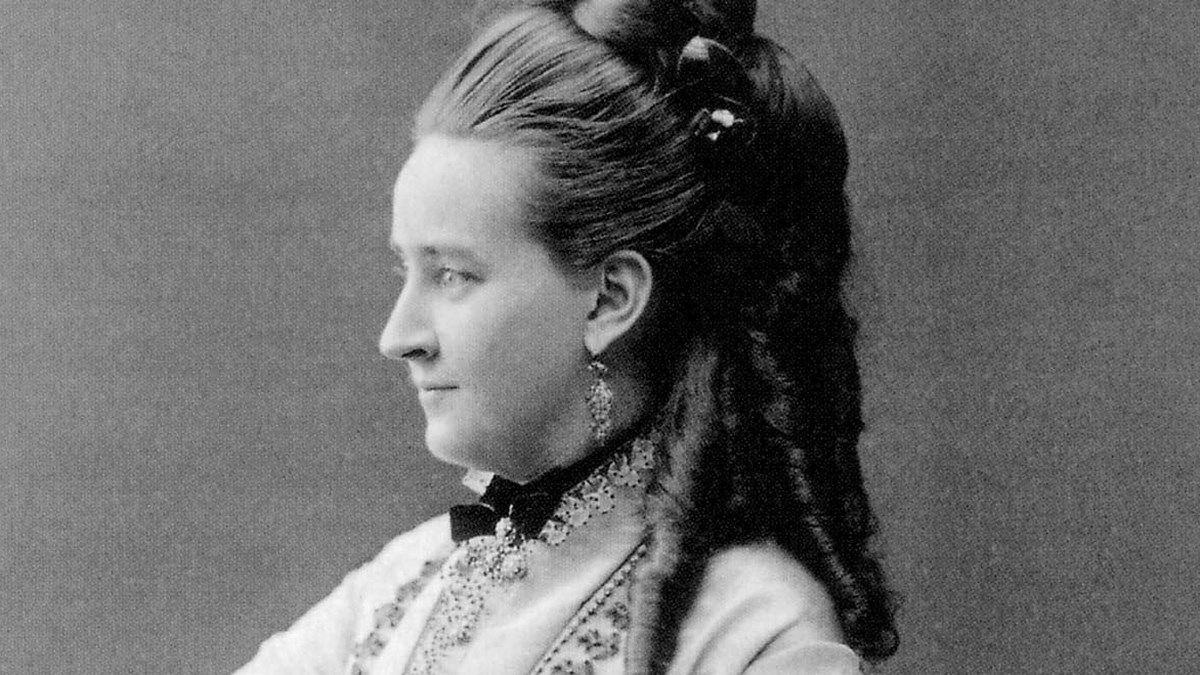
• Helena Munktell Swedish Composer Rediscovered

    Helena Munktell Swedish Composer Rediscovered

    by 

    in
    7 responses

    I’ve long since passed the point where I’ll be able to listen to all of the music in my collection. In choosing “something for the ride” this morning, my eyes fell upon the spine of a CD that’s never been off the shelf, of works by Helena Munktell (1852-1919).

    Munktell was born in Grycksbo, Dalarna County, Sweden. She studied music – including piano, voice, and composition – first at the Stockholm Conservatory, then privately, in Vienna, with Julius Epstein. After that, it was off to Paris for further polish with Benjamin Godard and Vincent d’Indy. Munktell would go on to became a member of the Royal Swedish Academy of Music and co-founder of the Swedish Society of Composers.

    Clearly, she adored her childhood home. Coniferous forests, rustic dances, and summer nights inform her “Suite dalecarlienne” (translated as the “Dala Suite”). The work was first performed in Paris in 1910. Its four movements: “Sunday in the Village,” “Lake Siljan,” “Rustic Dances,” and “Summer Night… The Dance Grows Quicker.”

    Me, I’m charmed by just about anything that’s folk-inflected. If I were on the air right now, I would have no hesitation in playing this during the dinner hour.

    https://www.youtube.com/watch?v=cI9eRqAIOvM

    But perhaps charm isn’t your thing, in which case “Breaking Waves” is more dynamic:

    https://www.youtube.com/watch?v=lAM5BKIZLWs

    There’s also a piece about Walpurgis Night (“Walpurgisfire”), which isn’t as wild as I had hoped. (I concede that the fault is mine, since overindulgence was not her aim.) It would be Munktell’s final composition – evocative, impressionistic, and six years after Stravinsky had already opened up both barrels of vernal savagery in “The Rite of Spring.”

    https://www.youtube.com/watch?v=Du-AW2OPZOw

    The compositions may not be world-beaters, but they are agreeable, and I am curious to hear more, especially a piece (not on the disc) called “Old Coffee-O Name-Day Show.” I like coffee!

    Munktell was the youngest of nine children. Her sister (the second-youngest), Emma Josepha Sparre, was a painter, and evidently also touched by the home of her childhood, despite her fatigued expression in the self-portrait below. One of her many canvases, “From the Manor Park at Grycksbo,” adorns the CD booklet.

    Here someone has put together a slideshow of Sparre’s works, presented to music by Ole Bull:


    Clockwise from top: Sisters Helena Munktell and Emma Josepha Sparre (self-portrait, “Resting by the Easel,” 1890), along with a CD of Munktell’s works, illustrated by Sparre painting



  • Connie Weldon First Female Tubist Dies at 88

    Connie Weldon First Female Tubist Dies at 88

    by 

    in
    3 responses

    Constance “Connie” Weldon has died. She is believed to have been the first female tubist to attain a principal position with a major symphony orchestra.

    Weldon turned down an offer from the Rio de Janeiro Symphony in the early 1950s to continue her studies in Miami. Soon, she was touring with the Boston Pops. She also played at Tanglewood under Leonard Bernstein.

    Later, she became a member of the North Carolina and Kansas City Symphonies. During studies abroad, she served as principal tubist with the Netherlands Ballet Orchestra and acting principal tubist with the Concertgebouw Orchestra of Amsterdam.

    Back home, she joined the Miami Philharmonic and became an influential teacher at Miami University. From 1972 to 1991, she served as Associate Dean for Undergraduate Studies at University of Miami School of Music (now the Frost School).

    At the time of her death, she was 88 years-old.


  • Dvořák’s Symphony No. 8: A Celebration of Life

    Dvořák’s Symphony No. 8: A Celebration of Life

    by 

    in
    6 responses

    This is one of those works that just makes you feel like it’s great to be alive.

    Antonin Dvořák composed his Symphony No. 8 over two months, from the end of August to the beginning of November, in happy seclusion at his country home of Vysoká, in 1889. The symphony is his most bucolic, cheery, and lyrical, steeped in the Bohemian folk song he adored.

    Dvořák himself conducted its first performance, at the National Theater in Prague, in 1890. He then took it to Frankfurt and Cambridge, where he was awarded an honorary doctorate. The symphony became a great favorite in England. In fact, it was published there, by the London firm of Novello, after the usual disagreements with Simrock, Dvořák’s regular publisher. Simrock preferred shorter, snappier works and insisted on marketing them in German. Dvořák, a proud Bohemian, found this increasingly annoying. Not incidentally, Simrock had also low-balled him on the price (offering one thousand marks, as opposed to the three thousand marks he had paid for the Symphony No. 7).

    In 1893, Dvořák was in America, as director of the National Conservatory of Music in New York, when he brought his new symphony to the World’s Columbian Exposition. At the time, the symphony was promoted as his Fourth. It was only in the 1950s, with the publication of Dvořák’s earlier works in the form, that the symphonies were renumbered, which is why there are now nine Dvořák symphonies, as opposed to five. At the world’s fair, Dvořák conducted his Eighth with an expanded Chicago Symphony Orchestra. According to the Chicago Tribune, the performance was met with enthusiasm, marked by “tremendous outbursts of applause.”

    The composer claimed that in its writing the melodies simply poured out of him. Here’s my favorite recording of the piece, made with the Columbia Symphony Orchestra, assembled specifically for the great Bruno Walter.

    Všechno nejlepší k narozeninám! Happy birthday, Dvořák!


    PHOTO: Composer and family, relaxing at Vysoká


  • Labor Day Listen Paul Robeson’s Joe Hill

    Labor Day Listen Paul Robeson’s Joe Hill

    by 

    in
    3 responses

    Can’t – and shouldn’t – get through Labor Day without listening to Paul Robeson sing “Joe Hill.”


  • SCTV’s Grapes of Wrath Parody A Labor Day Treat

    SCTV’s Grapes of Wrath Parody A Labor Day Treat

    by 

    in
    3 responses

    A Labor Day treat. One of the things I always loved about SCTV: this is a show that never talked down to its audience, and it trusted viewers to find it funny, even if they weren’t entirely sure what was going on. Nearly 40 years after its release into theaters, and still well before the advent of specialty cable channels devoted to classic movies, here’s a spot-on parody of John Ford’s “The Grapes of Wrath.” I must say, Joe Flaherty does a pretty mean (mean, mad) Henry Fonda.

    https://www.youtube.com/watch?v=MqBvwHqr7fk


Tag Cloud

Aaron Copland (93) Beethoven (95) Composer (114) Film Music (145) Film Score (143) Film Scores (255) Halloween (94) John Williams (195) KWAX (229) Leonard Bernstein (104) Marlboro Music Festival (125) Movie Music (160) Mozart (91) Opera (213) Philadelphia Orchestra (89) Picture Perfect (174) Princeton Symphony Orchestra (109) Radio (88) Ross Amico (244) Roy's Tie-Dye Sci-Fi Corner (290) The Classical Network (101) The Lost Chord (269) Vaughan Williams (105) WPRB (397) WWFM (881)

DON’T MISS A BEAT

Receive a weekly digest every Sunday at noon by signing up here


RECENT POSTS