• The Frankfurt Gang: English Music Rebels

    The Frankfurt Gang: English Music Rebels

    by 

    in
    7 responses

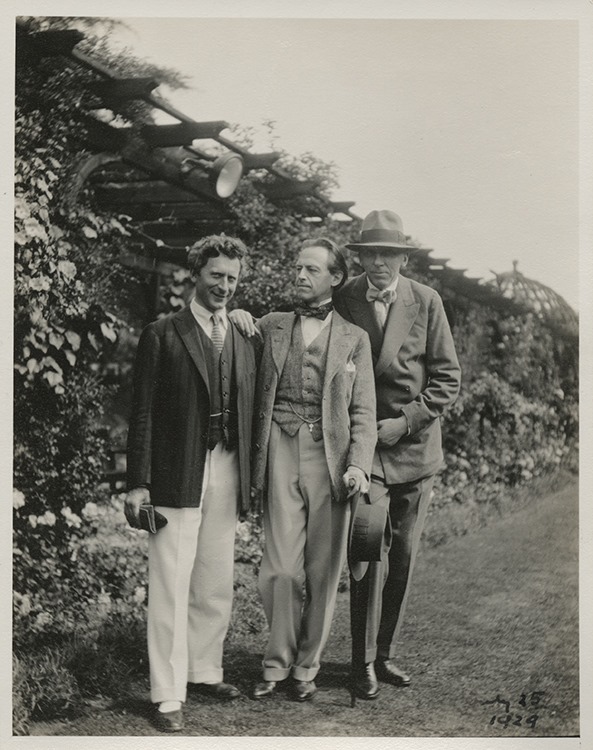
    The loose collective known as “The Frankfurt Gang” came together in 1890s, as students at the Hoch Conservatory in Frankfurt-am-Main. Its members included Balfour Gardiner, Roger Quilter, Norman O’Neill, Cyril Scott, and the youngest of the bunch, the piano prodigy Percy Grainger. This brilliant array of talent bonded in a foreign land, united by a shared language and culture, but also a determination to break away from Teutonic dominance in music, with the goal of creating a fresh “English” art.

    This Sunday night on “The Lost Chord,” we’ll have music by four of these firebrands, including Gardiner’s “Overture to a Comedy,” Quilter’s “Where the Rainbow Ends,” Scott’s “Neptune” (refashioned from an earlier work inspired by the sinking of the Titanic), and one of Grainger’s choral settings of a text from Kipling’s “Jungle Book.”

    The Hoch Conservatory of the day had the reputation of being one of the very finest in Europe. Clara Schumann had been on the faculty there until 1892 – within a few years of the Frankfurt Group’s arrival. In fact, at least one of them was there before Schumann’s departure.

    Scott arrived at the school early, at the age of 12, and then later returned for a second stint. Gardiner was also there twice, taking a break to attend Oxford. Grainger was 13 at the time he was admitted. He was to remain at the Hoch Conservatory for four-and-a-half years.

    Frankfurt alumni aim for the high notes this week. I hope you’ll join me for “Hochschule Musical,” this Sunday night at 10:00 EDT, on WWFM – The Classical Network and at wwfm.org.


    Hochschule reunion: (left to right) Grainger, Scott, and Quilter

  • Zardoz COVID Ennui Sci-Fi Reappraisal

    Zardoz COVID Ennui Sci-Fi Reappraisal

    by 

    in
    4 responses

    In “Zardoz” (1974), the Eternals, an immortal race, suffer ennui and even slide into catatonia, as each day bleeds into the next. No end, no passion, no inspiration, no purpose. Does this movie have added resonance in time of COVID?

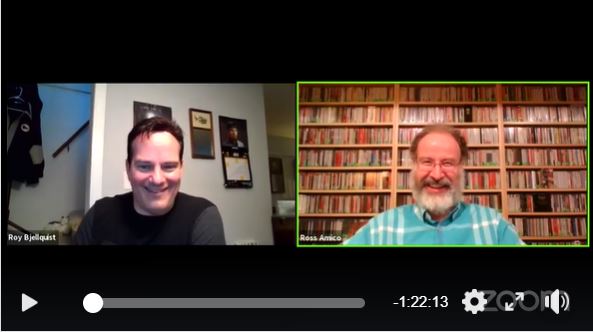
    In case you missed it (and I know you did), here’s my latest appearance on “Roy’s Tie-Dye Sci Fi Corner.” Roy and I chisel away at John Boorman’s trippy, hopelessly pretentious, yet somehow oddly relevant parable, which riled critics and baffled audiences at the time of its release, but today seems surprisingly worthy of reevaluation.

    New episodes of “Roy’s Tie-Dye Sci-Fi Corner” stream Fridays and Sundays at 7 p.m. EDT.

    Join Roy this Sunday AT A SPECIAL TIME, 4 PM, for a conversation with special effects legend Brian Johnson, the Academy Award winning artist who worked on “Alien,” “The Empire Strikes Back,” “Dragonslayer,” “Space: 1999,” “Thunderbirds,” and “2001: A Space Odyssey.”

    Thanks again, Roy! See you next Friday, for “The War of the Worlds!”

    Ross and Roy on “Zardoz”:

    Watch Brian Johnson, Sunday at 4 p.m., here:

    https://www.facebook.com/roytiediescificorner/


  • Arabian Nights Cinematic Delights

    Arabian Nights Cinematic Delights

    by 

    in
    2 responses

    Open sesame! It’s an Aladdin’s Cave of cinematic delights.

    This week on “Picture Perfect,” the focus is on tales from “The Arabian Nights.”

    These traditional folk stories from the Orient have come down to us filtered through the sensibilities of Western translators. Further translation was required to get the stories from page to screen; so it’s hardly surprising to find Sinbad, for instance, fighting a giant walrus at the North Pole.

    The film versions are often showcases for the work of production designers and special effects artists, but composers have certainly gotten in on the act with suitably imaginative scores.

    Bernard Herrmann lent plenty of color and wit to the skeleton duel in “The Seventh Voyage of Sinbad” (1958) by employing a battery of castanets, xylophone, and brass. Stop motion artist Ray Harryhausen was responsible for the memorable effects. “Sinbad” proved to be a dry run for the climax of “Jason and the Argonauts,” in which Harryhausen outdid himself by animating not one, but seven skeletons, and again, Herrmann supplied the music.

    Harryhausen animated two further Sinbad adventures – “The Golden Voyage of Sinbad” (1974) and “Sinbad and the Eye of the Tiger” (1977). Over the course of the three “Sinbad” films, audiences were treated to fantastic encounters with, in addition to the skeleton, a Cyclops, a roc, a dragon, a statue of the goddess Kali, a centaur, a giant walrus, and a saber-tooth tiger, among others.

    “Sinbad and the Eye of the Tiger” was scored by Roy Budd. Budd’s reputation was largely that of a jazz musician and composer. He wrote scores for over 50 films, including “Get Carter” and “The Wild Geese,” before his early death of a brain hemorrhage, at the age of 46, in 1993.

    Walt Disney created a modern classic in “Aladdin” (1992). The music was by Alan Menken, with lyrics by Howard Ashman and Tim Rice. “Aladdin” won Academy Awards for Best Original Score and Best Original Song (“A Whole New World”). Menken has a whole shelf full of Oscars for his work for Disney. Need I say, Robin Williams was the voice of the manic, freewheeling Genie?

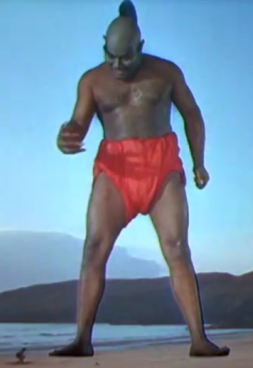
    Rex Ingram’s Genie steals the show in “The Thief of Bagdad” (1940). Ingram emerges from his magic lamp and looms over a cowering Sabu, whom he addresses as “Little Master of the Universe.” The beach resounds with his maniacal laughter. There was an earlier, justly celebrated, silent version of “Thief,” with Douglas Fairbanks. The remake splits the thief and the prince into two separate characters. Sabu plays the incorrigible Abu (the thief), and Conrad Veidt is his nemesis, the treacherous vizier Jaffar.

    The score is by three-time Academy Award winner Miklós Rózsa. Rózsa was in London, in the employ of Alexander Korda, when the lavish Technicolor production was moved to Hollywood on account of the Blitz. Rózsa would go on to become one of Hollywood’s greatest composers. His music for “Ben-Hur” alone has earned him a place in the film music pantheon. He never wrote a more charming score, however, than he did for this.

    I hope you’ll join me for an hour of cinematic enchantments. That’s “A Thousand and One Nights at the Movies,” on “Picture Perfect,” this Friday evening at 6:00 EDT, on WWFM – The Classical Network and wwfm.org.


  • Sinbad Zardoz Fashion Film Fest Tonight

    Sinbad Zardoz Fashion Film Fest Tonight

    by 

    in
    4 responses

    If you’ve got a passion for fashion, have I got an “Ideal” double feature for you!

    I hope you’ll join me, as I present “A Thousand and One Nights at the Movies” on “Picture Perfect” – with selections from “The Seventh Voyage of Sinbad” (Bernard Herrmann), “Sinbad and the Eye of the Tiger” (Roy Budd), “Aladdin” (Alan Menken), and “The Thief of Bagdad” (Miklos Rozsa) – at 6:00 this evening (EDT) on WWFM – The Classical Network and wwfm.org.

    Then at 7:00, I guarantee it will be all you’ll ever want to see of Sean Connery. The giant floating head wasn’t the only thing stoned in the making of John Boorman’s “Zardoz” (1974). Roy Bjellquist and I will engage in a spirited conversation about Brutals, Eternals, Renegades, and Apathetics, on the next “Roy’s Tie-Dye Sci-Fi Corner.”

    How catty will it get on the catwalk? As catty as we knead!

    Catch it via Facebook live stream, and leave a question or comment!

    https://www.facebook.com/roytiediescificorner/


    For a hit of “Zardoz,” here’s the trailer:

    And David Munrow’s arrangement of Beethoven’s 7th:


    PHOTOS: Rocking the whole pony tail/red diaper thing, Rex Ingram as the Genie in “The Thief of Bagdad” (left) and Sean Connery as Zed the Exterminator in “Zardoz”


  • Respighi’s Long Shadow Classical Music Surprises

    Respighi’s Long Shadow Classical Music Surprises

    by 

    in
    8 responses

    Wow! Did you know that Respighi’s widow died in 1996? That’s as crazy to contemplate as the fact that Gustav Mahler (whose birthday it was on Tuesday) would have turned 80 on the day Ringo Starr was born. And of course, there are those photos of Alma talking with Leonard Bernstein. History is collapsing in on itself like a telescope!

    Respighi’s wife, Elsa, outlived him by some 60 years. A singer and composer herself, she died one week shy of her 102nd birthday. She remained her husband’s biggest cheerleader, tirelessly promoting his music, after his own untimely death in 1936, at the age of 55, and even completed his last opera, “Lucrezia.”

    Respighi, of course, is best known for his trilogy of opulent, at times rafter-rattling tone poems celebrating the scenes and history of Rome – “Fountains of Rome” (1916), “Pines of Rome” (1924), and “Roman Festivals” (1928) – and his time-tripping sets of Renaissance lute recreations, the “Ancient Airs and Dances” (composed in 1917, 1923 & 1932).

    In 1929, when conductor Serge Koussevitzky suggested Respighi orchestrate some of Rachmaninoff’s keyboard pieces, Rachmaninoff responded enthusiastically. He supplied Respighi with hidden programs behind the works to lend additional insights into their creation. Koussevitzky was impressed with the results, which he unveiled with the Boston Symphony Orchestra in 1931. More importantly, Rachmaninoff found the orchestrations to be faithful to the spirit of the originals.

    Here is “The Sea and the Seagulls,” from “Cinq Études-Tableaux” by Respighi, after Rachmaninoff.

    Also, footage of Arturo Toscanini conducting “Pines of Rome” in 1952, with the NBC Symphony. Toscanini conducted the work’s U.S. premiere, with the New York Philharmonic, in 1926.

    https://www.youtube.com/watch?v=vThMQzLbN-Y

    Happy birthday, Ottorino Respighi!


    PHOTO: Respighi (second from right), horsing around with quattro vitelloni


Tag Cloud

Aaron Copland (93) Beethoven (95) Composer (114) Film Music (145) Film Score (143) Film Scores (255) Halloween (94) John Williams (195) KWAX (229) Leonard Bernstein (104) Marlboro Music Festival (125) Movie Music (160) Mozart (91) Opera (213) Philadelphia Orchestra (89) Picture Perfect (174) Princeton Symphony Orchestra (109) Radio (88) Ross Amico (244) Roy's Tie-Dye Sci-Fi Corner (290) The Classical Network (101) The Lost Chord (269) Vaughan Williams (105) WPRB (397) WWFM (881)

DON’T MISS A BEAT

Receive a weekly digest every Sunday at noon by signing up here


RECENT POSTS