• Montsalvatge Mystery A Composer An Artist A Bookplate

    Montsalvatge Mystery A Composer An Artist A Bookplate

    by 

    in
    5 responses

    It’s one of those strange coincidences.

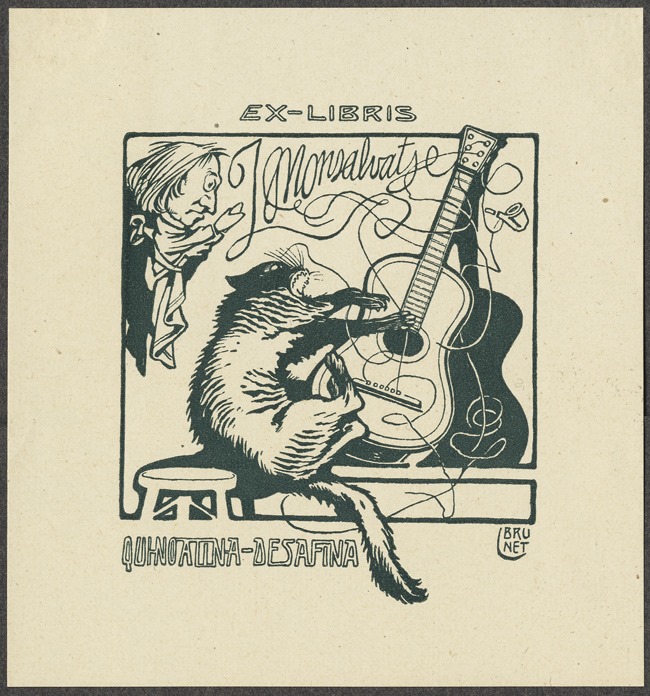
    I was online perusing vintage bookplates yesterday, and I just happened to stumble across this image. I found the design highly amusing, of course, but what really caught my attention is the name on the plate, which looks an awful lot like “J. Montsalvatje.” On Friday, out of the blue, I had just played the “Cinco canciones negras” by Catalan composer Xavier Montsalvatge (note the variant spelling). Montsalvatge also composed an opera, “El gato con botas,” on the subject of Puss in Boots.

    But that’s not all. I once found myself at a party in Philadelphia – this was a number of years ago – and at a point struck up a conversation with an artist by the name of… Javier Montsalvatje. I couldn’t believe it. Of course, I had to ask if he knew of the composer. If anything, he was more astonished than I. How the hell would anyone in Philadelphia know about Xavier Montsalvatge? It turns out he was his grandson or his nephew or his cousin. I can’t remember, I was drinking.

    Some quick research turns up the fact that Xavier Montsalvatge was credited in some of his film work as… you guessed it, Javier Montsalvatje.

    So what’s the deal with this bookplate? I emailed his descendant this morning.


    Montsalvatge, ““Cinco canciones negras”


  • Stravinsky on TV A Lost Saturday Morning

    Stravinsky on TV A Lost Saturday Morning

    by 

    in
    3 responses

    For your Saturday morning, Igor Stravinsky on NBC. Good God, what happened to television?


  • Kirk Douglas: Music from His Greatest Films

    Kirk Douglas: Music from His Greatest Films

    by 

    in
    6 responses

    Hollywood legend Kirk Douglas died on February 5 at the age of 103. An actor of vitality, determination, and conscience, Douglas appeared in over 90 films. This week on “Picture Perfect,” we’ll honor his memory with music from four of his personal favorites.

    We’ll begin with “Spartacus” (1960). Douglas plays the 1st century leader of a slave revolt against the Roman Empire. His co-stars include Laurence Olivier, Jean Simmons, and Tony Curtis. The music is by Alex North (born in Chester, PA, just outside of Philadelphia). The love theme, one of North’s best-known melodies, lends a sense of human connection amidst the martial fanfares and gladiatorial violence.

    Douglas is often credited with having broken the back of the Hollywood blacklist by openly acknowledging Dalton Trumbo as the screenwriter on “Spartacus.” Trumbo had been forced underground as a ghostwriter for refusing to testify before the House Un-American Activities Committee. The film became the biggest money-maker in the history of Universal Studios, up to that time.

    Vincente Minnelli’s cynical exposé of behind-the-scenes Hollywood, “The Bad and the Beautiful” (1952), stars Douglas as a ruthless mogul, who uses and abuses everyone around him. It’s one of his great “bad boy” characterizations. The film, which also features Lana Turner, Walter Pigeon, Dick Powell, and Gloria Graham, won a whole slew of Oscars. Graham was recognized as Best Supporting Actress.

    The music is by Philadelphia-born David Raksin, who is best-remembered for his theme to the all-time noir classic “Laura.” It doesn’t seem possible, but here he really surpasses himself. If you love the sound of Golden Age Hollywood, complete with haunting saxophone, then this one’s for you!

    Minnelli directed Douglas in another one of his standout roles, a much more sympathetic portrayal of the tortured artist Vincent Van Gogh, in “Lust for Life” (1956). For the film, Douglas turns in one of the great performances of his career. Furthermore, his physical resemblance to the painter is uncanny.

    Anthony Quinn won an Oscar for Best Supporting Actor as Van Gogh’s sometimes friend, the artist Paul Gaugin. The powerful score is by the great Miklós Rózsa, who here marries his Hungarian-inflected signature sound to an evocative sort of French impressionism.

    Finally, when Kirk isn’t fighting giant squid, he’s singing “A Whale of Tale,” as Ned Land, in Walt Disney’s “20,000 Leagues Under the Sea” (1954). The otherwise brooding score is a real showcase for Paul J. Smith, who had earlier provided incidental music for Disney’s animated features “Snow White and the Seven Dwarfs,” “Bambi,” and “Pinocchio.”

    As actor, director, producer, and author, Douglas was a whale of a talent. He himself included these four titles among his top ten films.

    Bad and beautiful, with a lust for life, and in a league of his own… Douglas can still knock your block off, this Friday evening at 6:00 EST, on WWFM – The Classical Network and at wwfm.org.


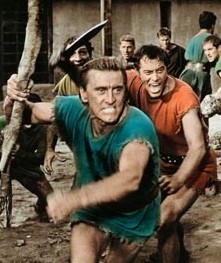
    PHOTOS: Douglas in “Spartacus,” “The Bad and the Beautiful,” “Lust for Life,” and “20,000 Leagues”


  • Ross Amico Takes Over The Classical Network Today!

    Ross Amico Takes Over The Classical Network Today!

    by 

    in
    4 responses

    Surprise! Get ready for SEVEN HOURS of Classic Ross Amico today, as I fill in for my colleague, Carl Hemmingsen, early this afternoon on The Classical Network; then stick around for my usual late afternoon air shift.

    I’ll be celebrating a number of notable birthdays along the way, with symphonies by Jan Kalivoda (a.k.a. Johann Kalliwoda) and Charles-Marie Widor, a complete ballet of Léo Delibes, and a nod to guitarist Andrés Segovia.

    At 6:00, I’ll be your host for “Picture Perfect,” music for the movies. This week, we’ll salute actor Kirk Douglas, who died on February 5 at the age of 103. We’ll hear selections from “Spartacus” (Alex North), “The Bad and the Beautiful” (David Raksin), “Lust for Life” (Miklós Rózsa), and “20,000 Leagues Under the Sea” (Paul J. Smith).

    First, on today’s Noontime Concert, once again, we’ll travel to the Park Slope neighborhood of Brooklyn, for another Concerts on the Slope. Concerts on the Slope was founded in 2012 to present top-notch chamber music performances featuring rising young artists from New York City and around the world. Today’s broadcast emanates from St. John’s Episcopal Church. On the program will be works by Andy Akiho, Nick DiBernardino, Thomas Kotcheff, David Crowell, Dave Molk, and Pulitzer Prize winner Julia Wolfe, performed by Sandbox Percussion.

    There’s plenty of room in the box for everyone. Just don’t get sand in my sandwich, as I’ll need all the fuel I can get, from 12 to 7 p.m. EST, on WWFM – The Classical Network and wwfm.org.


  • Kurtág and Boccherini: A Marlboro Birthday Bash

    Kurtág and Boccherini: A Marlboro Birthday Bash

    by 

    in
    4 responses

    On this week’s “Music from Marlboro,” we’ll have works by birthday celebrants – and strange bedfellows – György Kurtág and Luigi Boccherini.

    Kurtág, the aphoristic Hungarian master, was born on this date in 1929; Boccherini, the “Haydn of the Mediterranean,” lived from 1743 to 1805.

    Kurtág studied at the Franz Liszt Academy in Budapest. It was there that he met his wife and forged a lifelong friendship with György Ligeti. Following the Hungarian uprising of 1956, he spent an extended period in Paris, where he studied with Olivier Messiaen, Darius Milhaud, and Schoenberg pupil Max Deutsch. It was also during this time that he was introduced to the music of Anton Webern and the plays of Samuel Beckett. He returned to Budapest, where eventually he wound up teaching at his alma mater for 26 years.

    It is fortunate that Kurtág has been so long-lived, since it wasn’t until an age when most people contemplate retirement, in his 60s, that his international reputation really began to take off. Gradually, he became regarded as one of the most respected composers of his time.

    Kurtág is a meticulous artist. His works are like finely honed miniatures. But these are not pieces for display in the curio cabinet; rather exquisitely crafted microcosms, notable for their poetry and flashes of expressive intensity.

    “Hommage à Mihály András,” written in 1977 for the 60th birthday of the Hungarian composer, conductor, and cellist, is a set of twelve “microludes.” Each one corresponds to the twelve degrees of the chromatic scale. Collectively, they span no more than ten minutes in length. Individually, they are the distillation of a lifetime’s worth of experience. The work was performed at Marlboro in 1997 by violinists Robert Waters and Catherine Szepes, violist Jessica Troy, and cellist Siegfried Palm.

    Luigi Boccherini composed his music in another world, the court of Madrid, where he was in the employ of the Infante Don Luis, younger brother of the King of Spain. While the Guitar Quintet No. 7 in E minor, G. 451, of 1797, adheres to Classical form, its minor key suggests, at times, an undercurrent of wistfulness that feints toward an emotional preoccupation of a sort that would later come to dominate the Romantic era. We’ll hear a 1974 recording featuring guitarist David Starobin, violinists Pina Carmirelli & Philip Setzer, violist Philipp Naegele, and cellist Peter Wiley.

    This unlikely duo, Boccherini and Kurtág, will be united, paradoxically, in contrasts – Béla Bartók’s “Contrasts.” Though separated by 45 years, Bartók and Kurtág were both born in the Hungarian-speaking Banat region of modern-day Romania.

    “Contrasts,” of 1938, is a raw, fascinating work. Inspired by Hungarian and Romanian dance melodies, the piece was commissioned by Benny Goodman, of all people. This trio – for clarinet, violin, and piano – contains passages of bitonality and frenzied dances for scordatura violin. We’ll hear it performed at the 1998 Marlboro Music Festival by clarinetist Anthony McGill, violinist Catherine Cho, and pianist Pierre-Laurent Aimard.

    There will be ample pálinka to offset the paella, as we celebrate Kurtág and Boccherini on their birthdays, on the next Music from Marlboro, this Wednesday evening at 6:00 EST, on WWFM – The Classical Network and wwfm.org.

    Marlboro School of Music and Festival: Official Page


    Concise, but not curt: happy birthday, György Kurtág

Tag Cloud

Aaron Copland (93) Beethoven (95) Composer (114) Film Music (145) Film Score (143) Film Scores (255) Halloween (94) John Williams (195) KWAX (229) Leonard Bernstein (104) Marlboro Music Festival (125) Movie Music (160) Mozart (91) Opera (213) Philadelphia Orchestra (89) Picture Perfect (174) Princeton Symphony Orchestra (109) Radio (88) Ross Amico (244) Roy's Tie-Dye Sci-Fi Corner (290) The Classical Network (101) The Lost Chord (269) Vaughan Williams (105) WPRB (397) WWFM (881)

DON’T MISS A BEAT

Receive a weekly digest every Sunday at noon by signing up here


RECENT POSTS