• Mummers Exhibit Opens at Trenton Library

    Mummers Exhibit Opens at Trenton Library

    by 

    in
    7 responses

    If you’re one of those people who gets stir crazy even at the thought of snow, perhaps this is just the thing for you.

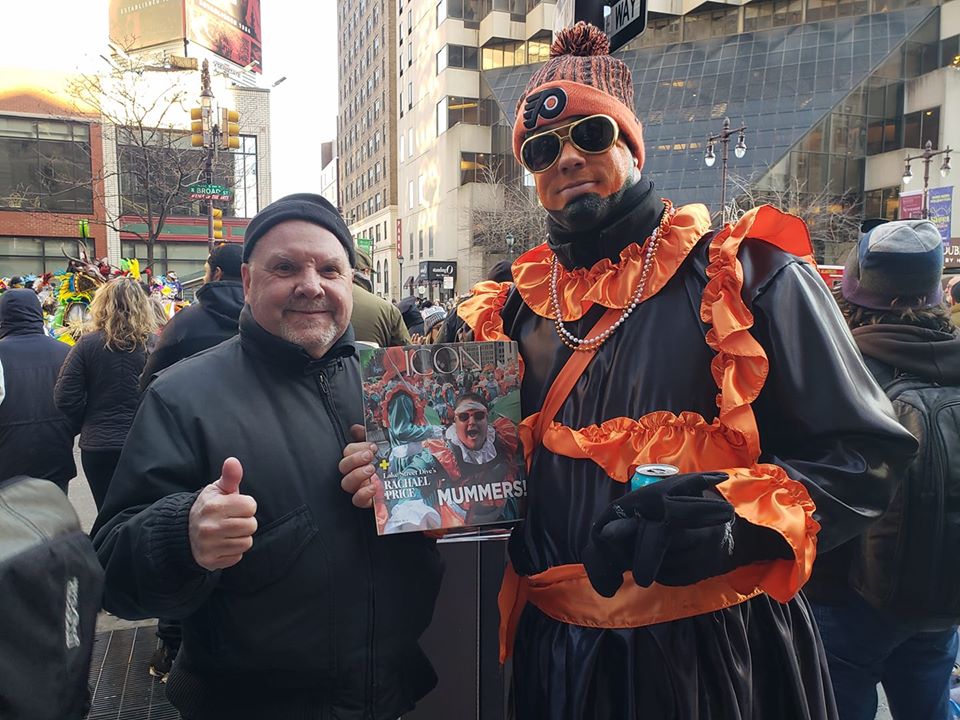
    Dan Aubrey, my long-suffering arts editor at U.S. 1 Newspaper – PrincetonInfo, is displaying his Philadelphia Mummers photos, alongside those of retired newspaper photographer Bryan Grigsby, as part of the exhibition “Mummers X 2,” at Trenton Free Public Library through February 28.

    A reception will be held at the library this afternoon from 3:00 to 4:30 p.m., and I’m told there will be complimentary Philly soft pretzels. Everyone craves carbs when it snows, right? Just be careful driving.

    Mummers x 2 Exhibit Opens at Trenton Public Library


    SO META: A photo of Dan (left), posing with a Mummer, who in turn is holding a magazine with a photo of a Mummer taken by Dan


  • Barry Tuckwell Legendary Hornist Dies at 88

    Barry Tuckwell Legendary Hornist Dies at 88

    by 

    in
    6 responses

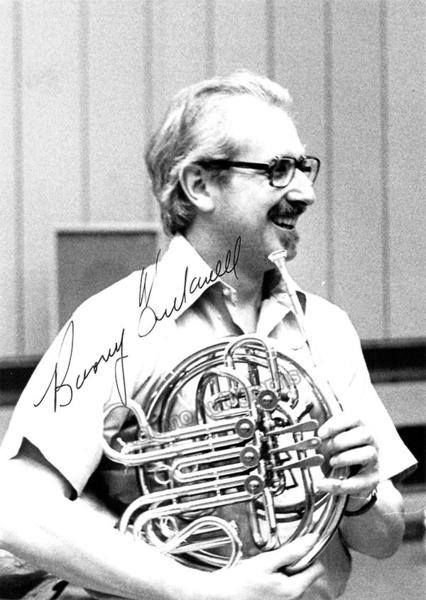
    Legendary hornist Barry Tuckwell has died. Tuckwell was principal horn of the London Symphony Orchestra and a widely recorded soloist.

    Born in Melbourne in 1931, he didn’t discover the horn until the age of 13. Following lackluster studies on the piano, organ and violin, he embraced the instrument as if it were love at first sight. Within six months, he was playing professionally. In two years, he was appointed principal horn with the Melbourne Symphony Orchestra. Soon after, he became principal of the Sydney Symphony.

    When Dennis Brain was killed in an automobile accident in 1957, Tuckwell became, incontestably, Britain’s foremost hornist at the age of 24. He had been appointed first horn with the London Symphony Orchestra in 1955, playing alongside other rising young players Neville Marriner and Gervase de Peyer. He remained with the LSO for 13 years.

    Following his departure, he became one of the rare hornists to make a career as a soloist. He would be nominated for a Grammy Award three times.

    His farewell appearance was in Oliver Knussen’s Horn Concerto, a piece written for him, with the Baltimore Symphony Orchestra, in 1997. By that time, he had already established a parallel career as a conductor.

    Tuckwell left behind over 50 recordings. His repertoire spanned the Baroque to the present, including acclaimed recordings of Mozart and Strauss and many contemporary composers.

    He cited Tommy Dorsey as a principal influence. On one occasion, he recollected, he was approached by an awestruck Japanese fan, who stammered, “You, God of Horn.” Thereafter, Tuckwell wryly appended the letters GoH to his personal email.

    Tuckwell died yesterday at the age of 88.

    https://www.abc.net.au/classic/read-and-watch/news/vale-barry-tuckwell/11876484


  • Dystopian Film Soundtracks

    Dystopian Film Soundtracks

    by 

    in
    3 responses

    If you think the world is in rough shape now, consider tomorrow.

    This week on “Picture Perfect,” gaze into the crystal ball for an hour of dystopian visions – glimpses of a bleak future rendered hopeful, in large part, through music.

    “Fahrenheit 451” (1966), based on the Ray Bradbury novel, presents a society in which books are outlawed by the state and burned as a means to control the masses. The title refers to the alleged temperature at which paper will ignite. Oskar Werner and Julie Christie star in this Francois Truffaut-directed film. Composer Bernard Herrmann finds the heart at fire’s center.

    A robot is left behind to clean up a long-abandoned Planet Earth, in “WALL-E” (2008), one of Pixar’s finely-crafted entertainments. This one has a serious subtext, about rampant consumerism and its impact on an earth made uninhabitable by the sheer volume of garbage. But there’s also a love story, as WALL-E pursues another robot into outer space, with fate-changing consequences. The inventive score is by Thomas Newman.

    As dystopias go, Steven Spielberg’s “A.I.: Artificial Intelligence” (2001) is a little more unpleasant than most. “A.I.” grew out of an incomplete project of Stanley Kubrick. Based on Brian Aldiss’s short story, “Super-Toys Last All Summer Long,” the film stars Haley Joel Osment as a child-like android programmed to love, only to be rejected by his adopted family. Abrasive blood sport, unpleasant visions of a debauched city, and human extinction ensue. A great time is had by all!

    Also, the film doesn’t know when to end. I hate this movie.

    That said, John Williams gives it his usual best. The voice of soprano Barbara Bonney graces the admittedly gorgeous soundtrack.

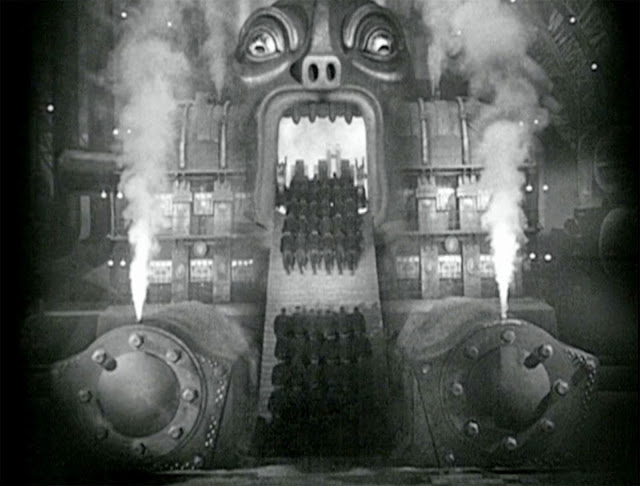
    One of the landmarks of silent cinema, Fritz Lang’s “Metropolis” (1927) is an eerily prescient vision of a world divided between the “haves” and “have-nots.” Once seen, the subterranean hell of the workers “hive” is not soon to be forgotten. So much of the film continues to resonate, even as its iconography is shamelessly recycled.

    Gottfried Huppertz’s original score already adheres to the Straussian model of Golden Age film scores, with leitmotifs representing the characters and ideas. It’s a concept that became associated with Max Steiner and Erich Wolfgang Korngold, and which has had an enormous influence on film composers down through the decades, all the way to John Williams and beyond.

    Learn more about the challenges of writing such a complex score – which was performed live, with orchestra, at showings of the movie, even as the film was still being edited right up until its premiere – when listening to tonight’s show.

    In the meantime, hang on to your humanity! Join me for these cautionary tales about totalitarian government, corporate control, and technology gone awry, on “Picture Perfect,” this Friday evening at 6:00 EST, on WWFM – The Classical Network and wwfm.org.
  • Remembering Barry Tuckwell on The Classical Network

    Remembering Barry Tuckwell on The Classical Network

    by 

    in
    6 responses

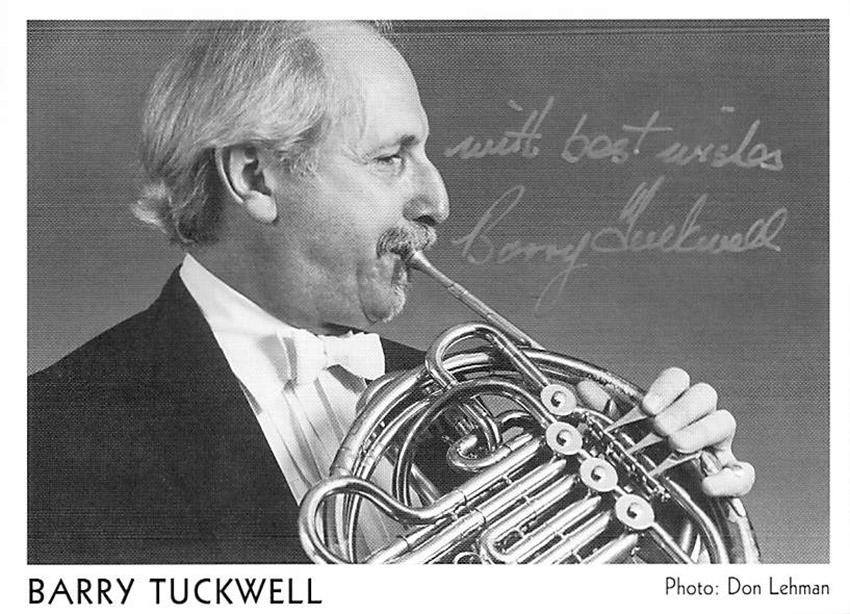
    This afternoon on The Classical Network, we’ll remember Barry Tuckwell. Tuckwell, one of the greatest hornists of his generation, died yesterday at the age of 88. He was one-time principal horn of the London Symphony Orchestra, who splintered off to record widely as a soloist.

    We’ll begin the 4:00 hour today, with some samples of his artistry (Telemann, Knussen and Strauss). Then we’ll observe the anniversaries of the birthdays of Wilhelm Kienzl, François-Joseph Gossec, Ulysses Kay, and Afro-Cuban violinist José Silvestre White y Lafitte.

    At 6:00, it’s an hour of dystopian visions on “Picture Perfect,” music for the movies, including selections from “Fahrenheit 451” (Bernard Herrmann), “WALL-E” (Thomas Newman), “A.I. Artificial Intelligence” (John Williams), and “Metropolis” (Gottfried Huppertz).

    That should be enough to wet your whistle. Music is our valve, as we celebrate Tuckwell and company, from 4 to 7 p.m. EST time, on WWFM – The Classical Network and wwfm.org.

  • Tuckwell’s Mozart Horn Grooves

    Tuckwell’s Mozart Horn Grooves

    by 

    in
    3 responses

    Barry Tuckwell’s grooviest Mozart?


Tag Cloud

Aaron Copland (93) Beethoven (95) Composer (114) Film Music (145) Film Score (143) Film Scores (255) Halloween (94) John Williams (195) KWAX (229) Leonard Bernstein (104) Marlboro Music Festival (125) Movie Music (160) Mozart (91) Opera (213) Philadelphia Orchestra (89) Picture Perfect (174) Princeton Symphony Orchestra (109) Radio (88) Ross Amico (244) Roy's Tie-Dye Sci-Fi Corner (290) The Classical Network (101) The Lost Chord (269) Vaughan Williams (105) WPRB (397) WWFM (881)

DON’T MISS A BEAT

Receive a weekly digest every Sunday at noon by signing up here


RECENT POSTS