• Remembering William Hootkins Star Wars to Batman

    Remembering William Hootkins Star Wars to Batman

    by 

    in
    6 responses

    Does anyone else remember William Hootkins?

    Somehow I wound up on his Wikipedia page, while scrambling down the rabbit hole in search of more information on a Lalo Schifrin piano concerto. Schifrin is the composer of over 100 film and television scores, including those for “Cool Hand Luke,” “Bullitt,” “Dirty Harry,” “Enter the Dragon,” “Rush Hour,” and of course “Mission: Impossible.”

    You know how it is. You look up a recording, then the artist, you click on a link to the composer, glance over his film credits, click on a film, and then take a look at the cast. In this case, while running my eyes down a page devoted to a totally forgotten 1998 film called “Something to Believe In,” I recognized a familiar name in the role of “Car Dealer.”

    Although his parts were generally quite small, William Hootkins was a highly visible character actor to those of us of the “Star Wars” generation. He would have first been imprinted on our consciousness as Rebel pilot Jek Porkins (a.k.a. Red Six) during the climactic dogfight over the first Death Star.

    He was also Major Eaton, who sent Indiana Jones on his quest for the Ark of the Covenant in “Raiders of the Lost Ark.” He played a corrupt cop in Tim Burton’s “Batman,” opposite Jack Nicholson. He was Dr. Zarkov’s turncoat assistant in 1980’s “Flash Gordon.” He also appeared in a couple of “Pink Panther” films, “A River Runs Through It,” and the 1996 version of “The Island of Dr. Moreau.”

    The same year as “Star Wars,” 1977, he played Fatty Arbuckle in Ken Russell’s “Valentino.” At the time of his death, he was at work on a screenplay for a projected biopic in which he planned to reprise his role as the disgraced silent comic.

    On stage, Hootkins scored his biggest success as Alfred Hitchcock, in a London production of “Hitchcock Blonde.” With talk of a Broadway opening, it seemed as if he was poised for wider recognition at last. Sadly, he was diagnosed with pancreatic cancer. The illness would claim his life in 2005, at the age of 57. “Hitchcock Blonde” was not performed in the United States until a year after his death.

    “Hoot” was born in Dallas, Texas, in 1948. A high school classmate of Tommy Lee Jones, he attended Princeton University, where he pursued astrophysics and oriental studies. It was John Lithgow who recommended he study acting at the London Academy of Music and Arts.

    Hoot’s residence in the UK made him easily accessible to American productions that set up shop at Elstree and Pinewood Studios.

    Although he was rarely onscreen for more than a few minutes, he was always a memorable presence. His prolific film work ensured a kind of cumulative recognition.

    I am posting about him here because of his unexpected Princeton connection, and as one of millions of adolescents who actually gave a hoot about Hootkins.


  • Scarlatti’s Cat Fugue Halloween Music

    Scarlatti’s Cat Fugue Halloween Music

    by 

    in
    3 responses

    31 DAYS OF HALLOWEEN (DAY 26)

    On the birthday of Domenico Scarlatti, beware his “Cat’s Fugue.” Scarlatti’s feline companion, Pulcinella, used to walk across the keys of his harpsichord. The story goes that on one of those occasions, the composer jotted down the notes and used it as the lead subject for his famous sonata. Spooky.


  • Vampire Movie Soundtracks from Page to Screen

    Vampire Movie Soundtracks from Page to Screen

    by 

    in
    5 responses

    This week on “Picture Perfect,” it’s all widow’s peaks and plastic fangs, as we listen to music from film adaptations of novels about vampires.

    “Interview with the Vampire” (1994), based on the novel by Anne Rice, featured some pretty counterintuitive casting, including Tom Cruise as Lestat (Rice would have preferred Rutger Hauer), but thanks largely to director Neil Jordan the film still managed to deliver the goods. Elliot Goldenthal’s music was nominated for an Academy Award. Interestingly, the American Boychoir sings the opening “Libera me.”

    Frank Langella’s characterization of Bram Stoker’s Dracula drove the critics wild when the play by Hamilton Deane and John L. Balderston was revived on Broadway in 1977. (It was the same adaptation that launched Bela Lugosi on his big screen career.) But when the film “Dracula” (1979) was released a couple of years later, reviews were mixed. Langella retained his dreamy magnetism, and the producers managed to secure Sir Laurence Olivier and Kate Nelligan for the parts of Van Helsing and Mina, respectively, but I wonder if John Badham was the best choice for director. Badham had just come off the enormous box office success of “Saturday Night Fever,” and it looks as if his Dracula retains John Travolta’s hair. You know, just for luck.

    I remember being so excited, as a 13 year-old, watching the trailer at the movies. When Langella leaped through a window and transformed into a wolf in mid-flight to John Williams’ dramatic music, it was almost more than I could bear. Watch the trailer here:

    https://www.youtube.com/watch?v=ydj01YcD83A

    How could a film called “Abraham Lincoln: Vampire Hunter” (2012) ever live up to its title? The answer is, it can’t, but the adaptation of Seth Grahame-Smith’s supernatural-historical mash-up wasn’t as terrible as everyone says it was. Sure, I would have preferred it had Daniel Day-Lewis played Lincoln, but put anybody in a stove-pipe to fight vampires with an axe, and I’m happy. I probably wouldn’t have been so permissive had I seen it in the theater, where the noise and effects would have pushed me over the edge, but it was a diverting rental, with a gothic score by Henry Jackman that ping-ponged between Americana lyricism and an orchestra bolstered by electronics and heavy metal guitars. But what are you going to listen to when you’re fighting vampires, a string quartet?

    James Bernard’s music for Hammer Studios’ “Dracula,” released in the United States as “Horror of Dracula” (1958), is one of his best-known efforts. His Dracula theme, with its clashing harmonies, laid the groundwork for the sound of the film’s numerous sequels, most of which featured Christopher Lee in his most iconic role. Bernard became so closely associated with Hammer and vampires that he was approached late in life to provide a new score for the silent classic “Nosferatu.”

    Finally, “Bram Stoker’s Dracula” (1992), despite the claims of utmost fidelity in its very title, was not a faithful adaptation of Stoker’s book. Why? WHY??? The film was lovely to look at, with eye-popping costumes and production design that combined Universal Studios in-the-camera trickery and honest-to-goodness miniatures with a few more Jean Cocteau references than perhaps was for its own good. This could have been THE Dracula film. Alas, it wasn’t. However, for me, it had THE Dracula score. It was a stroke of genius to hire Polish composer Wojciech Kilar to give the film just the right Eastern European sound.

    Get your blood up, with page-to-screen vampires this week, on “Picture Perfect.” Watch out for those paper cuts, this Friday evening at 6:00 EDT, on WWFM – The Classical Network and wwfm.org.


  • Superman vs Frankenstein Halloween Tunes

    Superman vs Frankenstein Halloween Tunes

    by 

    in
    2 responses

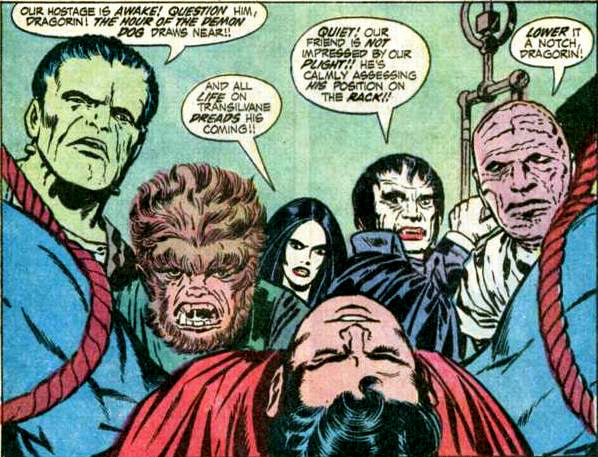
    31 DAYS OF HALLOWEEN (DAY 25)

    Poor Kal-El. Lone survivor of the planet Krypton, and here he is, once again besieged by monsters. Thank you, Jack Kirby!

    “Herr Supermann” from HK Gruber’s “Frankenstein!!”

    And Moritz Eggert’s “The Son of the Daughter of Dracula Versus the Incredible Frankenstein Monster (from Space),” with two theremins.

    Enjoy all your pleasures at once.


    ARTWORK: Superman’s Pal, Jimmy Olsen #143 (1971)


  • George Crumb American Original at 90

    George Crumb American Original at 90

    by 

    in
    6 responses

    George Crumb is an American original, the reigning Grand Old Man of American Music. Crumb, who makes his home in Swarthmore, PA, produces works with an economy and elegance that seem to contradict – and yet, somehow, paradoxically, to reinforce – an Ivesian tendency to suggest greater vistas beyond their seemingly modest means.

    On a more visceral level, sometimes they can be downright scary. Which is especially amusing since, by all accounts – and supported by my own experience, having met him perhaps five or six times – he has been unfailingly approachable, modest and even cheerful.

    It’s fortuitous indeed that his birthday falls so close to Hallowe’en. It’s not for nothing that his work for electric string quartet, “Black Angels,” was used in “The Exorcist.”

    Crumb has enjoyed a remarkable Indian summer, drawing on the hymns and folk songs of his West Virginia boyhood and lending them a unique resonance through his imaginative and colorful use of percussion. These are collected into seven cycles for voice titled “American Songbook” – remarkably effective and affecting works, especially when heard live in concert, where the breadth and subtlety of the instrumentation can be fully appreciated.

    Just because you’ve been pigeonholed as an avant-gardist doesn’t mean your music can’t be fun. “Mundus Canis” (“A Dog’s World”) is a musical portrait gallery for guitar and percussion inspired by the Crumbs’ family pets. Five of them are enshrined in the suite: Tammy, Fritzi, Heidel, Emma-Jean and Yoda. Apparently Yoda, a fluffy white mixed-breed, adopted from a New York City pound, was especially disobedient.

    “Mundis Canis”

    Many happy returns to George Crumb on his 90th birthday!


    “Black Angels” (wait until after breakfast)


    From his “American Songbook:”

    “All the Pretty Horses”

    “Poor Wayfaring Stranger”

    “One More River to Cross”

    “Give Me That Old Time Religion”


    PHOTO: George Crumb with “bad dog” Yoda


Tag Cloud

Aaron Copland (93) Beethoven (95) Composer (114) Film Music (145) Film Score (143) Film Scores (255) Halloween (94) John Williams (195) KWAX (229) Leonard Bernstein (104) Marlboro Music Festival (125) Movie Music (160) Mozart (91) Opera (213) Philadelphia Orchestra (89) Picture Perfect (174) Princeton Symphony Orchestra (109) Radio (88) Ross Amico (244) Roy's Tie-Dye Sci-Fi Corner (290) The Classical Network (101) The Lost Chord (269) Vaughan Williams (105) WPRB (397) WWFM (881)

DON’T MISS A BEAT

Receive a weekly digest every Sunday at noon by signing up here


RECENT POSTS