31 DAYS OF HALLOWEEN (DAY 17)
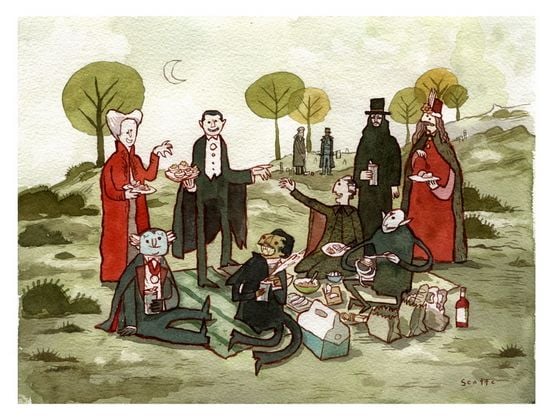
Eat your heart out, Debussy – or the Count will do it for you!
“L’après-midi du Dracoula” by Robert Moran:
IMAGE: “Picnic with the Draculas,” Scott Campbell
by
31 DAYS OF HALLOWEEN (DAY 17)
Eat your heart out, Debussy – or the Count will do it for you!
“L’après-midi du Dracoula” by Robert Moran:
IMAGE: “Picnic with the Draculas,” Scott Campbell

by
Autumn comes to Vermont on this week’s “Music from Marlboro,” as Pablo Casals conducts the Marlboro Festival Orchestra in a performance of Wolfgang Amadeus Mozart’s Symphony No. 40 in G minor.
Of Mozart’s 41 numbered symphonies, only two are cast in a minor key. (The other, in case you’ve forgotten, is the Symphony No. 25, also in the key of G minor.) This is the Mozart of shadows and dark poetry. The performance, from 1968, is a strong one, propulsive and compelling, with a powerful sense of purpose. It’s hard to believe the maestro was 91 years-old!
Some of Casals’ recordings as conductor can be a little raggedy from time to time – this was, after all, a makeshift ensemble, albeit one made up of some of the world’s greatest musicians – but any rough edges are of secondary consideration, when taking into account the spontaneity and excitement of the live concert experience. In the case of Mozart’s 40th, the players follow their leader with uncanny precision and plenty of fire.
Franz Schubert’s “Introduction and Variations on ‘Trockne Blumen’” takes its theme from his song cycle “Die schöne Müllerin.” These settings of poems by Wilhelm Müller form a narrative about a wanderer who falls in love with a miller’s beautiful daughter (hence, the title). Unfortunately, he is supplanted in her affections by a strapping hunter bedecked in green. The color becomes something of a morbid obsession. The wanderer fantasizes about his own death and ultimately drowns himself in the stream that had led him to the mill.
“Trockne Blumen” (“Withered Flowers”) is one of the last songs in the cycle. The wanderer imagines reclaiming his dried-up flowers from the miller’s daughter and bearing them to his grave, from which, he muses, they will spring afresh as witnesses to his true love.
Schubert’s variations on his own song were performed at the Marlboro Music Festival in 1968, by flutist Paula Robison and pianist Rudolf Serkin.
Remember that the first of this season’s Marlboro tours will take place from October 19th to October 27th, with stops in Groton, Massachusetts; Weill Recital Hall at Carnegie Hall in New York City; the Perleman Theater at the Kimmel Center for the Performing Arts in Philadelphia; the Freer Gallery’s Meyer Auditorium in Washington D.C., and at Longy School of Music in Boston.
On the program will be Mozart’s Oboe Quartet in F major, Beethoven’s String Quartet in F, Op. 59. No. 1, and a work by Brett Dean, for soprano and string quartet, “And Once I Played Ophelia” – Dean’s String Quartet No. 2. Brett Dean was composer-in-residence at Marlboro in 2017. For tickets and information, visit marlboromusic.org.
It’s withered flowers and minor keys, on this week’s “Music from Marlboro.” Mozart and Schubert get their brood on, this Wednesday evening at 6:00 EDT, on WWFM – The Classical Network and wwfm.org.
Marlboro School of Music and Festival: Official Page
by
31 DAYS OF HALLOWEEN (DAY 16)
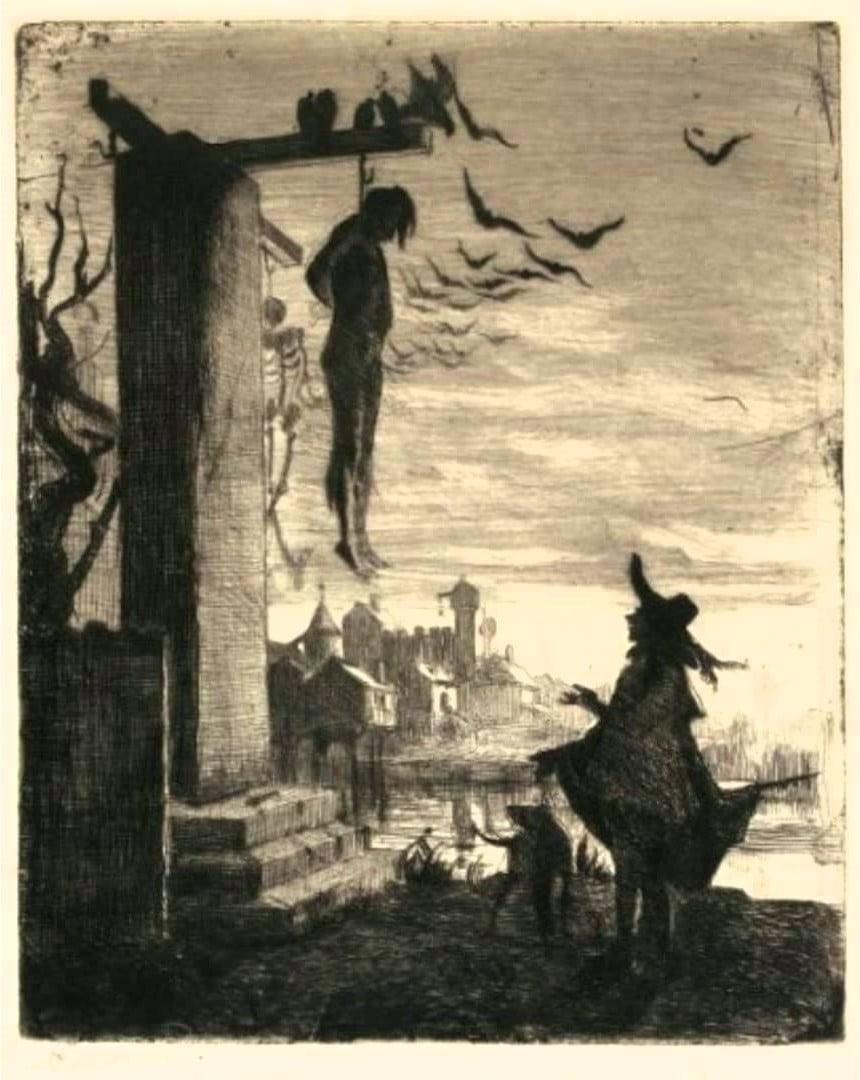
It’s a dark and stormy night. Keep an eye out for Ondine, Scarbo, and the hanged man on the gibbet! Sir John Gielgud recites Aloysius Bertrand’s poetry, and Gina Bachauer performs Maurice Ravel’s “Gaspard de la Nuit.”
by
For today’s Noontime Concert on The Classical Network, you had better pack a lunch. We’ll be bypassing the deli in favor of Delhi. The Akshara Music Ensemble will perform classical Indian music-inspired works, on a program given at the Downtown Concert Series in Freehold, NJ, this past May.
Founded in 2008, the award-winning Akshara is a pioneer in crossover music rooted in the Indian classical genre. Tune in for the distinctive sounds of the bansuri, the mridangam, and the tabla.
The Downtown Concert Series is presented at Freehold’s historic St. Peter’s Church. This season’s opening concert, a recital by pianist Janice Carissa, will take place on Saturday at 7:30 p.m. For more information, visit downtownconcertseries.org.
Following the noon broadcast, we’ll hear works on Indian themes, including Karl Goldmark’s “Sakuntula Overture” (after the Mahabharata), Gustav Holst’s “Choral Hymns from the Rig Veda,” and Wilhelm Stenhammar’s “Chitra,” inspired by the writings of Rabindranath Tagore.
We’ll also explore the opulent and distinctive sound world of pianist-composer Kaikhosru Shapurji Sorabji, born in Greater London, whose father was a civil engineer from Bombay.
John Foulds moved in the opposite direction, arriving India in 1935. There, he labored tirelessly to fulfill his vision of a synthesis between Eastern and Western music.
All of these artists were sincere in their admiration. I’ll do my best to sidestep any whiff of imperialism.
It’s an imaginary passage to Indian this afternoon, from 12 to 4 p.m. EDT, on WWFM – The Classical Network and wwfm.org.
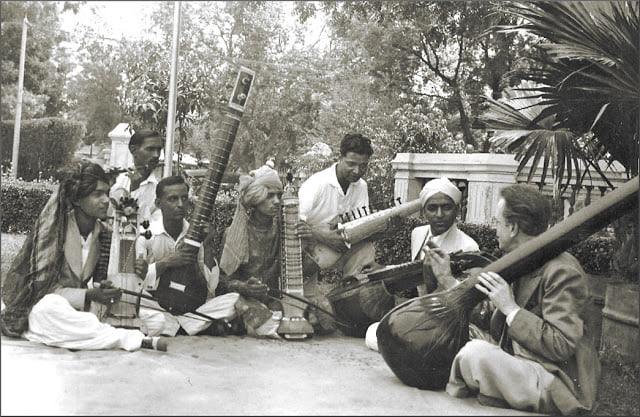
PHOTO: Original crossover artist John Foulds, with members of his Indo-European Orchestra
by
31 DAYS OF HALLOWEEN (DAY 15)
On this date in 1886, Modest Mussorgsky’s “A Night on Bald Mountain” was given its posthumous debut. The premiere took place in St. Petersburg, with the Russian Symphony Orchestra conducted by Nikolai Rimsky-Korsakov.
Mussorgsky’s rough-hewn textures, idiosyncratic harmony, slap-dash orchestration, and illogical modulations were often viewed as “mistakes” by his well-intentioned contemporaries. The composer was notoriously fond of alcohol, flamboyantly reckless, until a series of seizures sent him into a rapid decline. A week after his 42nd birthday, Modest Mussorgsky was dead.
Understandably, many of the artistic choices of this raging bull of a man were regarded with skepticism and even pity.
It is through the arrangements, revisions and completions of his friend, Rimsky-Korsakov, that “A Night on Bald Mountain,” “Boris Godunov,” and “Khovanschina” became world-famous. It is only in recent decades that Mussorgsky’s original thoughts have been reassessed. And you know what? The guy may have been a total slob, but he was brilliant.
“A Night in Bald Mountain” exists in several incarnations, the first dating all the way back to 1867. It was a symphonic poem; it was outfitted with a chorus for a collaborative project by members of the Mighty Handful (the opera-ballet “Mlada”); and it was plugged into one of Mussorgsky’s own operas, “Sorochinsky Fair,” left incomplete at the time of the composer’s death.
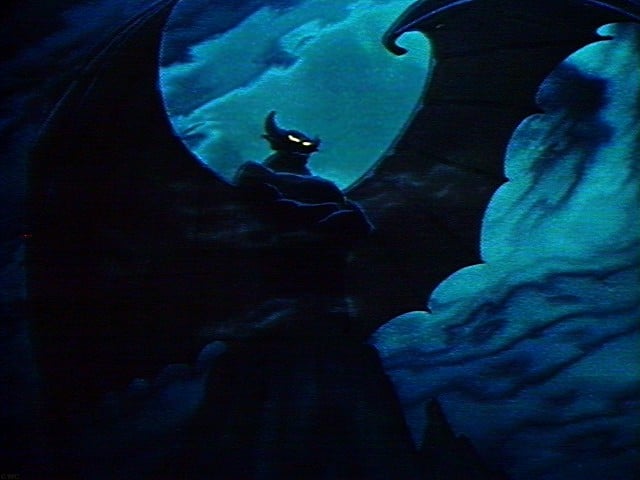
Some fifty years after “Bald Mountain’s” debut in the Rimsky edition, Leopold Stokowski made his own arrangement for the Walt Disney classic, “Fantasia.” And it’s been scaring the hell out of little kids ever since. Happy Hallowe’en!
Behold, the demon Chernabog:
“The Scary Origins of Disney’s Most Evil Character”
Aaron Copland (93) Beethoven (95) Composer (114) Film Music (145) Film Score (143) Film Scores (255) Halloween (94) John Williams (195) KWAX (229) Leonard Bernstein (104) Marlboro Music Festival (125) Movie Music (160) Mozart (91) Opera (213) Philadelphia Orchestra (89) Picture Perfect (174) Princeton Symphony Orchestra (109) Radio (88) Ross Amico (244) Roy's Tie-Dye Sci-Fi Corner (290) The Classical Network (101) The Lost Chord (269) Vaughan Williams (105) WPRB (397) WWFM (881)
2 responses