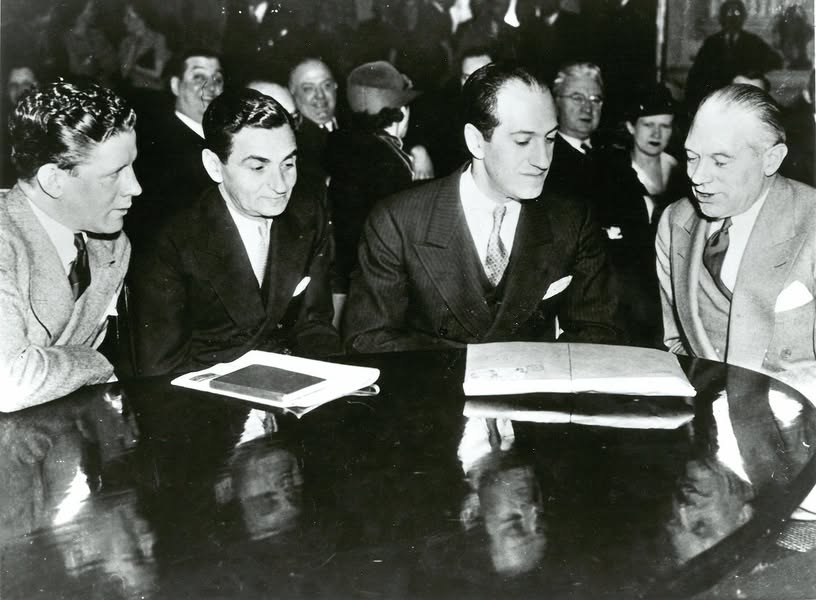
• George Antheil Bad Boy Genius Rediscovered

    George Antheil Bad Boy Genius Rediscovered

    by 

    in
    3 responses

    This week on “The Lost Chord,” Trenton’s Bad Boy makes good.

    George Antheil, self-proclaimed “Bad Boy of Music” (the title of his autobiography), sparked one of classical music’s great riots when his “Ballet Mécanique” was unveiled in Paris in 1926.

    The work made preposterous demands on performers and audience alike, with its battery of player pianos, sirens, bells, and airplane propellers – all difficult to coordinate, but worth it, if they were to transform concert halls into free-for-alls and secure Antheil’s status as enfant terrible. His notoriety earned him the respect, friendship, and envy of Paris’ artistic community. From the stage, he watched as Man Ray punched a heckler in the face, as Satie cheered, “Quel precision!,” and as Ezra Pound shouted, “Shut up, you are all stupid idiots!” Pound became one of Antheil’s most ardent champions, taking a break from poetry to publish an inflammatory book, “Antheil and the Treatise on Harmony.”

    Antheil speculated, perhaps facetiously, that his mechanistic nightmares may have been inspired by his having been born across the street from a noisy machine shop. In fact, a number of his works bear the boisterous imprint of the factories he knew in Trenton as a boy, including the “Airplane Sonata,” “The Death of Machines,” and the “Sonata Sauvage.”

    It was all rather forward-looking. Antheil was one of the first composers to search beyond conventional instruments for musical means. He not only presaged the alien soundscapes of Edgard Varèse, but also anticipated the stupefying repetitions of minimalism – though infusing his own compositions with enough violence to prevent them from ever becoming numbing. Stravinsky was his hero. He fed off the savagery of “The Rite of Spring,” then followed the master’s subsequent hairpin turn into neoclassicism. Both artists suffered a backlash from former idolaters who felt betrayed by what was perceived as a cowardly retreat into the past.

    In Antheil’s case, his reputation never recovered. The one-two punch of his Piano Concerto No. 2, transparently influenced by Bach, and the spectacular failure of his “Ballet Mécanique” to impress at its American premiere at Carnegie Hall (mostly due to faulty machinery) cast Antheil, rebel angel that he was, from the lofty heights of notoriety to the slag heap of has-beenery.

    But if it is true that the remainder of his career was indeed that of a has-been, we should all be so lucky.

    The composer of six symphonies, Antheil also wrote books on endocrinology and speculative war tactics, a murder mystery, a nationally syndicated column of advice to the lovelorn, and over 30 Hollywood film scores. With the actress Hedy Lamarr, he patented a torpedo guidance system that became the basis for modern Bluetooth, Wi-Fi, and cellular phone technology.

    I hope you’ll join me for music by this eccentric and multitalented figure, including “Ballet Mécanique,” in all its original, uncompromising glory; then selections from his neo-classical Piano Concerto No. 2, his wartime Symphony No. 4, and dance music from his score to the ballet film noir “Specter of the Rose.”

    That’s “Antheil Establishment” – three days before the composer’s birthday anniversary – on “The Lost Chord,” now in syndication on KWAX, the radio station of the University of Oregon!


    Clip and save the start times for all three of my recorded shows:

    PICTURE PERFECT, the movie music show – Friday at 8:00 PM EDT/5:00 PM PDT

    SWEETNESS AND LIGHT, the light music program – Saturday at 11:00 AM EDT/8:00 AM PDT

    THE LOST CHORD, unusual and neglected rep – Saturday at 7:00 PM EDT/4:00 PM PDT

    Stream them, wherever you are, at the link!

    https://kwax.uoregon.edu/


    PHOTO: Sylvia Beach acts as spotter as Antheil ascends to his second-story apartment, located above the legendary Parisian bookshop Shakespeare and Company


  • Americana Film Scores for the Fourth of July

    Americana Film Scores for the Fourth of July

    by 

    in
    2 responses

    This week on “Picture Perfect,” it’s my birthday AND the Fourth of July, so I’ve selected four Americana film scores to enjoy with sparklers and cake.

    Okay, so “To Kill a Mockingbird” (1962) is not the most celebratory film, but I don’t care – it’s a beautiful movie, based on a beautiful book (by Pulitzer Prize winner Harper Lee), with beautiful music by Elmer Bernstein, full of nostalgia and yearning, and a playful sense of fun when the kids are rolling in tires. It’s steeped in Americana, so I’m going with it. Gregory Peck is unforgettable as the forthright attorney and model father, Atticus Finch. FUN FACT: John Williams played the piano part in the original recording heard in the film.

    A rather more questionable role model is at the heart of “The Film-Flam Man” (1967), with George C. Scott as “Master of Back-Stabbing, Cork-Screwing and Dirty-Dealing” confidence man Mordecai C. Jones. Irvin Kershner directed, and Jerry Goldsmith’s music (harmonica, banjo, honky-tonk piano, etc.) lends to the film’s freewheeling spirit with a folksy, bluegrass-imbued score.

    Jerome Moross is largely recognized for his classic score for “The Big Country.” However, that sense of quintessential Americana colors much of his output, including, most sensitively, his music for “Rachel, Rachel” (1968). Joanne Woodward plays the isolated schoolteacher of the title (the character lives above a funeral parlor with her mother), who belatedly experiences passion and asserts her independence. The director was none other than Woodward’s husband, Paul Newman.

    Finally, we’ll turn to one of John Williams breakthrough scores, for “The Reivers” (1969), based on the semi-autobiographical novel of William Faulkner. The music, if possible, is even folksier and more frenetic than Goldsmith’s “The Flim-Flam Man” – though, typical of Williams, there is also an expansive sentiment and indefinable yearning to the more lyrical episodes.

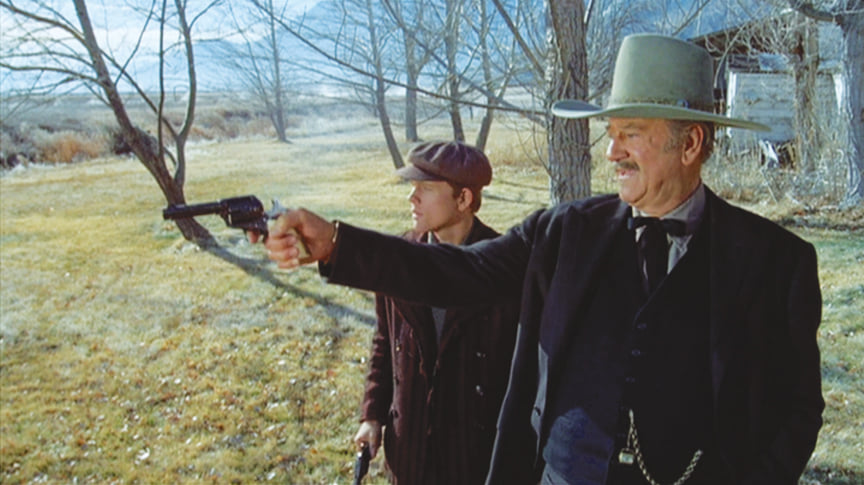
    It’s said that the composer’s work on “The Reivers” is what moved Steven Spielberg to hire him for “The Sugarland Express.” The Spielberg association brought Williams to “Jaws,” and the first of his truly iconic film scores. Williams collaborated with the director of THIS film, Mark Rydell, on a number of occasions, as well – on “The Cowboys,” “Cinderella Liberty,” and “The River.”

    I hope you’ll join me for a Fourth of July tug of war between rowdiness and sensitivity, with Americana film scores on “Picture Perfect,” music for the movies, now in syndication on KWAX, the radio station of the University of Oregon!


    Clip and save the start times for all three of my recorded shows:

    PICTURE PERFECT, the movie music show – Friday at 8:00 PM EDT/5:00 PM PDT

    SWEETNESS AND LIGHT, the light music program – Saturday at 11:00 AM EDT/8:00 AM PDT

    THE LOST CHORD, unusual and neglected rep – Saturday at 7:00 PM EDT/4:00 PM PDT

    Stream them, wherever you are, at the link!

    https://kwax.uoregon.edu/


  • Janáček Sci-Fi Opera & A Hi-Fi Crossword

    Janáček Sci-Fi Opera & A Hi-Fi Crossword

    by 

    in
    3 responses

    On Leoš Janáček’s birthday, I recollect that I was on my way to see “The Makropulos Case” at the Metropolitan Opera a number of years ago, when my car broke down on the New Jersey Turnpike. I never did get to see it. Janáček’s 1925 opera – based on a play by Karel Čapek, author of the novel “War with the Newts” and the play “R.U.R.” (credited with introducing the word “robot”) – is about a 337-year-old woman who, thanks to an elixir, is preserved in the flower of youth, but comes to regard life with clinical detachment.

    This is not Janáček’s only science fiction opera. Less-known, perhaps, is Janáček’s “The Excursions of Mr. Brouček to the Moon and to the 15th Century” – actually more of a fantasy, I suppose.

    These got me pondering, and not for the first time, the “lowly” genre of science fiction and its unlikely influence on the high art of classical music. The topic is still fresh in my mind from having recently revisited Karl-Birger Blomdahl’s 1959 opera “Aniara,” in which a journey to Mars goes horribly wrong, thanks to, of all things, a good old-fashioned Swedish celebration of Midsummer.

    During the pandemic in 2020, one of the things that kept me mentally engaged while doing menial chores around the house was compiling clues for a weekly crossword puzzle that I would post on Sunday mornings. The topic for the first week of October was “Hi-Fi Sci-Fi.”

    I know tomorrow is the 4th of July and the weekend is bound to be a busy one for many, but if you’re interested in bookmarking it for later, you’ll find a link to the puzzle below. Both Janáček operas (and “Aniara”) are among the clues.

    To fill out the puzzle, follow the link and select “solve online” at the bottom of the page. You’ll then be able to type directly into the squares. Once you feel you’ve exhausted the puzzle, you’ll find the solutions by clicking on “Answer Key PDF.”

    Test your knowledge of “Hi-Fi Sci-Fi” here:

    https://www.armoredpenguin.com/crossword/Data/2020.10/0407/04073509.417.html

    Happy birthday, Leoš Janáček!


    IMAGES (clockwise from upper left): Janáček; art deco stage design for “The Makropulos Case;” art nouveau cover art for libretto to “The Excursions of Mr. Brouček;” Čapek’s “Makropulos” novel


  • Gluck’s Orfeo Filmed Fresh Birthday Tribute

    Gluck’s Orfeo Filmed Fresh Birthday Tribute

    by 

    in
    5 responses

    On the anniversary of the birth of Christoph Willibald Gluck (on this date in 1714), here’s Interesting filmed production of his most famous opera, “Orfeo ed Euridice,” complete with Orpheus’ wake-up routine – bereft musicians should not leave home without laurels and lyre – periwigged orchestra and “thanks, Mean Joe” epilogue honoring the emotional truth of the mythological tale while undercutting the composer’s happy ending. American countertenor Bejun Mehta sings Orfeo, Austrian soprano Eva Liebau sings Euridice, and Václav Luks conducts Collegium 1704.

    The opera was filmed at the Baroque Theater of Český Krumlov Castle (every castle should have one) in the South Bohemian Region of the Czech Republic. The theater dates from 1767, within five years of the opera’s first performance (at the Burgtheater in Vienna in 1762). Gluck revised the work twelve years later, the better to suit the taste of Parisian audiences.

    The opera’s naturalistic expression and dramatic simplicity, with its rejection of the formulaic – ornamental arias interleaved with recitative and scene changes – proved highly influential. Here, the arias subvert formula and avoid grandstanding, serving a coherent drama, with an emphasis on sustained mood (melancholy) and poetry, as opposed to by-the-numbers fiery passions and vocal acrobatics.

    Gluck’s reforms, which would have been perceived as radical, pissing off showboating singers of the day and confusing, perhaps even frustrating, audience expectations, influenced sympathetic composers from Mozart to Weber, from Berlioz to Wagner.

    You might say, they was all shook by Gluck.

    Happy birthday, C.W.G.!


  • O Canada: Classical Roots of the Anthem

    O Canada: Classical Roots of the Anthem

    by 

    in
    2 responses

    Happy Canada Day! Let us honor the classical music heritage of the Canadian national anthem.

    The music was composed by Calixa Lavallée, a French-Canadian, who had been a Union band musician with the Fourth Rhode Island Regiment during the American Civil War. Lavallée was commissioned to write the piece in 1880 by Théodore Robitaille, then Lieutenant Governor of Québec, in anticipation of that year’s Saint-Jean-Baptiste Day celebrations.

    The words (in French) were added later, by Sir Adolphe-Basile Routhier. The first English translation was published in 1906. Two years later, an official translation, by Robert Stanley Weir, appeared. “O Canada” served as the country’s de facto national anthem beginning in 1939. It was officially adopted only in 1980!

    In 2020, musicologist Ross Duffin put forth that “O Canada” was not an original composition at all, but rather a patchwork of preexisting melodies from the classical repertoire. To which I say, what took him so long? Anyone with a passing knowledge of “The Magic Flute” knows that. Also, as far back as 2008, a listener wrote to inquire of me what was the name of the Franz Liszt composition I played that sounded so much like “O Canada?” All is revealed here, with musical examples below:

    https://www.theglobeandmail.com/arts/music/article-expat-musicologist-contends-o-canada-not-an-original-composition/

    A refresher on the Canadian anthem:

    One of its sources, from Mozart’s “The Magic Flute”:

    Variations on the theme from a Piano Sonata in F major by Anton Reicha:

    Listen for a familiar, repeated interlude in Liszt’s symphonic poem “Festklänge” (“Festive Sounds”), in this performance from across Lake Michigan:

    “Wach’ auf” from Wagner’s “Die Meistersinger”

    Finally, Matthias Keller’s “The American Hymn.” I confess, this one is new to me. For its discovery, I must tip my hat to Professor Duffin.

    It’s not inconceivable that Lavallée would have fulfilled his commission with a pastiche, a common enough practice among band musicians of the day. This is not to take anything away from the Canadian national anthem. As you may know, the melody for “The Star-Spangled Banner” was appropriated from a British drinking song!


    PHOTO: Rabbit rabbit, Canada style*

    (* Original postage stamp does not include flag. Also, they’re Arctic hares.)


Tag Cloud

Aaron Copland (93) Beethoven (95) Composer (114) Film Music (127) Film Score (143) Film Scores (255) Halloween (94) John Williams (190) KWAX (229) Leonard Bernstein (102) Marlboro Music Festival (125) Movie Music (142) Mozart (87) Opera (205) Philadelphia Orchestra (89) Picture Perfect (174) Princeton Symphony Orchestra (107) Radio (88) Ross Amico (244) Roy's Tie-Dye Sci-Fi Corner (290) The Classical Network (101) The Lost Chord (268) Vaughan Williams (103) WPRB (396) WWFM (881)

DON’T MISS A BEAT

Receive a weekly digest every Sunday at noon by signing up here


RECENT POSTS