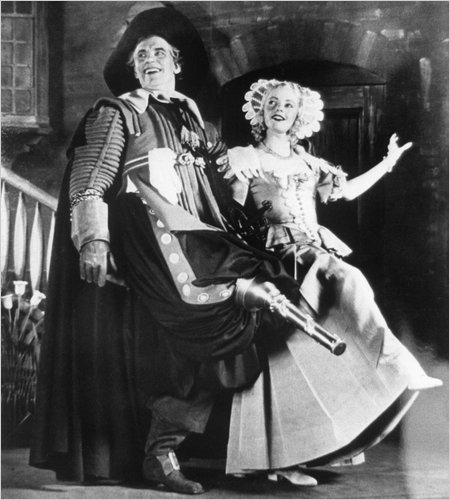
My goodness, it’s the last of September! It won’t be long now before I’ll be watching Walter Huston as Mr. Scratch in “The Devil and Daniel Webster” (1941). Here he is to sing Kurt Weill’s “September Song,” from “Knickerbocker Holiday” (1938). The lyrics are by Maxwell Anderson.
-
September Song Devil and Daniel Webster Movie
by
-
Kavalier & Clay Opera A Comic Book Masterpiece Revisited

by
5 responses
I’ve been revisiting Michael Chabon’s “The Amazing Adventures of Kavalier and Clay,” which I finally got around to reading for the first time only within the past decade. (The book won the Pulitzer Prize for Fiction in 2001.) I wanted it to be fresh in my mind when I see Mason Bates’ new opera at the Met next week. I’m a little over halfway through (I was hoping to knock it out before the first of October so that I can get on with my Halloween reading), and I’m loving it all over again.
First of all, I sense in the author a kindred spirit, as he obviously adores all the pop cultural detritus that I myself have been lapping up since childhood. He also has an enviable grasp of the history and the social history of New York, a mindboggling eye for detail, and a real flair for crafting playful similes that makes Ray Bradbury seem positively drab by comparison.
Of course, there’s a lot of comic book lore, both real and fabricated, as the dynamic duo of Joe Kavalier and Sammy Clayman, cousins, one European and one native, are brought together in a Brooklyn tenement to pool their talents in the creation of an unapologetically antifascist superhero, The Escapist. (Recall when Jack Kirby had the temerity to draw Captain America punching out Hitler a year before Pearl Harbor.) The team is also, I assume, inspired in part by Siegel and Shuster of “Superman” fame, both in terms of a crafting one of the first comic book superheroes and also getting screwed by their publishers.
But the story is lent a whole other, higher-stakes dimension through Joe’s plight, his separation from his family in his own escape from Nazi-occupied Prague, and later his efforts to have his younger brother to join him in safety in the United States. Joe’s passage is lent a touch of magical realism in the inclusion of a genuine Golem (folkloric protector of the Jews). Quite the ponderous symbol! Golems and escapists and explorations of the true nature of heroism pervade the narrative. The backdrop of the war, the Holocaust, and the tragedy that propelled so many immigrants to the United States haunts the American dream at a time when the U.S. is about to emerge – thanks in no small part to the ingenuity and hard work of European refugees – as the mightiest and most vibrant force in the history of the world.
Chabon shuffles a magic card deck, interleaving characteristics of the American Jewish experience and those of their displaced brethren with the worlds of classic comics, escape artists, magicians, strong men, surrealists, pulp writers, radio actors, Greenwich Village bohemians, the Empire State Building, the 1939 World’s Fair, “Citizen Kane,” and too many other subjects to catalogue. There’s even mention of a Karol Szymanowski Society (and Szymanowski’s “Songs of the Infatuated Muezzin”)!
It’s the rare modern novel that I wish I had written. We’ll see what Mason Bates does with it. I’m happy to see that some of The Escapist’s exploits will be brought to life through choreography and projections. If nothing else, it will be a spectacle. But it will be the music, especially idiomatic, ingratiating writing for voice, that will determine whether or not the opera will have legs. I can’t for the life of me imagine how one can cram so much incident into an opera. I assume librettist Gene Scheer worked with the composer to pare down the novel to what they believe is its essence. I am amused to find Salvador Dali, at least, made the final cut.
“The Amazing Adventures of Kavalier and Klay” runs at the Metropolitan Opera through October 11.
https://www.metopera.org/season/2025-26-season/the-amazing-adventures-of-kavalier–clay/
Photos taken during my recent trip to Lincoln Center to see Gustavo Dudamel conduct the New York Philharmonic, with the exception of the one of The Escapist cleaning Hitler’s clock, borrowed from the Met’s Facebook page
-
NJ Festival Orchestra Delights and Surprises

by
3 responses
While it was the prospect of experiencing those mighty brass fanfares at either end of Leoš Janáček’s “Sinfonietta” that got my antennae vibrating – and the added enticement of Manuel de Falla’s music from “The Three-Cornered Hat” that sealed the deal – the soul of this weekend’s program of the New Jersey Festival Orchestra was laid bare in the second movement of Max Bruch’s Violin Concerto No. 1. That’s when soloist Xiao Wang – a former student of Joseph Silverstein at the Curtis Institute, who now serves on the faculty of the Manhattan School of Music – caressed the heartstrings with his warm vibrato.
Conversely, Wang also brought the greatest thrill last night with his encore: a virtuoso transcription of Franz Schubert’s nightmarish “Erlkönig” (“The Erl-King”), a welcome foretaste of Halloween. Schubert’s most famous lied, or one of them, is derived from a Goethe ballad about a father on a galloping horse, riding hard through the swirling mists of a sinister forest, his ailing child held close, as he attempts to conceal his mounting desperation with consoling words. The child hallucinates that he hears and sees the Erl-King, a presentiment of death, whose enticements to join him bring increasingly frantic outbursts from the feverish boy, begging his father to protect him.
Wang seduced, hypnotized, and stunned, much like the Erlkönig himself, with his technical mastery of the piece, which I assume must have been the transcription by 19th century virtuoso Heinrich Wilhelm Ernst. He conveyed not only the white-knuckle drama of the song, but also the distinctive voices of each of its principals – father, son, and unholy ghost – producing trick after trick from his violinist’s quiver. The galloping horse hoofs, the Erl-King’s sweetly alluring voice, the child’s mounting intensity were all conveyed through an unsuspected variety of color, harmonics, pizzicati, and jaw-dropping double-stops. Truly, it was a marvel to experience.
The encore was one of several unanticipated bonuses of the evening, as the Imperial Brass – an amateur group associated with the Presbyterian Church of Westfield – was given the stage following the Janáček for an unadvertised mini-concert of John Williams’ “Imperial March,” Erik Leidzén’s “Notturno Religioso,” and Nikolai Rimsky-Korsakov’s “Procession of the Nobles,” under the direction of Ronald Waiksnoris. It always seems like the lower brass impress the most in these ensembles – I mean, they’ve got the trombones and euphoniums – while the higher instruments like the cornets and the trumpets sweat hard in navigating the showier passages.
Anyway, there’s something about the community brass band tradition, in that, though I admire it greatly, in theory, I confess, in practice, it often keeps me a little bit at arm’s length with its arrangements, especially with the baffling predilection for “wah-wah” that comes from over-employing mutes in the more lyrical passages. It must be a “brass thing.” That said, the group impressed and even thrilled when it was called on to bring the power.
Unfortunately, the brass was relegated to the balcony for the “Sinfonietta,” muting much of its effect, and I couldn’t help but wonder how much more impactful it would have been had the musicians been elevated on risers at the back of the stage.
Granted, the venue was the Presbyterian Church of Westfield (about an hour’s drive north of me), but the orchestra itself played on a platform of several feet. I understand it’s effort and expense, and who knows, maybe the church couldn’t accommodate such a thing, but it would have been so much more satisfying had the brass had its own platform at the rear.
That said, the orchestra itself, made up of presumably freelance musicians of very high quality (Westfield is easily accessible from New York and its pool of superior talent), acquitted itself well under the baton of its longtime music director David Wroe. The loss in the brass was more than compensated for by being up close to Janacek’s strings and, behind them, the nimble woodwinds.
After the brass band mini-concert, there was a brief intermission before the Bruch. Then came both suites from “The Three-Cornered Hat,” yet another Ballets Russes triumph, originally presented with choreography by Léonide Massine and costumes and designs by Pablo Picasso. I’ve heard this music played by larger bands, but here the orchestra performed with enough color and testosterone to effectively sell the score. It was instructive to have a sightline to the harp, which emphasized Falla’s sensitivity to color, which can sometimes get a little lost in all the preening.
I noted with bemusement that the concert was marketed as “The Gypsy Spirit” – are we even allowed to use the G-word anymore? – despite the fact that nothing on the program had any connection whatsoever to the Romani people. But hey, I don’t care, and I don’t think anyone else did either. There were no protestors, and everyone seemed to enjoy themselves. As usual at these events, most of the audience was old enough that their conception of Gypsies was probably formed when having seen Maria Ouspenskaya as Maleva the fortuneteller in the Lon Chaney version of “The Wolfman.” I confess, though I’m still somehow younger, mine was too. (Hey, it’s better than the Port Authority.)
I’ve known about the New Jersey Festival Orchestra for a long time – from back in the days when it was still called the Westfield Symphony Orchestra, in fact. For a few years, they were providing live accompaniment to silent movies around Halloween. And not all of them were horror movies, mind you. In 2011, I was invited to give the preconcert talk for Douglas Fairbanks’ “The Iron Mask,” after the scheduled speaker fell off a horse. (I had written a newspaper article previewing the event, which must have been cursed since, on top of that, it had also been postponed because of a freak Halloween snowstorm!)
Two seasons ago, Wroe and his orchestra managed a luminous performance of Vaughan Williams’ Symphony No. 5, which I still recall in its visceral and spiritual impact, and for which I will be forever grateful.
I should probably add that while my seat was better than it might have been (in a cushioned pew probably seven rows from the stage, as opposed to in one of the side-pews under the curving balcony), the next time I attend at this venue, I will try for a seat in the rear balcony, which seems the optimal vantage point for this particular hall – which I have to say, is an impressive space, a truly lovely, uncluttered church with, it would seem, pretty good acoustics.
Summing up, it was a program of characterful music – except for the Bruch, not exactly overexposed – all well-played by a competent ensemble of skilled musicians. I don’t know about you, but I would happily travel an hour for that kind of experience. The program will be repeated at the Sieminski Theater in Basking Ridge, NJ, this afternoon at 2:30.
For more information – and to witness the building of the platform at the Westfield venue (through the magic of time-lapse photography) – visit the orchestra’s website.
-
Beethoven & Beyond Sonatina Delights on KWAX
by
2 responses
Think a sonatina for mandolin and piano is a bit far-fetched? Tune in to hear what Beethoven made of it.
This morning on “Sweetness and Light,” the unifying theme is sonatinas, or “little” sonatas.
Florent Schmitt’s “Sonatine en Trio” is a happy discovery indeed. There’s a certain neoclassic quality to the music, which we’ll hear in a version for flute, cello and piano, by a French composer whose orchestral works can be quite opulent. The title itself seems to harken back to an earlier time. In fact, the keyboard part was originally conceived for harpsichord. It’s cheering music, and I think you’ll agree, a great start to the day!
Carlos Guastavino is largely remembered for his songs. He wrote his Sonatina while visiting Manuel de Falla, who spent his final years in self-imposed exile in Cordoba, Argentina, following the Spanish Civil War. We’ll hear it performed by Gila Goldstein from a Centaur Records release, “Latin American Piano Gems,” a transporting collection of works by Ernesto Lecuona, Astor Piazzolla, Manuel Ponce, and Heitor Villa-Lobos.
We’ll also hear Philadelphia composer Romeo Cascarino’s Bassoon Sonata, written after World War II for his Army buddy Sol Schoenbach, principal bassoonist of the Philadelphia Orchestra. “Sonatina” may not be in the title, but the character is light, and the sonata is only seven minutes long!
The program will also include delights by Federico Moreno Torroba, Eugène Bozza, and Erik Satie.
A cup of coffee, a scone, and a soundtrack of sonatinas. Give thanks for life’s “Small Pleasures” on “Sweetness and Light,” this Saturday morning at 11:00 EDT/8:00 PDT, exclusively on KWAX, the radio station of the University of Oregon!
Stream it wherever you are at the link:
-
Shilkret’s Genesis Suite Schoenberg Stravinsky

by
4 responses
The creation of the heavens and the earth may have taken six days, but Nathaniel Shilkret and I only have one hour.
This week on “The Lost Chord,” I hope you’ll join me for a true curiosity, a collaborative effort organized by Shilkret – a child prodigy from Queens who was associated with the New York Philharmonic, the Metropolitan Opera, the Victor Herbert Orchestra, the Sousa Band, the Victor Talking Machine Company (later RCA Victor), NBC Radio, the RKO and M-G-M movie studios, and concerts and recordings featuring many of the starriest jazz and classical artists of his time – who managed to cajole a number of the day’s greatest composers, then living in California, into contributing to a seven-movement piece for narrator, chorus and orchestra.
Take a gander at the layout for the “Genesis Suite” (1943):
“Prelude (The earth was without form),” composed by Arnold Schoenberg;
“Creation,” by Shilkret;
“Adam and Eve,” by Alexandre Tansman;
“Cain and Abel,” by Darius Milhaud;
“Noah’s Ark,” by Mario Castelnuovo-Tedesco;
“Babel,” by Igor Stravinsky;
and “The Covenant,” by Ernst Toch.
No one can accuse the project of a lack of ambition!
The “Genesis Suite” is the only time the twin titans of twentieth century music, Schoenberg and Stravinsky, were to collaborate on the same piece – though they never actually worked together. The two men were highly suspicious of one another, to put it mildly, and rehearsals had to be carefully calibrated so as to keep both composers from showing up at the same time. On the one occasion when they did, they remained aloof on opposite ends of the hall.
I give more background on the show – probably more than is necessary – but it’s all very interesting, I hope. That’s “First Among Equals” – Nathaniel Shilkret and the “Genesis Suite” – on “The Lost Chord,” now in syndication on KWAX, the radio station of the University of Oregon!
Clip and save the start times for all three of my recorded shows:
PICTURE PERFECT, the movie music show – Friday at 8:00 PM EDT/5:00 PM PDT
SWEETNESS AND LIGHT, the light music program – Saturday at 11:00 AM EDT/8:00 AM PDT
THE LOST CHORD, unusual and neglected rep – Saturday at 7:00 PM EDT/4:00 PM PDT
Stream them, wherever you are, at the link!
IMAGE: Adam and Eve (1526) by Lucas Cranach the Elder
Tag Cloud
Aaron Copland (93) Beethoven (95) Composer (114) Film Music (144) Film Score (143) Film Scores (255) Halloween (94) John Williams (195) KWAX (229) Leonard Bernstein (104) Marlboro Music Festival (125) Movie Music (159) Mozart (91) Opera (212) Philadelphia Orchestra (89) Picture Perfect (174) Princeton Symphony Orchestra (109) Radio (88) Ross Amico (244) Roy's Tie-Dye Sci-Fi Corner (290) The Classical Network (101) The Lost Chord (269) Vaughan Williams (105) WPRB (397) WWFM (881)
5 responses