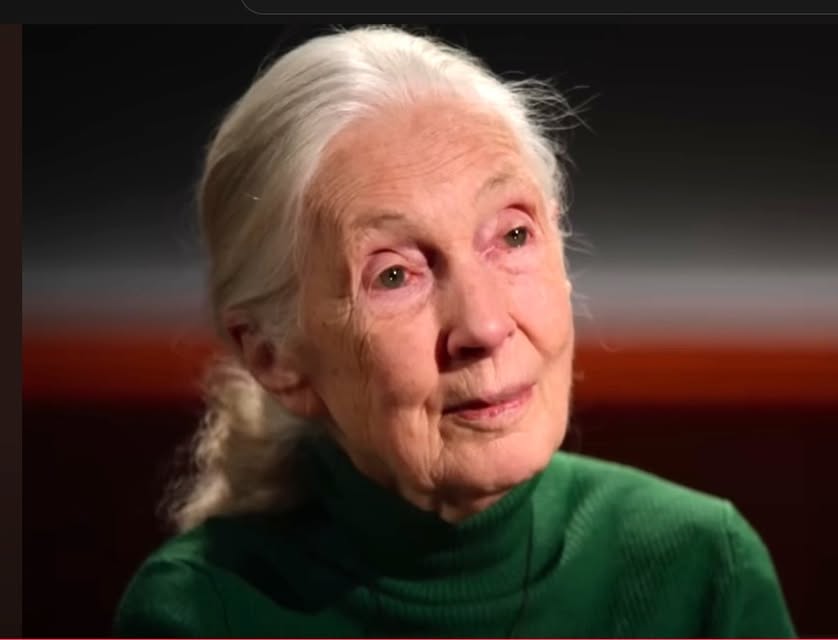
If you have Netflix and you haven’t watched this yet, you should. It’s 55 minutes very well spent. The interview was recorded with the specific intention to offer it for streaming after Jane Goodall’s death.
There are few surprises – she was a genuinely good person, and a wise one – but she’s magnetic in her serenity and honesty and insight. In particular, her true last words, after the interviewer gets up and leaves the room at the end and she’s left alone with the remotely-operated cameras, are important for everyone to hear. I don’t care what political axe you may have to grind, if any. If you aren’t touched by her humanity, I am sorry for you.
I’ve refrained from saying anything about her death, because it’s outside the arts and not really in my wheelhouse – but it is, really, since her mission was always a holistic one and what happens to any of us affects all of us, human or animal.
Don’t react to anything you may have read in the press or on social media about what she says in the interview. There’s too much tendency in the modern world to have kneejerk reactions to soundbites. Real life isn’t tabloid news, and Jane encourages us to really listen to one another. I hope you will watch and listen and really take it all in.
There’s no questioning that hers was a life well-lived. I hope her vision of what the Hereafter may hold for her spirit has come to pass. If anyone has earned it, she has.
Just a clip from “Famous Last Words: Dr. Jane Goodall”:
The years, they do fly by. How can Yo-Yo Ma be 70? It seems only yesterday we were celebrating his 60th birthday.
Arguably the most visible and charismatic cellist of his generation, Ma was born on October 7, 1955. He’s recorded more than 90 albums and been recognized with 19 Grammy Awards. In addition, among innumerable other honors, he has been the recipient of the National Medal of the Arts and the Presidential Medal of Freedom. As recently as 2020, he was included in Time Magazine’s “100 Most Influential People.”
Ma began playing cello at the age of 4. That’s when he “put away childish things” – that is to say, a juvenile pursuit of the violin, viola, and piano! At 5, he began performing in public, and at 7, played for Presidents Dwight D. Eisenhower and John F. Kennedy. At 8, he was introduced to American television audiences courtesy of Leonard Bernstein. The next year, Isaac Stern brought him along to “The Tonight Show with Johnny Carson.”
This was all before Ma attended Juilliard, where he studied with Leonard Rose. He dropped out of Columbia – only to attend Harvard. He spent four summers at the Marlboro Music Festival, where he played under the direction of legendary cellist and conductor Pablo Casals. He’s been friends with Emanuel Ax, a regular chamber music partner, since their student days.
Ma has long been acclaimed for his interpretations of the Bach Cello Suites, chamber music by Beethoven and Brahms, and most of the major concertos for cello and orchestra. However, his first commercial recording, believe it or not, was of the Cello Concerto by English composer Gerald Finzi. Ma recorded the piece while in his early 20s, with the Royal Philharmonic Orchestra conducted by Vernon Handley.
Later, having conquered the classical concert hall and established his mastery of the standard repertoire, Ma proved increasingly restless and exploratory, with forays into Baroque music on period instruments, American bluegrass, Argentinean tango, improvisatory duets with Bobby McFerrin, and several musical journeys along the Silk Road.
He’s also been active in film, contributing to the soundtracks of “Seven Years in Tibet” and “Memoirs of a Geisha” for John Williams and “Crouching Tiger, Hidden Dragon” (the recipient of an Academy Award for Best Original Score) for Tan Dun. And of course his album of arrangements of Ennio Morricone themes sold faster than a tray full of cannoli.
Ma’s friendship with Williams also yielded a cello concerto, which they first recorded together in 1994. My most recent Ma acquisition is his recording of the concerto in its revised version, released on Sony Classical in 2022, and of course it’s wonderful. However, the earlier release has an alluring bonus in Williams’ “Elegy,” reworked from material originally conceived for “Seven Years in Tibet” – six transporting minutes of unalloyed loveliness.
Ma is one of classical music’s last media celebrities, whether introducing kids to the cello on PBS’ “Arthur,” “Sesame Street,” or “Mr. Rogers’ Neighborhood,” or playing Bach in support of dancer Misty Copeland and sitting in with the band on “The Late Show with Stephen Colbert.”
I’ve been privileged to see him in concert several times. Last season, he was in Princeton at McCarter Theatre for a conversation with PBS NewsHour correspondent Jeffrey Brown. His love for music is such that it is not unusual for him to return after intermission, following a star turn in a big concerto, to modestly sit in with the rest of the cello section and play as a rank-and-file musician on the concert’s second half.
All in all, I suspect he’s a really good guy. In fact, I’m sure he is. Happy birthday, and thanks for everything, Yo-Yo Ma!
John Williams’ “Elegy”
On Colbert with Misty Copeland
At the age of 7, presented by Leonard Bernstein
“Crouching Tiger, Hidden Dragon”
Ma with saxophonist Joshua Redman, playing “Crazy Bus” on “Arthur”
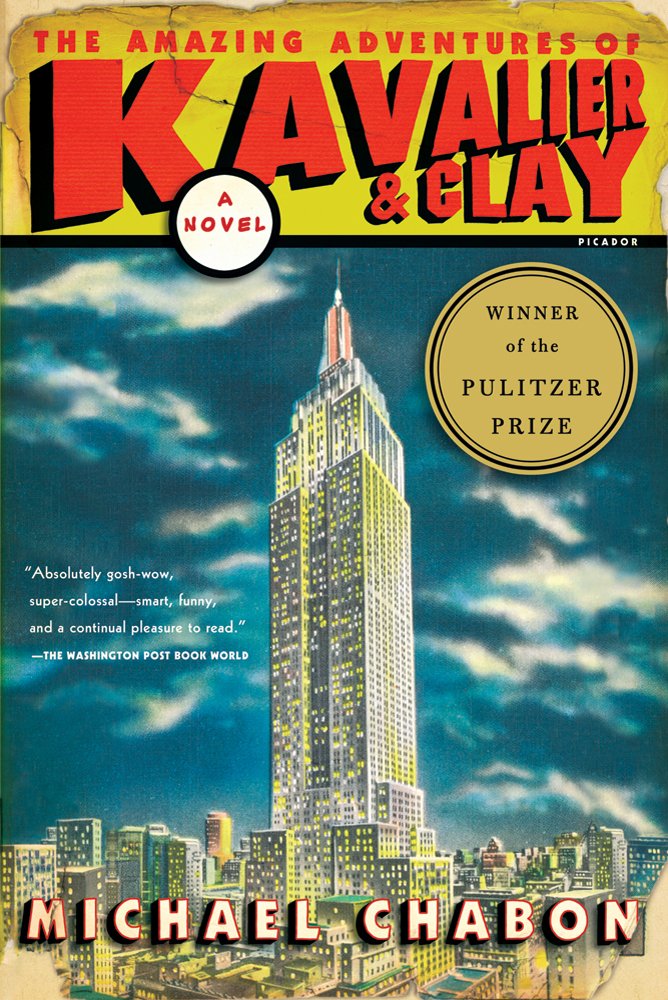
I’ve been rereading “The Amazing Adventures of Kavalier & Klay” to refresh my memory, in advance of checking out Mason Bates’ new opera at the Met this week. A little while ago, I watched an unrelated interview with the book’s author, Pulitzer Prize winner Michael Chabon, who straddles the worlds of “serious” and pop cultural fiction (i.e. comic books, the pulps, genre pastiche) with the authority of a literary colossus. The interview was geared toward young readers, and one of the things he recommended was making an effort to read outside one’s comfort zone. By that, he means not only reading about subjects to which one wouldn’t ordinarily gravitate, but also getting to know different characters by writers who come from diverse backgrounds, as it can really expand one’s understanding and empathy for other perspectives. It’s clear that Chabon practices what he preaches, as it’s the only explanation for the richness of the world he creates and recalls in “Kavalier & Clay” (much of the book is set during the Great Depression and World War II) and the realistic characters who occupy it.
For instance, I don’t know what kind of music Chabon enjoys, but clearly he’s an intellectual omnivore. His curiosity about the classics may not extend very deeply into opera (the premiere of “Kavalier & Klay” was the first time he ever set foot in the Met), but it drove him far enough beyond Bach and Beethoven to turn up no less than Karol Szymanowski. Szymanowski, one of Poland’s foremost composers, was born on this date (according to some sources) in 1882. Szymanowski is referenced multiple times throughout “Kavalier & Clay,” and I’m not entirely sure why. It could just be that the author enjoys his music, or perhaps he simply likes the sound of his name (Shim-an-OFF-ski). Or it could be that he is trying to demonstrate, as he lets drop several times throughout the narrative, that many of these characters who are caught up in the pulp, comic, and novelty business are actually very talented people, immigrants who perhaps abandoned their higher aspirations when they settled in the United States and determined to improve their lot. Which would explain why long-suffering publisher Sheldon Anapol is a member of the Szymanowski Society.
Later in the book, Szymanowski is not mentioned by name when we are told that a portrait of the composer of “Songs of an Infatuated Muezzin” hangs on the wall behind his desk. Holy moly, Chabon! “Songs of an Infatuated Muezzin” isn’t even one of Szymanowski’s better-known works! I wonder if, thematically, the author might also have found the subject matter – a Muslim holy man who, in the execution of his sacred duty to call the faithful to prayer five times a day, finds himself increasingly distracted by erotic thoughts of his beloved – apposite to the situation of one of Chabon’s protagonists, Joe Kavalier, who succumbs to his guilt over the distraction from his primary mission, to get his family out of Nazi-occupied Czechoslovakia. In the meantime, he’s been engaged in a serious affair. Two affairs, actually – one with a free-spirited Greenwich Village bohemian and another, his artistic devotion to comic books – and the reader wonders which passion outstrips the other. In his way, he too is distracted from his sacred duty by a beguiling mistress.
I don’t know that Chabon had this in mind, but the parallel is there. Or, as I say, it could be that he just likes the music.
Looking forward to “Kavalier & Clay.” Also, happy birthday, Karol Szymanowski!
“Songs of an Infatuated Muezzin”
“The Amazing Adventures of Kavalier & Clay” at the Met
Yesterday, I had folks in from out of town and took them over to see Einstein’s furniture at Updike Farm on Quaker Road. Since 2004, the property has been owned by the Historical Society of Princeton.
I’d been there before, but yesterday was the first time I thought to lean in and take note of what was on Einstein’s turntable. By squinting, I could just about make out Eugene Ormandy and the Philadelphia Orchestra, but it was only by taking a photo, flipping it, and enlarging that I could make out the music: William Schuman’s Symphony No. 3! A most bizarre selection as, despite his friendship with Bohuslav Martinů and association with Arnold Schoenberg, from everything I’ve heard, Einstein was not really a contemporary music guy. He was all about the meat-and-potato classics. (He loved Haydn and Mozart.)
If this record was indeed from Einstein’s personal collection, it was a very interesting choice, making more of an impression on me than E = mc². But I am the first to admit, as a classical music lover at the science fair, I tend to look at things a little differently.
More than likely, someone who didn’t know William Schuman from Robert Schumann had selected it – if he or she even knew who Schumann was. I like to think the record was actually from Einstein’s collection and not just something from the period that somebody picked up at a yard sale. The docent, while friendly and attentive, didn’t seem to know anything about it. But I’m used to that.
In the same room, as part of an Innovators Gallery, there’s also some material on Freeman Dyson, one of Einstein’s colleagues at Princeton’s Institute for Advanced Study, who also happened to be the son of eminent English composer Sir George Dyson. Again, I appeared to be the only one with much interest in the connection (neither was it noted, that I could see, in the literature).
In his day, William Schumann was recognized as one of our great American symphonists. In particular, his Symphony No. 3 of 1941 was held up, alongside the corresponding symphonies of Roy Harris and Aaron Copland, as among the best this country had to offer. Schuman won the Pulitzer Prize for Music in 1943, became president of the Juilliard School in 1945, and president of Lincoln Center in 1961.
By coincidence, he was a student of Roy Harris, whose Symphony No. 3 is being performed this afternoon by the Princeton University Orchestra. The concert, a repeat of last night’s program, will be held at Princeton University’s Richardson Auditorium at 3:00. Also on the program will be Hector Berlioz’s “Symphonie fantastique.” Be there, or be square.
When lyrics were added to the best-known polka of Czech composer Jaromir Vejvoda, it also became perhaps the most famous Czech song.
Originally conceived as the “Modřanská Polka” – or “Polka of Modřany” – with words it took on a new life as “Škoda lásky” (“Unrequited Love”). It was also a hit in Germany as “Rosamunde.” World-wide popularity ensued, as soldiers adopted it as a drinking song during World War II and introduced it at home as the “Beer Barrel Polka.”
This week on “Sweetness and Light,” in this season of the harvest and Oktoberfest, it will be one of our featured works as we roll out the barrels for a salute to BARLEY AND THE GRAPE.
The hour will include the “Revelry Overture” by Montague Phillips and Leopold Godowsky’s “Symphonic Metamorphosis on ‘Wine, Women and Song’” after Johann Strauss II. We’ll raise our goblets to the god of wine with ballet music from Jules Massenet’s rarely-heard opera “Bacchus” and the “Procession of Bacchus” from Léo Delibes’ ballet “Sylvia” (conducted by Richard Bonynge, who turned 95 this week).
We’ll also quaff to drinking songs by Reginald De Koven (“Brown October Ale” from the comic opera “Robin Hood”) and Henry Purcell (himself a casualty of one too many pub-crawls).
We’ve a powerful thirst for BARLEY AND THE GRAPE on “Sweetness and Light.” The taps are open, this Saturday morning at 11:00 EDT/8:00 PDT, exclusively on KWAX, the radio station of the University of Oregon!



4 responses