Prior to the authenticity movement, musicians basically did whatever they wanted, employing works of the masters as so much grist for the mill. Bach and Handel were played by a hundred instruments, swooning portamenti applied, and trombones and bass drums added if it was felt the music required a good punch.
Hamilton Harty’s arrangement of Handel’s “Water Music” was one of the saner applications, though it has come to sound somewhat strange to our ears today. At the other end of the scale was freewheeling Thomas Beecham, who was not at all bashful about lending cymbal crashes to “Messiah.”
But you’ve got to remember, Sir Thomas was also crafting orchestral canapés and bonbons from Handel operas at a time when they were basically unknown outside of musicological circles.
A sample of Beecham’s arrangements for the 1932 “Handel” ballet “The Origin of Design” will cap this morning’s “Sweetness and Light.” The climactic battle music is an amalgam of selections from Handel’s “Giulio Cesare,” “Rinaldo,” and “Ariodante” – and we’ll hear Beecham conduct it hell-for-leather!
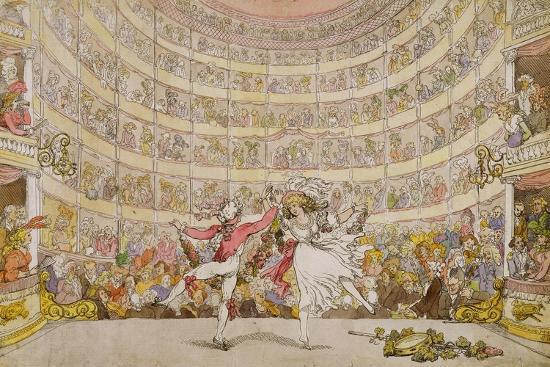
“The Origin of Design” was choreographed by Ninette de Valois, who also devised the scenario and choreography for Constant Lambert’s ballet “The Prospect Before Us (or, Pity the Poor Dancers).” Here, Lambert dips heavily into works of 18th century English composer William Boyce, whose eight delectable symphonies we still hear from time to time. Unsurprisingly, selections from some of these find their way into Lambert’s 1940 score, which he introduced with the Sadler’s Wells Ballet. Valois was inspired by a collection of drawings and prints by Thomas Rowlandson. (A reproduction of one is included with this post.)
In between, we’ll admire the handiwork of a quite reputable, 19th century intermediary. It was no less than Johannes Brahms who lifted a portion of a harpsichord suite as the basis for his “Variations and Fugue on a Theme by Handel,” a piece conceived for solo piano in 1861. In 1938, English composer Edmund Rubbra orchestrated the work. We’ll hear it, given the luxury treatment, in a 1960 recording with Eugene Ormandy and the Philadelphia Orchestra.
Yes, that’s right. Back in the day, the prevailing philosophy was “If It’s Baroque, Fix It.” 18th century inspirations will be polished up by 20th century hands on “Sweetness and Light,” this Saturday morning at 11:00 EDT/8:00 PDT, exclusively on KWAX, the radio station of the University of Oregon!
Stream it wherever you are at the link:
Leave a Reply