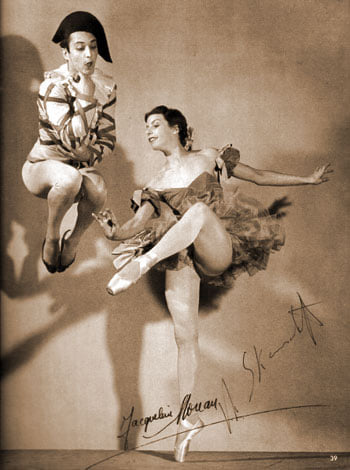
It seems as if it was only a matter of time before any Baroque musician of merit would become embroiled in a musical duel.
In the case of Domenico Scarlatti, he was challenged by none other than George Frideric Handel, in Rome. The resulting contest led to Handel being judged superior to his rival on the organ; however, on the harpsichord Scarlatti was deemed to be supreme. In fact, Scarlatti’s unusual facility at the keyboard has had artists “keyed up” for centuries.
Born in Naples in 1685 – the same year as Handel and Bach – Scarlatti spent much of his career in the service of the Portuguese and Spanish royal families. He wrote 555 keyboard sonatas, which have been admired by composer-performers from Frederic Chopin to Marc-André Hamelin.
This week on “The Lost Chord,” we’ll enjoy several works written in tribute to this Baroque master.
Charles Avison, whose life overlapped Scarlatti’s own (he was born in 1709, when Scarlatti was 23 years-old), arranged a number of his elder colleague’s keyboard works into a set of 12 concerti grossi. We’ll sample one of those, Avison’s Concerto No. 10 in D.
Then we’ll turn to American composer Norman Dello Joio. Dello Joio was the recipient of the Pulitzer Prize for Music in 1957 for his “Meditations on Ecclesiastes.” From 1979, we’ll hear his four-movement piano work, “Salute to Scarlatti.”
Dmitri Shostakovich arranged two of Scarlatti’s keyboard sonatas for small wind ensemble and percussion. We’ll enjoy performances of these by members of the former USSR Ministry of Culture Symphony Orchestra conducted by Gennady Rozhdestvensky.
Finally, Alfredo Casella’s 1926 suite for piano and orchestra, “Scarlattiana,” draws its inspiration from dozens of Scarlatti sonatas. Though unquestionably high-spirited, it was not originally intended for the dance – but since it unabashedly recalls Stravinsky’s “Pulcinella,” it is hardly surprising that some clown decided to choreograph it.
I hope you’ll join me for a mixed salad of Scarlatti tributes, on “Italian Dressing,” on “The Lost Chord,” now in syndication on KWAX Classical Oregon!
——-
Clip and save the start times for all three of my recorded shows:
PICTURE PERFECT, the movie music show – Friday at 8:00 PM EDT/5:00 PM PDT
SWEETNESS AND LIGHT, the light music program – Saturday at 11:00 AM EDT/8:00 AM PDT
THE LOST CHORD, unusual and neglected rep – Saturday at 7:00 PM EDT/4:00 PM PDT
Stream them, wherever you are, at the link!
https://kwax.uoregon.edu
——-
PHOTO: Wladimir Skouratoff (levitating) and Jacqueline Moreau in a 1954 production of “Scarlattiana”
Tag: Handel
-
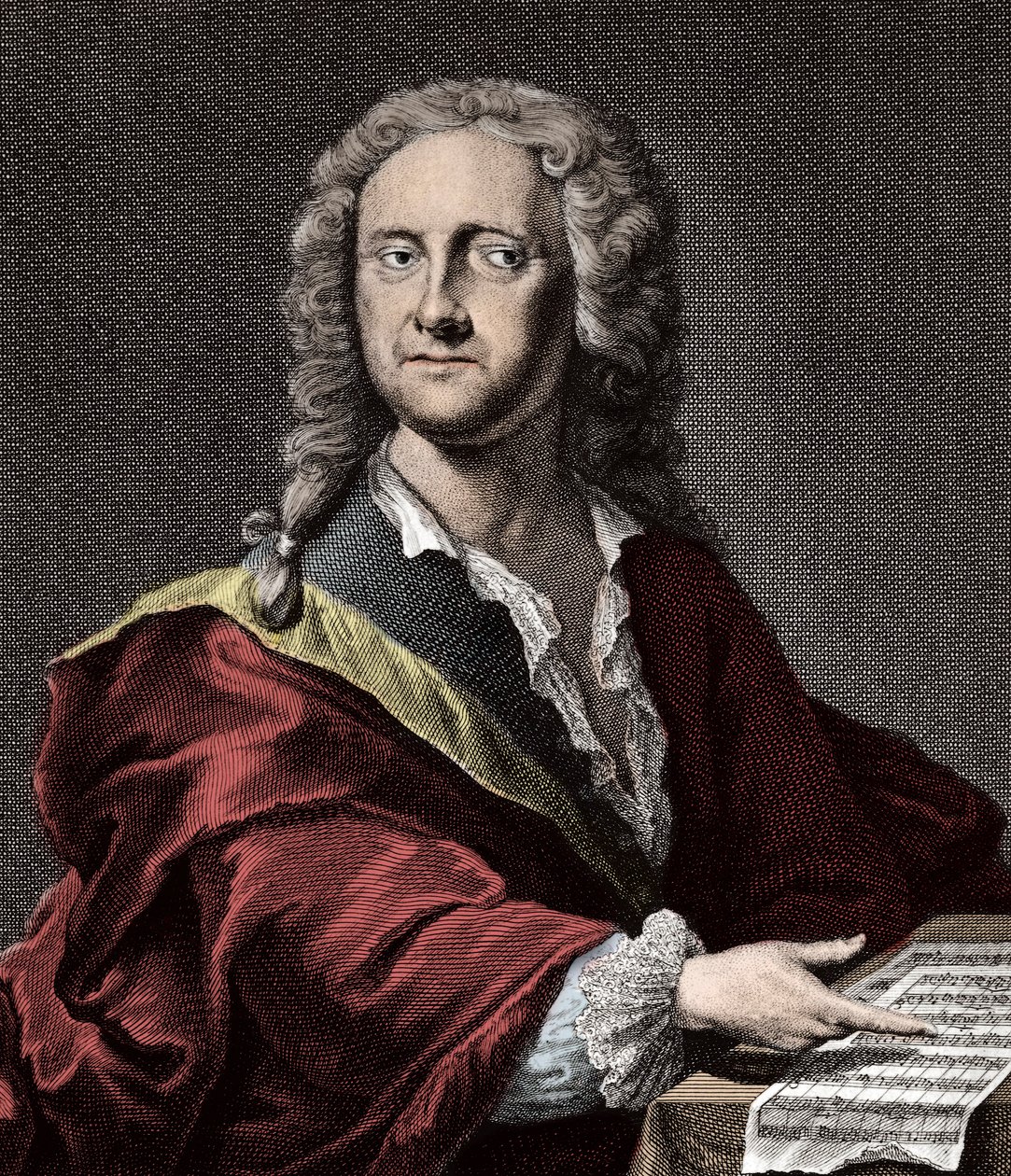
Telemann Has a Lot to Tell
Poor Telemann. Every year, if I write anything laudatory about him for his birthday anniversary, following as closely as it does on the heels of the March birthdays of his great colleagues and rivals, Handel (March 5) and Bach (March 21), it seems to bring the invective raining down upon him.
“He’s boring!” will write one.
“He’s a notespinner!” will opine another.
“How many times can you rewrite the same piece?” will grumble a third.
Could it be that he was a casualty of having done his job too well?
After all, Telemann wrote more music than Bach and Handel combined – over 3,000 works – making him one of the most prolific composers of all time. Yet nothing in his oeuvre has captured the public imagination quite like the “Brandenburg Concertos” or the “Water Music.”
Of course, Telemann wrote “Water Music” too. Keep in mind, this was not conceived for a king’s leisurely cruise down the Thames (à la Handel), but rather to celebrate the centennial of the Hamburg Admiralty. That’s a pretty dry commission.The work opens with an Ouverture in C, perhaps suggestive of the movement of the water itself. Then Telemann begins to gussy it up with music representative of various mythological figures (Thetis asleep and awake, Neptune in love, Naiads at play, Triton the jokester, stormy Aeolus, and pleasant Zephir, comprising movements 2-8). The penultimate movement is a gigue inspired by the tides, and the work concludes with a suggestion of some jolly sailors.
No one is going to argue against the fact that Handel had the more indelible tunes. As a classical music broadcaster, I’ve had more experience with this suite than most, but I still can’t say I could pick it out of a police line-up.
Nevertheless, Telemann was a significant talent, who was recognized in his own lifetime. He was an innovator, assimilating Italian and French influences into his own style, and his contemporaries bought and studied his scores. He was offered the cantorate of the Thomaskirche in Leipzig, ahead of Bach. He counted Bach among his friends, as well as Handel. Bach even requested that he be the godfather of his son, Carl Philipp Emanuel.
Telemann lived an unusually long life (86 years), though it was not without its miseries. His first wife died young. His second ran up gambling debts in amounts larger than his annual income. Ultimately, his friends had to bail him out. As he grew older, he suffered further indignities, including failing eyesight.
Celebrated in his own day, by the 19th century he was dismissed as a “polygraph,” someone who had simply composed too much. In a sense, he was a victim of his own success.
Today, he inspires renewed enthusiasm among early music specialists, who have done much to restore his reputation. At the very least, he deserves a little love on his birthday.
Happy Birthday, Georg Philipp Telemann!*
——————
One of my favorite Telemann moments, the “Air à l’Italien” from the Suite in A Minor for Flute and Orchestra:
Always been partial to this one, too:——————
*NOTE: By the Julian calendar, Telemann was born on March 14
-
On Purim, I Have Less Confidence in Area Bakeries Than I Do Princeton’s Thomas De Hartmann
I had to be out this morning anyway, so I’m just back from crossing off two more bakeries from the checklist on my annual search for the perfect hamantaschen on Purim. I am sorry to report, neither sample I consumed today lived up to expectations. (Of course, in my optimism, I purchased several from both shops.) In the interest of kindness, I won’t name the bakeries, as I have no animosity toward them, even though their hamantaschen suck.
Hamantaschen, in case you don’t know, are triangular, pocket-filled pastries associated with Haman, the villain of the Purim story as related in the Book of Esther – “tash” meaning “pocket” or “pouch” in Yiddish. In Hebrew, they’re sometimes referred to as “Haman’s ears.” And what an appetizing image that is, especially when biting into the fruity center!
The cookie is often filled with apricot, raspberry, poppy seed, or my personal favorite, prune – which may sound a little geriatric, but trust me, with a good cup of coffee, it infuses one with a ridiculous sense of well-being.
The best hamantaschen I ever had were from Rindelaub’s Bakery, then located right across the street from one of my many Philadelphia apartments, on South 18th Street, just a few doors north of Rittenhouse Square. That was decades ago, when I was in my 20s. A prune-centered hamantasch and a large cup of coffee consumed in the square on a sunny afternoon was a recipe for pure bliss. Alas, once a Philadelphia institution, Rindelaub’s is no more.
In the name of all that’s holy, avoid hamantaschen from the local grocery store. They’re generally pretty terrible – hard jelly in a tasteless cookie that will turn to powder as soon as you bite into it. But if you can find them at an actual bakery, give them a shot – although, I confess, I have not had a lot of luck. In the Trenton-Princeton area, so far the closest I’ve come to recapturing the unalloyed pleasure of Rindelaub’s pastries was from a vendor at Trenton Farmer’s Market, but I haven’t been back there in years and the market is only open Thursday to Sunday.
If someone knows of a great Jewish bakery in the vicinity, please let me know. I’ve already been to Cramer’s in Yardley, a couple of years back. With all respect to Cramer, it wasn’t even close. I also experienced an epic fail at a bakery in Sea Girt last summer.
A few years ago, I put together a post about music inspired by the Purim story. The best-known musical response is still probably George Frideric Handel’s “Esther,” from 1732. Handel’s first English oratorio recounts the events of the Biblical book, by way of an Old Testament drama by Jean Racine. The Hebrew Esther becomes Queen of Persia and thwarts the machinations of the king’s jealous vizier, which would have resulted in the extermination of her people.
Interestingly, although Princeton doesn’t seem to have any good Jewish bakeries, it turns out the town is the final resting place of a composer who, I only just learned this week, wrote an opera based on the same Racine play.
Thomas De Hartmann was born in Ukraine in 1885. He studied composition with Rimsky-Korsakov, Anton Arensky, and Sergei Taneyev. He was friendly with the mystic-philosopher George Gurdjieff, who acted as his spiritual adviser and with whom De Hartmann and his wife, Olga, an opera singer, departed Russia following the revolution. Eventually, in 1950, they settled in the United States. De Hartmann and Gurdjieff collaborated on a number of musical works.
De Hartmann would die of a heart attack several weeks after performing his Violin Sonata in Princeton (with Alexander Schneider, violin, and the composer at the keyboard). He is buried next to his wife in Princeton Cemetery, his grave marked by a very distinctive headstone, which bears a quotation from his unfinished Fourth Symphony.
I wrote about him for an article in the Princeton weekly newspaper U.S. 1, as part of a “haunted tour” of local composers’ gravesites I compiled one year for Halloween.
https://www.communitynews.org/princetoninfo/coverstories/a-requiem-for-princeton-s-passed-composers/article_a83ca082-5487-11ed-9182-8771c220bdaf.html
Since then, I’ve purchased two volumes of his orchestral music on the Toccata Classics label, and earlier this season heard Joshua Bell play his Violin Concerto with the New York Philharmonic. Bell’s recording of the Violin Concerto has been coupled with Matt Haimovitz’s performance of the Cello Concerto, for Pentatone Records. I wonder if we’re poised on the brink of a full-blown Thomas De Hartmann revival?
Also imminent from Pentatone is the premiere recording of De Hartmann’s opera, “Esther,” which the label only just previewed on its YouTube channel yesterday. To learn more about it, read the description under the video at the link.
Comparisons to Poulenc, Debussy, Strauss, and Korngold? I’m there!
Thomas De Hartmann’s “Esther” will be released on April 24.
Even if the bakeries let me down, I’m fairly confident De Hartmann will not.
———-
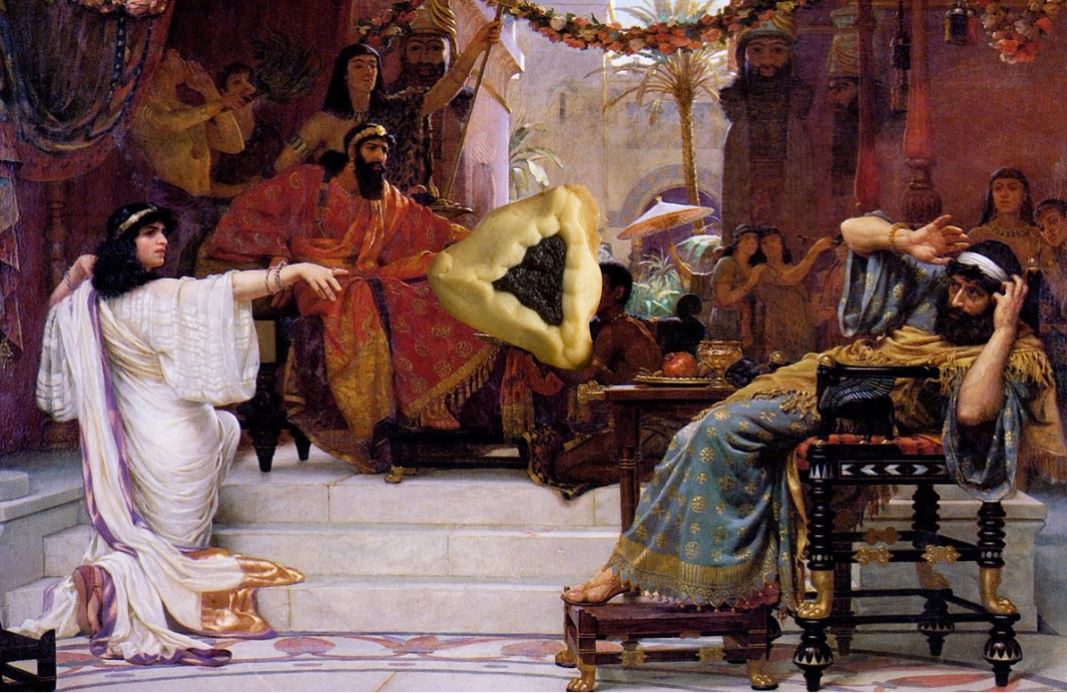
IMAGE: “Esther Denouncing Haman to King Ahasuerus” (1888) by Ernest Norman, with hamantasch added by me -
Baroque Remixed: Handel, Brahms & More
Prior to the authenticity movement, musicians basically did whatever they wanted, employing works of the masters as so much grist for the mill. Bach and Handel were played by a hundred instruments, swooning portamenti applied, and trombones and bass drums added if it was felt the music required a good punch.
Hamilton Harty’s arrangement of Handel’s “Water Music” was one of the saner applications, though it has come to sound somewhat strange to our ears today. At the other end of the scale was freewheeling Thomas Beecham, who was not at all bashful about lending cymbal crashes to “Messiah.”
But you’ve got to remember, Sir Thomas was also crafting orchestral canapés and bonbons from Handel operas at a time when they were basically unknown outside of musicological circles.
A sample of Beecham’s arrangements for the 1932 “Handel” ballet “The Origin of Design” will cap this morning’s “Sweetness and Light.” The climactic battle music is an amalgam of selections from Handel’s “Giulio Cesare,” “Rinaldo,” and “Ariodante” – and we’ll hear Beecham conduct it hell-for-leather!
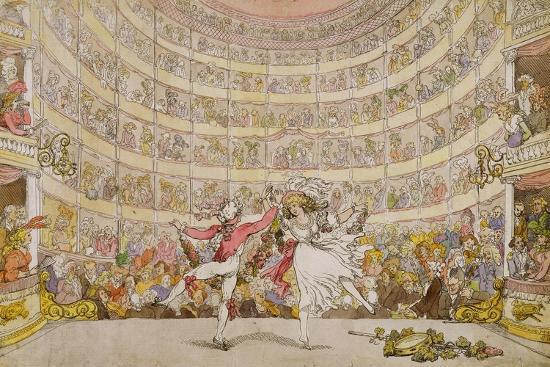
“The Origin of Design” was choreographed by Ninette de Valois, who also devised the scenario and choreography for Constant Lambert’s ballet “The Prospect Before Us (or, Pity the Poor Dancers).” Here, Lambert dips heavily into works of 18th century English composer William Boyce, whose eight delectable symphonies we still hear from time to time. Unsurprisingly, selections from some of these find their way into Lambert’s 1940 score, which he introduced with the Sadler’s Wells Ballet. Valois was inspired by a collection of drawings and prints by Thomas Rowlandson. (A reproduction of one is included with this post.)
In between, we’ll admire the handiwork of a quite reputable, 19th century intermediary. It was no less than Johannes Brahms who lifted a portion of a harpsichord suite as the basis for his “Variations and Fugue on a Theme by Handel,” a piece conceived for solo piano in 1861. In 1938, English composer Edmund Rubbra orchestrated the work. We’ll hear it, given the luxury treatment, in a 1960 recording with Eugene Ormandy and the Philadelphia Orchestra.
Yes, that’s right. Back in the day, the prevailing philosophy was “If It’s Baroque, Fix It.” 18th century inspirations will be polished up by 20th century hands on “Sweetness and Light,” this Saturday morning at 11:00 EDT/8:00 PDT, exclusively on KWAX, the radio station of the University of Oregon!
Stream it wherever you are at the link:
-

Handel at 340: Still Fresh, Still Thrilling
George Frideric Handel was born 340 years ago, and he’s still as fresh as a rose. Fresher. Actually, come to think of it, there is a climbing rose named after him…
For one thing, the standard of Handel performance has gotten so much better in recent decades. I guess you really don’t hit your stride as a composer until after the first 300 years.
For as much as I hold a nostalgic affection for Hamilton Harty’s ponderous take on the “Water Music” – a concert staple for over half a century – a modern orchestra gives little indication of just how thrilling Handel can be. At its best, his vocal stuff, in particular, can be sublime.
I didn’t always feel this way. When I attended a performance of “Ariodante” in Philadelphia, back in the 1989, even with the dream pairing of Benita Valente and Tatiana Troyanos, I was afraid I was going to give up the ghost. When it really doesn’t connect, three or four hours of Baroque opera can easily start to feel like too much of a good thing. My girlfriend at the time wanted to leave after the second act, but I insisted we stick it out. I was eager to witness the climactic swordfight, described in the synopsis – which, in the end, amounted to a single, slow-motion riposte. The weak pay-off earned me an evil glare.
The experience had the effect of putting me off Handel opera in much the same way that downing a bottle of Inver House whiskey in my teens put me off Scotch. Just as I later discovered, to my surprise and delight, how much I truly appreciate a fine single malt, when I had occasion to reacquaint myself with “Ariodante” at the Princeton Festival in 2010, I was astonished to find that I actually liked Handel opera after all.
A few years ago, when I wandered into a library book sale, I discovered that someone had dumped their entire collection of Handel operas and oratorios. I don’t know how many there were to begin with, but I walked out with everything that was left. Who knows if I’ll ever get through all of them before I die, but I am very happy to have them.
That said, I do find Handel’s operas work best when encountered live, in performance – whether seen in person or on screen – which is the opposite of what I would say about most of the operas I prefer. The images that are formed in my mind by the music far surpass anything that can be realized on a stage. When attending opera, it is the experience of the orchestra, the voices, and the sense of “theater” I enjoy. But the visuals are too mundane for my grandiose vision.
I also tend to get annoyed at modern stagings, with concepts that too often seem forced and undercut the vitality of the music. Again, Handel is different. David McVicar’s production of “Agrippina” must be one of the best things in the Met’s current repertoire.
Of course, there is always the possibility that it is not so much Handel who has changed – despite a pronounced shift toward “authentic” performance practice over the past 40 years or so. It could be that even a paragon such as myself, sprung fully-formed from the head of Zeus, might have evolved. I’m reminded of the famous Twain observation that, when he was 14, his father was so ignorant he could hardly stand it; but when he was 21, he was astonished by how much the old man had learned.
I’ve come a long way since my friends and I spent an ouzo-soaked 24 hours celebrating Handel’s tercentenary back in 1985. I recollect even now the six-mile round-trip I made with one of them, on foot, on a cold February evening, from Temple University campus to Center City Philadelphia and back, with a bottle nestled in his bag to keep us warm for an in-town performance of “Judas Maccabaeus.”
Everything old is new again. Handel grows wiser with the years, but also more thrilling.
Happy birthday, G.F.H.
Amanda Forsythe and Apollo’s Fire, with an aria from “Giulio Cesare”
Danielle de Niese with the same aria, staged:
Of course, there’s always Thomas Beecham, bringing it old school, to prove me wrong:
Tag Cloud
Aaron Copland (94) Beethoven (95) Composer (114) Film Music (150) Film Score (143) Film Scores (255) Halloween (102) John Williams (198) KWAX (233) Leonard Bernstein (105) Marlboro Music Festival (125) Movie Music (165) Mozart (91) Opera (215) Philadelphia Orchestra (90) Picture Perfect (174) Princeton Symphony Orchestra (110) Radio (90) Ross Amico (244) Roy's Tie-Dye Sci-Fi Corner (290) The Classical Network (101) The Lost Chord (269) Vaughan Williams (107) WPRB (397) WWFM (881)