Tag: Handel

  • Radical Opera or Handel’s Genius?

    Radical Opera or Handel’s Genius?

    So many modern opera productions of the classics are radically, even provocatively, reimagined, ill-considered, half-baked, and just plain tiresome. I don’t want to pay big bucks to go to an opera house to have my eyes assaulted by a bunch of grotesque imagery calculated to undermine the glorious music. If I want to feel grim and depressed, it’s much less expensive to go to the movies. It’s the composers’ genius that has kept opera alive all these years, not the desperate antics of flash-in-the-pan directors.

    That said, every once in a while, a bold swing for the fences thrillingly connects. Fresh approaches to Baroque opera, in particular, seem to have yielded their share of unexpected delights, perhaps because the old ways often pretty much reflected what Peter Schaffer’s Mozart complained about, in his earthy fashion, when he characterized the kind of opera peopled with classical and historical heroes as being moribund, the characters so lofty that they sound as if they defecate marble.

    In some respects, I suppose, I am a product of my time, so I don’t mind a little flash now and again, to keep things lively, even if it is a concession to the eye more than to the ear. I was delighted by David McVicar’s take on George Frideric Handel’s “Agrippina,” for instance, with, in one manic aria, mad Nero cutting cocaine with a credit card.

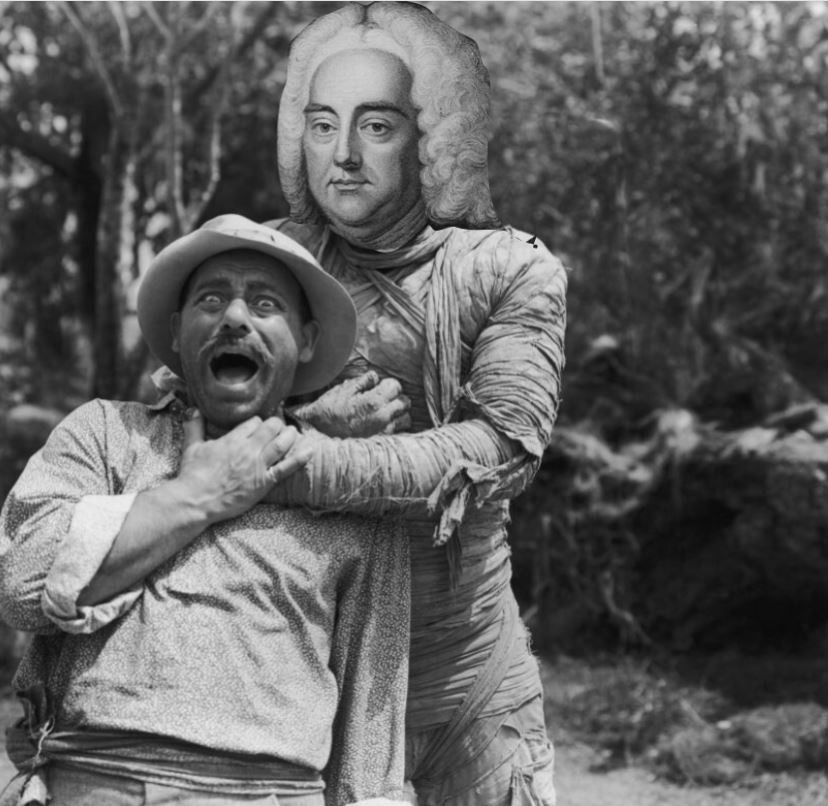
    Now, for Handel’s birthday, here’s one to set aside for the weekend. A traditional production of “Giulio Cesare in Egitto” (“Julius Caesar in Egypt”) opens in 48 B.C. This one, however, is built on the premise of a Howard Carter-like figure uncovering an Egyptian tomb in the 1920s – only to have the contents spring to life. The approach was conceived by George Petrou, artistic director of the International Handel Festival Göttingen.

    The production opens with a quote from Carl Jung, rendered in the style of a silent movie intertitle: “Where love reigns, there is no will to power, and where power takes precedence, love is absent. One is the shadow of the other.” Cleopatra emerges from a sarcophagus, the priests are all dressed like Anubis, canine-headed Egyptian lord of the underworld, and there are mummies all over the place. Nireno’s aria that opens Act II is given ‘20s-style jazz inflections. Furthermore, on this occasion, it is sung from the wings while lip-synched and pantomimed by the production’s assistant director, because the scheduled singer was under the weather!

    Handel was 39 when he wrote the music. Is the production in line with what the composer imagined? Well, not exactly, but it looks like it could be inventive and fun, in an escapist kind of way. I look forward to sitting down and watching the whole thing. Nothing screams Handel like hot sand, jodhpurs, and pith helmets.

    Happy birthday, Handel!

  • Scarlatti’s Musical Duels and Lasting Legacy

    Scarlatti’s Musical Duels and Lasting Legacy

    It seems as if it was only a matter of time before any Baroque musician of merit would become embroiled in a musical duel.

    In the case of Domenico Scarlatti, he was challenged in Rome by none other than George Frideric Handel. The resulting contest led to Handel being judged superior to his rival on the organ; however, on the harpsichord Scarlatti was deemed to be supreme. In fact, Scarlatti’s unusual facility at the keyboard has had artists “keyed up” for centuries.

    Born in Naples in 1685 – the same year as Handel and Bach – Scarlatti spent much of his career in the service of the Portuguese and Spanish royal families. He wrote 555 keyboard sonatas, which have been admired by composer-performers from Frederic Chopin to Marc-André Hamelin.

    This Sunday night on “The Lost Chord,” we’ll enjoy several works written in tribute to this Baroque master.

    Charles Avison, whose life overlapped Scarlatti’s own (he was born in 1709, when Scarlatti was 23 years-old), arranged a number of his elder colleague’s keyboard works into a set of 12 concerti grossi. We’ll sample one of those, Avison’s Concerto No. 10 in D.

    Then we’ll turn to American composer Norman Dello Joio. Dello Joio was the recipient of the Pulitzer Prize for Music in 1957 for his “Meditations on Ecclesiastes.” From 1979, we’ll hear his four-movement piano work, “Salute to Scarlatti.”

    Dmitri Shostakovich arranged two of Scarlatti’s keyboard sonatas for small wind ensemble and percussion. We’ll enjoy performances of these by members of the former USSR Ministry of Culture Symphony Orchestra conducted by Gennady Rozhdestvensky.

    Finally, Alfredo Casella’s 1926 suite for piano and orchestra, “Scarlattiana,” draws its inspiration from dozens of Scarlatti sonatas. Though unquestionably high-spirited, it was not originally intended for the dance – but since it unabashedly recalls Stravinsky’s “Pulcinella,” it is hardly surprising that some clown decided to choreograph it.

    I hope you’ll join me for a mixed salad of Scarlatti tributes, on “Italian Dressing,” on “The Lost Chord,” now in syndication on KWAX, the radio station of the University of Oregon!


    Keep in mind, KWAX is on the West Coast, so there’s a three-hour difference for the Trenton-Princeton area. Here are the respective air-times of my recorded shows (with East Coast conversions in parentheses):

    PICTURE PERFECT, the movie music show – Friday on KWAX at 5:00 PACIFIC TIME (8:00 PM EDT)

    THE LOST CHORD, unusual and neglected rep – Saturday on KWAX at 4:00 PACIFIC TIME (7:00 PM EDT)

    Stream them here!

    https://kwax.uoregon.edu/

  • Handel: The Great Bear of Music

    Handel: The Great Bear of Music

    With enormous appetites to rival his formidable musicianship, a larger-than-life reputation, and an eccentric, much remarked-upon manner of walking, George Frideric Handel was affectionately nicknamed “The Great Bear.”

    Handel is fondly remembered for his “Water Music” and “Music for the Royal Fireworks,” his epic oratorios, his florid operas, and his copious concertos and chamber music.

    Though by many accounts a kind-hearted man with a good sense of humor, he was also prone to an explosive, bear-like temper. I imagine this would have gone unnoted during the several years he spent in Italy, but in England people tended to take heed.

    Music historian Charles Burney recalled Handel berating a chorister during rehearsals for “Messiah.” “… Handel let loose his great bear upon him; and after swearing in four or five languages, cried out in broken English….”

    During rehearsals for the opera “Ottone,” he once grabbed the soprano Francesca Cuzzoni and threatened to toss her out a window. Cuzzoni, looking to make the best impression with her London debut, had roused “the Bear” by pressing him for a replacement aria, the better to showcase her unique talents.

    But Cuzzoni could give as good as she got. During a Handel production of Giovanni Bononcini’s opera “Astianatte,” she and her costar, Faustina Bordoni, flew at one another in a fury and began tearing at their costumes. They had to be dragged off stage.

    Some years earlier, as a young man of 19, Handel was filling in as conductor at the premiere of Johann Mattheson’s opera “Cleopatra.” Mattheson also sang the tenor role of Antony, so while he was on stage, Handel was to sit at the harpsichord and keep order among the musicians.

    Trouble arose when Mattheson returned to the orchestra and Handel refused to cede his place. A power struggle ensued, as Mattheson sought to regain control, but Handel insisted on continuing to conduct. The performance was interrupted when Mattheson suggested the two take the quarrel outside. Swords were drawn, and one of Mattheson’s thrusts glanced off a button near Handel’s heart. This had the effect of dousing the combatants with cold water, and the two reconciled to become lifelong friends.

    It wasn’t all claws and teeth, to be sure. Ursine Handel could also be a bit of a teddy bear, and a generous one. One of his more enduring works, “Messiah” – penned in a mere 24 days – was given its first performance in Dublin, on April 13, 1742, as a charitable event. It benefited two hospitals and liberated 142 men from debtor’s prison.

    Eight years later, Handel revived the work at London’s Foundling Hospital, a recently-instituted home for abandoned infants and children. He had already donated an organ to the hospital’s chapel, and the year before, recycled the “Hallelujah Chorus” as part of his “Foundling Hospital Anthem.” Again, Handel’s oratorio raised a ton of money. The charitable presentation became an annual event, with the composer returning every year for the rest of his life. Handel’s relationship to the institution was cemented with an honorary title. After his death, he left the rights to the oratorio to the hospital.

    When Handel finally did die, blind but rich, in 1759, at the age of 74, his funeral was attended by 3,000 people. He never married, but filled his hours with composing – leaving 30 oratorios and 50 operas – and of course living the good life, with plenty of beer and food. He was interred at Westminster Abbey, a very great honor indeed.

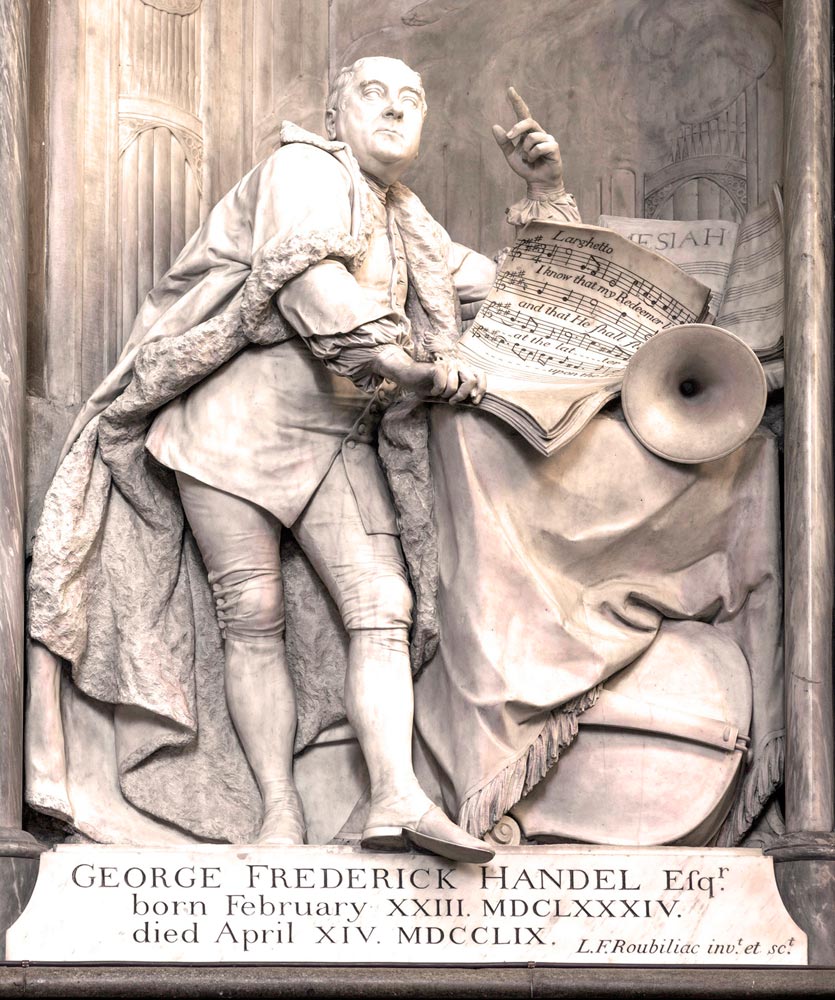
    Above his grave, there is a monument, a sculpture of Handel in the act of composing his cash cow, the oratorio “Messiah.” The bear may now be in hibernation, but every Christmas – and sometimes Lent – his music lives on.

    Happy birthday, Handel!


    CLOCKWISE FROM LEFT: Handel memorial at Westminster Abbey; unkind caricature of the composer as a fat boar (Joseph Goupy, “The Charming Brute,” 1743); Handel threatens to throw Francesca Cuzzoni out a window (Peter Jackson, “When They Were Young: Handel the Musician,” 1966); Handel crosses swords with Johann Mathesson (Andrew Howat, “Strange Tales,” 1977)

  • Weekend Music Bruckner Handel Diversions

    Weekend Music Bruckner Handel Diversions

    With the weekend nearly upon us, here are two musical diversions for your consideration.

    The first is an absorbing conversation about Bruckner’s Symphony No. 4. Dr. Benjamin Korsvedt chats with MusicaNova Orchestra music director Warren Cohen. Cohen and the orchestra would go on to present the world premiere of the rediscovered 1878 version of Bruckner’s most popular symphony – 144 years after it was composed! To experience the performance, you have to order the CD or BluRay, but the tantalizing conversation is free. You’ll find all the information here:

    https://www.abruckner.com/editorsnote/news/the-world-premiere-of-the-1878-bruckner-4th—reco/?fbclid=IwAR3sBJc2TjuKmeeS_EY0lEv6MITSR1ODMKIPcLNciIiXNvkwYl9mOCNyis4

    MusicaNova Orchestra has a reputation for its truly remarkable programming. You will find music performed there that you won’t encounter anywhere else. Bookmark their homepage, and if you happen to find yourself in Arizona, definitely check them out.

    https://musicanovaaz.org/

    Then head back to the East Village to enjoy a hit of Handel in Campos Community Garden. Here’s H. Paul Moon’s concert film of Handel’s “Orlando.” The distillation is by Metropolitan Opera countertenor Jeffrey Mandelbaum, who also assumes the title role. Plenty of greenery and bird song with lovely music, and without the sun and bugs.

    https://zenviolence.com/orlando

    Zen Violence Films

    Here’s to a beautiful, musical weekend!

  • Sir Thomas Beecham Birthday Tribute

    Sir Thomas Beecham Birthday Tribute

    From the Beecham humidor on his birthday…

    Beecham conducts the nascent London Philharmonic in Tchaikovsky’s “Polish” Symphony

    Beecham interview and rehearsal

    Beecham conducts his arrangements of Handel

    Mozart

    https://www.youtube.com/watch?v=vA83lt-Kg0M

    More about Beecham here:

    https://www.theguardian.com/friday_review/story/0,3605,468909,00.html

    In Delius:

    Berlioz:

    Schubert:

    Liszt:

    Balakirev:

    Vintage Handel:

    Sibelius:

    “The British may not like music, but they absolutely love the noise it makes.”

    Happy birthday, Sir Thomas Beecham (1879-1961)

Tag Cloud

Aaron Copland (92) Beethoven (95) Composer (114) Film Music (119) Film Score (143) Film Scores (255) Halloween (94) John Williams (185) KWAX (229) Leonard Bernstein (99) Marlboro Music Festival (125) Movie Music (134) Opera (198) Philadelphia Orchestra (87) Picture Perfect (174) Princeton Symphony Orchestra (106) Radio (87) Ralph Vaughan Williams (85) Ross Amico (244) Roy's Tie-Dye Sci-Fi Corner (290) The Classical Network (101) The Lost Chord (268) Vaughan Williams (102) WPRB (396) WWFM (881)

DON’T MISS A BEAT

Receive a weekly digest every Sunday at noon by signing up here


RECENT POSTS