Tag: Handel

  • Handel: The Great Bear of Music and Temper

    Handel: The Great Bear of Music and Temper

    With enormous appetites to rival his formidable musicianship, a larger-than-life reputation, and an eccentric, much remarked-upon manner of walking, George Frideric Handel was affectionately nicknamed “The Great Bear.”

    Handel is fondly remembered for his “Water Music” and “Music for the Royal Fireworks,” his epic oratorios, his florid operas, and his copious concertos and chamber music.

    Though by many accounts a kind-hearted man with a good sense of humor, he was also prone to an explosive, bear-like temper. I imagine this would have gone unnoted during the several years he spent in Italy, but in England people tended to take heed.

    Music historian Charles Burney recalled Handel berating a chorister during rehearsals for “Messiah.” “… Handel let loose his great bear upon him; and after swearing in four or five languages, cried out in broken English….”

    During rehearsals for the opera “Ottone,” he once grabbed the soprano Francesca Cuzzoni and threatened to toss her out a window. Cuzzoni, looking to make the best impression with her London debut, had roused “the Bear” by pressing him for a replacement aria, the better to showcase her unique talents.

    But Cuzzoni could give as good as she got. During a Handel production of Giovanni Bononcini’s opera “Astianatte,” she and her costar, Faustina Bordoni, flew at one another in a fury and began tearing at their costumes. They had to be dragged off stage.

    Some years earlier, as a young man of 19, Handel was filling in as conductor at the premiere of Johann Mattheson’s opera “Cleopatra.” Mattheson also sang the tenor role of Antony, so while he was on stage, Handel was to sit at the harpsichord and keep order among the musicians.

    Trouble arose when Mattheson returned to the orchestra and Handel refused to cede his place. A power struggle ensued, as Mattheson sought to regain control, but Handel insisted on continuing to conduct. The performance was interrupted when Mattheson suggested the two take the quarrel outside. Swords were drawn, and one of Mattheson’s thrusts glanced off a button near Handel’s heart. This had the effect of dousing the combatants with cold water, and the two reconciled to become lifelong friends.

    It wasn’t all claws and teeth, to be sure. Ursine Handel could also be a bit of a teddy bear, and a generous one. One of his more enduring works, “Messiah” – penned in a mere 24 days – was given its first performance in Dublin, on April 13, 1742, as a charitable event. It benefited two hospitals and liberated 142 men from debtor’s prison.

    Eight years later, Handel revived the work at London’s Foundling Hospital, a recently-instituted home for abandoned infants and children. He had already donated an organ to the hospital’s chapel, and the year before, recycled the “Hallelujah Chorus” as part of his “Foundling Hospital Anthem.” Again, Handel’s oratorio raised a ton of money. The charitable presentation became an annual event, with the composer returning every year for the rest of his life. Handel’s relationship to the institution was cemented with an honorary title. After his death, he left the rights to the oratorio to the hospital.

    When Handel finally did die, blind but rich, in 1759, at the age of 74, his funeral was attended by 3,000 people. He never married, but filled his hours with composing – leaving 30 oratorios and 50 operas – and of course living the good life, with plenty of beer and food. He was interred at Westminster Abbey, a very great honor indeed.

    Above his grave, there is a monument, a sculpture of Handel in the act of composing his cash cow, the oratorio “Messiah.” The bear may now be in hibernation, but every Christmas – and sometimes Lent – his music lives on.

    Happy birthday, Handel!


    IMAGE: “When They Were Young: Handel the Musician. Handel threatens to throw the temperamental Italian opera singer out of his window.” (Peter Jackson, 1966)

  • Handel vs. Bononcini: Opera Rivals in London

    Handel vs. Bononcini: Opera Rivals in London

    It took a German composer to kick off the Italian opera craze in England.

    George Frideric Handel, fresh off an Italian sojourn, exploded onto the London music scene with “Rinaldo” in 1711. In fact, despite some stiff competition from rival companies, Handel would dominate Italian opera there for several decades.

    One of his chief competitors was the Italian composer, cellist, and singer Giovanni Bononcini. In fact, it was their rivalry, and the rabid partisan allegiance of their respective followers, that spawned the epigram “Tweelde-dum and Tweedle-dee.” The phrase was coined nearly 150 years before Lewis Carroll’s usage, by John Byrom in 1725.

    Some say, compar’d to Bononcini
    That Mynheer Handel’s but a Ninny
    Others aver, that he to Handel
    Is scarcely fit to hold a Candle
    Strange all this Difference should be
    ‘Twixt Tweedle-dum and Tweedle-dee!

    It was on this date 300 years ago that Handel and Bononcini were pitted against one another in a back-to-back musical contest, when directors of the Royal Academy of Music arranged for the two composers to set adjacent acts of the same opera. The music for the first act of “Muzio Scevola” would be written by house composer Filippo Amadei, for the second by Bononcini, and for the third by Handel.

    You might think that Handel, in clean-up position, had the natural advantage, but Bononcini had already written two complete operas based on the libretto himself, in 1695 and 1710. Furthermore, he had been composing operas for the Academy for just as long as Handel had been its music director. There were plenty who preferred Bononcini’s lighter touch and straightforward melodies. Underlying all, there was also an interesting political component, as Handel was favored by the Whig party, and Bononcini by the Tories.

    Neither composer’s victory was a foregone conclusion. But on the night of the opera’s premiere, March 23, 1721, the audience overwhelmingly favored Handel.

    In the end, Bononcini left London in disgrace in 1732, when it was discovered that he had passed off a madrigal by Antonio Lotti as his own work – unusual blowback in an era when composers frequently stole from one another with impunity.

    Adding insult to injury, Handel took the libretto for Bononcini’s “Xerse” and set it to music himself, as “Serse” or “Xerxes.” Granted, it was received as one of Handel’s rare failures (Londoners were taken off guard by its comedic elements). Nevertheless, it yielded one of his best-known melodies, the aria “Ombra mai fu,” widely circulated in countless instrumental arrangements as “Handel’s Largo.”


    “Ombra mai fu”

    Handel’s Largo

    “Lascia ch’io pianga” from Handel’s “Rinaldo”

    “Muzio Scevola”

    Baroque opera… ‘tis a silly place (if occasionally sublime).


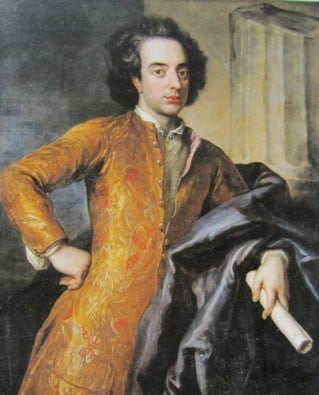
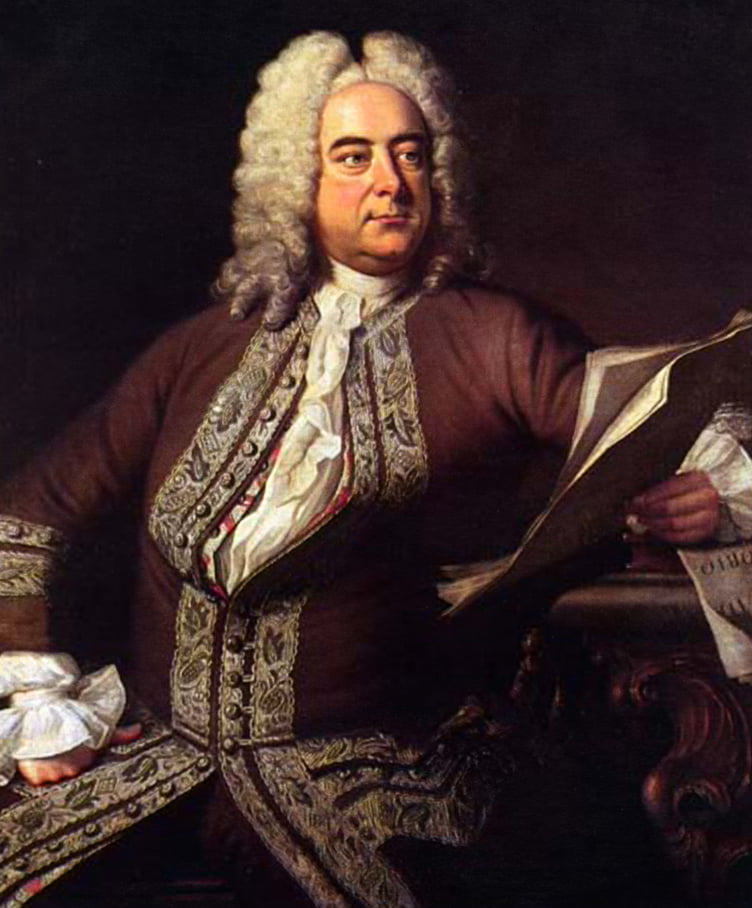
    Dueling portraits of Bononcini and Handel. Is it any wonder that Handel was favored by the “Whigs?”

  • Handel’s Solomon St Patrick’s Day Surprise

    Handel’s Solomon St Patrick’s Day Surprise

    On this date in 1749, one of George Frideric Handel’s most popular oratorios, “Solomon,” was first performed, at London’s Covent Garden Theater. Little did he dream that, 234 years later, the Irish folk band De Dannan would take his showstopping Act III sinfonia and give it a distinctly Irish twist, as “The Arrival of the Queen of Sheba (In Galway Bay).” I venture to guess even De Dannan didn’t realize “Solomon” received its debut on St. Patrick’s Day!

    https://www.youtube.com/watch?v=MB8NhXtgG_A

    No doubt Handel would have approved. He spent nine months in Ireland in 1742 to raise money for charity. The most performed oratorio in the history of the world, “Messiah,” was introduced in Dublin, at the Great Musick Hall, on Fishamble Street, on April 13, 1742.

  • Handel’s Enduring Appeal: A Modern Renaissance

    Handel’s Enduring Appeal: A Modern Renaissance

    Is it just me, or has the standard of Handel performance gotten so much better in recent decades? I guess you really don’t hit your stride as a composer until after the first 300 years.

    For as much as I hold a nostalgic affection for Hamilton Harty’s ponderous take on the “Water Music” – a concert staple for over half a century – a modern orchestra gives little indication of just how thrilling Handel can be. At its best, his vocal stuff, in particular, can be sublime.

    I didn’t always feel this way. When I attended a performance of “Ariodante” in Philadelphia, back in the 1989, even with the dream pairing of Benita Valente and Tatiana Troyanos, I was afraid I was going to give up the ghost. When it really doesn’t connect, three or four hours of Baroque opera can easily start to feel like too much of a good thing. My girlfriend at the time wanted to leave after the second act, but I insisted we stick it out. I was eager to witness the climactic swordfight, described in the synopsis – which, in the end, amounted to a single, slow-motion riposte. The weak pay-off earned me an evil glare.

    The experience had the effect of putting me off Handel opera in much the same way that downing a bottle of Inver House whiskey in my teens put me off Scotch. Just as I later discovered, to my surprise and delight, how much I truly appreciate a fine single malt, when I had occasion to reacquaint myself with “Ariodante” at the Princeton Festival in 2010, I was astonished to find that I actually liked Handel opera after all.

    A few years ago, when I wandered into a library book sale, I discovered that someone had dumped their entire collection of Handel operas and oratorios. I don’t know how many there were to begin with, but I walked out with everything that was left. Who knows if I’ll ever get through all of them before I die, but I am very happy to have them.

    That said, I do find Handel’s operas work best when encountered live, in performance – whether seen in person or on screen – which is the opposite of what I would say about most of the operas I prefer. The images that are formed in my mind by the music far surpass anything that can be realized on a stage. When attending opera, it is the experience of the orchestra, the voices, and the sense of “theater” I enjoy. But the visuals are too mundane for my grandiose vision.

    I also tend to get annoyed at modern stagings, with concepts that too often seem forced and undercut the vitality of the music. Again, Handel is different. David McVicar’s production of “Agrippina” must be one of the best things in the Met’s current repertoire.

    Of course, there is always the possibility that it is not so much Handel who has changed – despite a pronounced shift toward “authentic” performance practice over the past 40 years or so. It could be that even a paragon such as myself, sprung fully-formed from the head of Zeus, might have evolved. I’m reminded of the famous Twain observation that, when he was 14, his father was so ignorant he could hardly stand it; but when he was 21, he was astonished by how much the old man had learned.

    I’ve come a long way since my friends and I spent an ouzo-soaked 24 hours celebrating Handel’s tercentenary back in 1985. Everything old is new again. Handel grows wiser with the years, but also more thrilling.

    Happy birthday, G.F.H.


    Amanda Forsythe and Apollo’s Fire, with an aria from “Giulio Cesare”

    Danielle de Niese with the same aria, staged:

    Of course, there’s always Thomas Beecham to prove me wrong:

  • Beethoven Handel & Hanukkah Music

    Beethoven Handel & Hanukkah Music

    Remember when 2020 was supposed to be the big Beethoven year? To mark the 250th anniversary of his birth, I mean? How did that work out?

    Small compensation, I know, but how about a week’s worth of posts about Beethoven, to mark his actual birthday, commonly observed on December 16?

    On the fourth evening of Hanukkah, the obvious choice is Beethoven’s “Variations on ‘See the conquering hero comes,’” from Handel’s “Judas Maccabaeus.” Here’s a performance I’ve got all cued up from a recording of the complete cello sonatas:

    Beethoven was a great admirer of Handel’s music. “Handel is the greatest composer who ever lived,” he said. “I would uncover my head and kneel down on his tomb.” On his deathbed, he indicated an edition of Handel’s works and said, “There is the truth.”

    Handel’s influence can also be heard in Beethoven’s “Consecration of the House Overture” (which has nothing at all to do with the Maccabees). Note the stately intro of the piece, the fanfares, and the magnificent fugal passages:

    If you’ve got a long evening ahead of you, why not give Handel’s “other” holiday oratorio a whirl?

    If you want to skip right to the big tune, here it is:

    Then I hope you’ll join me for an hour of Hanukkah music by Michael Isaacson, Leon Stein, and Ofer Ben-Amots, on “Pieces of Eight,” on “The Lost Chord,” this Sunday night at 10:00 EST, on WWFM – The Classical Network and wwfm.org.


    Judah Maccabee, 18th century style

Tag Cloud

Aaron Copland (92) Beethoven (95) Composer (114) Film Music (119) Film Score (143) Film Scores (255) Halloween (94) John Williams (185) KWAX (229) Leonard Bernstein (99) Marlboro Music Festival (125) Movie Music (134) Opera (198) Philadelphia Orchestra (87) Picture Perfect (174) Princeton Symphony Orchestra (106) Radio (87) Ralph Vaughan Williams (85) Ross Amico (244) Roy's Tie-Dye Sci-Fi Corner (290) The Classical Network (101) The Lost Chord (268) Vaughan Williams (102) WPRB (396) WWFM (881)

DON’T MISS A BEAT

Receive a weekly digest every Sunday at noon by signing up here


RECENT POSTS