• Busoni, Strauss, and Queen Christina on the Radio

    Busoni, Strauss, and Queen Christina on the Radio

    by 

    in
    5 responses

    When his parents named him Ferruccio Dante Michelangelo Benvenuto Busoni, clearly they had high expectations for their boy. These expectations were more than fulfilled, when he went on to become one of the outstanding pianists of his day, a brilliant intellectual, and an influential teacher. He also composed what may be the most grandiose piano concerto of all time.

    Join me this afternoon on The Classical Network to hear Busoni’s magnum opus. The five-movement concerto, written in 1904, when the composer was 38, spans over 70 minutes and concludes with a male chorus. Chamber music it is not!

    The apotheosis is a setting of a lofty text lifted from the verse drama “Aladdin,” by the Danish playwright Adam Oehlenschläger. By contrast, there are passages in the fourth movement, of much earthier stuff, that barely skirt self-parody, conjuring the specter of Chico Marx.

    There was no way I would have been able to present this piece yesterday, Busoni’s birthday, during afternoon drive time, and reasonably expect to fit much else; but a Tuesday mid-afternoon is ideal for such an epic journey. The pianist will be Garrick Ohlsson, whose birthday it is tomorrow. Expect the concerto to commence around 2 p.m. EDT.

    We’ll follow that with one of Richard Strauss’ lesser-heard works, the ambitious symphonic fantasy “Aus Italien” (“From Italy”), from 1886. When Strauss, at 22 years-old, employed what he believed to be a traditional Italian melody in the fantasy’s finale, he suddenly found himself the target of a lawsuit. The Neapolitan song “Funiculì, Funiculà” had been composed in celebration of a funicular cable car that was used to convey passengers up and down Mount Vesuvius – before it was predictably destroyed in an eruption in 1944. The song was composed in 1880 by Luigi Denza (music) and Peppino Turco (lyrics). It became a huge international hit and sold over a million copies. Poor Strauss. He wound up having to pay a royalty fee every time “Aus Italien” was performed.

    We’ll begin our sojourn with today’s Noontime Concert, which will feature The Dryden Ensemble in a program titled “Queen Christina Goes to Rome.” The musical selections were chosen to mirror the unorthodox Swedish queen’s journey from Stockholm via Innsbruck to Italy, with excursions to Paris and Hamburg. Composers will include Dietrich Buxtehude, Louis Couperin, Arcangelo Corelli, Alessandro Scarlatti, and Johann Heinrich Schmelzer, among others.

    The free-spirited queen scandalized her contemporaries by dressing as a man and refusing to marry. Equally confounding was her abdication at the age of 28, trading her throne for a life of music, art, and religion in Rome. The concert will feature actors Roberta Maxwell as Christina and Paul Hecht as the narrator, in dramatic readings from the letters and diaries of the queen and other historical figures. The program and script were assembled by Dryden artistic director Jane McKinley.

    The Dryden Ensemble’s next set of concerts will take place this weekend. “Musica Stravagante” will include works for oboe and strings by German and Italian masters, including Tomaso Albinoni, Johann Sebastian Bach, Heinrich Ignaz Franz von Biber, and Antonio Vivaldi, again among others. The program will be presented twice, on Saturday at 7:30 p.m., at Trinity Episcopal Church in Solebury (outside New Hope, PA), and on Sunday at 3 p.m., at Princeton Theological Seminary’s Miller Chapel. For more information, visit drydenensemble.org.

    I hope you’ll join me today in getting a “kick” out of music from the Apennine Peninsula, from 12 to 4 p.m. EDT, on WWFM – The Classical Network and wwfm.org.


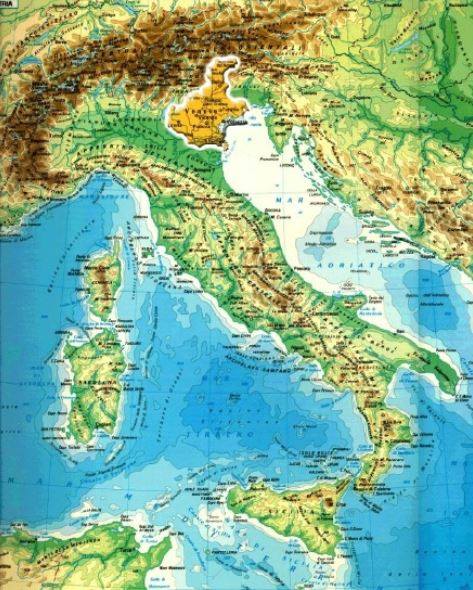
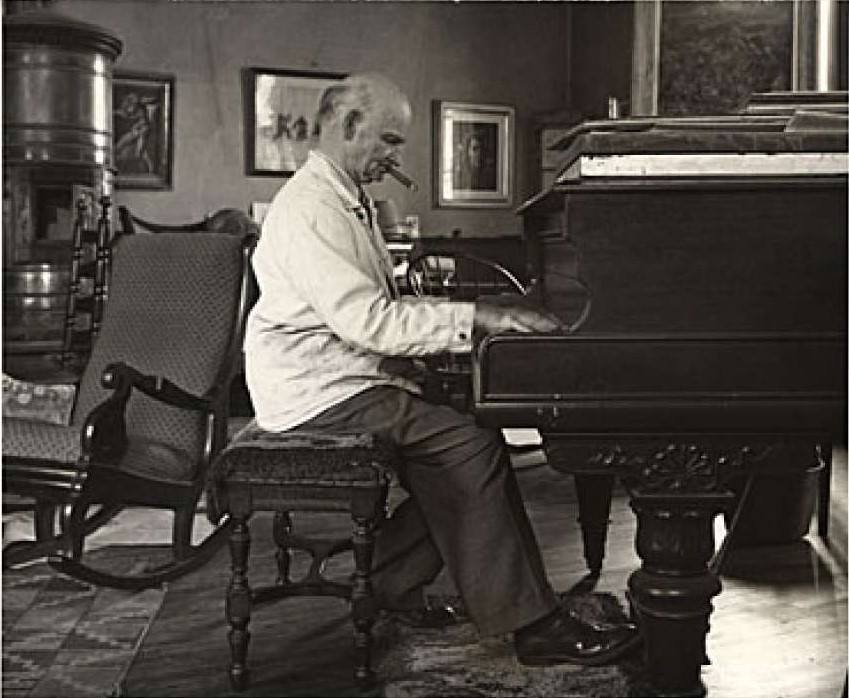
    Clockwise from left: The Apennine “boot;” Garbo as Queen Christina; a Vesuvian funicular car; Ferruccio Busoni enjoying a cigar

  • Rachmaninoff’s Humor Love & April Fools

    Rachmaninoff’s Humor Love & April Fools

    by 

    in
    3 responses

    Depending on where you look, Igor Stravinsky described Sergei Rachmaninoff as either “six foot two of Russian gloom” or “a six and a half foot scowl” (perhaps both). It’s true, you won’t find very many photos of Rachmaninoff smiling, but just to prove that he was not entirely without a sense of humor, I share with you the following anecdote:

    Rachmaninoff and his friend, the violinist Fritz Kreisler, were in the middle of a joint recital, when all of a sudden Kreisler got lost and began to noodle. Rachmaninoff would have noticed immediately, of course, and the two improvised brilliantly as the violinist searched for a way back. Hoping to save face, Kreisler inched over to his pianist and whispered, “Where are we?” To which Rachmaninoff replied, “Carnegie Hall.”

    On this April Fool’s Day – which also happens to be Rachmaninoff’s birthday – the two friends will be reunited in Rachmaninoff’s transcription of Kreisler’s “Liebesfreud,” or “Love’s Joy.”

    More in keeping with our impression of the dour pianist-composer, Rachmaninoff was crushed by the failure of his First Symphony (the responsibility for which may lay at the feet of its conductor, Alexander Glazunov, who is said to have been drunk at the work’s premiere). So devastated was the 23 year-old Rachmaninoff that he found himself unable to compose and sought psychiatric help. His physician, Nikolai Dahl, who was also an amateur violist, was able to restore his confidence after months of hypnotherapy, and Rachmaninoff returned to the concert stage in blazing triumph with his Piano Concerto No. 2.

    In gratitude, Rachmaninoff dedicated the concerto to Dahl, but there is another story behind the work, and it is a tender one. Rachmaninoff had fallen in love with Natalia Satina, a fellow pianist, who would later become his wife. Already in hot water with his piano teacher, Nikolai Sverev, who berated him for diverting time from his practice in order to compose, Rachmaninoff now endured the additional stress of making his relationship with Satina public, much to the dismay of his family and the Russian Orthodox Church.

    You see, Satina was Rachmaninoff’s first cousin. Any kind of union between the two would have been forbidden. However, Rachmaninoff was able to obtain a special dispensation from the Tsar, and the couple bypassed the Church by marrying at a military barracks. By all accounts the union was a happy one, and the Rachmaninoffs raised two healthy daughters.

    The marriage took place only after the concerto’s successful premiere. So “Brief Encounter” is not the only love story to be able to claim it as a soundtrack. Love makes fools of us all.

    What are the odds? Today is also the anniversary of the birth of another one of the great pianists, Ferruccio Busoni. We’ll keep it light with Busoni’s “Lustspielouverture,” or “Comedy Overture,” as well as his fantasy on themes from Mozart’s elevated farce, “The Marriage of Figaro.”

    The rest of the afternoon will be devoted to April’s fools and salutations to the month. We’ll be none the wiser, from 4 to 7 p.m. EDT, on WWFM – The Classical Network and wwfm.org.


  • Composer Painters Music and Art

    Composer Painters Music and Art

    by 

    in
    5 responses

    For some people, being a master in one field, it seems, just isn’t enough. This Sunday night on “The Lost Chord,” we’ll hear works by three successful composer-painters.

    Carl Ruggles (1876-1971), a friend of Charles Ives, lived 95 years. The cantankerous American modernist was the creator of a handful of meticulously-crafted, uncompromising works. His complete, authorized output amounts to four times the length of an LP side. We know this, because Michael Tilson Thomas recorded just about everything as part of a two-LP set, issued on the Columbia Masterworks label back in 1980.

    Ruggles’ method was described by musicologist Charles Seeger as “dissonant counterpoint,” a system wherein all the traditional rules of counterpoint are reversed, so that dissonance, rather than consonance, is the norm. The very practice smacks of contrarianism!

    Not surprisingly, he was beloved by Ives. When someone had the audacity to boo a work by Ruggles at a concert given in 1931, Ives berated the critic as a sissy. “Why can’t you stand up before fine, strong music like this, and use your ears like a man?” he challenged.

    In addition to his activities as a composer, Ruggles created hundreds of paintings. They were deemed successful enough that he was invited to hang shows and even sold many of his canvases.

    His musical composition “Sun-Treader” was inspired by Robert Browning’s poem, “Pauline” – in particular the line, “Sun-treader, light and life be thine forever!”

    In contrast to Ruggles, a gifted dilettante who tossed off paintings in an afternoon, Mikalojus Čiurlionis (1875-1911) is considered every bit as important a painter as he was a composer.

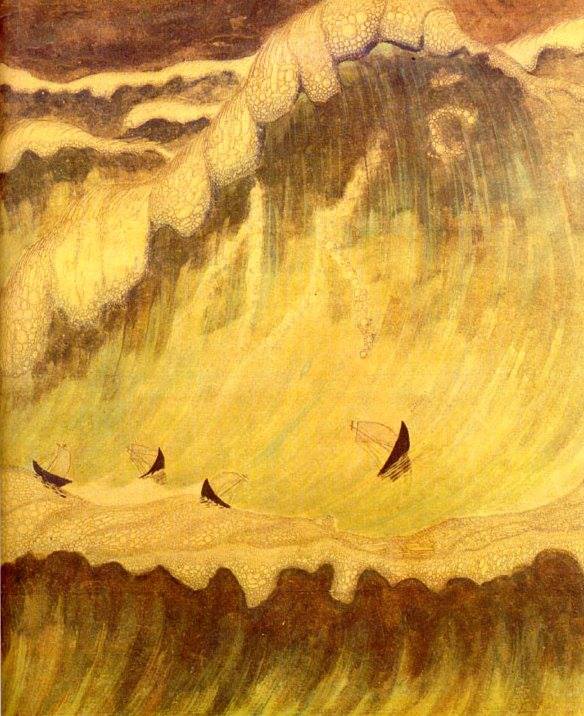
    In his 35 years, Čiurlionis managed to compose about 400 pieces of music and paint about 300 canvases. A pioneer of abstract art in Europe, he was an exemplar of the symbolist and art nouveau movements, a representative of the fin de siècle epoch, and a major figure in Lithuanian culture. Interestingly, Čiurlionis was also a synesthete; that is to say, he perceived colors and music simultaneously. We’ll hear his vibrant symphonic poem, “The Sea.”

    Lyonel Feininger (1871-1956), on the other hand, is known almost exclusively as a visual artist. Born and raised in New York, he moved to Germany at the age of 16. There, he became a leading practitioner of German Expressionism and the Bauhaus. With the rise of the Nazis in the 1930s and the party’s campaign against modern art, Feininger was driven out of Germany, and after 50 years returned to the United States, where he met with great success.

    Feininger had no formal music studies, beyond a few years of violin lessons. Regardless, he composed thirteen fugues (with extant sketches for a fourteenth). These, he wrote by ear, with the music of Johann Sebastian Bach being an undisguised influence. Feininger claimed that the influence of Bach was equally evident in his paintings.

    Prepare to see double this week. It’s an hour of music by ambidextrous artists. Join me for “Fixtures at an Exhibition,” this Sunday night at 10:00 EDT, on WWFM – The Classical Network and wwfm.org.


    “Sonata of the Sea: Finale” (1908), by Mikalojus Čiurlionis


  • Carl Ruggles’ Sun-Treader on WWFM

    Carl Ruggles’ Sun-Treader on WWFM

    by 

    in
    7 responses

    If I said March would be going out like a lamb, I’d be lion! Get ready for the ecstatic dissonances of Carl Ruggles’ “Sun-Treader.”

    “Sun-Treader” kicks off tonight’s edition of “The Lost Chord,” an hour of music by composers who were also devoted painters (and one visual artist who also happened to compose).

    That’s “Fixtures at an Exhibition,” this Sunday night at 10:00 EDT, on WWFM – The Classical Network and wwfm.org.


    Ruggles with a cigar and three of his paintings (left to right): “Flowers,” “The Church,” and “Forebodings.”


  • Alaska Purchase & the Music of Space

    Alaska Purchase & the Music of Space

    by 

    in
    2 responses

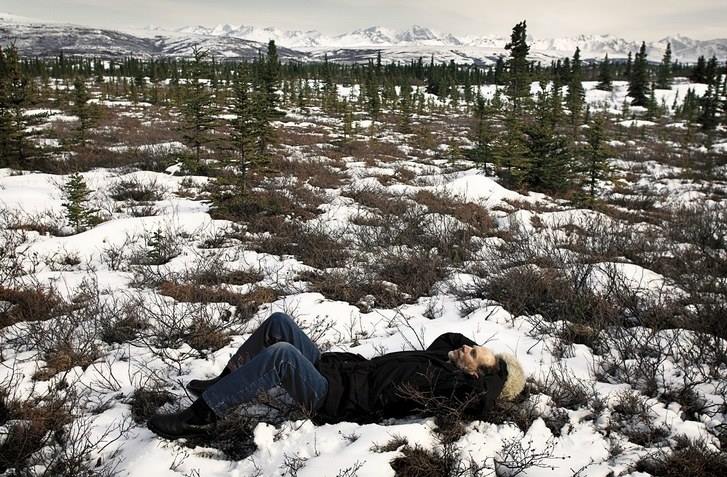
    On this date in 1867, the United States bought Alaska from Russia for $7,200,000 – two cents an acre. Celebrate “Seward’s Folly” with music by John Luther Adams. Adams, who lived most of his adult life in interior Alaska – about 100 miles south of the Arctic Circle – was awarded the Pulitzer Prize for Music in 2014.

    Here is Adams on his composition “In a Treeless Place, Only Snow” (1999):

    White is not the absence of colour. It is the fullness of light.

    Silence is not the absence of sound. It is the presence of stillness.

    As the Inuit have known for centuries, and as painters from Malevich to Ryman have shown us more recently, whiteness embraces many hues, textures and nuances.

    As John Cage reminded us, silence does not literally exist. Still, in a worlds going deaf with human noise, silence endures as a deep and resonant metaphor.

    In his “Poetics of Music,” Stravinsky speaks of music as a form of philosophical speculation. But music can also be a form of contemplation: the sensual reaching for the spiritual.

    I aspire to music which is both rigorous in thought and sensuous in sound.

    For many years now, I’ve worked with an ideal of “sonic geography” – music as place, and place as music. The treeless, windswept expanses of the Arctic are enduring creative touchstones for my work, and “In A Treeless Place” is an attempt to evoke an enveloping musical presence equivalent to that of a vast tundra landscape.

    But I want to go beyond landscape painting with tones, beyond language, metaphor and the extra-musical image.

    I no longer want to be outside the music, listening to it as an object apart. I want to INHABIT the music, to be fully present and listening in that immeasurable space which Malevich called “a desert of pure feeling.”

    Listen to the music here:

    On a much more ambitious scale, here is a selection from Adams’ “Inuksuit” (2009), as filmed by Paul Moon.

    FUN FACT: When I was in second grade, I played Seward in a school play!


Tag Cloud

Aaron Copland (93) Beethoven (95) Composer (114) Film Music (145) Film Score (143) Film Scores (255) Halloween (94) John Williams (195) KWAX (229) Leonard Bernstein (104) Marlboro Music Festival (125) Movie Music (160) Mozart (91) Opera (213) Philadelphia Orchestra (89) Picture Perfect (174) Princeton Symphony Orchestra (109) Radio (88) Ross Amico (244) Roy's Tie-Dye Sci-Fi Corner (290) The Classical Network (101) The Lost Chord (269) Vaughan Williams (105) WPRB (397) WWFM (881)

DON’T MISS A BEAT

Receive a weekly digest every Sunday at noon by signing up here


RECENT POSTS