This week on “Sweetness and Light,” we’ll lend plenty of paprika and poppyseed to your breakfast with an hour of Hungarian delights.
Enjoy a selection from a beloved film score by Miklós Rózsa (you can take the composer out of Hungary, but you can’t take Hungary out of the composer!), a “Hungarian Capriccio” by Eugene Zador (who assisted Rózsa as an orchestrator), some old Hungarian dances arranged by Ferenc Farkas, Hungarian fantasies by Franz Lehár and Franz Doppler, Doppler’s orchestration of a work by Franz Liszt, Liszt’s arrangement of a patriotic melody, and a schmaltzy treatment of a work by Jenő Hubay.
That’s an ample helping of goulash and czardas on “Sweetness and Light,” this Saturday morning at 11:00 EDT/8:00 PDT, exclusively on KWAX, the radio station of the University of Oregon!
It’s hardly surprising that anyone would be moved to write music for Pablo Casals.
Regarded by many as the greatest cellist of his time, perhaps ever, Casals was certainly a giant of an artist and of a man. Born in Catalonia, he stood up to the Franco regime, entering into self-imposed exile and refusing to perform in countries that recognized Franco’s authority. He rediscovered the Bach cello suites in a secondhand bookshop and made them famous. Over the course of his career, he played for both Queen Victoria and John F. Kennedy.
As a conductor and an administrator, he founded the Prades Festival and Casals Festival. He established the Puerto Rico Symphony and Conservatory. He gave master classes, conducted and recorded at Marlboro. He was even a talented composer.
This week on “The Lost Chord,” we’ll hear works dedicated to Casals by three of his friends and colleagues.
Ralph Vaughan Williams wrote his seldom-heard “Fantasia on Sussex Folk Tunes” around the time he was at work on his Piano Concerto and “Job: A Masque for Dancing.” Casals performed the piece in 1930. It was not heard again until 1983, the year of its world-premiere recording (featuring Julian Lloyd Webber). The composer later undertook a full-scale concerto for Casals. It was never completed, but the sketches for its slow movement were realized for a 2010 performance at the BBC Proms, under the title “Dark Pastoral.”
Donald Francis Tovey, who would achieve fame as a musicologist and writer on music, wrote quite a lot of music himself, most of it now forgotten. In 1935, he composed a concerto for Casals. At nearly an hour in length, the work may be the longest cello concerto ever written.
In 1912, Tovey was a houseguest of Casals and cellist Guilhermina Suggia, at their summer home at Playa San Salvador on the Mediterranean coast. There, he played tennis, swam and performed chamber music with the likes of Enrique Granados and Mieczyslaw Horszowski. He also made great strides on his opera, “The Bride of Dionysus.” As a show of thanks, he composed for his hosts a Sonata for Two Cellos in G major, which became part of the evenings’ entertainments. The work’s second movement is a set of variations on a Catalan folk song. We’ll hear it performed by Marcy Rosen and Frances Rowell, from a Bridge Records, Inc. release.
Finally, Arnold Schoenberg (whose birthday it is today), himself an amateur cellist, had done editorial work on three pieces by the 18th century composer Georg Matthias Monn for inclusion in the publication “Monuments of Music in Austria.” When Casals invited Schoenberg to conduct his orchestra in Barcelona, the composer set about arranging a “new” concerto, based upon a harpsichord work by Monn, written in 1746. We’ll hear Schoenberg’s transformation of the piece performed by Yo-Yo Ma.
I hope you’ll join me for “Casals’ Pals” – music written for Pablo Casals by notable composers, friends and colleagues – on “The Lost Chord,” now in syndication on KWAX, the radio station of the University of Oregon!
Clip and save the start times for all three of my recorded shows:
PICTURE PERFECT, the movie music show – Friday at 8:00 PM EDT/5:00 PM PDT
SWEETNESS AND LIGHT, the light music program – Saturday at 11:00 AM EDT/8:00 AM PDT
THE LOST CHORD, unusual and neglected rep – Saturday at 7:00 PM EDT/4:00 PM PDT
The game is afoot! This week on “Picture Perfect,” it’s an hour of music from movies inspired by the world’s greatest detective.
“Sherlock Holmes” (2009) stars Robert Downey Jr. and Jude Law, in Michael Ritchie’s post-“Matrix” take on the master detective. While some of the film adaptations over the years may have glossed over the character’s physicality, Ritchie’s revisionist Holmes perhaps errs a mite too far in the other direction. Hans Zimmer (whose birthday it is today) wrote the music, he too going against received wisdom, and in the process coming up with one of his more interesting scores, if only for the quirky instrumentation, which includes a Hungarian cimbalom, accordion, fiddles, and a broken-down pub piano.
Admittedly, it’s unfair to put Zimmer up against an old pro like Miklós Rózsa. Rózsa wrote the music for Billy Wilder’s melancholy portrait of the great detective, “The Private Life of Sherlock Holmes” (1970). Wilder requested that the composer adapt his lovely Violin Concerto for the project, a recording of which the director had listened to repeatedly during the writing of the screenplay. Rózsa and Wilder had previously collaborated on “Double Indemnity” and “The Lost Weekend.”
The Sherlock Holmes comedy “Without a Clue” (1988) represents a missed opportunity of sorts. The hope had been for Sean Connery to play Watson opposite Michael Caine’s Holmes, a much-longed-for reunion between the two, who had worked so well together in “The Man Who Would Be King.” In the end, it was Ben Kingsley who assumed the role.
The fun conceit that sets “Without a Clue” apart is that Holmes is the fictional creation of mastermind Watson, who is in reality the gifted crime-solver. By way of necessity, Watson hires a second-rate actor to play the part of Holmes. Of course, the actor turns out to be a bumbling idiot. Henry Mancini provides the British Light Music style score, with a nod to Edward White’s “Puffin’ Billy” (familiar stateside as the theme to “Captain Kangaroo”).
Finally, the Steven Spielberg-produced “Young Sherlock Holmes” (1985) offers a conjectural origins story, including Holmes and Watson’s first meeting as teenagers (ignoring the particulars laid out by Arthur Conan Doyle in his stories, with Watson already a war veteran who had served in Afghanistan). It’s all for fun, though it’s unfortunate the filmmakers felt the need to interject ‘80s-style special effects, rather than simply trust in the inherent magic of the subject matter. “Young Sherlock Holmes” features the first photorealistic, fully computer-generated character (a stained-glass knight). Also, some Indiana Jones B-movie antics involving an Egyptian cult seem especially out of place.
Interestingly, the film’s screenwriter, Chris Columbus, went on to direct the first two Harry Potter films. By my recollection, “Young Sherlock Holmes,” with its boarding school setting, has some of that same feel.
The music, by Bruce Broughton, is certainly buoyant and beautiful, in the best John Williams tradition. Broughton scored a handful of big screen hits, notably “Silverado” and “Tombstone,” though arguably it is in the medium of television that he’s made his greatest impact. Thus far, his work has been recognized with a record 10 Grammy Awards.
It’s elementary, my dear Watson. I hope you’ll join me for “Picture Perfect,” music for the movies, now in syndication on KWAX, the radio station of the University of Oregon!
Clip and save the start times for all three of my recorded shows:
PICTURE PERFECT, the movie music show – Friday at 8:00 PM EDT/5:00 PM PDT
SWEETNESS AND LIGHT, the light music program – Saturday at 11:00 AM EDT/8:00 AM PDT
THE LOST CHORD, unusual and neglected rep – Saturday at 7:00 PM EDT/4:00 PM PDT
9/11 is about the last thing to make anyone nostalgic. But at least in 2001 we still lived in a society in which national tragedy brought us together rather than divided us. That is, until the scapegoating began. Now it’s gotten to the point where I dread not what the next 24 years will bring, but rather the next 24 hours. No dona nobis pacems, please. The way to “peace” and a better world is in every one of us. Alas, so are the impediments. If we love our country and our families and value anything good we ever experienced here, thanks to our great good fortune in having lived in a comparatively free, safe, and sane United States, it’s time to grow up and take responsibility for fixing what’s broken, in ourselves and in the world. I realize about five people read this page, and everyone is here to talk about music, but I beg your indulgence for just a few sentences. We must rise above our baser instincts. Reject fomenters. Embrace compassion. Be humane. Can I myself live up to these ideals? Probably not. I get angry when somebody sits in their car checking their cell phone while I’m waiting for a parking space. But I can try harder, and you can too. Because if we don’t, there’s a greater chance of us imploding in suspicion, fear, hatred, and violence than there ever was of our crumbling from external forces like those that, ironically, brought unity in suffering on 9/11.
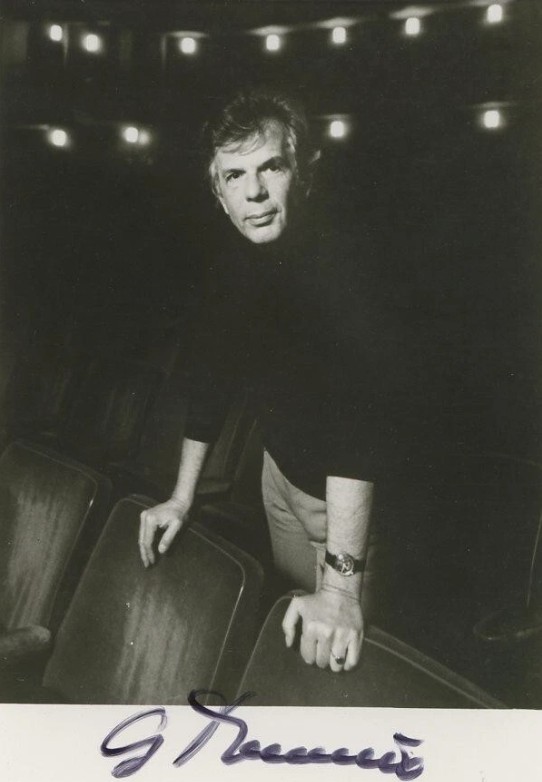
For some reason, Christoph von Dohnányi didn’t come to Philadelphia much. I can recall he came through on tour once, probably with the Cleveland Orchestra. I’m sure he must have come through more than that, but if he did, I never heard him live. He was music director in Cleveland from 1984 to 2002 (having conducted the orchestra for the first time in 1981) – enough to keep anyone’s hands full, I suppose. But I knew him from his recordings, naturally.
He had an interesting lineage. His grandfather was the eminent Hungarian composer, pianist, conductor, and educator Ernst von Dohnányi (born Ernő). His uncle, on his mother’s side (also his godfather), was the theologian and anti-Nazi dissident Dietrich Bonhoeffer. A number of his family members were part of the German Resistance movement during World War II. Several, including his father and uncle, were detained in concentration camps and executed when Dohnanyi was 15.
The young Dohnányi set out on an academic career with an intention to study law, but in common with so many musicians who pursued that course, in the end succumbed to the siren lure of music.
In 1951, he first came to the United States to study with his repatriated grandfather at Florida State University. The elder Dohnányi had actually met and played with Brahms.
Christoph is now being widely lauded for having “restored” to the Cleveland Orchestra to its former excellence, following the lackluster tenure of Lorin Maazel, who succeeded George Szell (who of course made the orchestra). Maazel was appointed music director over the voluble protests of its musicians. Be that as it may (or may not; was the orchestra ever bad?), Dohnányi learned firsthand how difficult it was to emerge from the shadow of a legend. He once quipped, “We give a great concert, and George Szell gets a great review.”
Dohnányi defined the difference between them: Szell, a notorious martinet (my words, not his), drilled the musicians mercilessly and drove them with a palpable sense of inner intensity. Dohnányi, on the other hand, assimilated the lessons he learned in the opera house, beginning as an assistant to Georg Solti in Frankfurt, not worrying so much about bar-lines, but following the example of singers in allowing the music to breathe.
Eventually, he would become music director in Frankfurt. He also held posts at the opera houses of Lübeck and Hamburg. Later, he brought staged opera to Cleveland.
Among his orchestra positions, he was chief conductor of the Staatsorchester Kassel and the WDR Symphony Orchestra Cologne. Following Cleveland, he was principal guest conductor, and then principal conductor, of London’s Philharmonia Orchestra. In 2004, he became chief conductor of the North German Radio Symphony Orchestra, a position he held until 2010.
Of course, he guest conducted all the great orchestras of the United States (including Cleveland), as well as most of them in Europe, and also the Israel Philharmonic. Throughout, he remained active in opera.
Although wholly devoted to music, he was not a flashy conductor and preferred to keep a low profile. He acknowledged that he was a strong leader, but he was never one for razzle dazzle.
Dohnányi died on Saturday. Today would have been his 96th birthday. R.I.P.
Interestingly, I note that I don’t have all that many of Dohnányi’s recordings in my own collection, although I have had dealings with many of them over the course of my career in radio. Of the ones I do own, I have great affection for his first recording of Mendelssohn’s “Die erste Walpurgisnacht,” with the Vienna Philharmonic Orchestra and Chorus. He’s the conductor on favorite recordings of the Busoni Piano Concerto (with Garrick Ohlsson) and the Philip Glass Violin Concerto (with Gidon Kremer). I also have the recording of Alban Berg’s “Wozzeck” he made with his wife, Anja Silja. I’m sure there are more, but not many. The comparative neglect is attributable to my deficiency and not his.
Dohnányi made a number of recordings of the works of Antonin Dvořák (including the Symphonies Nos. 6, 7, 8 & 9, the Piano Concerto, and the “Slavonic Dances”). These received heavy air play for decades, especially by a certain host who shall remain nameless, during my years at the local classical music radio station. Since today is also Dvořák’s birthday anniversary, here’s a link to his recording of the Symphony No. 7.
He was also a champion of Hans Werner Henze. Thanks to Mather Pfeiffenberger for directing me to this link to orchestral fragments (Adagio, Fugue and Maenads’ Dance) from “The Bassarids.” In 1965, Dohnányi conducted the premiere of Henze’s “Der junge Lord” (which he also recorded).


5 responses