• Marlboro Music B-Flat Bliss Mozart Beethoven

    Marlboro Music B-Flat Bliss Mozart Beethoven

    by 

    in
    7 responses

    With heat index values of 105, there is nothing to be done but be flat – or B flat, as the case may be.

    On this week’s “Music from Marlboro,” I’ll make few demands on a sweltering listenership by offering works by Mozart and Beethoven, both in the key of B flat.

    Beethoven’s Piano Trio, Op. 97, known as the “Archduke,” was one of 14 works the composer wrote for his friend and patron Archduke Rudolf of Austria. Rudolf, an amateur pianist, was the youngest child of Holy Roman Emperor Leopold II.

    Beethoven himself appeared at the keyboard at the work’s premiere in 1814. His encroaching deafness so diminished his former prowess as a performer that he retired from concertizing after a repeat performance a few weeks later. The violinist and composer Louis Spohr summed up the discomfort and pity felt by those in attendance, “I am deeply saddened by so hard a fate.”

    The music remains unbowed. Today, the “Archduke” Trio is as noble and inspiring as ever.

    We’ll hear it performed at the 2006 Marlboro Music Festival by pianist Mitsuko Uchida – Marlboro’s sole artistic director since 2013 (next year she’ll be joined by Jonathan Biss) – violinist Soovin Kim, and cellist David Soyer of the legendary Guarneri Quartet.

    The hour will open with a delightful work by Mozart – his Sonata in B-flat for Bassoon and Cello, K. 292. The 1975 performance will feature bassoonist Alexander Heller and a 19 year-old cellist named Yo-Yo Ma.

    The performances are unfailingly at pitch, even when we’re all flat. Join me for music in B flat on this week’s “Music from Marlboro,” this Wednesday evening at 6:00 EDT, on WWFM – The Classical Network and wwfm.org.

    Marlboro School of Music and Festival: Official Page

  • Classical Music Beach Vacation Getaway

    Classical Music Beach Vacation Getaway

    by 

    in
    5 responses

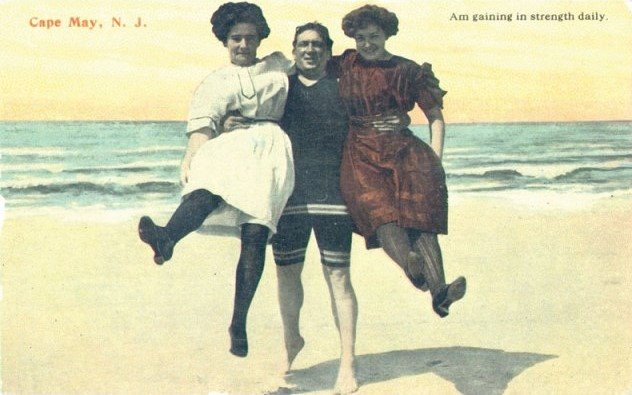
    With summer vacation winding down – and some even back to school already, poor dears – we’ll take one last trip to the beach. On today’s Noontime Concert on The Classical Network, it’s another program from the Cape May Music Festival.

    The New York Chamber Ensemble will present “Folk Dance in Chamber Music,” with repertoire including works by Béla Bartók, Luigi Boccherini, Astor Piazzolla, and Antonin Dvořák, alongside arrangements by Robert Beaser.

    Following the concert broadcast, stick around for Rick Sowash’s “Cape May Suite.” Sowash, who makes his home in Ohio, fondly recalls vacationing in South Jersey with his family.

    Then cast off with music by the Breton composer Jean Cras. Like Nikolai Rimsky-Korsakov and Albert Roussel, Cras was a navy man. Impressions of the sea saturate many of his works, a number of which were actually written in a ship’s cabin. We’ll hear his symphonic suite, “Journal de bord,” which, like Debussy’s “La mer,” attempts to convey the moods of the sea at different hours of the day.

    Rimsky-Korsakov had retired from active service by the time he came to write his Quintet for Piano and Winds. Even so, he had been appointed to the civilian post of Inspector of Naval Bands. We’ll hear a performance of Rimsky’s cheery quintet featuring members of the Munich Residenz Quintet and Wolfgang Sawallisch at the keyboard.

    I believe it was Igor Stravinsky who once said, “A good composer does not imitate; he steals.” No one is going to claim the Flemish composer Paul Gilson’s “De Zee” (“The Sea”) is one of the world’s great masterpieces, but clearly there is something to it for Debussy to have borrowed so shamelessly from it when he came to write “La mer.”

    Jacques Ibert served in the Navy during World War I. Before our time is out, we’ll travel to destinations around the Mediterranean – in Italy, North Africa, and Spain – with Ibert’s symphonic suite “Escales” (“Ports of Call”).

    You won’t have to join the Navy to see the world. We’ve got one in every port, this afternoon from 12 to 4 p.m. EDT, on WWFM – The Classical Network and wwfm.org.


  • Rebecca Clarke and Eric Coates Born on This Day

    Rebecca Clarke and Eric Coates Born on This Day

    by 

    in
    7 responses

    On this date in 1886, two noteworthy figures in English music were born.

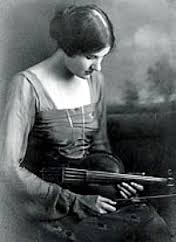
    Rebecca Clarke entered London’s Royal College of Music at a time when female students were still considered anomalies. Her teacher, Sir Charles Villiers Stanford, persuaded her to switch from violin to viola, since from that vantage she would be better able to absorb the mechanics of the orchestra. Also, thanks to musicians like Lionel Tertis, the viola was just beginning to be viewed as a viable instrument in itself.

    Clarke played in the Queen’s Hall Orchestra, under Sir Henry Wood. Then in 1916, she packed up and moved to America. Critics tended to praise her works which were listed in concert programs under male pseudonyms, while those identified as her own were often dismissed.

    The notable exception of her career was her Viola Sonata, which tied for first place in a competition sponsored by Elizabeth Sprague Coolidge with a work of Ernest Bloch. Even so, there were some who grumbled that the work couldn’t possibly have been composed by a woman, and that perhaps Bloch himself had even written it.

    Clarke married James Friskin, a founding member of the Juilliard School faculty, in 1944, and although he was supportive of her endeavors, lack of recognition and struggles with depression resulted in her ultimately giving up on composing. She died in 1979, at the age of 93. Today, her sonata is considered one of the great works written for the viola.

    Here’s Rebecca Clarke’s “Morpheus”:

    By contrast, Eric Coates enjoyed enormous popularity as a master of British Light Music. Ironically, Coates had taken viola lessons with Tertis at the Royal Academy of Music.

    Among his best-known works are his “London Suite,” and this one, the perfect Coates confection for a late summer day:

    I hope you’ll join me this afternoon for works by Clarke and Coates. They’ll be among my featured composers between 4 and 7 p.m. EDT, on WWFM – The Classical Network and wwfm.org.


  • Vaughan Williams Remembered on WWFM

    Vaughan Williams Remembered on WWFM

    by 

    in
    8 responses

    With all the hoo-ha surrounding the 100th anniversary of the death of Claude Debussy, it’s easy to forget that Ralph Vaughan Williams (who studied for a time with Ravel) died 60 years ago today. Yeah, I know 60 doesn’t quite have the marketing punch of 50 or 100, but Vaughan Williams is one of my all-time favorite composers, so I am going to go with it.

    This Sunday night on “The Lost Chord,” we’ll remember one of England’s finest composers by way of three rare recordings he made of his own music.

    Unlike Sir Edward Elgar, who was given the opportunity to record most of his major output, Vaughan Williams was generally overlooked as a conductor by the major labels – which is a shame, because the few recordings he did make are superb.

    Among the acoustical documents, none match the hilarity of RVW’s 1925 performance of “The Wasps” overture. Vaughan Williams’ recording is by far the fastest – and jauntiest – “Wasps” on record, although I’m unsure whether it is due to the composer’s own preference, or because of the limitations of the technology. It’s hard not to smile at such manic high spirits.

    By contrast, his 1937 recording of the Symphony No. 4 is a masterpiece of temperament and ferocity – all the more jarring in that the turbulence evoked in the work is not at all what most people associate with this composer. The urgency of the music is captured, eerily, at a time when the ink was still fresh on the page and the world was on the brink of chaos. It certainly belies the snide dismissal of much of the composer’s output as languid “cow-pat” music.

    In all, Vaughan Willliams’ meager commercial discography as a conductor wouldn’t even fill two hours. It is most fortunate, then, that a few concert recordings have emerged over the years. We’ll conclude with of one of RVW’s loveliest pieces, the “Serenade to Music,” the work which actually brought tears to the eyes of Sergei Rachmaninoff at its first performance in 1938. The text is from Act V, scene I, of Shakespeare’s “The Merchant of Venice.”

    “How sweet the moonlight sleeps upon this bank!
    Here will we sit and let the sounds of music
    Creep in our ears: soft stillness and the night,
    Become the touches of sweet harmony.”

    This performance was captured at Royal Festival Hall on November 22, 1951. Vaughan Williams was 79 years old. What’s especially remarkable is that the recording features 11 of the 16 soloists who sang in the work’s 1938 premiere. We’ll hear it from a compact disc issued on Albion Records, the official label of the Ralph Vaughan Williams Society.

    Vaughan Williams’ ashes are interred in Westminster Abbey alongside some of the nation’s greatest artists – yet, in some measure, the composer is still underestimated, especially by those outside the British Isles. I hope you’ll join me as we remember RVW on the 60th anniversary of his death. That’s “Vaughan, But Not Forgotten,” this Sunday night at 10:00 EDT, on WWFM – The Classical Network and wwfm.org.


  • Bernstein Centennial on The Classical Network

    Bernstein Centennial on The Classical Network

    by 

    in
    3 responses

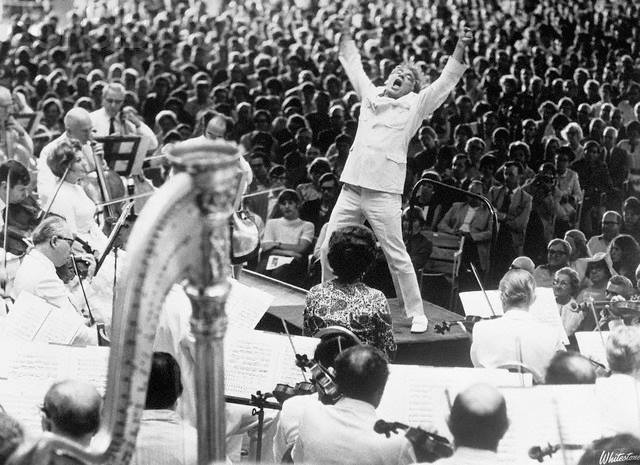
    The Bernstein centennial has arrived! The celebration continues on The Classical Network. Join Bill Jerome from 8:00 a.m. to 12:00 p.m. and David Osenberg from 1:00 to 5:00 p.m. for more classic Bernstein performances, compositions, and spoken word.

    In addition, “Pipedreams” will be all-Bernstein, tomorrow at 7:00 a.m., and Ted Otten and Michael Kownacky will present the second part of their survey of Bernstein’s music for the theater on “The Dress Circle,” tomorrow at 7:00 p.m.

    You’ll find a more comprehensive list of WWFM Bernstein programs here. Click on the individual links to enjoy webcasts of shows that aired earlier in the week.

    http://www.wwfm.org/topic/leonard-bernstein-100#stream/0

    We’re still loony for Lenny on WWFM – The Classical Network and wwfm.org. Happy Birthday, Leonard Bernstein!


Tag Cloud

Aaron Copland (93) Beethoven (95) Composer (114) Film Music (145) Film Score (143) Film Scores (255) Halloween (94) John Williams (195) KWAX (229) Leonard Bernstein (104) Marlboro Music Festival (125) Movie Music (160) Mozart (91) Opera (213) Philadelphia Orchestra (89) Picture Perfect (174) Princeton Symphony Orchestra (109) Radio (88) Ross Amico (244) Roy's Tie-Dye Sci-Fi Corner (290) The Classical Network (101) The Lost Chord (269) Vaughan Williams (105) WPRB (397) WWFM (881)

DON’T MISS A BEAT

Receive a weekly digest every Sunday at noon by signing up here


RECENT POSTS