• Bernstein at 100: Celebrating a Musical Superstar

    Bernstein at 100: Celebrating a Musical Superstar

    by 

    in
    7 responses

    The classical music world has got a fever, and the only prescription is more Bernstein.

    With the centennial of the composer-conductor-pianist-teacher’s birth coming up on Saturday, Lenny Mania is about to achieve critical overload. Bernstein has been everywhere for the past year, and the remembrances and celebrations look as if they will continue through at least the end of next season, with concert schedules ripe with representative works.

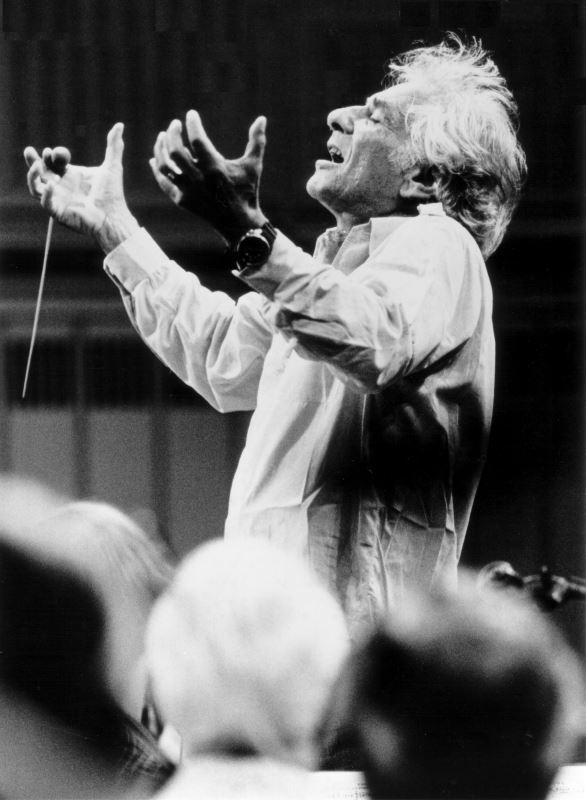
    All the fuss is justifiable, of course. After all, there was no more influential figure in American music, and I would be hard pressed to think of any other conductor who achieved his level of glamour and universal recognition. Lenny was that rare bird in classical music – he was a superstar.

    In common with musical organizations all over the world, The Classical Network can’t very well let this milestone pass without a good party. In particular, all this week, many of our syndicated programs and locally produced shows have been trumpeting this outrageously talented figure.

    The birthday blow-out will climax with two days of Bernstein’s recordings and compositions, and perhaps even a sample or two of his spoken observations on music. After all, Bernstein was unusually articulate on the subject. I hope you’ll join us in celebrating Lenny on The Classical Network, as the bulk of our programming this Friday and Saturday will be made up of playlists lovingly curated by WWFM on-air hosts.

    How about you? Do you have a Bernstein story you’d like to share? The Classical Network is giving you two options through which to do so. You can either post your story on the station Facebook page at WWFM – The Classical Network or email it to info@wwfm.org, identifying it in the subject line simply with the name “Bernstein.”

    We’ll select from these on Friday and Saturday and share them with our audience in between some of Lenny’s classic recordings. It can be a personal anecdote, or it can be a broader observation. How has Leonard Bernstein touched your life?

    From a personal standpoint, I am curious to hear about your own favorite recordings. I’ll be sharing some of mine on the air tomorrow afternoon. What are some of yours? I’d be happy to chat with you about it in the comments section below. If you want any of your comments shared on the air, be sure to send them to WWFM. Otherwise, what happens on Classic Ross Amico stays on Classic Ross Amico.

    Then tune in on Friday and Saturday as we light 100 candles for Leonard Bernstein, on WWFM – The Classical Network and wwfm.org.


    Photo courtesy of The Leonard Bernstein Office, Inc.

  • Debussy’s Enduring Quartet Music from Marlboro

    Debussy’s Enduring Quartet Music from Marlboro

    by 

    in
    2 responses

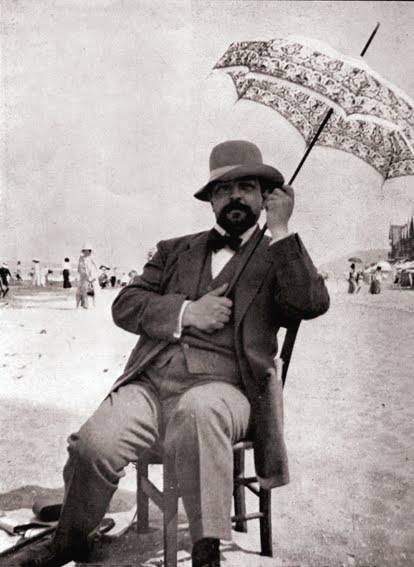
    Claude Debussy may have died 100 years ago (March 28, 1918), but his music hasn’t aged a bit. On this week’s “Music from Marlboro,” we celebrate Debussy’s birthday (August 22, 1862) – a more festive occasion, I think – with a performance of his String Quartet in G minor.

    Debussy’s quartet, composed in 1893, was very much of its time, but also ahead of its time. Its flights of fancy and free association mirror currents in contemporaneous French painting and poetry; but when it comes to change, music often has a tendency to be “la plus que lente.”

    Debussy’s bold rejection of German academicism likely caused more than a few whiskers to bristle. Ernest Chausson, its dedicatee, had personal reservations about the piece, and the premiere, given by the Ysaÿe Quartet, received mixed reviews. Poetry and sensuality dominate, with a kind of cyclic structure, reliant on a recurring motto, declared at the very outset, standing in for the rules of classical harmony. Wrote the composer, “Any sounds, in any combination, and in any succession, are henceforth free to be used in a musical continuity.”

    Debussy disliked the term “Impressionism,” by the way. Quel dommage!

    We’ll hear Debussy’s one-and-only quartet, performed by Marlboro musicians – violinists Joseph Lin and Judy Kang, violist Richard O’Neill, and cellist David Soyer – on tour at the Isabella Stewart Gardner Museum in Boston in 2002. For a complete schedule of this year’s tours, including stops in New York and Philadelphia, look online at marlboromusic.org.

    Maurice Ravel’s Piano Trio will be included on a Marlboro tour in March, alongside music by Haydn and Kodály. That’s a long time to wait, n’est-ce pas, so let’s give it a listen this evening, shall we?

    Ravel, who also composed a single string quartet, very much under the influence of Debussy, finally sat down to write his Piano Trio over the summer of 1914. By that point, it had already been gestating for at least six years. Progress was slow, but when war was declared in August, Ravel put on a burst of speed so that he could do his patriotic duty and enlist in the French army. He was rejected from the infantry and the air force on account of his diminutive size and precarious health, but he learned to drive a truck and cared for the wounded at Verdun and the Western Front.

    From 2016 Marlboro Music Festival, we’ll hear a performance with pianist Bruno Canino, violinist Robyn Bollinger, and cellist Jonah Ellsworth.

    I’m hoping to leave some good Impressions, on the next “Music from Marlboro,” this Wednesday evening at 6:00 EDT.

    Tune in a little early, beginning at 4 p.m., to enjoy more Debussy – alongside representative selections by fellow birthday celebrants Pierre Danican Philidor, Sir Alexander Mackenzie, and Karlheinz Stockhausen (gussied up somewhat by Pulitzer Prize winner Caroline Shaw) – on WWFM – The Classical Network and wwfm.org.

    Marlboro School of Music and Festival: Official Page


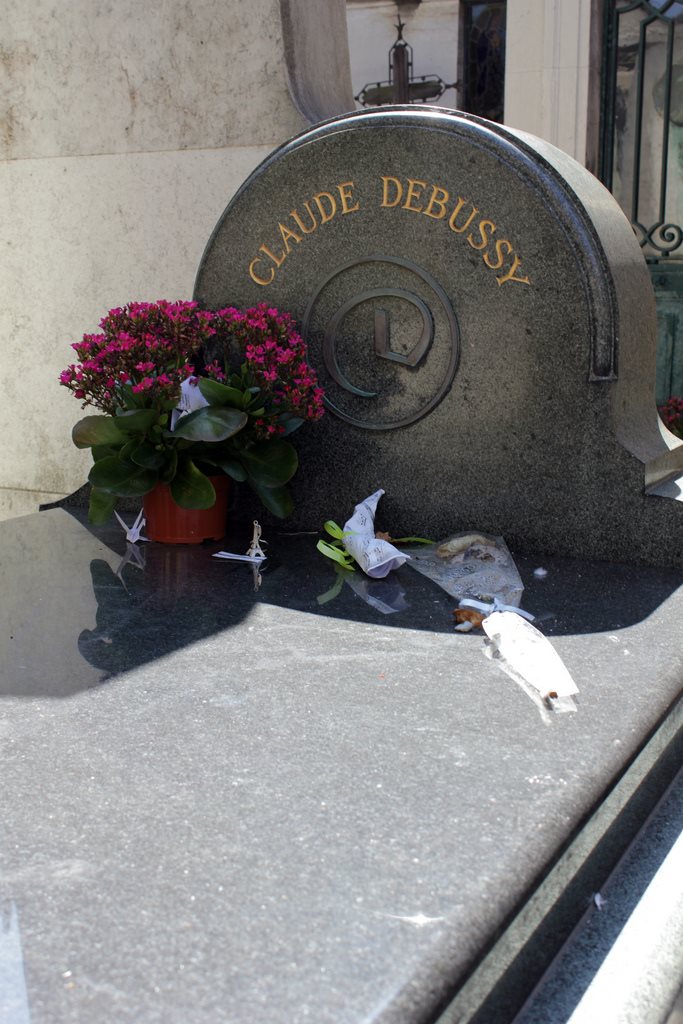
    PHOTO: Debussy at “La mer”


  • Debussy Bernstein Celebrations on The Classical Network

    Debussy Bernstein Celebrations on The Classical Network

    by 

    in
    One response

    Of the two most trumpeted classical music anniversaries being observed this year, the centenary of the death of Claude Debussy has been far overshadowed by the centennial celebrations for the birth of Leonard Bernstein. I suspect this is because, in part, it’s a little perverse to celebrate somebody’s death.

    Be that as it may, this week on The Classical Network, as Lenny Mania builds to fever pitch, we’ll give Debussy his due on two Noontime Concerts, when flutist Mimi Stillman, artistic director the Philadelphia-based Dolce Suono Ensemble, will join WWFM’s David Osenberg.

    The programs will include music not only by Debussy, but also by some of his French contemporaries, as well as works by later composers Toru Takemitsu and Andrea Clearfield that bear his influence. In addition, there will be two world premieres, courtesy of Jan Krzywicki and Thomas Whitman.

    Both concerts take their names from Debussy’s own words: “Pleasure Is the Law” will air on Tuesday (today), and “Between the Notes” will follow on Thursday. Both will commence at 12 p.m.

    The broadcasts will frame Debussy’s birthday, which is tomorrow, August 22; NOT the anniversary of his death, which fell on March 25.

    Then we’ll shift focus between 1:30 and 4 this afternoon, as I present Bernstein’s recording of Harold Shapero’s beautifully executed – though absurdly neglected – “Symphony for Classical Orchestra,” in which the composer succeeds in fusing the seemingly disparate worlds of Beethoven and Stravinsky. Shapero is another one of those tragic figures (tragic for us) who worried so about the power of his own muse that ultimately he abandoned composition in order to devote himself to teaching.

    While Shapero’s symphony is clearly modeled on Beethoven’s 7th, the Swiss-born French composer Arthur Honegger alludes to Beethoven’s 6th, the “Pastoral,” in his own bucolic meditation “Pastorale d’été” (“Summer Pastoral”), which Bernstein will also conduct.

    Finally, with the fall of the Berlin Wall, Bernstein arranged for a performance of Beethoven’s Symphony No. 9 at the city’s Schauspielhaus, inaccessible to the West behind the Iron Curtain for over 40 years. For the occasion, musicians drawn from East and West Germany joined players from representative orchestras of America, Russia, France, and Great Britain – all of which maintained a post-war presence in the divided city – for a grandly symbolic statement on Christmas Day, 1989.

    Bernstein elected to swap out the word “freude” in the climactic singing of Schiller’s original text, already an ode to universal brotherhood, in favor of “freiheit,” to further underscore the entire enterprise as a grand celebration of freedom. It’s a performance that transcends criticism.

    I hope you’ll join us for observations of two of the year’s biggest musical anniversaries, today between 12 and 4 p.m. EDT. Bernstein Mania is also reflected in many of our specialty shows this week. The celebration will reach its glorious apex this Friday and Saturday, on WWFM – The Classical Network and wwfm.org.


    PHOTOS: Debussy at rest (left); Bernstein chips away at the Wall


  • Peri Opera’s Birth & Dukas’ Persian Fairy

    Peri Opera’s Birth & Dukas’ Persian Fairy

    by 

    in
    4 responses

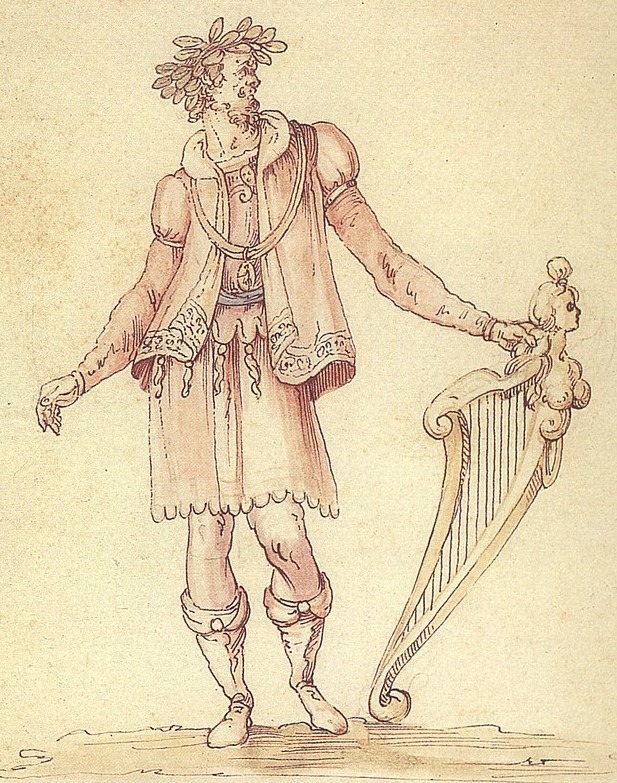
    I wish that I could have a cool nickname like “Il Zazzerino.” Sadly, Jacopo Peri got there first. Oh yeah, he also happened to invent opera.

    Peri’s “Dafne” (c. 1597) has the distinction of being the first work written in the genre. The earliest surviving opera, “Euridice” (1600), was also composed by Peri.

    So who was this Peri fellow, and what drove him to envision the marriage of music and theater on such an ambitious scale? As with most of the finer things in the development of Western Civilization, we can blame it all on the Greeks.

    Though in the employ of the Medici court, Peri engaged in philosophical discourse with Florence’s other great musical patron, Jacopo Corsi. Peri and Corsi, as have human beings of every generation since the expulsion from Eden, lamented the decay of art and civilization and pined for the good old days – which in their case were the days of Ancient Greece. Together, they attempted to resurrect Greek theater, as they understood it. Of course, their solution is like nothing the Greeks would have recognized, but what they conceived would influence other composers for centuries.

    Few of Peri’s own works are still performed today, except perhaps as historical curiosities. Even in his own time, his experiments in the form began to feel a little creaky next to those of the younger operatic firebrand Claudio Monteverdi. Today, Monteverdi’s “L’Orfeo” (1607) is in the standard repertoire and is the earliest opera to be regularly performed.

    French composer Paul Dukas had nothing of early Italian opera in mind when he came to write his 1912 ballet – or “dance poem,” as he described it – “La Péri.” A Peri is a kind of Persian fairy, the guardian of the Flower of Immortality. According to legend, Iksender, or Alexander the Great, attempts to retrieve the prize. The ballet is yet another pilgrimage by a Western composer to the temple of Orientalism. Dukas’ music is by turns mysterious, sinuous, and ecstatic.

    This would be the last published work by the composer of “The Sorcerer’s Apprentice.” Dukas, a notoriously self-critical artist, destroyed most of his own output. Eventually, he gave up composition altogether. Perhaps sharing Iksender’s sense of unworthiness, Dukas receded into the shadows, channeling his energy into the teaching of others, including Carlos Chávez, Maurice Duruflé, Olivier Messiaen, Manuel Ponce, and Joaquin Rodrigo.

    I hope you’ll join me for a pair of Peri, among my featured music today, between 4 and 7 p.m. EDT, on WWFM – The Classical Network and wwfm.org.


    PAIRING PERI: Il Zazzerino (left) and the guardian of the Flower of Immortality


  • Ida Rubinstein Scandalous Sugar Heiress

    Ida Rubinstein Scandalous Sugar Heiress

    by 

    in
    2 responses

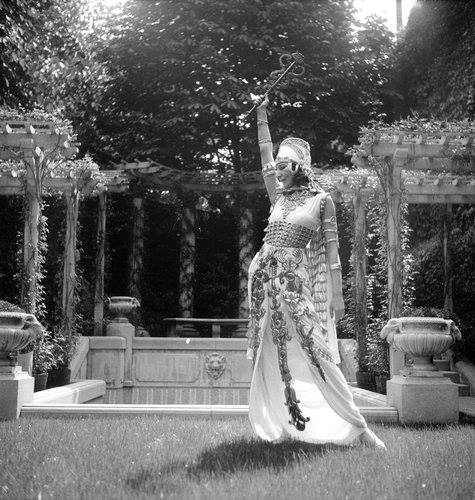
    The actor and dancer Ida Rubinstein specialized in strong, often sultry heroines. A remarkable figure, this sugar heiress from a family of Ukrainian Orthodox Jews essentially willed herself onto the Parisian stage, where her acting ability and natural magnetism more than compensated for her limited ability as a dancer.

    She was welcomed into the Ballets Russes in 1909, where she assumed the roles of Cleopatra and Scheherazade. Later, for her own company, she introduced Ravel’s “Bolero” and Stravinsky’s “Le Baiser de la fée” (“The Fairy’s Kiss”).

    She gained notoriety for her often racy sensuality, stripping naked for the “Dance of the Seven Veils” in a production of Oscar Wilde’s “Salome” in 1908. Her performance in the title role in Gabriele d’Annunzio and Claude Debussy’s “The Martyrdom of Saint Sebastian” generated further scandal in 1911. The Archbishop of Paris prohibited all Catholics from attending, on account of Saint Sebastian being portrayed by a woman and a Jew.

    This Sunday night on “The Lost Chord,” we salute Rubinstein with music that supported two of her lesser-known characterizations.

    In 1924, she appropriated the symphonic variations “Istar,” by Vincent d’Indy. Originally composed in 1896, the subject was a natural fit for the Rubinstein image, with the Assyrian goddess of love and war descending into the underworld to rescue her lover. Along the way, she passes through seven doors. At each door, she removes a piece of jewelry or an article of clothing, until, as she passes through the last, she stands unadorned. So does the music arrive finally at a complete statement of the theme, turning the usual structure of theme and variations on its head to suit the narrative.

    We’ll also hear “Sémiramis,” from 1934. This time Rubinstein played an Assyrian queen with insatiable carnal appetites. The music was by Arthur Honegger, and the instrumentation is quite striking: female narrator, vocal soloists, five-part mixed chorus, with orchestra including double bass clarinet, saxophone, two harps, two pianos, celesta, and two ondes Martenot – electronic keyboard instruments sounding very much like a couple of theremins.

    This was the fifth commission the composer was to receive from Rubinstein The sixth and last brought forth his magnum opus, “Jeanne d’Arc au Bûcher” (“Joan of Arc at the Stake”).

    “Sémiramis” was not a success, and the work remained unpublished during Honegger’s lifetime. In particular, a 15 minute monologue toward the climax, written by Paul Valéry, took all the air out of the room. This spoken interlude has been omitted from the recording we’ll hear of the piece’s first modern performance in 1992.

    I hope you’ll join me as we celebrate Ida Rubinstein, with “Ida Danced All Night,” this Sunday night at 10:00 EDT, on WWFM – The Classical Network and wwfm.org.


    PHOTO: Diaphanous dancer Ida Rubinstein


Tag Cloud

Aaron Copland (93) Beethoven (95) Composer (114) Film Music (145) Film Score (143) Film Scores (255) Halloween (94) John Williams (195) KWAX (229) Leonard Bernstein (104) Marlboro Music Festival (125) Movie Music (160) Mozart (91) Opera (213) Philadelphia Orchestra (89) Picture Perfect (174) Princeton Symphony Orchestra (109) Radio (88) Ross Amico (244) Roy's Tie-Dye Sci-Fi Corner (290) The Classical Network (101) The Lost Chord (269) Vaughan Williams (105) WPRB (397) WWFM (881)

DON’T MISS A BEAT

Receive a weekly digest every Sunday at noon by signing up here


RECENT POSTS