• Aquatic Horror Movie Soundtracks

    Aquatic Horror Movie Soundtracks

    by 

    in
    4 responses

    Just when you thought it was safe to go back in the water…

    This week on “Picture Perfect,” it’s an hour of summer bummers, as I play to your fears of what lurks below.

    “Beneath the 12-Mile Reef” (1953) stars Robert Wagner, Terry Moore, and Peter Graves in a Romeo and Juliet story about two families of competing fishermen along the Gulf coast of Florida, one working class and of Greek origin, and the other a family of privileged WASPs. Gilbert Roland is the Greek patriarch who runs afoul of an improbably large octopus. Bernard Herrmann wrote the music, which employs no less than nine harps (one for each arm, and a spare).

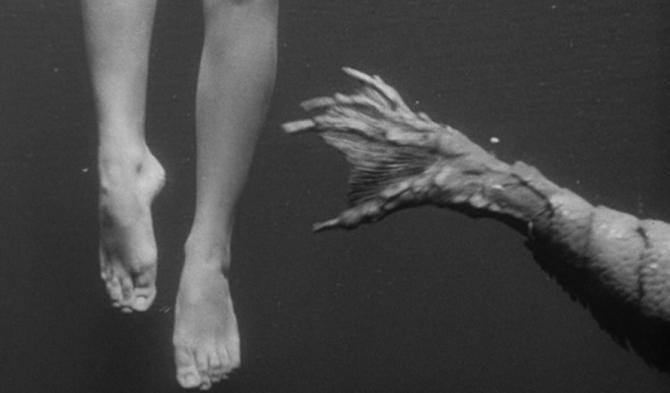
    A young Henry Mancini was one of three composers to work on “Creature from the Black Lagoon” (1954). Mancini, soon to be world famous for “Moon River,” “Baby Elephant Walk,” and “The Pink Panther,” was teamed with veteran film composer Hans J. Salter and Herman Stein. None of the three were credited on screen – typical of what was then considered just another low-budget B-movie.

    What can I say about John Williams’ masterful music for “Jaws” (1975)? It’s right up there with “Psycho” and “The Good, the Bad and the Ugly,” in terms of most recognized and most frequently parodied. Everyone remembers the primal shark theme, but what is sometimes overlooked is that “Jaws” is also one of the great adventure scores, the music effortlessly navigating the choppy waters of suspense, horror, and seafaring swashbuckler. The composer was recognized with a richly-deserved Academy Award (his second of five).

    The conflict in “The Swimmer” (1968) is not a giant octopus, nor a great white shark, nor a prehistoric gill man, but rather the progressive psychological breakdown of an upper middle class Connecticut man who believes he’s living the American Dream.

    Adapted from a short story by John Cheever, “The Swimmer” stars Burt Lancaster as the man, who acts on a quixotic impulse to travel all the way home, across county, by way of a network of suburban swimming pools. The adventure starts out well enough, with Lancaster and everyone he encounters full of optimism and fun; but the further he moves along his allegorical journey, the more the enterprise, the climate, and the people begin to grow cold.

    “The Swimmer” is a decidedly downbeat tale which could make the viewer as reluctant to dip a toe into a chlorinated in-ground swimming pool as the shark-infested waters of Peter Benchley’s Amity Beach. The score is by Marvin Hamlisch, of all people, and it suits the film brilliantly.

    Join me, if you dare, for an hour of aquatic traumas, on “Picture Perfect,” music for the movies, this Friday evening at 6:00 EDT, on WWFM – The Classical Network and wwfm.org.



  • Jonathan Biss to Lead Marlboro Music

    Jonathan Biss to Lead Marlboro Music

    by 

    in
    4 responses

    In foreign lands, cries of “Bis!” at the end of a concert signify an audience’s desire to hear more. It is a happy coincidence, then, that at the Marlboro Music School and Festival, Biss happens to be the surname of its incoming co-artistic director.

    Earlier this week, it was announced that the pianist Jonathan Biss will join Mitsuko Uchida as co-director of the celebrated chamber music retreat, which is situated in Vermont’s Green Mountains. Uchida has served in a leadership capacity at Marlboro for over 20 years. For the past five of these, she has been the festival’s sole artistic director. Prior to that, she was assisted in the festival’s direction by Richard Goode (1994-2013) and Andras Schiff (1994-1999).

    Biss first attended the Marlboro Music Festival in 1997. He was invited to return as a senior artist in 2006 – in classic Marlboro fashion, giving back to new generations of young musicians the kind of mentorship and comradery he himself experienced there.

    Biss, who is on the faculty of the Curtis Institute of Music in Philadelphia, is acclaimed not only as a performer and recording artist, but also as a teacher and a writer, wholly comfortable exploring unique opportunities of the digital age, offering online lectures and publishing a bestselling eBook, “Beethoven’s Shadow.”

    We’ll celebrate Biss’ appointment on this week’s “Music from Marlboro,” with a performance of Franz Schubert’s Piano Trio No. 1 in B-flat major, D. 898. Biss will be joined by violinist David Bowlin and cellist Marcy Rosen, from the 2008 Marlboro Music Festival.

    Then we’ll hear Marlboro legends, soprano Benita Valente, clarinetist Harold Wright, and pianist Rudolf Serkin, in Schubert’s “The Shepherd on the Rock.” The three set down a classic recording of the work in 1960; we’ll hear a live performance, captured at Marlboro nine years later.

    The Marlboro Music School and Festival was co-founded in 1951 by Serkin, Adolf Busch, and Marcel Moyse. Serkin served as Marlboro’s first artistic director until his death in 1991.

    Today happens to be the anniversary of Busch’s birth. Tune in this afternoon, between 4 and 6 p.m., prior to today’s “Music from Marlboro” broadcast, for a little bonus, in the form of one of Busch’s own compositions.

    “Music from Marlboro” begins at 6:00 EDT, on WWFM – The Classical Network and wwfm.org.

    Marlboro School of Music and Festival: Official Page


    PHOTO: Uchida (left), with Marlboro’s incoming co-artistic director


  • Baroque & Sea Music on The Classical Network

    Baroque & Sea Music on The Classical Network

    by 

    in
    5 responses

    AAAaaAaAaaaRRRRgh!

    We’ll bust open a sea chest full of Baroque treasures on today’s Noontime Concert on The Classical Network. Harpsichordist Elena Zamolodchikova and violinist Natalie Kress will perform music by Heinrich Ignaz Franz von Biber, William Byrd, Girolamo Frescobaldi, and Johann Heinrich Schmelzer.

    The program was presented on December 7, 2017 at St. Bartholomew’s Church, 50th Street and Park Avenue, in Midtown Manhattan, where free lunchtime concerts are held every Thursday at 1:15 p.m. The 2017-2018 schedule has run its course, but concerts will resume in the fall.

    Today’s broadcast is made possible in part by Gotham Early Music Scene, or GEMS. GEMS is a non-profit corporation that supports and promotes artists and organizations in New York City devoted to early music – music of the Middle Ages, Renaissance, Baroque, and early Classical periods. For more information and updates to GEMS’ events calendar, look online at gemsny.org.

    Then we bid farewell to landlocked humidity and strike out for the high seas. We’ll feel the spray in our faces and the wind in our hair, courtesy of Ralph Vaughan Williams’ “A Sea Symphony,” Georg Philipp Telemann’s “Water Music” (written in celebration of the centennial of the Hamburg Admiralty), and Anton Rubinstein’s “Ocean” Symphony.

    Start queuing up now for your mermaid tattoos. It’s anchors aweigh, from 12 to 4 p.m. EDT, on WWFM – The Classical Network and wwfm.org.


  • Cool Classical Music for Hot Summer Days

    Cool Classical Music for Hot Summer Days

    by 

    in
    5 responses

    It’s going to be another hot one! Before air conditioning, one struck out for the country, hit the local watering hole, or staggered to the shade of the nearest grove. The 17 year-old Felix Mendelssohn composed his overture to “A Midsummer Night’s Dream” while secluding himself in the family garden. The work was completed on this date in 1826.

    Join me this afternoon as we seek relief with music inspired by gardens, fountains, and forests. We’ll think cooling thoughts, from 4 to 7 p.m. EDT, on WWFM – The Classical Network and wwfm.org.


  • Rued Langgaard Eccentric Genius Rediscovered

    Rued Langgaard Eccentric Genius Rediscovered

    by 

    in
    5 responses

    Even by composer standards, Rued Langgaard (1893-1952) was a little bit of a strange bird. Despite a promising start – born to musical parents, a precocious childhood, meetings with major conductors, and a symphony performed by the Berlin Philharmonic – his personal and creative eccentricities worked against him.

    Langgaard followed his personal muse deep into the realm of late Romanticism at a time when most of the musical world was exploring modernist territory. Though he was given a state grant at 30, he failed to secure a permanent job until the age of 46, as an organist at the cathedral in Ribe, the oldest town in Denmark – which somehow seems appropriate for this most anachronistic of Danish outsiders.

    An eccentric, shabby figure with wild hair, Laangaard died in Ribe 13 years later, in 1952, just shy of his 59th birthday, still largely unrecognized as a composer.

    His reputation would not begin to gain traction for another 16 years. In all, he composed over 400 works, including 16 symphonies – which bear evocative titles such as “Yon Hall of Thunder” and “Deluge of the Sun” – and an opera, “Antikrist.”

    It was in 1968 that no less a personage than György Ligeti found himself on a jury alongside Danish composer Per Nørgård. In this capacity, he examined a large number of new scores by Scandinavian composers. Unbeknownst to his fellow jurors, Nørgård had slipped in the score of Langgaard’s “Music of the Spheres.” Ligeti became captivated by what he found. When the ruse was revealed, he exclaimed, with a twinkle in his eye, “Gentlemen, I have just discovered that I am a Langgaard epigone!”

    Langgaard had anticipated some of the technical aspects – tone clusters, layers, and so forth – which would appear in Ligeti’s avant garde experiments of the 1960s, in works such as “Atmosphères.”

    Hear “Music of the Spheres,” alongside Langgaard’s String Quartet No. 3, this week on “The Lost Chord.” That’s “Rued Awakenings,” this Sunday night at 10:00 EDT, on WWFM – The Classical Network and wwm.org.


Tag Cloud

Aaron Copland (93) Beethoven (95) Composer (114) Film Music (145) Film Score (143) Film Scores (255) Halloween (94) John Williams (195) KWAX (229) Leonard Bernstein (104) Marlboro Music Festival (125) Movie Music (160) Mozart (91) Opera (213) Philadelphia Orchestra (89) Picture Perfect (174) Princeton Symphony Orchestra (109) Radio (88) Ross Amico (244) Roy's Tie-Dye Sci-Fi Corner (290) The Classical Network (101) The Lost Chord (269) Vaughan Williams (105) WPRB (397) WWFM (881)

DON’T MISS A BEAT

Receive a weekly digest every Sunday at noon by signing up here


RECENT POSTS