Here’s an interesting discovery for Mozart’s birthday – a recording of the Flute Concerto No. 1 in G major, K. 313, conducted by Karlheinz Stockhausen, employing Stockhausen’s own cadenzas!
Movt. I https://www.youtube.com/watch?v=idBfzgaKV2w

by
Here’s an interesting discovery for Mozart’s birthday – a recording of the Flute Concerto No. 1 in G major, K. 313, conducted by Karlheinz Stockhausen, employing Stockhausen’s own cadenzas!
Movt. I https://www.youtube.com/watch?v=idBfzgaKV2w

by
What kind of a price tag do you put on something of intangible worth? It’s the age-old conundrum of the value of art.
Without getting into whether or not art is “good” for you or for your community (like spinach), consider for a moment what having classical music on WWFM has meant for the quality of your life. If you seriously feel it has done much to enrich your days and to give you solace or inspiration at all hours, then why not follow your heart – within the restraints of your budget, of course?
Public radio isn’t here to break the bank. Ideally, if everyone who enjoys the service – an endangered one in an increasingly commercial, talk, and news-driven market – then there would be no danger of having this invaluable asset lost or compromised. We’ve already had to make some hard decisions in recent years in order to survive within our budget.
If you’ve already given recently, thank you so much for your support – but if it’s been a year or more, how about it? Can you spare $20, $50, $120 for the station you love? $120 is just ten dollars a month. It may not seem like it would amount to much, but if even a few dozen people were to contribute, that’s quite a considerable chunk of change. If our entire listenership could be moved to be so generous, The Classical Network would one of the most well-off public radio stations in existence. But the reality is only a very small percentage of listeners give.
Regardless of what attracts you to the station – Who’s your favorite composer or performer? What’s your preferred era or genre? Who’s your favorite host or what’s your favorite specialty show? – we like to think we offer something for everyone who cares about classical music.
As you consider what you are able to do in order to help support our future, enjoy a day of wall-to-wall Mozart, as Alice Weiss (9 to noon), David Osenberg (10 to 2), Carl Hemmingsen (1 to 4), Michael Kownacky (2 to 6) and yours truly (4 to 6) share some of our favorites, in advance of the master’s 262nd birthday. (The actual anniversary is tomorrow.)
Then stick around for “Picture Perfect,” music for the movies, coming your way at 6 p.m. I’ve selected four recordings of scores by another one of classical music’s great musical prodigies, Erich Wolfgang Korngold. I’ll post a little more about that in just a bit.
“Picture Perfect” kicks off a Friday evening of unique specialty shows and live concert material. Bill McGlaughlin brings you another edition of “Exploring Music” (and more Mozart) at 7; Carl Hemmingsen hosts a concert of the Princeton Symphony Orchestra, with music by Respighi, Schulhoff, and Mendelssohn, at 8; Allan Kelly presents “Distant Mirror” at 10; and Lewis Baratz hosts “Well-Tempered Baroque” at 11.
The Mozart celebration is already underway on WWFM – The Classical Network. Please show your support by calling 1-888-232-1212 or by contributing online at wwfm.org. We wouldn’t be here without your generosity. Thank you for your support!
by
Errol Flynn writes a ballet? Charles Boyer composes a tone poem? Claude Rains writes a cello concerto!
This week on “Picture Perfect,” we’ve got three examples from Hollywood’s Golden Age of movies about fictional composers. These, of course, required music allegedly written by the characters, and this was provided by two-time Academy Award-winner Erich Wolfgang Korngold.
Korngold is probably best known to movie buffs as the composer for Flynn swashbucklers such as “The Adventures of Robin Hood” and “The Sea Hawk,” but his filmography is more varied than one might at first suspect. No matter what the subject, Korngold could be counted on to bring that opulent fin de siècle gloss, developed in a Vienna steeped in Mahler and Strauss.
We’ll hear music from “Escape Me Never” (1947), a slightly preposterous melodrama about two composer brothers who become rivals in love; “The Constant Nymph” (1943), about a would-be romantic bond between a composer struggling to find his true voice and an admiring girl on the verge of womanhood who develops deeper feelings for him; and “Deception” (1946), about a cellist reunited with his former love, who had believed him killed during the war, and the vindictive composer who attempts to shatter his psyche through grueling rehearsals of his latest concerto.
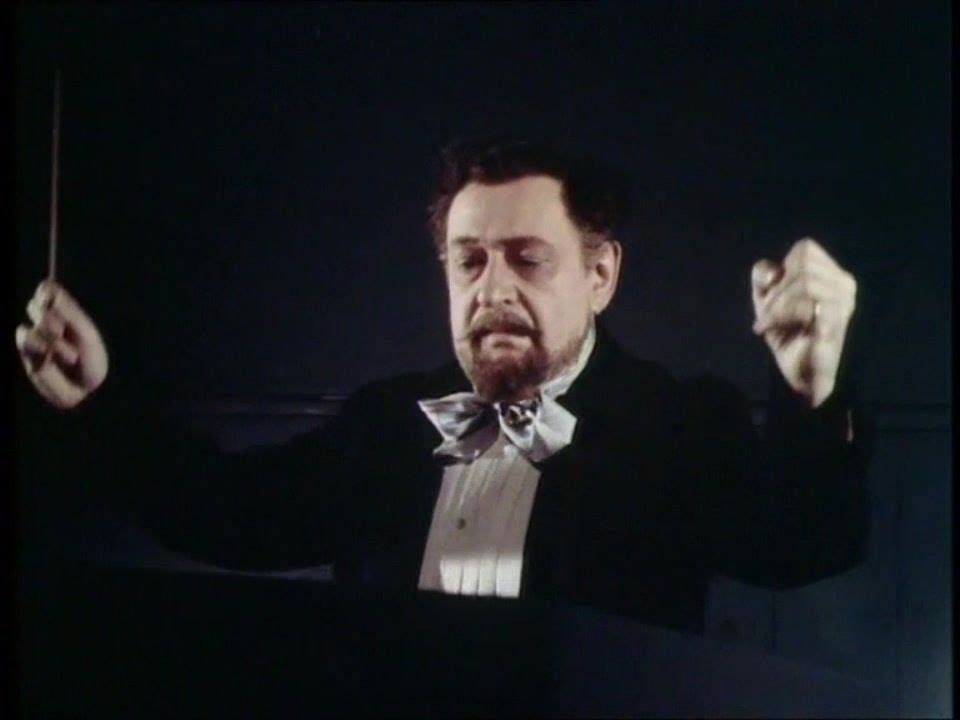
“Deception” was Korngold’s last, wholly original score, though he was lured back to Hollywood for one final project, “Magic Fire” (1955), a biopic of the composer Richard Wagner, for which he adapted selections from Wagner’s operas. Furthermore, Korngold makes an appearance onscreen (!) as conductor Hans Richter. The film was subject to heavy cuts prior to its U.S. release and was not a success.
Hollywood seldom gets it right when it comes to portraying the process of the composer, but Korngold, true to his name, did his best to spin gold from corn, producing some appropriately grand utterances, albeit condensed to only a few minutes of screen time. Quite a task for this figure who made his greatest mark in opera.
Join me for these examples of Korngold as ghostwriter, on “Picture Perfect,” this Friday evening at 6:00 EST, on WWFM – The Classical Network and wwfm.org.
Follow the link to hear Korngold improvise on themes from “The Flying Dutchman” (with entertaining stills):
https://www.youtube.com/watch?v=h4bNEw1nu3I
MAGIC FIRE: When the actor who was hired to play Hans Richter failed to show, Korngold was rushed into make-up (hence, the fake beard). This is the only existing footage of Korngold conducting.

by
The best conductors are more than just interpreters. They are partners in creation, who will secret mansions into existence from the mere blueprint of a score. Many have had experience creating such worlds from scratch. This Thursday morning on WPRB, we’ll focus on original compositions by artists that have become better known for their reputations on the podium.
Skipping over, for the moment, musicians who have received plaudits as recognized composer-conductors (Leonard Bernstein, Pierre Boulez), or those from the distant past (Felix Mendelssohn, Gustav Mahler), we’ll hear neglected music by Victor de Sabata, Antal Doráti, Sir Eugene Goossens, Otto Klemperer, Igor Markevitch, Jean Martinon, Paul Paray, André Previn, Evgeny Svetlanov, George Szell, and Wilhelm Furtwängler (on his birthday).
Join me for original works by conductors who genuinely know the score, this Thursday morning from 6 to 11 EST, on WPRB 103.3 FM and wprb.com. The conductors are always properly grounded, on Classic Ross Amico.

by
Don’t call him revolutionary. He didn’t care for that. Arnold Schoenberg did not see himself as a troublemaker. Rather, if you could bring yourself to ask him, he might have described himself as a traditionalist who was merely extending the legacy of an inherited past. Then he might have painted your portrait or challenged you to a game of tennis.
On this week’s “Music from Marlboro,” we’ll hear Schoenberg’s Janus-like Serenade, Op. 24. Sure, the Serenade contains the first published example of Schoenberg’s twelve-tone method to employ multiple instruments (and human voice): a setting of Petrarch’s Sonnet No. 217, according to the composer, always so concerned with precision. In actuality, it’s the Sonnet No. 256, if we’re to go by the standard Italian edition of the poet’s works, but who’s counting?
The other five movements push tonality beyond the breaking point, true, but they are not “twelve-tone.” If you find yourself hanging on by your fingernails at the seeming lack of identifiable landmarks, it might be better for you to just let go and allow all the colors to wash over you. Schoenberg employs, in addition to a vocal basso in the three-minute Petrarch setting, B-flat and bass clarinets, mandolin, guitar, violin, viola, and cello.
The composer looks back to classical form through the use of repetitions in the opening “March,” the second movement “Minuet,” and the fifth movement “Dance Scene.” There is also a seeming affirmation of the past through the deliberate choice of Petrarch as a source of inspiration for the fourth movement “Sonnet.” The third movement is a set of “Variations,” and the sixth a “Song (without Words).” A “Finale” caps the piece,” which, by Schoenberg standards, is fairly light and easygoing.
We’ll hear a performance from the 1966 Marlboro Music Festival, with Leon Kirchner directing the ensemble. Coincidentally, today is Kirchner’s birthday.
To round off the hour, we’ll also have a delightful work by Wolfgang Amadeus Mozart – his Sonata in B-flat for Bassoon and Cello, K. 292. The 1975 performance will feature bassoonist Alexander Heller and a 19 year-old cellist named Yo Yo Ma.
Ma plays Mozart, and we take a shine to Schoenberg, on the next “Music from Marlboro,” this Wednesday evening at 6:00, on WWFM – The Classical Network and wwfm.org.
Marlboro School of Music and Festival: Official Page
Arnold Schoenberg: music’s menace loved his tennis
Aaron Copland (93) Beethoven (95) Composer (114) Film Music (145) Film Score (143) Film Scores (255) Halloween (94) John Williams (195) KWAX (229) Leonard Bernstein (104) Marlboro Music Festival (125) Movie Music (160) Mozart (91) Opera (213) Philadelphia Orchestra (89) Picture Perfect (174) Princeton Symphony Orchestra (109) Radio (88) Ross Amico (244) Roy's Tie-Dye Sci-Fi Corner (290) The Classical Network (101) The Lost Chord (269) Vaughan Williams (105) WPRB (397) WWFM (881)
3 responses