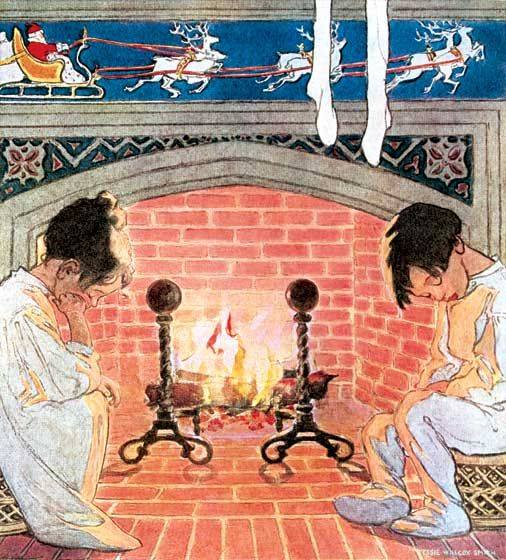
Cozy up to the “Fireside Tales” of American composer and pianist Edward MacDowell (born on this date in 1860) and bask in the warm glow of a carol medley performed by Russian-German soprano Rita Streich (born in 1920). They’ll be among our featured works, from 4 to 7 p.m. EST, on WWFM – The Classical Network and wwfm.org.
-
MacDowell & Streich on WWFM
by
-
Christmas Nightmares Naughty Holiday Puppets
by
4 responses
Nothing says Christmas like malevolent puppets.
If you’ve ever had a nightmare about a grimacing nutcracker or found yourself profoundly disturbed by a Rankin-Bass Christmas special, then this one is for you.
This Sunday night on “The Lost Chord,” we present as our centerpiece Paul Hindemith’s unusual Christmas fairy tale, “Tuttifäntchen,” written in 1922, in which a wooden figure carved out of a fir by a master woodcutter comes to life and causes all sorts of havoc. He literally robs a young girl of her good heart, thrashes children, and sends all of the Christmas trees in the world out onto the marketplace – all en route to a desired reunion with the fir of his origin. (Fortunately, his reign of terror spans only 24 hours, and everything ends well.)
It may sound like a real horror show, but the music is disarming in its simplicity and warmth. Hindemith’s score incorporates familiar Christmas songs and a contagious foxtrot, called “Dance of the Wooden Puppets.” A delightful suite from “Tuttifäntchen” was released on the CPO label back in 1999. In 2013, CPO issued this complete recording, from which I excise most of the spoken dialogue, since it is in German.
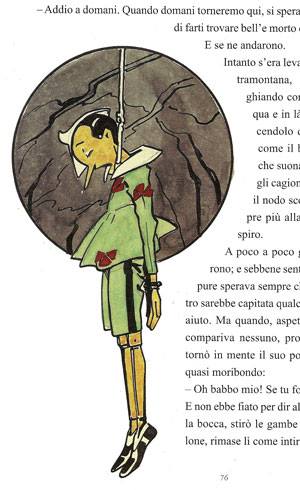
This allows time for two additional pieces. From “Tuttifäntchen,” my thoughts travel immediately to Pinocchio. In Carlo Collodi’s original story – published in the 1880s, over a half century before Walt Disney gave him a good scrubbing up – the boy-puppet is an absolute terror. He even kills Jiminy Cricket with a hammer!
His exploits inspired Ernst Toch, a Hindemith contemporary, to compose “Pinocchio: A Merry Overture,” in 1935. Toch was awarded the Pulitzer Prize for Music in 1956, for his Symphony No. 3.
The hour will open with the “Punch and Judy Overture,” from 1945, by American composer Leroy Robertson. Punch, of course, is the classic murderous puppet, who outsmarts the Devil and even Death himself.
“THAT’S the way to do it,” as he’s fond of saying. (If you’ll notice, Mr. Punch is always self-satisfied – hence the phrase “pleased as Punch.”)
“In my opinion the street Punch is one of those extravagant reliefs from the realities of life which would lose its hold upon the people if it were made moral and instructive. I regard it as quite harmless in its influence, and as an outrageous joke which no one in existence would think of regarding as an incentive to any kind of action or as a model for any kind of conduct. It is possible, I think, that one secret source of pleasure very generally derived from this performance… is the satisfaction the spectator feels in the circumstance that likenesses of men and women can be so knocked about, without any pain or suffering.”
– Charles Dickens (Mr. Christmas, himself), in a letter from 1849
I hope you’ll join me for “Hindemith Branches Out” – celebrating the holidays with the naughty puppet Tuttifäntchen and friends – this Sunday night at 10:00 EST, on WWFM – The Classical Network and wwfm.org.
For a teaser, here’s Hindemith’s “Dance of the Wooden Dolls,” in a version for solo piano:
In Collodi’s original, Pinocchio kills Jiminy Cricket, eats the Cat’s paw and pays the ultimate price. The publisher thought the ending too depressing and made Collodi change it. (The puppet still commits pesticide and maims the cat, though.)
-
Happy Birthday Beethoven Celebrate with Lost Symphony
by
4 responses
Happy birthday, Beethoven!
The Classical Network wrapped up its anticipatory day-long celebration yesterday evening at 6:00. We were hoping to raise $8000, an amount tied in numerically to our 35th anniversary (3+5 = 8; get it?), but we came up a little shy at around $6500 – and that thanks to a couple of very generous listeners who stepped up fairly late in the game.
Regrettably, this meant I was unable to fulfill my personal ambition to share with you a dynamite complete performance of Beethoven’s Ninth Symphony, which I was hoping to play if we met our goal by about 4:50. I really worked hard on the selection, too!
In case you are curious, the recording features Leontyne Price, Maureen Forrester, David Poleri, and Giorgio Tozzi as the vocal soloists, with the New England Conservatory Chorus and the Boston Symphony Orchestra conducted by Charles Munch. This misplaced treasure, from 1958, was buried deep in my personal library, as part of EMI’s Great Conductors of the 20th Century Series. Everyone in the studio was blown away by the hell-bent intensity of the finale, which was all we had time for. I ruefully commented that if we had been able to hear the first and second movements, as I had hoped, they would have realized that by the end Munch and crew sound almost winded by comparison.
Alas, any airing of the Ninth is and should be a special occasion, so this now-cherished recording will go back on my shelf until the next opportunity. Or you can listen to it here:
Thank you to all of you who kept the day from being a total “bust.” (Cue Schroeder.) We will still be accepting contributions over the weekend, if you’d like to send a little gift in the name of Ludwig Van, by way of wwfm.org. Thank you for supporting WWFM – The Classical Network, and more great music to you for the holidays and the year to come.
-
Beethoven A King Among Composers?

by
2 responses
Was Beethoven the King of Composers?
If anything, Beethoven proved just how far someone could go with determination, a gift for fantasy, and plain old hard work. Beethoven may have lacked the natural facility of a Bach or a Mozart, yet through an uncompromising force of will he managed to achieve greatness. In fact, so powerful was his musical imagination that he managed to change music. And he knew his own worth, even to the point of not deferring to his “betters.”
How much is Beethoven worth to you? As The Classical Network observes the Master’s birthday today (he was born on December 16, 1770) with a full day of his music, join us in celebrating the great Ludwig Van with your gift of support at 1-888-232-1212 or wwfm.org.
Because of listeners just like you, we have been able to share 35 years of some of the greatest music ever written. All of us at WWFM – The Classical Network thank you for your generosity.
-
Beethoven’s Ninth A Hidden Gem Revealed
by
4 responses
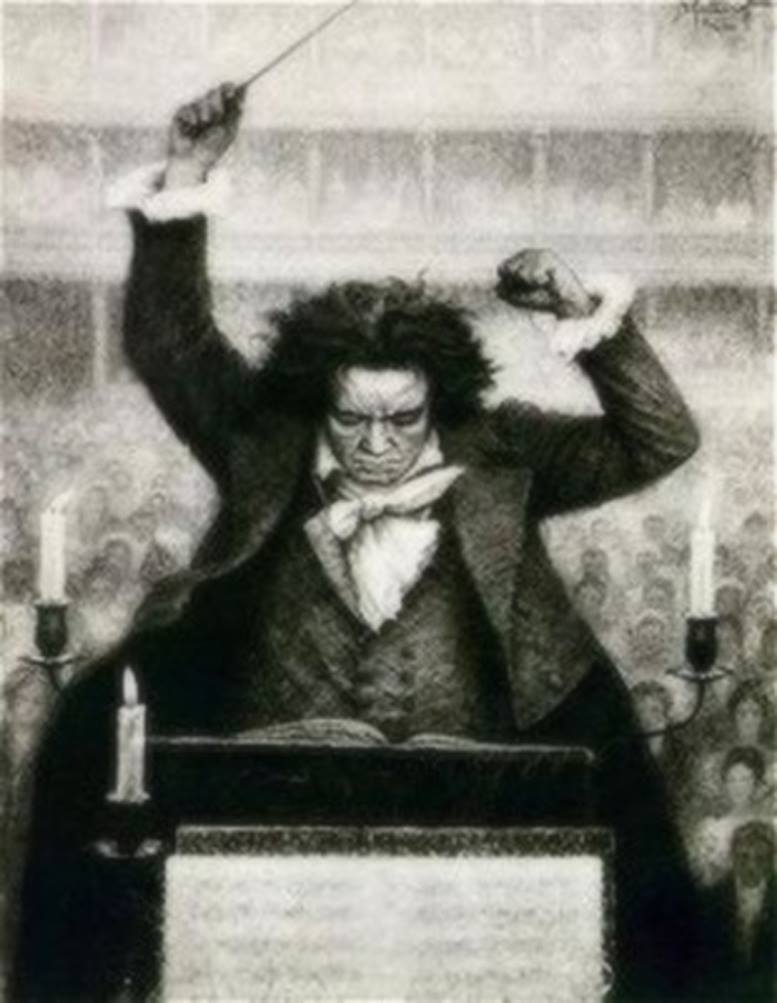
I’VE FOUND MY NINTH!
Of course no recording of Beethoven’s Ninth Symphony can be all things to all people. However, having gone through my collection and sampled a number of the greats – Bernstein, Furtwängler, Szell, Toscanini, Walter – I came across something of a dark horse.
If we can reach our goal of $8000 by around 4:45 this afternoon, we will enjoy this extraordinary performance in its entirety. If we can’t, then we’ll just have to settle for the finale, and that would be a real shame, since the first two movements sound like the musicians ate lava for breakfast.
Our salute to Beethoven resumes on WWFM – The Classical Network, following today’s Noontime Concert. Won’t you support us at 1-888-232-1212 or wwfm.org? Make that recording of Beethoven’s Ninth the joyous occasion it is meant to be!
Tag Cloud
Aaron Copland (93) Beethoven (95) Composer (114) Film Music (145) Film Score (143) Film Scores (255) Halloween (94) John Williams (195) KWAX (229) Leonard Bernstein (104) Marlboro Music Festival (125) Movie Music (160) Mozart (91) Opera (213) Philadelphia Orchestra (89) Picture Perfect (174) Princeton Symphony Orchestra (109) Radio (88) Ross Amico (244) Roy's Tie-Dye Sci-Fi Corner (290) The Classical Network (101) The Lost Chord (269) Vaughan Williams (105) WPRB (397) WWFM (881)
2 responses