• Hanukkah Music & Holiday Concerts on Classical Network

    Hanukkah Music & Holiday Concerts on Classical Network

    by 

    in
    4 responses

    Hanukkah begins at sunset. Get ready for the Festival of Light.

    String quintets by Mozart will illuminate your lunch hour, on today’s Noontime Concert on The Classical Network. The Manhattan Chamber Players will perform the Quintet No. 2 in C minor, K. 406, and the Quintet No. 4 in G minor, K. 516.

    The musicians will appear with guest artist/violist Samuel Rhodes tomorrow night (Wednesday at 7:30) in concert in Engelman Recital Hall at Baruch College in New York City. The program will include Maurice Ravel’s “Introduction and Allegro” for harp, flute, clarinet, and string quartet, Frank Bridge’s “Lament” for two violas, Brahms’ Clarinet Trio in A minor, and Arnold Schoenberg’s “Verklärte Nacht.” A pre-concert talk will be given at 7:00. You’ll find more information at manhattanchamberplayers.com.

    We’ll also hear the Symphony No. 3 by English composer Stanley Bate, on his birthday, and Ralph Vaughan Williams’ ballet “On Christmas Night,” inspired by Charles Dickens’ “A Christmas Carol.”

    If you like Benjamin Britten’s “A Ceremony of Carols,” I think you’ll enjoy Samuel Adler’s “The Flames of Freedom.” The cantata, scored for three-part treble chorus, is based on ten well-known Hanukkah songs and hymns, alongside original music to two other liturgical Hanukkah texts. The work is cast in eight movements to represent the eight candles of the menorah.

    Then, in the festive spirit of midwinter celebrations of all cultures, we’ll hear Christopher Rouse’s “Karolju,” a wholly fabricated holiday blow-out based on a kind of pidgin text drawn from many different languages. Even the title is pure invention, suggestive of the word “carol,” but ending with “u” (because the composer always liked words that end with “u”). Hey, just like “Merry Christmas” and “Happy Hanukkah,” it’s the thought that counts.

    There will be much multi-cultural merriment, this Tuesday from 12 to 4 p.m. EST, on WWFM – The Classical Network and wwfm.org.


  • Berlioz Love Passion and Revenge

    Berlioz Love Passion and Revenge

    by 

    in
    4 responses

    Quite possibly, he is the quintessential Romantic composer, with a capital “R.”

    Hector Berlioz revolutionized art music, even as his personal life practically rolled off the rails with unbridled emotion. My favorite Berlioz anecdote concerns Harriet Smithson, the equally fiery Irish actress who resisted his advances. Then he wooed her with a symphony – the grandest of grand gestures – and they lived miserably ever after, at least for a time. Berlioz could not understand spoken English, and Smithson didn’t know French, but apparently they were both fluent in volcanic passion.

    They married in 1833. (Franz Liszt was a witness at the civil ceremony.) It would prove to be a tempestuous relationship between two strong-willed artists. The couple had a son, but then Berlioz found a mistress and Smithson began to drink. Eventually, they separated, but Berlioz continued to support Smithson until her death in 1854.

    Ostensibly both the “Symphonie fantastique” (1830) – with a program of unrequited love that drives an artist to attempt suicide through an overdose of opium (and the nightmarish visions he experiences as a result) – and its seldom-heard sequel, “Lelio, or The Return to Life” (1831) – in which the artist finds consolation in music and literature, especially Shakespeare – were inspired by Smithson. That was the official story endorsed by the composer.

    However, Berlioz being Berlioz, after writing the symphony, but before Smithson could hear it, he reacted to her indifference by entering into a rebound relationship. This resulted in a quick engagement. Then the composer went to Italy to study, having been awarded a Prix de Rome scholarship. While there, he learned that his recent fiancée, prompted by her mother, had made a more favorable match.

    Berlioz flew into a rage, and he was determined to have his revenge. His plan involved assuming the disguise of a woman and taking a coach back to Paris with a pair of double-barrel pistols in order to put an end to his inconstant lover, her new beau, her mother, and then himself. If the pistols happened to jam, he would poison everyone instead. As luck would have it, he left the costume in the side pocket of the carriage, and this gave him a chance to cool down.

    In his day, much of Berlioz’s music was deemed hopelessly avant-garde and met with confusion, if not outright hostility. We know better now. Right?

    Join me for selections by Berlioz, Miecyszlaw Karlowicz, and Elliot Carter, all birthday celebrants, this afternoon between 4 and 7 p.m. EST, on WWFM – The Classical Network and wwfm.org.


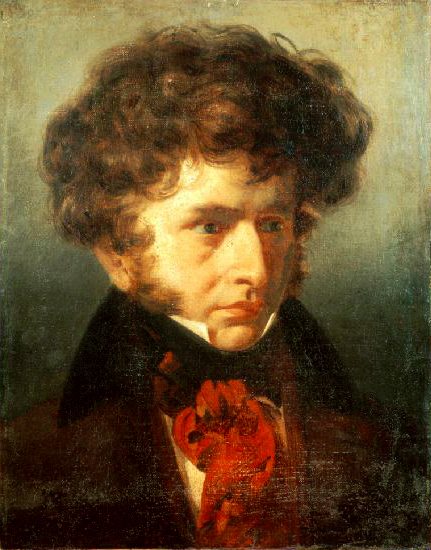
    Berlioz in 1832. Believe it or not, I once had hair like this.


  • Brubeck’s Bridge: Jazz, Faith, and Justice

    Brubeck’s Bridge: Jazz, Faith, and Justice

    by 

    in
    5 responses

    We all recognize Dave Brubeck as one of the titans of jazz. What is perhaps not so widely known is that Brubeck (like Burt Bacharach and the Grateful Dead’s Phil Lesh) was a pupil of Darius Milhaud. He also took a few private lessons with Arnold Schoenberg, though ultimately they didn’t see eye to eye.

    When Brubeck disbanded his famous Quartet at the end of 1967, it allowed him more time to focus on extended orchestral and choral works. In 1968, he composed an oratorio, “Light in the Wilderness.” The next year, he wrote “The Gates of Justice,” a cantata on Biblical and Hebrew liturgical texts and excerpts from the speeches of Martin Luther King, Jr. African-American spirituals also provided inspiration, as did the words of the Jewish sage Hillel. Brubeck’s wife, Iola, supplied additional lyrics.

    Brubeck was distressed in the late 1960s by what he saw as strained relations between blacks and Jews, after all that had been accomplished by the Civil Rights Movement. Following the assassination of Martin Luther King, there was much anger, fear and distrust. In general, it was a turbulent time, with the war in Vietnam and riots on university campuses lending fuel to political, generational and racial tensions in American society.

    Brubeck described “The Gates of Justice” as humanistic and universal, his plea for tolerance and understanding. Brubeck himself was not Jewish, but rather a devout Catholic, from 1980 onward. However, it was his experiences in the Second World War that really triggered a spiritual awakening. He believed profoundly in the brotherhood of man, and set himself the mission of building a musical bridge between what he saw as parallel cultures.

    This Sunday night on “The Lost Chord,” we’ll hear a recording of “Gates of Justice,” from the Milken Archive of American Jewish Music, on the Naxos label. Brubeck himself appears as pianist, in improvisatory passages with the rhythm section of his quartet.

    There are obvious Hebraic flourishes all over the piece, including several shofar blasts at the work’s opening. It was Brubeck’s desire that, whenever possible, the tenor should be sung by a cantor, and the baritone by a black singer steeped in the tradition of spirituals and blues. The Milken recording features Cantor Alberto Mizrahi and baritone Kevin Deas.

    I hope you’ll join me for “Just Brubeck” – Dave Brubeck’s “The Gates of Justice” – this Sunday night at 10:00 EST, on WWFM The Classical Network and wwfm.org.


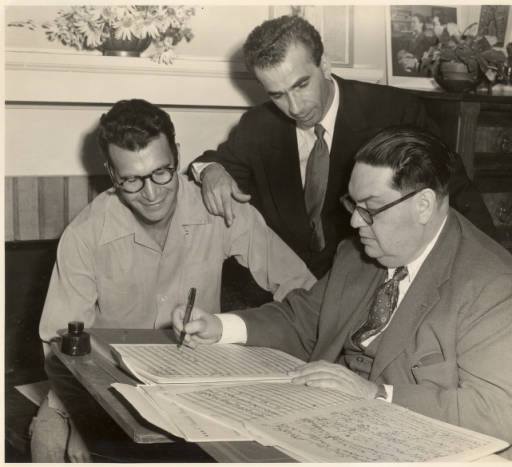
    PHOTO (left to right): Dave Brubeck, Michael Random, and Darius Milhaud


  • Gävle Goat Lives! Sweden’s Wild Yule Tradition

    Gävle Goat Lives! Sweden’s Wild Yule Tradition

    by 

    in
    7 responses

    December 9, and the Gävle Goat yet stands! Last year, Sweden’s 40-foot straw icon was set ablaze within hours of its construction. The catastrophe was timed to coincide with a security guard’s bathroom break.

    One of Northern Europe’s wackier Christmas traditions (no doubt with pagan roots), the Yule Goat may have derived from the worship of Thor. The God of Thunder’s chariot was drawn by two goats. The Christmas version is led about by Saint Nicholas, possibly as a symbol of the subjugation of evil.

    Whatever the goat’s function, it goes way back. For hundreds of years, rowdy young men in costumes would go door to door enacting plays and demanding gifts. One of these, naturally, was the ornery Yule Goat. Scandinavians sometimes refer to the practice of wassailing as “going Yule Goat.”

    In the 19th century, the Goat’s role was transformed into a giver of gifts. Though the Goat has since been replaced by a humanoid Father Christmas, in Finland he is still referred to by the name Joulupukki (you guessed it: Yule Goat).

    Nowadays, the goat is mostly seen in its incarnation as a miniature tree ornament, made of straw and bound by red ribbon. A notable exception is the Gävle Goat, which is basically that ornament, only on the grandest of scales. The Gävle Goat is constructed over a period of two days in time for Advent.

    Then begins an unsanctioned game of cat-and-mouse, with the authorities attempting to guard the Goat, while everyone else attempts to light it off. Yes, you read that correctly. If the Goat is burned to the ground before December 13 (the feast day of St. Lucia), it is rebuilt.

    Over the years, the Goat has been rammed by a Volvo, damaged by fireworks, stomped to pieces, fired upon with flaming arrows (launched by vandals dressed as Santa and gingerbread men), and torched by a hapless American who was talked into using his lighter by Swedes who convinced him it was a perfectly legal holiday tradition (it’s not). In 2010, there was even a failed plot to abduct the goat by helicopter.

    You’ll find more information and a complete history of the Goat’s destruction here:
    http://en.wikipedia.org/wiki/G%C3%A4vle_goat

    Excellent time-lapse burning of the Goat:
    http://travelbetweenthepages.com/…/12/22/yule-got-your-goat/

    Follow the Goat’s twitter feed:
    https://twitter.com/Gavlebocken?ref_src=twsrc%5Egoogle%7Ctwcamp%5Eserp%7Ctwgr%5Eauthor

    View the live webcam:
    http://www.visitgavle.se/en/gavle-goat

    To keep it musical, here’s a Christmas song by Swedish composer Hugo Alfvén:

    Anyone care to start a pool?


  • Fantastic 18th-Century Movie Adventures

    Fantastic 18th-Century Movie Adventures

    by 

    in
    10 responses

    The Enlightenment isn’t exactly remembered for its flights of fancy. If the odd novel embraced a fantastic tone, it was frequently in the service of satire, an entertaining means to send-up contemporary mores and pursuits or to poke fun at authority figures and good old reliable human frailty. This week on “Picture Perfect,” we’ll explore a few of these fantastic adventures of the 18th century.

    “The Surprising Adventures of Baron Munchausen” (1785) pokes fun at a real-life German nobleman and veteran of the Russo-Turkish War, one Hieronymus Karl Friedrich, Freiherr von Münchhausen, whose reputation for telling outrageous tall tales was lampooned by Rudolf Erich Raspe. Raspe, fearing a libel suit, published the work anonymously, with the result that it was commonly believed that the Baron had actually dictated the tales himself. Naturally, Munchausen was upset by the unwanted attention. The name “Munchausen” has come down through the centuries to describe feigned illness and pathological lying.

    The book has been adapted to film several times, beginning with a silent version by Georges Méliès, all the way back in 1911. We’ll be hearing music from two subsequent adaptations. The first, titled simply “Münchhausen” (1943), is undeniably entertaining and exceptionally well-made. However, underlying a sense of enjoyment is a kind of unease in the knowledge that the film was a pet project of Joseph Goebbels, who wanted to celebrate the 25th anniversary of the UFA film studio by producing a lavish spectacle worthy to stand toe-to-toe with foreign efforts like “The Wizard of Oz” and “The Thief of Bagdad.”

    Considering the source, one would have to look awfully hard to come up with anything resembling Nazi propaganda. The entire exercise comes across as a pastoral escape from the horrors of totalitarianism, total war and the Final Solution. The elegant music, by Georg Haentzschel, would not be out of place in the concert hall. Haentzschel is regarded as perhaps the last representative of a generation of Middle European light music composers.

    More than 40 years later, director Terry Gilliam undertook another production design-driven adaptation that resembled a series of Doré illustrations brought to life. Contrary to received wisdom, “The Adventures of Baron Munchausen” (1988) managed to pull in a respectable amount of per-screen capital. Ultimately, the film was a casualty of a management turnover at Columbia Pictures, with the new regime eager to bury the projects of the old. Therefore, it was never seen theatrically beyond a very limited release. The score, by Michael Kamen, while in a romantic heroic style, wittily contains abundant allusions to music of the 18th century.

    “The Manuscript Found in Saragossa” (1805) is a transitional work, with its ecstatically lurid opening chapter – replete with gypsy storytellers, highwaymen, dueling skeletons, lesbian vampires and a couple of corpses dangling in a gibbet – dragging the Enlightenment kicking and screaming into the Romantic age. It starts out as a masterpiece of surrealism by way of Gothic convention, with the spell eventually broken, sadly, by a large cold bucket of Enlightenment water in the form of a perfectly rational explanation at the end. But until then, the author, Jan Potocki, gets an A for effort. The interlocking structure, with stories inside stories inside stories looks ahead to postmodern experiments by writers like Italo Calvino and John Barth, to say nothing of Jorge Luis Borges.

    The book was made into an acclaimed Polish film, “The Saragossa Manuscript,” in 1965. Its cult status led to a restoration financed by Jerry Garcia, Martin Scorsese and Francis Ford Coppola that was released on VHS and DVD in 2001.

    Who else could provide the perfect soundtrack to such a hallucinogenic experience but Krzysztof Penderecki? Penderecki intersperses spooky passages with neo-classical and baroque interludes.

    Finally, we’ll have music from one of the many adaptations of Jonathan Swift’s “Gulliver’s Travels” (1726). “The Three Worlds of Gulliver” (1960) simplifies the book’s narrative and dispenses with a great deal of the misanthropic humor in favor of children’s fantasy. You won’t catch Gulliver extinguishing a fire in the Lilliputian Emperor’s palace with his urine in this version. What you will find is a good deal of technical wizardry and a delightful score by Bernard Herrmann.

    I hope you’ll join me for music from fantastic 18th century adventures this week, on “Picture Perfect” – music from the movies – this Friday evening at 6:00 EST, on WWFM – The Classical Network and wwfm.org.


    PHOTO: Munchausen hitches a ride on a cannonball


Tag Cloud

Aaron Copland (93) Beethoven (95) Composer (114) Film Music (145) Film Score (143) Film Scores (255) Halloween (94) John Williams (195) KWAX (229) Leonard Bernstein (104) Marlboro Music Festival (125) Movie Music (160) Mozart (91) Opera (213) Philadelphia Orchestra (89) Picture Perfect (174) Princeton Symphony Orchestra (109) Radio (88) Ross Amico (244) Roy's Tie-Dye Sci-Fi Corner (290) The Classical Network (101) The Lost Chord (269) Vaughan Williams (105) WPRB (397) WWFM (881)

DON’T MISS A BEAT

Receive a weekly digest every Sunday at noon by signing up here


RECENT POSTS