Be patient for “Job: A Masque for Dancing.” Experience Ralph Vaughan Williams’ unsung masterpiece, inspired by the Book of Job, from the Hebrew Bible, in an illustrated edition by William Blake. It’s coming up this afternoon in the 2:00 hour EST, on WWFM – The Classical Network and wwfm.org.
-
Vaughan Williams’ Job on WWFM Today

by
-
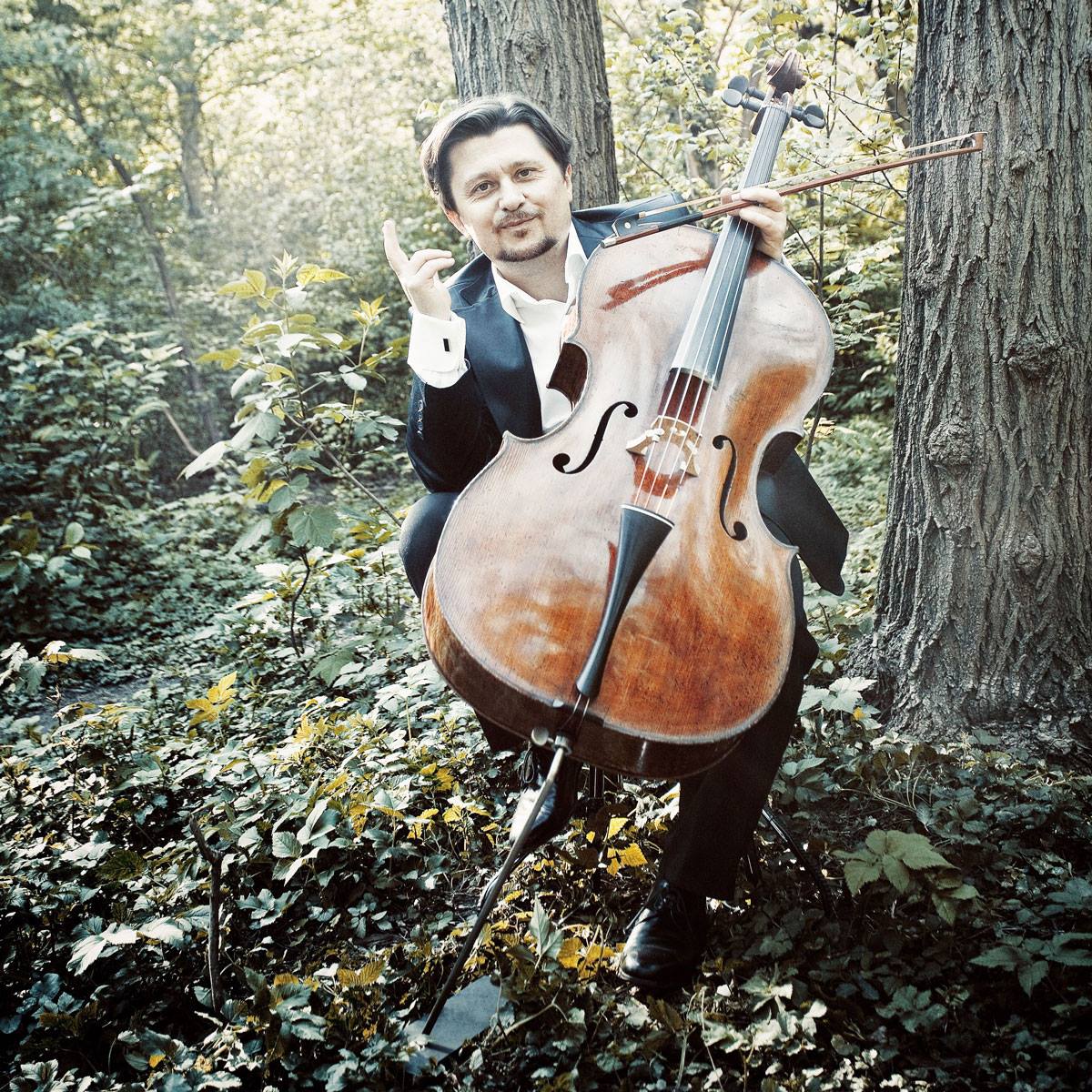
Cellist Friedrich Kleinhapl Interview
by
One response
This afternoon on The Classical Network, I’ll be interviewing the remarkable cellist Friedrich Kleinhapl.
Kleinhapl has been characterized by conductor Valery Gergiev as “one of the most promising talents of a new generation.” His performances have been described as “driven and unorthodox” (The Washington Post), undertaken with “abundant skills and unbridled passion” (The New York Times). His recordings of the Beethoven cello sonatas have been hailed as “among the most interesting in the catalogue” (The Strad).
As a young man, Kleinhapl homeopathically recovered from a brain tumor, radically changing the way he thinks and feels about music. His 1743 Guadagnini cello has been outfitted with custom titanium parts. Its angled endpin allows the instrument to slant more horizontally, allowing gravity to gently assist the effect of his modern bow. With his duo partner, Andreas Woyke – pianist and composer, and his own wife, Kleinhapl founded “Get a Hearing,” an association in support of children with hearing impairment, in 2015.
Kleinhapl and Woyke will appear on Tuesday at 7:30 p.m. at the Austrian Cultural Forum New York. On the program will be works by Beethoven, Shostakovich, Schnittke, and Gulda.
I’ll chat with Kleinhapl by telephone, today at 5:00 p.m. EST. From 4 to 7, I’ll also salute Adolphe Sax and John Philip Sousa on their birthdays, among our featured offerings, on WWFM – The Classical Network and wwfm.org.
-
Guy Fawkes Night William Byrd’s Secret Connection

by
2 responses
Remember, remember, the Fifth of November – also, I hope you remembered to turn your clocks back so that you’re well-rested for Guy Fawkes Night!
https://en.wikipedia.org/wiki/Guy_Fawkes_Night
William Byrd, a “Gentleman of the Chapel Royal,” was one of the best loved and certainly one of the most powerful musicians in England. In 1575, Queen Elizabeth granted him and Thomas Tallis – who had been a “Gentleman” from the time of Henry VIII – a 21 year monopoly on polyphonic music and a patent to print and publish music.
Despite Byrd’s favored status within the Anglican Church, he converted to Catholicism, and even rubbed shoulders with Robert Catesby, who formulated the Gunpowder Plot to blow up Parliament in 1605, during the reign of James I, for which Guy Fawkes gained his undying notoriety.
Though Byrd was never subject to imprisonment for his religion, he was involved in numerous lawsuits and subjected to heavy fines. Elizabeth interceded on his behalf at least once. He participated in illegal services, and the texts he chose to set to music could, at times, have a subversive edge. In particular, as a Catholic in a Protestant country, he became fond of texts related to persecution. Comparatively speaking, he went unmolested, because of his record of allegiance to the crown.
Learn more about Byrd here:
https://en.wikipedia.org/wiki/William_ByrdThe secret life of William Byrd:
http://www.telegraph.co.uk/news/religion/10323301/The-secret-life-of-William-Byrd.htmlByrd’s motet, “Ne irascaris Domine” (“Do not be angry, Lord”), from his “Cantiones sacrae”:
PICTURED: Gunpowder Plot conspirators
-
Autumnal Music with Bax & Lloyd on WWFM

by
3 responses
This Sunday night on “The Lost Chord,” we celebrate the eleventh month with music of an autumnal nature. We’ll open with Sir Arnold Bax’s ravishing tone poem, “November Woods,” of 1917. Then we’ll hear a symphony composed in 1981 by the criminally underrated George Lloyd.
Lloyd’s music is invariably well-crafted, even infectious, yet stubbornly tonal. It can often seem a bit old-fashioned, yet compositional integrity and musical good taste never go out of style. He’s certainly a composer well worth getting to know.
Lloyd’s Symphony No. 10, “November Journeys,” was commissioned by the BBC for the Northern Brass Ensemble. The commission coincided with the composer’s exploration by rail of a number of cathedrals. The sounds of the brass in the composer’s head paralleled his experience of taking in the magnificent buildings. At no point was he attempting to conjure an ecclesiastical air, yet he conceded that the second movement reminded him of a Christmas carol.
We’ll have just a little bit of time at the end of the hour, so I’m tossing in Bax’s “Red Autumn,” for two pianos, for good measure. The piece was originally composed in 1912, and though he never orchestrated it, it’s thought that his original intention had been to do so. In any case, it is marked by Bax’s characteristic opulence.
I hope you’ll join me for “Notions Eleven,” music for the eleventh month, this Sunday night at 10:00 EST – did you remember to change your clocks? – on WWFM – The Classical Network and wwfm.org.
-
Saturn Gives Back! Fall Back Time Change 2024
by
One response
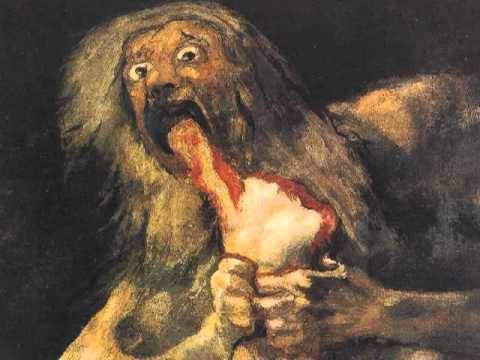
Saturn, the Bringer of Old Age, reminds you to turn your clocks tonight. Actually, Saturn will give you back an hour. Thank you, Saturn.
Detail: “Saturn Devouring His Son,” Francisco Goya (c. 1819-1823)
Tag Cloud
Aaron Copland (93) Beethoven (95) Composer (114) Film Music (145) Film Score (143) Film Scores (255) Halloween (94) John Williams (195) KWAX (229) Leonard Bernstein (104) Marlboro Music Festival (125) Movie Music (160) Mozart (91) Opera (213) Philadelphia Orchestra (89) Picture Perfect (174) Princeton Symphony Orchestra (109) Radio (88) Ross Amico (244) Roy's Tie-Dye Sci-Fi Corner (290) The Classical Network (101) The Lost Chord (269) Vaughan Williams (105) WPRB (397) WWFM (881)
4 responses