Brian De Palma is an extraordinarily adept filmmaker, who has been criticized for his adherence to “genre trash.” He has always been attracted to suspense and crime thrillers, usually of an especially violent nature, many of them tinged with horror.
This week on “Picture Perfect,” with Hallowe’en right around the corner, we’ll hear music from four of De Palma’s films.
It’s hardly surprising that such an admirer of Alfred Hitchcock would also hire Hitch’s signature composer. Bernard Herrmann scored two films for De Palma – “Sisters,” in 1973, and “Obsession,” in 1976.
“Obsession” is a spin on Hitchcock’s “Vertigo.” A botched rescue attempt results in the death of a businessman’s kidnapped wife. Years later, he encounters someone who could be her doppelganger. The film stars Genevieve Bujold, John Lithgow, and a very tan Cliff Robertson.
“The Fury,” from 1978, is a supernatural thriller based on a novel by John Farris. Two teenagers, endowed with powers of telekinesis and extra-sensory perception, are targeted by researchers who plan to harness them for their own nefarious ends. For a time, Kirk Douglas has fun as a former CIA agent, and John Cassavetes is a particularly slimy villain. Cassavetes’ comeuppance makes for one of the most memorable movie endings of its era – and we’ll leave it at that!
Critic Pauline Kael praised the music, which is by none other than John Williams – hot off his third Academy Award, for “Star Wars” – characterizing it as “as elegant and delicately varied a score as any horror film has ever had.”
Of course, “The Fury” was not the first De Palma film to deal with telekinesis. His adaptation of Stephen King’s “Carrie,” from 1976, became one the decade’s landmark horror films. It broadened King’s popularity and propelled De Palma into the A-list of Hollywood directors. It also essentially launched the careers of Amy Irving, John Travolta, and Nancy Allen, among others. Sissy Spacek was nominated for an Academy Award for her performance in the title role, as was Piper Laurie as Carrie’s overbearing, fundamentalist mother.
The music was by Pino Donaggio. The director had wanted to continue his collaboration with Herrmann, but the composer died before the film could be completed. Donaggio, though classically trained, made his fortune writing popular songs. His biggest hit was “You Don’t Have to Say You Love Me,” which was recorded by Dusty Springfield and treated to a well-known cover by Elvis Presley. Donnagio went on to become a regular De Palma collaborator, providing the music for seven of his films.
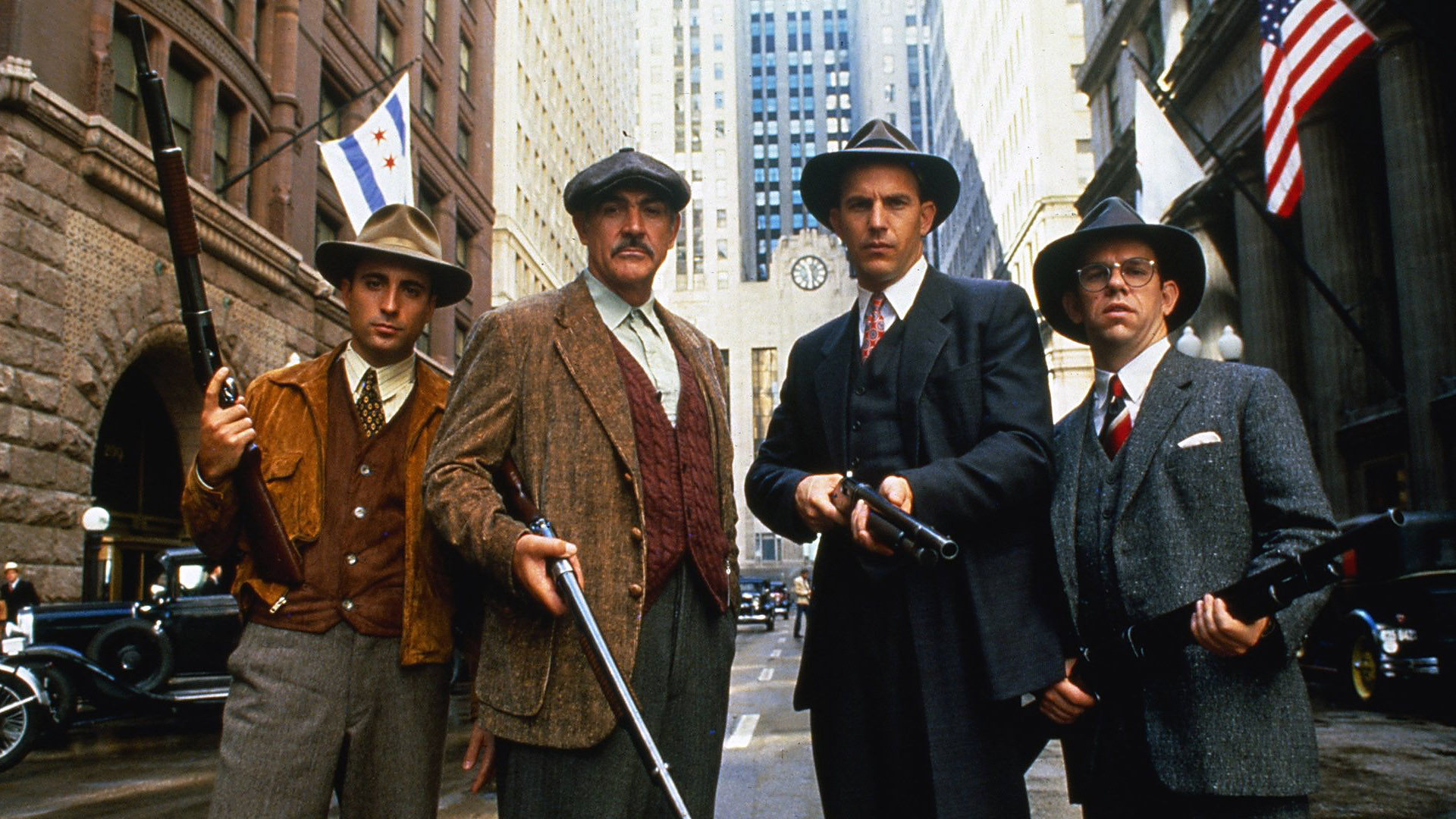
Finally, we’ll turn our back on horror, to listen to music from a successful period crime thriller, loosely based on the real-life exploits of Eliot Ness and his fellow prohibition agents – “The Untouchables,” from 1987. Kevin Costner plays the by-the-book federal agent who is given a valuable lesson in street smarts by an Irish beat cop played by an Academy Award winning Sean Connery. (“He pulls a knife, you pull a gun. He sends one of yours to the hospital, you send one of his to the morgue. That’s the Chicago way, and that’s how you get Capone.”) Capone is played, incidentally, by a baseball bat wielding Robert De Niro.
The score is by Ennio Morricone. Morricone, of course, was propelled to fame through his work on Sergio Leone’s spaghetti westerns. He applies some of that same mythmaking skill to this big screen adaptation, which had previously been published as a memoir and developed into a popular television series starring Robert Stack. The high point of the film must be the director’s nail-biting homage to Sergei Eisenstein, a slow motion shoot-out around a baby carriage as it teeters down the stairs of Chicago Union Station.
Start your weekend with a step in the right direction, with music from the films of Brian De Palma, on “Picture Perfect,” music for the movies, now in syndication on KWAX Classical Oregon!
———-
Clip and save the start times for all three of my recorded shows:
PICTURE PERFECT, the movie music show – Friday at 8:00 PM EDT/5:00 PM PDT
SWEETNESS AND LIGHT, the light music program – Saturday at 11:00 AM EDT/8:00 AM PDT (***now with a repeat Sunday at 9:00 PM EDT/6:00 PM PDT***)
THE LOST CHORD, unusual and neglected rep – Saturday at 7:00 PM EDT/4:00 PM PDT
Stream them, wherever you are, at the link!
https://kwax.uoregon.edu/
Tag: Alfred Hitchcock
-
Music Propels the Action on “Picture Perfect”
This week on “Picture Perfect,” we take flight with music from movies about airports and airplanes.
In the original “Airport” (1970), producer Irwin Allen established the prototype for disaster movies of all stripes by placing an all-star, aging cast in spectacular peril. Burt Lancaster! Dean Martin! George Kennedy! Jean Seberg! Jacqueline Bisset! Helen Hayes! The list goes on and on, longer than the longest runway. The bongo-laden theme is by veteran film composer Alfred Newman,” from the last of his over 200 scores.
Another movie with something of the same feel is “The V.I.P.s” (1963), allegedly inspired by the real-life love-triangle of Vivien Leigh, Laurence Olivier, and Peter Finch. The story is set at London Heathrow Airport, where flights are delayed because of a dense fog. The film was written by Terrence Rattigan and the parts cast from another laundry list of stars, including Elizabeth Taylor, Richard Burton, Louis Jourdan, Maggie Smith, Rod Taylor, and Orson Welles, with Margaret Rutherford in an Academy Award-winning performance. The music is by Miklós Rózsa.
By contrast, Steven Spielberg’s “The Terminal” (2004) is an (intentionally) comic take on the predicament of a hapless Eastern European who finds himself in a kind limbo, trapped in an international arrivals terminal in New York, after his country erupts into civil war, so that his passport and other documentation are no longer valid. His plight mirrors that of real-life Mehran Karimi Nasseri, an Iranian who lived for 17 years in a terminal at Charles de Gaulle Airport.
Tom Hanks plays the unfortunate traveler, who makes the terminal his home, and Catherine Zeta-Jones the airline attendant with whom he strikes up a relationship. The music is by regular Spielberg collaborator John Williams (whose 94th birthday it is on Sunday), and I think you’ll find it quite different from the Williams known for his work on “Star Wars” and “Indiana Jones.”
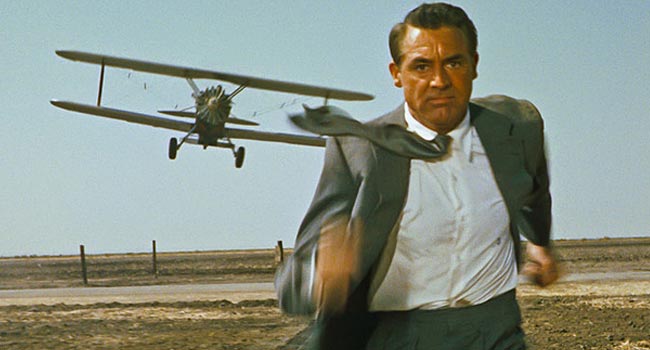
Finally, we’ll turn to the Alfred Hitchcock thriller “North by Northwest” (1959), a film in which Cary Grant encounters love and danger in, on, and from a variety of planes, trains, and automobiles. Planes are particularly significant. During the course of the film, it’s revealed that the title is in reference to a Northwest Airlines flight; Eve Kendall (Eva Marie Saint) must do all she can to avoid getting on a plane with Phillip Vandamm (James Mason); and of course, Roger Thornhill (Grant) flees from a strafing crop duster. Bernard Herrmann’s opening fandango propels us into the adventure.
FUN FACT: The film’s most iconic scene (pictured) is actually played without music.
Rush more to Rushmore! Music propels the action on “Picture Perfect,” music for the movies, now in syndication on KWAX Classical Oregon!
——–
Clip and save the start times for all three of my recorded shows:
PICTURE PERFECT, the movie music show – Friday at 8:00 PM EST/5:00 PM PST
SWEETNESS AND LIGHT, the light music program – Saturday at 11:00 AM EST/8:00 AM PST
THE LOST CHORD, unusual and neglected rep – Saturday at 7:00 PM EST/4:00 PM PST
Stream them, wherever you are, at the link!
https://kwax.uoregon.edu -
Double Your Pleasure on “Picture Perfect”
This week on “Picture Perfect,” we’re seeing double.
James Stewart plays Scottie Ferguson, a traumatized police detective who becomes obsessed with the woman he loves – and loses – in Alfred Hitchcock’s “Vertigo” (1958). Kim Novak portrays both the enigmatic beauty and her spitting image, who Ferguson, rather creepily, attempts to mold. Bernard Herrmann wrote the hypnotic score.
Krzysztof Kieślowski’s “La double vie de Véronique”/“The Double Life of Véronique” (1991) depicts parallel characters living in Poland and France who are mysteriously linked, both of them played by Irène Jacob. The performance(s) earned Jacob an award for Best Actress at the Cannes Film Festival. The music, which plays a significant role in the actual plot, is by Zbigniew Preisner.
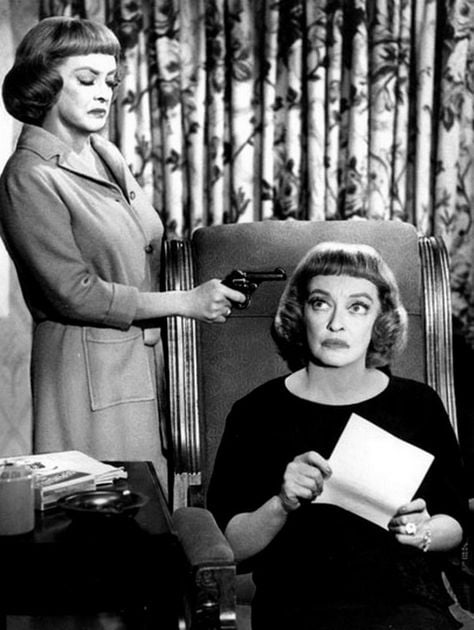
For the second time in her career, Bette Davis gets a chance to play an evil twin in “Dead Ringer” (1964). The first was in the 1946 good twin-bad twin melodrama, “A Stolen Life.” When asked what the difference was between the two performances, Davis quipped, “About 20 years.” “Dead Ringer” was directed by her longtime friend and “Now, Voyager” co-star Paul Henreid. The music is by André Previn, whose score employs a stock-in-trade sinister harpsichord, yet when he comes to write the love theme, he manages to whip up one hell of a tribute to Erich Wolfgang Korngold.
Korngold scored a number of Davis’ films in the 1940s, though he is principally remembered for his work on the swashbucklers of Errol Flynn. To capitalize on Flynn’s star-making performance in “Captain Blood,” Warner Brothers produced a big screen adaptation of Mark Twain’s Tudor switcheroo, “The Prince and the Pauper” (1937). Flynn steals the show as Miles Hendon, the devil-may-care guardian of Prince Edward and Tom Canty, Edward’s mirror image, played by real-life twins Bobby and Billy Mauch. If you’re a Korngold fan, or an enthusiast of violin concertos, you may recognize some of the music. Korngold recycled the theme for use in the last movement of his Violin Concerto, championed by Heifetz and others.
Double your pleasure with an hour of doppelgangers, twins, and dual identities, on “Picture Perfect,” music for the movies, now in syndication on KWAX Classical Oregon!
——–
Clip and save the start times for all three of my recorded shows:
PICTURE PERFECT, the movie music show – Friday at 8:00 PM EST/5:00 PM PST
SWEETNESS AND LIGHT, the light music program – Saturday at 11:00 AM EST/8:00 AM PST
THE LOST CHORD, unusual and neglected rep – Saturday at 7:00 PM EST/4:00 PM PST
Stream them, wherever you are, at the link!
https://kwax.uoregon.edu -

Hitchcock’s Other Composers Beyond Herrmann
Alfred Hitchcock’s most celebrated musical collaborator was Bernard Herrmann. Herrmann scored just about every one of Hitch’s films over the span of a decade, enhancing the impact and memorability of such classics as “Vertigo,” “North by Northwest,” and “Psycho.” But Hitchcock also worked with a number of other notable composers.
This week on “Picture Perfect,” we’ll cast some light into Herrmann’s shadow with selections from “Rebecca” (Franz Waxman), “Strangers on a Train” (Dimitri Tiomkin), “Spellbound” (Miklós Rózsa), and “Family Plot” (John Williams).
Herrmann goes on hiatus, and the suspense is killing us, on “Picture Perfect,” music for the movies, now in syndication on KWAX, the radio station of the University of Oregon!
Clip and save the start times for all three of my recorded shows:
PICTURE PERFECT, the movie music show – Friday at 8:00 PM EDT/5:00 PM PDT
SWEETNESS AND LIGHT, the light music program – Saturday at 11:00 AM EDT/8:00 AM PDT
THE LOST CHORD, unusual and neglected rep – Saturday at 7:00 PM EDT/4:00 PM PDT
Stream them, wherever you are, at the link!
-
Spielberg Hitchcock Herrmann Williams Radio
When Steven Spielberg was introduced to Bernard Herrmann during a scoring session for Martin Scorsese’s “Taxi Driver,” he wound up going all fan-boy.
“Oh, Mr. Herrmann!” Spielberg gushed. “I’m such an admirer of your work! You’re such an amazing genius!”
Herrmann, who was notoriously prickly, looked him up and down and scowled, before replying, “So why do you always hire John Williams?”
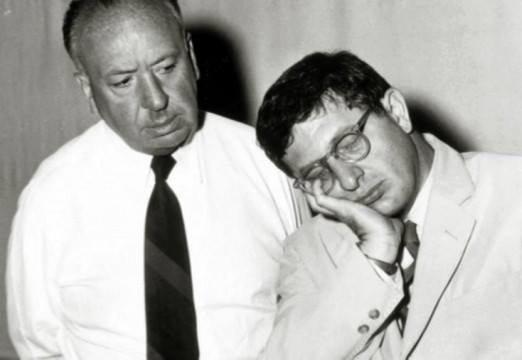
Interestingly, not long before, Spielberg, buoyed by the box office success of “Jaws,” worked up the courage to meet Herrmann’s one-time employer, Alfred Hitchcock, on the set of Hitch’s final film, “Family Plot” (which, coincidentally, Hitchcock also hired Williams to score).
Before Spielberg could say anything, Hitch had him escorted off set, commenting to actor Bruce Dern, “Isn’t that the boy who made the fish movie?”
The very night Spielberg met Herrmann (albeit briefly), the composer wrapped-up recording his music for “Taxi Driver,” went back to his hotel and died of a heart attack, in his sleep, in the wee hours of December 24, 1975. Hitchcock would follow his erstwhile collaborator in 1980.
I establish these connections, because two of my three radio shows this weekend focus on the music of Bernard Herrmann and John Williams.
In the mid-1950s, Herrmann and Hitchcock came together for a string of commercial, critical, and artistic successes, including, most notably, “Vertigo,” “North by Northwest” and “Psycho.” But the two collaborated on no less than nine films, if we count “The Birds,” on which Herrmann acted as sound consultant.
Today, on “Picture Perfect,” we’ll have selections from the other five – among them, “Marnie,” “The Trouble with Harry” and “The Wrong Man.”
Herrmann’s reworking of Arthur Benjamin’s “The Storm Clouds Cantata” was used at the climax of the 1956 version of “The Man Who Knew Too Much,” as a frantic James Stewart attempts to thwart an assassination plot at Royal Alert Hall. (In the film, Herrmann himself appears on the podium.)
We’ll also hear a portion of the rejected score for “Torn Curtain,” the project that ended the Herrmann-Hitchcock association. Hitchcock fired Herrmann, when the composer ignored his instructions to write something light and popular, under studio pressure. John Addison was hired as his replacement, and the film was a failure at the box office.
In recent years, Herrmann admirers have had several opportunities to sample the composer’s original thoughts. Quentin Tarantino is obviously a fan. He used some of Herrmann’s “Torn Curtain” music in “Once Upon a Time in Hollywood.”
I hope you’ll join me for lesser-heard Herrmann-Hitchcock, on “Picture Perfect,” music for the movies.
But wait – there’s more!
Tomorrow is John Williams’ 93rd birthday. To celebrate, I’ve assembled a miscellany of the composer’s music for film, television, and the Olympic Games for “Sweetness and Light.” Among the offerings will be selections from several scores written for Spielberg and one (“Family Plot”) written for Hitch.
Hitch yourself to Herrmann, this Friday at 8:00 EST/5:00 PST; then send well-wishes to Williams, this Saturday morning at 11:00 EST/8:00 PST, on “Picture Perfect” and “Sweetness and Light,” respectively – exclusively on KWAX, the radio station of the University of Oregon!
Clip and save the start times for all three of my recorded shows:
PICTURE PERFECT, the movie music show – Friday at 8:00 PM EST/5:00 PM PST
SWEETNESS AND LIGHT, the light music program – ALL NEW! – Saturday at 11:00 AM EST/8:00 AM PST
THE LOST CHORD, unusual and neglected rep – Saturday at 7:00 PM EST/4:00 PM PST
Stream them, wherever you are, at the link!
Tag Cloud
Aaron Copland (94) Beethoven (95) Composer (114) Film Music (150) Film Score (143) Film Scores (255) Halloween (102) John Williams (198) KWAX (233) Leonard Bernstein (105) Marlboro Music Festival (125) Movie Music (165) Mozart (91) Opera (215) Philadelphia Orchestra (90) Picture Perfect (174) Princeton Symphony Orchestra (110) Radio (90) Ross Amico (244) Roy's Tie-Dye Sci-Fi Corner (290) The Classical Network (101) The Lost Chord (269) Vaughan Williams (107) WPRB (397) WWFM (881)