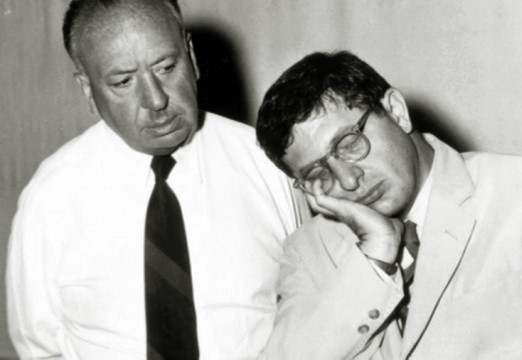
Tag: Alfred Hitchcock

  • Trains on Film: Music for Movie Lovers

    Trains on Film: Music for Movie Lovers

    Trains have always been very good for drama. They are symbols of departures and arrivals. They are conveyors of prisoners and vehicles of escape. They are objects of romance and objects to “hobo around” on. They are harbingers of civilization, and they are transports be robbed. You can fight on top of them. You can make out with Eva Marie Saint, or you can protect Marie Windsor so that she can testify against the mob. You can shuffle off to Buffalo.

    From the beginning, trains have provided good escapist fun at the movies. This week on “Picture Perfect,” we’ve got an hour of music from four memorable films in which trains play an important role.

    In “Strangers on a Train” (1951), arguably Alfred Hitchcock’s most underrated film of the 1950s, Farley Granger plays a tennis pro who unwittingly becomes involved in a double-murder plot (criss-cross!) through a chance encounter on a passenger train with a psychopath named Bruno (probably Robert Walker’s finest performance). The music is by Dimitri Tiomkin, who scored four films for Hitch – including “Shadow of a Doubt,” “I Confess,” and “Dial M for Murder.”

    Burt Lancaster stars in a film titled, simply, “The Train” (1964), as a reluctant railroad inspector who is persuaded to join the French Underground’s efforts to delay the transport of masterpieces looted from the museums of Paris by the Nazis, since Allied liberation of France is imminent. Paul Scofield plays the art-loving German officer determined to move the art at all costs. Real trains were destroyed in the making of the film, real dynamite was employed, and Lancaster, as was often the case, did all his own stunts. The score is by Maurice Jarre.

    “Murder on the Orient Express” (1974) is based on one of the best-known Agatha Christie vehicles involving her recurring character, celebrated detective Hercule Poirot. The late Albert Finney portrays Poirot most memorably in this, the first and best of the all-star Christie thrillers, set on a long-distance passenger train connecting Paris to Istanbul. The list of suspects includes Lauren Bacall, Martin Balsam, Ingrid Bergman, Sean Connery, John Gielgud, Anthony Perkins, Richard Widmark, and Michael York. The unforgettable score is by Richard Rodney Bennett.

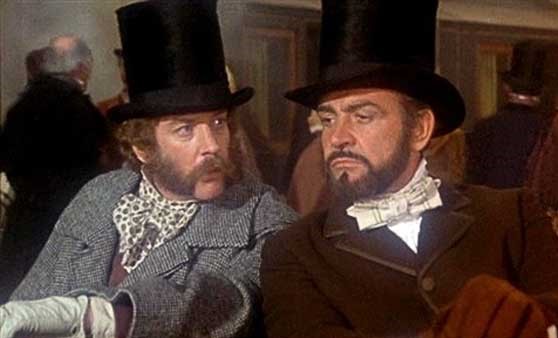
    Finally, we turn to the lighthearted caper “The Great Train Robbery” (1979), starring Sean Connery, Donald Sutherland, and Leslie-Anne Down. Michael Crichton wrote the screenplay, after his own novel, which in turn was based on an actual historical incident – an 1855 heist, in which an unbelievable amount of gold disappeared from a moving train. Crichton also directed the film. The music is by the great Jerry Goldsmith.

    All aboard! We’ll be taking the train today, on “Picture Perfect,” music for the movies, this Saturday evening at 6:00 EDT, on WWFM – The Classical Network and wwfm.org.


    TOP: Sutherland and Connery

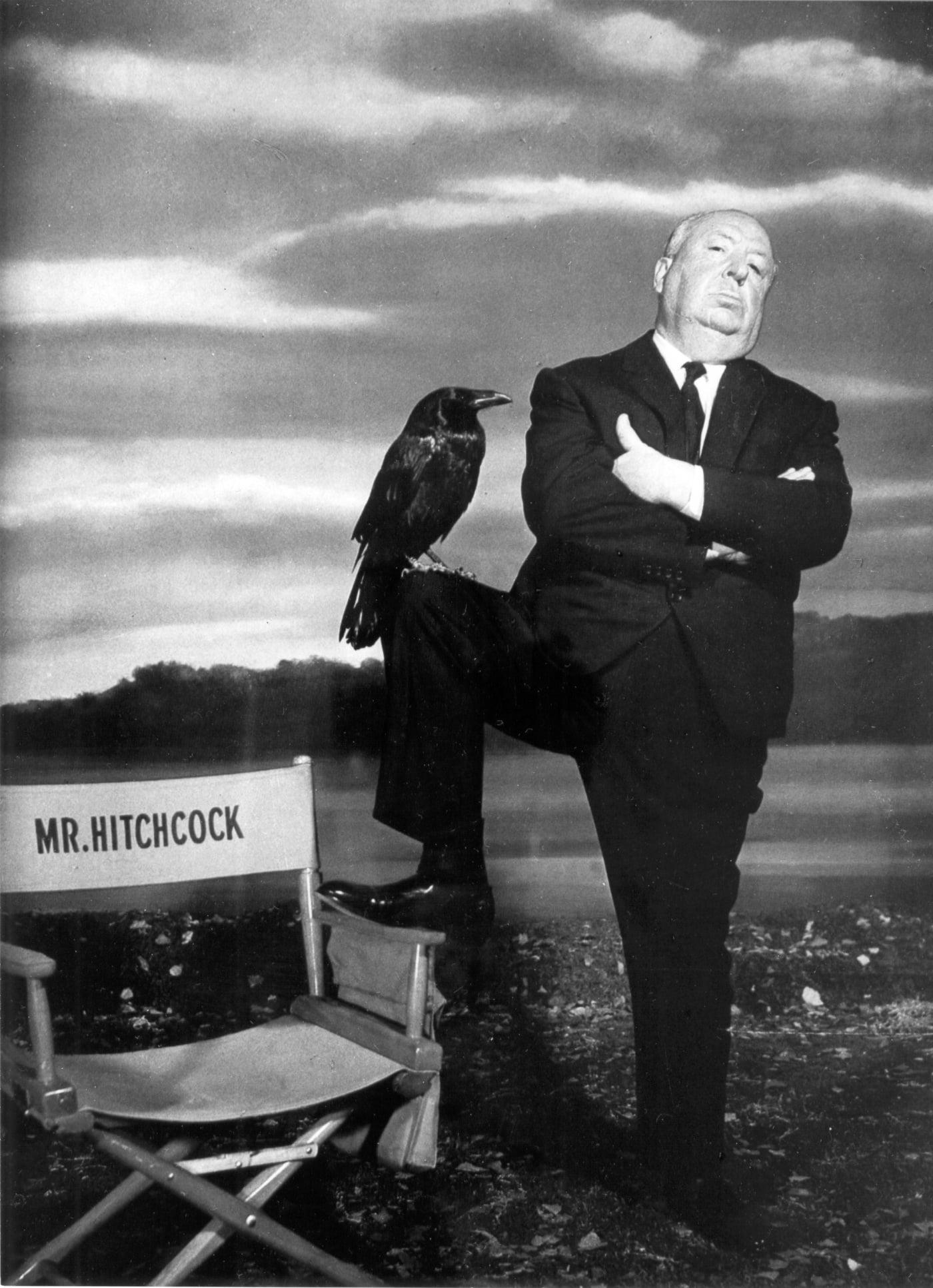
    BOTTOM (left to right): Farley Granger and Alfred Hitchcock pass in the night; Finney as Hercule Poirot; Lancaster means business

  • Israel Baker From THX 1138 to Hitchcock

    Israel Baker From THX 1138 to Hitchcock

    In researching the music for tonight’s discussion of “THX 1138” on Roy’s Tie-Dye Sci-Fi Corner, I was interested to note Israel Baker among the film’s musical personnel. In addition to working in the movies, Baker made many recordings for Columbia Records (now Sony), with the likes Jascha Heifetz, Bruno Walter, Glenn Gould, and Igor Stravinsky.

    At different points of his career, he was concertmaster of Stokowski’s All-American Youth Orchestra, a member of Toscanini’s NBC Symphony (where he would have played with flutist Carmine Coppola – father of Francis Ford Coppola – also listed among the “THX” personnel), leader of the Los Angeles Chamber Orchestra, and concertmaster of the Columbia Symphony. In addition, he led the classical and jazz ensembles at Capitol Records.

    Baker was Stravinsky’s first choice to record his Violin Concerto, but Columbia overruled in favor of the more marketable Isaac Stern. Alongside his work in the film and classical music fields, Baker appeared on hundreds of recordings by artists such as Benny Carter, Ella Fitzgerald, Johnny Mathis, Frank Sinatra, Barbra Streisand, Mel Tormé, Sarah Vaughan, Tom Waits, and The Dameans.

    Perhaps his most notorious contribution to film was as concertmaster at the recording sessions for Bernard Herrmann’s score to Alfred Hitchcock’s “Psycho” (in which capacity he played in the infamous shower scene). Baker also worked with Alfred Newman, Franz Waxman, André Previn, Elmer Bernstein, Maurice Jarre, John Barry, John Williams, and – in the case of “THX 1138” – Lalo Schifrin.

    He died on Christmas Day, 2012, at the age of 92.


    Baker plays the opening of “Scheherazade” with Erich Leinsdorf and the Concert Arts Orchestra

    Stravinsky’s “Pastorale”

    The dream team of Jascha Heifetz, Israel Baker, William Primrose, Gregor Piatigorsky, and Leonard Pennario, in César Franck’s Piano Quintet in F minor

    Playing Schoenberg with Glenn Gould

    An interview with Baker at the age of 90

    More about tonight’s discussion of “THX 1138”


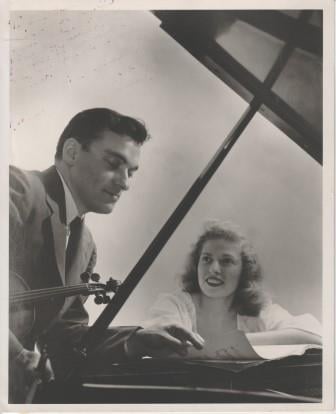
    PHOTO: Baker with his frequent duo partner, Yaltah Menuhin, sister of the famed violinist Yehudi Menuhin

  • Hitchcock Beyond Herrmann Scores Revealed

    Hitchcock Beyond Herrmann Scores Revealed

    Alfred Hitchcock’s most celebrated musical collaborator was Bernard Herrmann. Herrmann scored just about every one of Hitch’s films over the span of a decade, enhancing the impact and memorability of such classics as “Vertigo,” “North by Northwest,” and “Psycho.” But Hitchcock also worked with any number of other notable composers.

    This week on “Picture Perfect,” we’ll cast some light into Herrmann’s shadow with selections from “Rebecca” (Franz Waxman), “Strangers on a Train” (Dimitri Tiomkin), “Spellbound” (Miklós Rózsa), and “Family Plot” (John Williams).

    Herrmann goes on hiatus, and the suspense is killing us, on “Picture Perfect,” music for the movies, this Saturday evening at 6:00 EDT, on WWFM – The Classical Network and wwfm.org.

  • John Addison’s Centennial A Musical Tribute

    John Addison’s Centennial A Musical Tribute

    Today is the 100th birthday of Academy Award winning composer John Addison.

    Addison was awarded his statuette for “Tom Jones” in 1964. The score is a brilliant admixture of unusual instrumentation (harpsichord, well-worn upright, banjo, accordion) and music hall brio.


    Addison also provided the memorable music for “Sleuth.”

    And, for television, “Murder She Wrote.”

    Addison was the composer to whom Alfred Hitchcock turned, notoriously, after his falling out with Bernard Herrmann over the scoring of “Torn Curtain.” The studio was pressuring Hitch for a more “popular” sound. Ironically, Addison just wound up trying to conjure Herrmann – as did every one of Hitch’s collaborators thereafter.

    Addison also provided music for “The Entertainer,” “A Taste of Honey,” “The Loneliness of a Long Distance Runner,” “Start the Revolution Without Me,” “Luther,” “The Seven-Per-Cent Solution,” “A Bridge Too Far,” and the television miniseries “Centennial.”

    A student of Gordon Jacob at the Royal College of Music in London, he wrote a number of concert works, though he remarked, “If you find you’re good at something, as I was as a film composer, it’s stupid to do anything else.”

    Here is Addison’s Trumpet Concerto:


    Over a half century before Warren Beauty and Faye Dunaway got caught up in the infamous “La La Land” snafu, Sammy Davis Jr. was bitten by “Tom Jones”:

    Happy birthday, John Addison!

  • Hitchcock’s Harpsichords Crime Scores

    Hitchcock’s Harpsichords Crime Scores

    In trying to convey the tone he was looking for in his latest motion picture, director Alfred Hitchcock stated drolly to his composer, “Mr. Williams, murder can be fun.” With this in mind, John Williams, who had just won an Academy Award for his music to “Jaws,” turned to the harpsichord.

    Because of its use in mysteries and thrillers, the harpsichord – in context, a fusty-sounding instrument – had taken on a certain mischievous quality.

    This week on “Picture Perfect,” we’ll hear selections from “Family Plot” (1976), a neglected score from the dawn of Williams’ widespread popularity, alongside Ron Goodwin’s music for “Murder She Said” (1961), the first of Margaret Rutherford’s Miss Marple films; John Addison’s “Sleuth” (1972), an adaptation of Anthony Shaffer’s play, with Sir Laurence Olivier and Michael Caine engaged in a perilous battle of wits; and André Previn’s “Dead Ringer” (1964), starring a post-“Baby Jane” Bette Davis as dysfunctional twins whose fraught relationship leads to murder.

    The order has been placed for ham on wry. Join me for an hour of wicked fun with arch harpsichords, on “Picture Perfect” – music for the movies – this Friday evening at 6:00 EST, on WWFM – The Classical Network and wwfm.org.

Tag Cloud

Aaron Copland (92) Beethoven (95) Composer (114) Film Music (119) Film Score (143) Film Scores (255) Halloween (94) John Williams (185) KWAX (229) Leonard Bernstein (99) Marlboro Music Festival (125) Movie Music (134) Opera (198) Philadelphia Orchestra (86) Picture Perfect (174) Princeton Symphony Orchestra (106) Radio (87) Ralph Vaughan Williams (85) Ross Amico (244) Roy's Tie-Dye Sci-Fi Corner (290) The Classical Network (101) The Lost Chord (268) Vaughan Williams (102) WPRB (396) WWFM (881)

DON’T MISS A BEAT

Receive a weekly digest every Sunday at noon by signing up here


RECENT POSTS