Tag: American Symphony Orchestra

  • Botstein, Dodging Bullets, Conducts Berlioz Edition of Weber’s “Der Freischütz”

    Botstein, Dodging Bullets, Conducts Berlioz Edition of Weber’s “Der Freischütz”

    One of the times I saw John Williams in concert, he conducted some selections from his then recently-composed score to the Disney “Star Wars” revival, “The Force Awakens.” In between numbers, he remarked to the audience that he would continue to write music for the next installment, “The Last Jedi.” When the applause subsided, he followed it up with a quip, something along the lines of he really didn’t want to do it; but he really didn’t want anybody ELSE to do it either.

    I remembered that on Thursday night when I was at Carnegie Hall to hear a concert performance of Hector Berlioz’s edition of Carl Maria von Weber’s “Der Freischütz.”
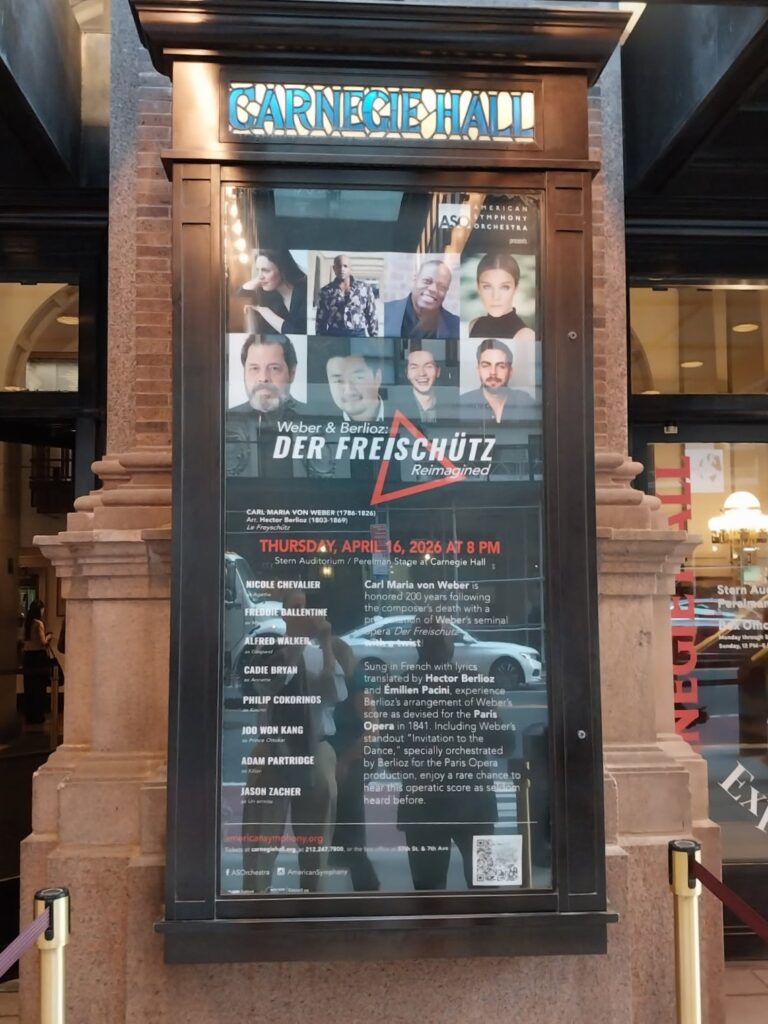

    Weber’s magnum opus, which took Europe by storm following its premiere in 1821, ignited a bold, new, Romantic era of lurid sensation in the opera house. German opera, in particular, would never be the same. The scenario and music reveled in an idealized past of roistering huntsmen and folk-like melodies, but also pushed into the darker territories of dread, emotional turmoil, and pacts with the Devil. The work traveled well, to New York, Rio de Janeiro, Cape Town, Sydney – everywhere it seems except Paris.

    Despite its near-universal appeal, “Freischütz” was dismissed by effete Parisians as being unsuited to their traditions. The Paris Opera forbade spoken dialogue, and the audience would have been scandalized had there not been a ballet in one of the later acts (a traditional diversion for aristocratic gentlemen who preferred to linger over supper, before settling into their boxes to ogle their mistresses among the dancers). As late as 1861, there were shouts of disdain when Wagner gave a big eff you to the French by placing his ballet at the beginning of “Tannhäuser.” When the second performance was disrupted by literal dog whistles, Wagner cancelled the rest of the run. If “Freischütz” were ever going to play Paris, it would require a major touch-up. And the Opera planned to do just that.

    Actually, it had been attempted once before at a rival house, the Théâtre de l’Odéon, in 1824, when Henri Castil-Blaze exercised a heavy hand in editing Weber’s original, cutting, reordering material, and even adapting vocal lines for a production retitled “Robin des Bois” – the French name for “Robin Hood,” even though the opera has nothing at all to do with the English folk hero.

    Berlioz was wild for “Freischütz,” to the extent that he lauded it in his memoirs and elsewhere as among his favorite operas. Unsurprisingly, he came to regard the Castil-Blaze version as an “insulting travesty, hacked and mutilated,” although enough of Weber’s magic remained, apparently, that he was compelled to attend several performances. Previously his operatic paragons had been the high-minded works of Christoph Willibald Gluck and Gaspare Spontini. Weber’s fantastic drama would have a profound influence on Berlioz’s subsequent development.
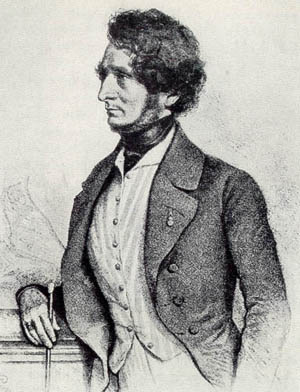
    Berlioz in 1845

    When Berlioz was approached by the Paris Opera to create his own edition of “Freischütz” (as “Le Freyschutz”) in 1841, he was not enthusiastic. Like Williams, who really didn’t want to do the next “Star Wars” movie, he feared what somebody else – somebody with less talent, less refinement, and less investment in the source material – might do with it. So Berlioz determined to commit to the project and worked hard to honor Weber’s legacy and actually make it good. And quite frankly, his version of the opera comes off better than anyone could ever hope.

    The title always sounds awkward in English. It’s often translated as “The Free-Shooter.” And the construction of the piece is about as clunky as the title would have you to expect. The work is not through-sung in the manner of a traditional opera, but rather it is a singspiel – you know, like Mozart’s “The Magic Flute” – with the arias, ensembles, and choruses linked by spoken dialogue. This has often posed a problem in recordings, as often it requires a major suspension of disbelief on a listener’s part to accept the actors who are assigned the spoken parts as analogous to the characters portrayed by singers of the roles. Also, for anyone who is not fluent in German, the spoken passages can very quickly wear out their welcome.

    So perhaps it is unsurprising – although it was a delightful surprise to me – that I actually found myself enjoying Berlioz’s edition more than Weber’s original. From a musical standpoint, it just goes down a whole lot easier, since Berlioz takes all those tiresome spoken lines and lends them musical interest by tastefully scoring them as recitative. “Der Freischütz” gains, therefore, from an unbroken musical flow. This might be considered blasphemous in some circles – no doubt German speakers will find more sustained interest in Weber’s original design – and for sure, there is a kind of bizarre alchemy that takes place if you allow yourself to think about the hybrid analytically. The sung French subtly changes the character of piece. The sound of the vocal lines is softened, and the text flows more mellifluously than it does when spiked with the harder, more intrusive consonants of German. And without drawing attention from Weber’s arias, Berlioz sustains and even enhances the atmosphere and dramatic momentum through his subtle artistry.

    In terms of the performance itself, listening to the execution of the overture on Thursday, I was reminded of Sir Thomas Beecham’s “two golden rules for an orchestra: start together and finish together. The public doesn’t give a damn what goes on in between.” It would have helped had the musicians been able to play with more commitment and intensity, to get the evening off to a good start. The horn passages were not particularly impressive, which was worrisome for an opera with plenty of exposed horn-playing, since after all it is brimming with huntsmen.

    Happily, whatever sense of foreboding instilled by the playing in the overture was dispelled immediately, as the horns were on point for the rest of the night. Furthermore, the performance ended strongly, with Leon Botstein and his musicians, especially the always superb Bard Festival Chorale (prepared by James Bagwell), tapped unsuspected reserves for the work’s Mozartian finale, which played like Sarastro’s grandest apotheosis ever. I didn’t see anything like it coming. So yes, it sent me out of the hall feeling uplifted and happy.

    The team of vocal soloists assembled for the evening included some familiar faces, from both American Symphony Orchestra and Bard Festival concerts. (Botstein directs both.) While I had my personal preferences, in terms of timbre, intensity, and projection, each had their individual strengths. The singers were mostly well-matched, but I found tenor Freddie Ballentine, in the lead role of Max, at his strongest in moments like his Act II trio, in which he blended sensitively his female costars.

    On a purely charismatic level, soprano Cadie Bryan – who sang Milada in last year’s production of Smetana’s “Dalibor” at Bard and here filled the supporting role of Annette – upstaged soprano Nicole Chevalier as her anguished cousin Agathe, whose character, let’s face it, is a real Debbie Downer. This despite the fact that Chevalier sang her arias beautifully.

    I’ve seen bass-baritone Alfred Walker a number of times, and he’s always very good – he had a meaty role as Saint-Saëns’ Henri VIII at Bard and also sang the King in “Dalibor” – but here, as Max’s duplicitous rival, he’s given less to do, especially since the opera in this performance was not staged. Essentially, the singers stood, sang, and emoted at their music stands.

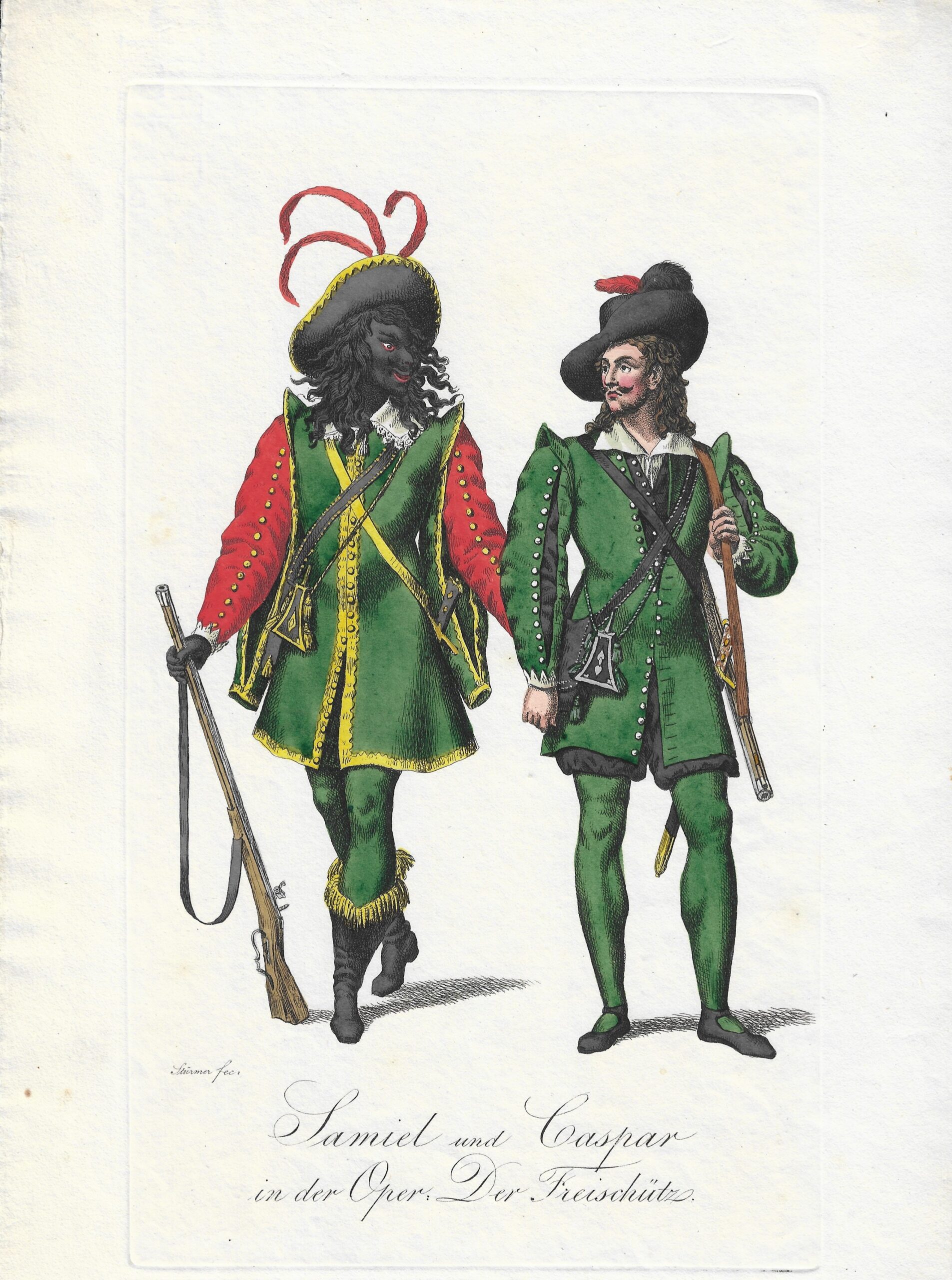
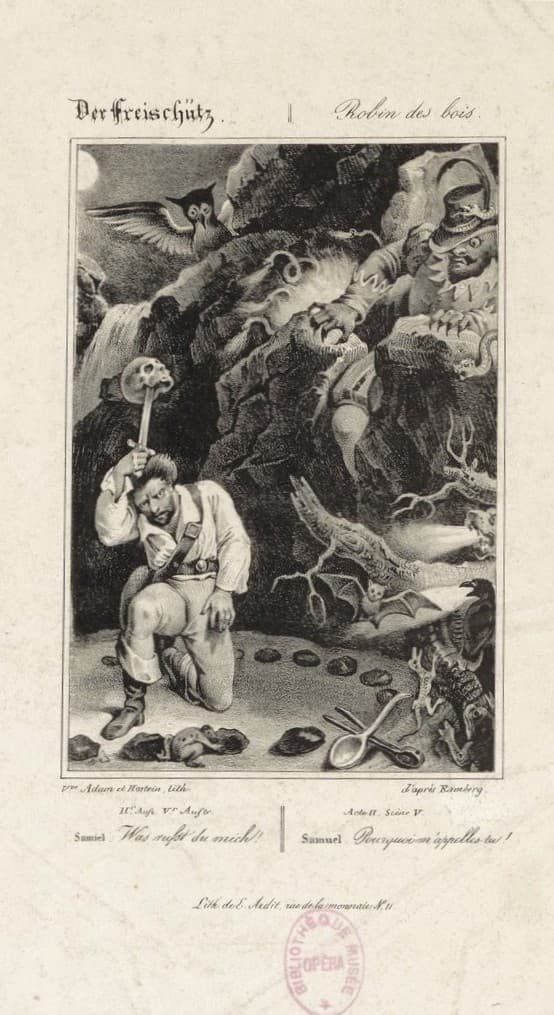
    Naturally, where any concert performance of “Freischütz” suffers the most is in the celebrated Wolf’s Glen sequence, with its creepy midnight rendezvous to barter souls for magic bullets. There should be specters, thunder and lightning, owls roosting in withered tress, and an all-important human skull. Thursday night’s audience pieced out these imperfections with their thoughts, while one of the choristers (unidentified in the program, alas) offered diabolical interjections from the balcony as Satanic Samiel, the Black Huntsman.

    Among the supporting singers, baritone Adam Partridge as Kilian, a good-natured peasant who outshoots Max in the contest of the opera’s first act, had a great voice and a commanding presence, and bass Philip Cokorinos, a familiar presence, here as Kuono, head gamekeeper and Agathe’s father, sang his part with satisfying resonance.

    The whole plot hinges on Max winning a shooting contest so that he can attain job security (as worthy successor to Kuono) and Agathe’s hand in marriage. His poor luck at the start leaves him open to the temptations of Gaspar, who himself has sold his soul to Samiel, the Dark Huntsman, for some magic bullets. Gaspar hopes to delay his hour of reckoning by luring Max to damnation and Agathe along with him.

    While bass-baritone Jason Zacher, who towered physically over the rest of the cast as the Hermit, really didn’t have all that much to do – he only really gets to sing at the end – this deus ex machina character always amuses me in his earnestness. What I would pay to hear him break character and cry, “Wait! I was going to make espresso!”

    For the ballet music, Berlioz orchestrated Weber’s piano piece “Invitation to the Dance” – which, in its new guise, became a breakout hit, even if, technically, it seems as out-of-place as the Viennese waltz interlude Erich Wolfgang Korngold employs during the rustic banquet in “The Adventures of Robin Hood.” A universal truth: for as long as Berlioz’s arrangement has been around, and for as frequently as it’s been played, people still applaud before the quiet cello denouement.

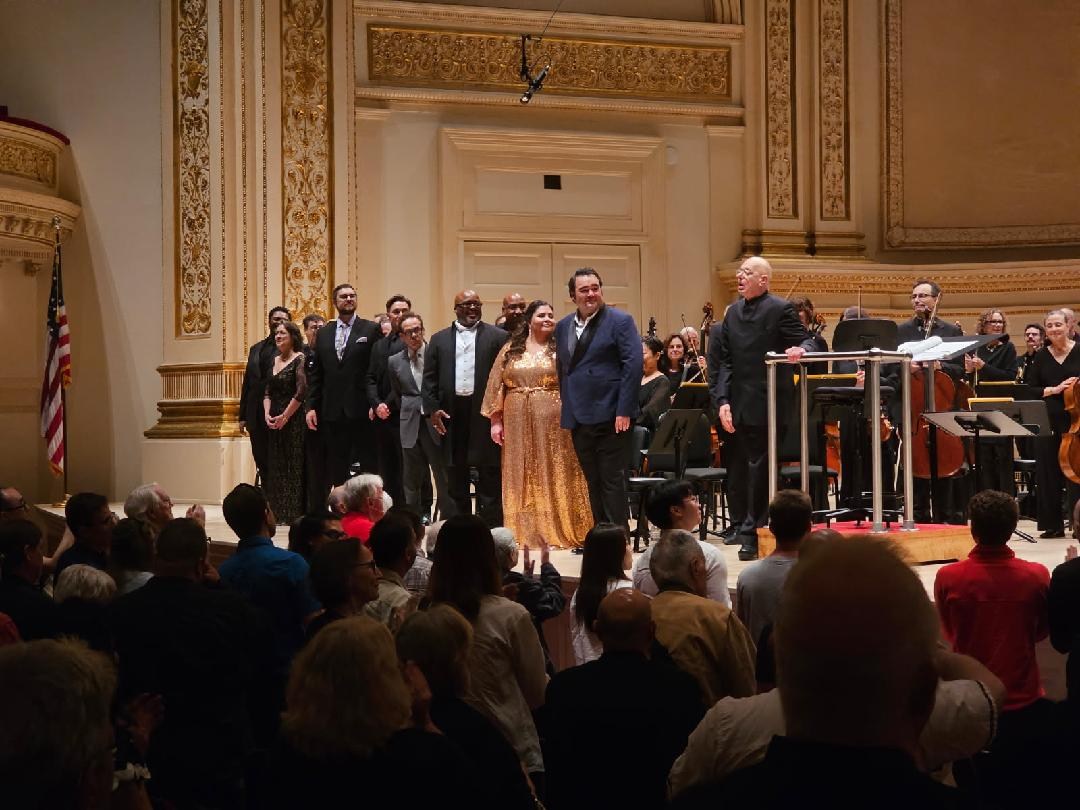
    The opera’s performance, taken as a whole, was a satisfying one, and as always, Botstein and his players should be proud to have shared yet another unusual, not insignificant, indeed revelatory work with such a large audience. (The concert was well attended.)
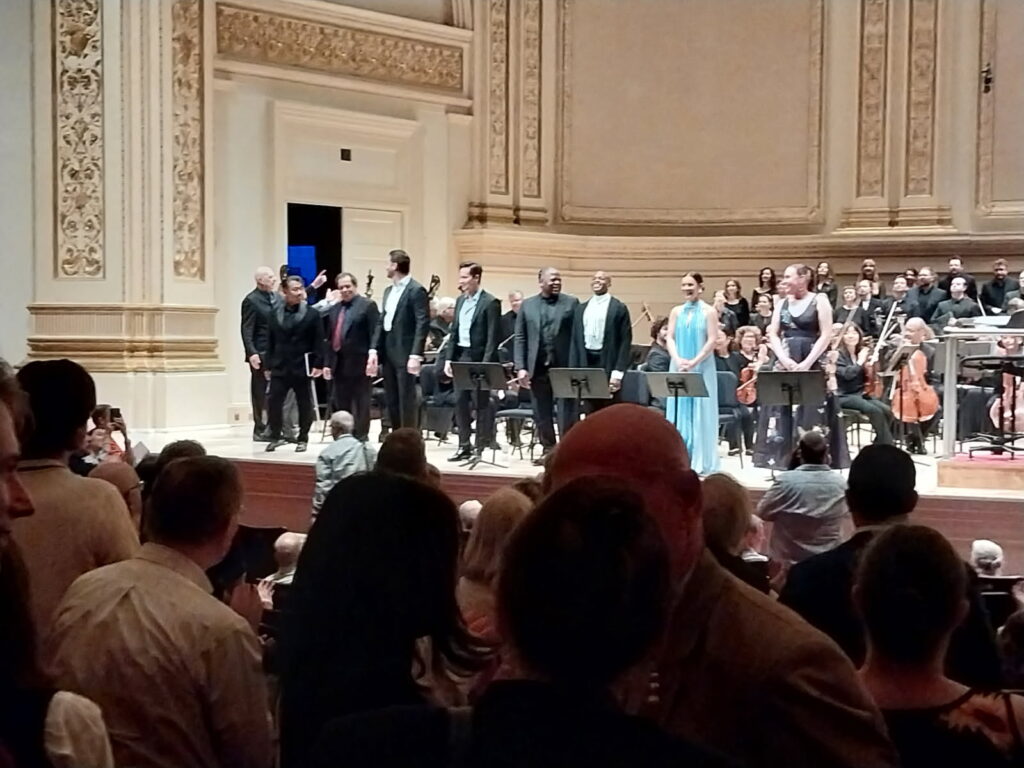

    As is often the case, Botstein, who has been music director of the American Symphony Orchestra for 34 years, delivered a pre-concert talk an hour before the performance. As president of Bard College for over half a century, he has long been a master in the art of public speaking. He imparts his information articulately and with impressive fluency, and an off-handedness that belies the care and lucidity of his thought. Key to his success as a communicator, I think, is that he always somehow manages to keep the intellectual balancing act both conversational and engaging. He also has a wry sense of humor, and he’s not afraid to use it.

    When he returned to the stage for the performance itself, the audience received him warmly. There were no boos or catcalls or demonstrations – no indication at all of the emotional turbulence that has roiled Bard campus since his name has been linked with that of Jeffrey Epstein.

    In a nutshell, Botstein, as college president and its most prominent fundraiser, did everything he could to court Epstein, after the latter’s unsolicited donation of $75,000 to the institution. Although Botstein himself has not been accused of any criminal activity, his allegedly having turned a blind eye to Epstein’s six-years-earlier conviction for soliciting prostitution from a minor has blown up at Bard since the release of the Epstein files, with outraged activists calling for him to step down. Botstein, who is pushing 80, but remains in good physical and mental health, has talked about retirement, with the possibility of him staying on to teach and conduct Bard’s graduate ensemble, The Orchestra Now. An independent investigation is ongoing.

    Botstein is scheduled to conduct a staged production of Richard Strauss’ “Die ägyptische Helena,” or “The Egyptian Helen,” at the school’s annual arts festival, Bard SummerScape, July 24-August 2. Presumably, he will then return to preside over this year’s Bard Music Festival, “Mozart and His World,” August 7-16, although the marketing so far has been very quiet regarding his hopeful participation.

    Botstein, of course, makes a specialty of resurrecting unusual and neglected repertoire. Mozart is unusually down-the-middle for him, but Bard is celebrated for its curve balls. We’ll see what they do with it.

    Incredibly, Thursday was the first time the Berlioz edition of “Der Freischütz” had ever been presented in the United States. There were no projected supertitles during the performance. Rather, the America Symphony Orchestra did it the old-fashioned way, with the complete French-English libretto included as an insert in the program booklet. I found it surprising, although it is certainly an incentive for me to hang onto mine. (It tickles me to see Wolf’s Glen, the haunted ravine where all the supernatural business goes down, translated as Gorge du Loup.) I am astonished to find there has been only one recording of the Berlioz edition. From what I gather, it is worth having for the curiosity value, even if the performance itself isn’t on a level with any of the primary recommendations of the standard German version.

    For as welcome a discovery as it was – and I would attend a performance of it again in a heartbeat – the sung dialogue and added ballet music made for a long evening, with three acts of roughly 50 minutes each and one intermission. With stopped traffic at the Lincoln Tunnel, I finally decided to take a chance and zip down to the Holland Tunnel, which turned out to be a big mistake. Even though by then it was after midnight, I don’t know how many lanes were funneling in from how many different directions, but once inside the tunnel there was construction, and everything was down to a single lane. It was nearly 2:00 by the time I arrived home in Princeton. More than once, my glacial escape from New York made me wish for one of Samiel’s magic bullets.

    But I will always have the memory of the night’s performance, capped by that rousing ending, with singers and instrumentalists joined in a grand finale that would have done Sir Thomas Beecham proud. It’s the kind of experience that makes attending a live musical event, under whatever circumstances, worthwhile.
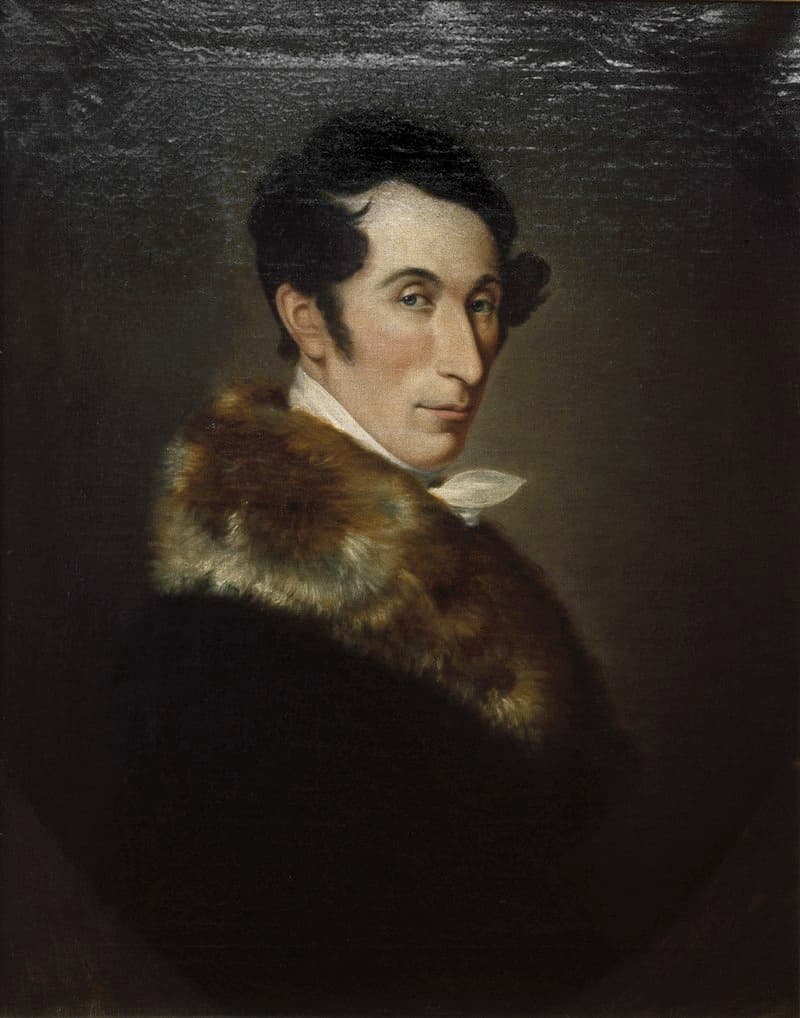
    Weber in 1825

    ——-

    “The Egyptian Helen” at Bard SummerScape, July 24-August 2

    https://fishercenter.bard.edu/series/the-egyptian-helen/

    “Mozart and His World” at the Bard Music Festival, August 7-16
    https://fishercenter.bard.edu/what…/bard-music-festival/

  • Strauss’ “Guntram”: A First-Class Second-Rate Opera?

    Strauss’ “Guntram”: A First-Class Second-Rate Opera?

    Few have done more to rehabilitate neglected Strauss, especially neglected Strauss opera, than Leon Botstein. But after all, rehabilitating the neglected is what Botstein does. He’s made a career of it, on record, in concert, and as part of the mission of the Bard Music Festival, a kind of music mecca that attracts the curious to Bard College every summer for total immersion in a composer’s work and world. (This year’s festival, which will take place largely over two weekends, August 8-10 and 14-17, will be devoted to the sleeping giant of Czech music, Bohuslav Martinů.) Botstein is the festival’s founder and co-artistic director. In that capacity he conducts the operas and most of the orchestral programs, serves on panels, writes illuminating essays, and delivers pre-concert lectures. At 78, he’s still an intellectual dynamo. His lumbering gait and considered speech belie a seemingly inexhaustible well of energy. Botstein has served as Bard’s president since 1975. Yes, you read that correctly. He assumed the office at the age of 29.

    On Friday, Botstein took the stage of Carnegie Hall to guide the American Symphony Orchestra (a group he has directed since 1992) through the resurrection, in concert, of Strauss’ first opera, the problem child “Guntram.” The work was tepidly received at its premiere in Weimar in May 1894. Basically, everyone thought it was fine, if not particularly special. Pauline de Ahna sang the role of Freihild. Four months later she would become Strauss’ wife. (He announced their engagement on the day of “Guntram’s” premiere.)

    In November, Strauss brought the work to his hometown of Munich, where he was serving as music director. Its reception there might be charitably characterized as brutal. So poorly did its single performance go down that the orchestra walked out on strike under the direction of its concertmaster (Strauss’ cousin). The two leads refused to reprise their roles, and a third singer was adamant about not returning until a better pension was negotiated. Ouch!

    By then, Strauss had already tasted success with his tone poems “Don Juan” and “Death and Transfiguration.” “Till Eulenspiegel’s Merry Pranks,” “Also sprach Zarathustra,” “Don Quixote,” and “Ein Heldenleben” were yet to come. He was a decade away from “Salome,” the work that would change his operatic fortunes forever. (But first, he would have his revenge on conservative Munich with his scandalous opera “Feuersnot.”) He would go on to become perhaps the most successful opera composer of the 20th century.

    Still, you know how it is. One never forgets the sting of rejection. Strauss just couldn’t get over “Guntram’s” failure. He tried to put it behind him with a humorous gesture, figuratively burying the pain with a symbolic gravestone erected on his property that bore the inscription:

    “Here lies the venerable, virtuous young Guntram—
    Minnesinger, who was gruesomely slain by the symphony orchestra of his own father
    May he rest in peace!”

    Strauss would enjoy wealth and celebrity, but that early humiliation stayed with him. In 1940, when he was in his mid-70s, at the other end of a very fruitful career, he revised “Guntram,” making some cuts and hoping its merits would finally be recognized. But its fortunes did not improve.

    “Guntram,” then, is right in Botstein’s wheelhouse. “Salome,” “Elektra,” and “Der Rosenkavalier” don’t need his help. Rather, he’s been working his way through Strauss’ lesser-known efforts, including the aforementioned “Feuersnot,” “Die ägyptische Helena,” “Die schweigsame Frau,” “Friedenstag,” “Daphne,” and “Der Liebe der Danae.” He and the ASO recorded “Die ägyptische Helene” and “Der Liebe der Danae” at Avery Fisher Hall in 2001 and 2003, respectively, for Telarc Records.

    Before I forget: it is essential that you get there early for any Leon Botstein performance. I guarantee his insightful pre-concert talks will enrich your experience of the music. On this occasion, had I missed his remarks, it would have gone right over my head that this was no mere Wagner knockoff, but rather a sly subversion of the Wagnerian aesthetic it would seem to embrace. I would have missed out on the entire social and historical context that allowed me to take vicarious pleasure in knowing that “Guntram” pissed off Strauss’ contemporaries. Of course, the music itself also happens to contain passages of great beauty, especially when heard live.

    Botstein conducted “Guntram” from that 1940 revision of the work, the only performance edition. While the opera may not be a world-beater, we’re far enough along from the prejudices and animosities that pummeled it in the 1890s to at least give it a fair and objective hearing.

    Strauss wrote his own libretto, which is full of the turgid Teutonic iconography familiar from so many German Romantic operas. A corrupt ruler, high-minded minnesingers, civil unrest, a saintly woman, thwarted love, and heavy swords that in my opinion never get enough use. Strauss further emulates Wagner through the employment of leitmotifs – musical snippets associated with certain characters or ideas that undergo transformation as they recur throughout the opera. Guntram’s is insistently memorable, helped no doubt by the fact that it’s basically the first three notes of the Enterprise fanfare from the original “Star Trek” television series. A leitmotif associated with Freihild’s love anticipates a similar one in Strauss’ “Die Frau ohne Schatten.”

    Certainly, “Guntram” has got its share of castles and pageantry and lofty-minded singing societies – in this case, a pacifist rebel alliance united against a tyrannical duke. Too bad Guntram kills him. If it were Wagner, you would expect the hero, or any rate the self-sacrifice of the heroine, to change the world. But there is no redemption in “Guntram.” Instead, the protagonist retires, like Strauss’ vision of the Hero at the end of his epic tone poem “Ein Heldenleben” – which actually quotes “Guntram” in the section celebrating “The Hero’s Works of Peace.” The climactic moments of the opera also put one very much in the mind of “The Hero’s Retirement from this World and Completion.”

    There are intimations of other Strauss works, as well. “Death and Transfiguration,” already written, finds its way in. There’s no question as to the identity of the composer. Strauss was already a master orchestrator, and his thumbprints are easily detectable without a magnifying glass. But the ghost of Wagner is forever lurking behind a column. One thing I forgot to mention is a dance that Strauss includes twice, which to my ears is a Romantic gloss on the same Tielman Susato dance Peter Warlock used as the basis for the last movement of his “Capriol Suite.” Can that be possible? How well known would Susato have been in the 19th century? Perhaps the similarity is just a coincidence? A chorus of monks also gets to intone some faux Gregorian chant. Great fun!

    Despite all the music’s feints at “Tristan und Isolde,” especially in the third act, “Guntram” is an opera without any sense of Wagnerian transcendence or redemption. It’s more like there’s the POSSIBILITY of redemption, perhaps, someday, I’ll have to get back to you, as Guntram wanders off into a life of renunciation, reflection, and seclusion; but before he goes, he exhorts Freihild, who clearly reciprocates his attraction, to devote herself to charitable works. What a guy.

    According to Botstein, this subversion of Wagnerian ideals would have been seen as heretical by his contemporaries. Read Alex Ross’ “Wagnerism: Art and Politics in the Shadow of Music” for a better understanding of just how pervasive Wagner’s influence was. No exaggeration, it permeated just about every aspect of human existence and thought – philosophy, fashion, architecture, politics, and of course the arts – apparently so much so that Strauss’ teacher, Alexander Ritter, an ardent Wagnerian, totally cooled on their friendship in the wake of “Guntram.” (On the other hand, Strauss’ rival, Gustav Mahler, respected its merits enough to include two of its preludes on a concert – at Carnegie Hall, as a matter of fact.) To mess with Wagner would have been to rock the pillars of the earth.

    A frequent criticism leveled against Botstein, a prolific scholar who has published in multiple disciplines (in multiple languages, for that matter) and is the head of a liberal arts college, is that as a conductor he conducts like a hell of an academic. It’s his curiosity that drives the performances as opposed to penetrative insight. I can’t say that has always been my experience, and in fact more often than not, I have attended Botstein concerts that have left me juiced – often in both senses, as in electrified AND drained, as those Bard concerts can attain epic dimensions. On the other hand, an Ives’ Second Symphony I heard Botstein conduct at Carnegie last season lacked any suggestion, in its execution, of a work that can live and breathe in a unique, vital, and even transcendent way. Under Botstein’s direction, it was just there. Like John Knowles Paine on a bad day. That’s the risk you take, with the vagaries of live performance.

    On Friday, I can attest, Botstein was like a surfer harnessing the energy of one bitching wave. I had been totally ignorant of John Matthew Myers, but he had a ringing heldentenor that rang effortlessly over the orchestra and carried out to every corner of the hall, gliding on Carnegie’s legendary acoustics. In fact, the acoustic flattered practically everyone. There was a lot of very good and attractive singing from a diverse cast. Katharine Goeldner sang with passion and commitment in the supporting role of the Old Woman. I was amused to recall Rodell Rosel, who sang the Duke’s Fool, as the Jester in Botstein and the ASO’s performance last season of Schoenberg’s “Gurre-Lieder.” When in need of motley antics, they must have him on speed dial. To keep it short, I could pretty much dole out praise across the board. Myers was the revelation, but for as stunning as he was, in the end anyone present would have had to concede the laurels should be cast at the feet of Angela Meade, who stunned especially at the end of Act II, when her character, Freihilde, the kind wife of the evil duke, was finally given something more to do than swoon. When she belts, “Ich liebe dich!,” that’s pretty much that. All you can do is go to intermission.

    Strauss famously characterized himself as “a first-class second-rate composer.” You can practically detect the twinkle in his eye when he said it. The performance of “Guntram” on Friday night certainly bore out his assessment. In all, I found the opera worked marvelously well in concert – I found it rewarding and even revelatory – although I can imagine the challenges for anyone attempting an actual staging. For one thing, all three acts are hampered by dramatically-stagnant monologues (three for Guntram and one for Freihild), making it a textbook park-and-bark. Any staging is bound to come off seeming like a series of tableaux, with the other singers waiting around for long stretches, holding poses, or doing their best to look natural. But with voices like these, who cares? Sometimes all you need are big voices and a powerful orchestra. Anyway, I happen to groove on ersatz Wagner.

    I must say, it was instructive, if perhaps a little foolhardy, to listen to this on the same weekend as the Philadelphia Orchestra’s performance of Wagner’s “Tristan und Isolde.”

    Thank you, Leon Botstein, the American Symphony Orchestra, and the men of the Bard Festival Chorus. It was a wonderful evening!


    Strauss was the focus of the Bard Music Festival in 1992. In 2011, Bard offered a series of staged performances of “Die Liebe der Danae” (“The Love of Danae”). In 2022, the opera was “Die Schweigsame Frau” (“The Silent Woman”). These can be viewed, with a number of other Bard opera productions, on YouTube.

    “Die Schweigsame Frau”

    “Die Liebe der Danae”

    Bard Music Festival 2025: Martinů and His World

    Bard Music Festival

    Fisher Center at Bard

    HAPPY BIRTHDAY, RICHARD STRAUSS!


    Photo by H. Paul Moon (who was also very kind to supply my ticket)

  • Schoenberg’s Gurre-Lieder at Carnegie Hall

    Schoenberg’s Gurre-Lieder at Carnegie Hall

    On Friday, I attended an all-too-rare performance of Arnold Schoenberg’s “Gurre-Lieder” at Carnegie Hall. I confess, I prefer the alternate spelling, without the hyphen, but since everything about “Gurre-Lieder” screams excess, I might as well swing for the fences. The American Symphony Orchestra was led by the indefatigable Leon Botstein, always one of my heroes for resurrecting underperformed repertoire and presenting it in a scholarly context. (Unfortunately, I missed the pre-concert talk.) Ostensibly, the Carnegie performance was planned to honor Schoenberg’s 150th birthday, the actual anniversary of which will fall in September. But any performance of “Gurre-Lieder” requires no excuse.

    This is not your grandpa’s Schoenberg – the high priest of dodecaphony who changed music forever and scared your grandma off buying tickets – but rather your great-grandpa’s Schoenberg – young, passionate, and all juiced up on Romanticism. Take Wagner, Strauss, and Mahler, toss them in a blender, and turn it up to 11. The composer embarked on the piece between 1900 and 1903 and completed it, after the interval of a few years, in 1911. The result is monumental post-Romanticism in its full flowering. The scoring itself is colossal, with vocal soloists, speaker, and three choruses. Its two-hour running time is epic and absorbing.

    “Gurre-Lieder” (“Songs of Gurre”) weaves texts by Jens Peter Jacobsen into a tapestry of doomed love, blasphemy, and damnation, unfurled at Castle Gurre in medieval Denmark. But it is a Middle Ages steeped in myth and legend. The work climaxes with a harrowing evocation of the Wild Hunt, with ghostly and supernatural beings roaring across the night sky, and concludes with an opulent sunrise.

    For all his laudable achievements, Botstein often takes heat for not being the most inspiring of conductors. It’s true, I didn’t feel quite as much juice radiating from the stage as I did the last time I heard the piece, with Simon Rattle, at Philadelphia’s Academy of Music in 2000. But Carnegie is a much larger hall. Acoustically, the vocalists were difficult to hear, from my vantage in the Dress Circle; but one would have to be the most reckless of heldentenors even to attempt to pierce the sonic blast of a 150-piece orchestra.

    Even so, all of the singers had their moments. The efforts of Dominic Armstrong to convey the ardor, brooding, and bitterness of King Waldemar were often frustrated by being swallowed up by his instrumental neighbors. He was best heard in the second half as, bereft at the murder of his mistress, Tove, by his wife, Queen Helvig, Waldemar essentially shakes an angry fist at God. For this, the king is condemned for all eternity to lead a pack of ghosts and reanimated skeletons on a nightly, hell-for-leather tour about the gloomy castle and its environs.

    The fearful sight is recounted by a pious Peasant, sung on Friday by bass-baritone Alan Held. Held was easier to make out, since Schoenberg’s orchestration of the latter half of the oratorio is more forgiving, in some regards, the composer having returned to complete the work after a hiatus, during which he obviously learned a thing or two about transparency.

    Carsten Wittmoser, as the speaker, supplied the uncanny narration in sprechstimme, an eerie netherworld of blended speech and song, which Schoenberg would explore more fully in “Pierrot Lunaire.”

    In one of those grotesque comic interludes of a kind seemingly so popular among Central European post-Romantics, tenor Brenton Ryan came across best among the male soloists, as he went the furthest to inhabit his part as Klaus the Fool. You really could imagine this jester being swept along against his will, face-to-tail, on horseback.

    Of the women, the palm went to Krysty Swann as the melancholy Wood Dove, who delivers the news of Tove’s death. Felicia Moore, as Tove, again had to push against the orchestra, though she seemed to be a good choice for the role. Both successfully landed their high notes.

    The chorus – though it seemed smaller than what I am accustomed to seeing in this work (I count 80 singers in the program; Schoenberg called for 200) – was appropriately rowdy and powerful when needed.

    No team of unamplified singers is ever going to go up against “Gurre-Lieder” in a hall of that size and be heard by everyone. Under the circumstances, supertitles would have been a great help and a sensible choice. Instead, the audience muddled through the old-fashioned way, with the very wordy text reproduced in the program in microscopic font to be discerned in semi-darkness.

    By coincidence, Friday also happened to be the anniversary of the birth of Werner Klemperer, son of conductor Otto Klemperer and two-time Emmy Award winner for his memorable turn as Colonel Klink on “Hogan’s Heroes.”

    Klemperer provided the sprechstimme as the Speaker on the late Seiji Ozawa’s recording of “Gurre-Lieder,” appearing alongside James McCracken, Jessye Norman, and Tatiana Troyanos. The recording was taken from a live performance, so it may well be the same as the one on this video, or at the very least it was taken from the same series of concerts. Klemperer makes his entrance at around 1 hour and 34 minutes in. And yes, he speaks fluent German.

    What you see in the video is wonderful, of course, but it is but a pale reflection of the visceral impact of experiencing the work live.

    I saw Klemperer (the son, not the father, alas) in person several times, narrating Beethoven’s “Egmont” with the Philadelphia Orchestra, playing the Majordomo (another speaking role) in a concert performance of Strauss’ “Ariadne auf Naxos,” again with the Philadelphia Orchestra, and as emcee for a starry gala for the Opera Company of Philadelphia – all at the old Academy of Music. I missed him in his Tony-nominated turn as Herr Schultz in the 1987 Broadway revival of “Cabaret” – which my parents attended – because I chose to hear the New York Philharmonic that night. (Kent Nagano conducted George Benjamin’s “Ringed by the Flat Horizon” and Béla Bartók’s “The Wooden Prince,” and Bella Davidovich was the soloist in Chopin’s Piano Concerto No. 2.)

    As I said, the last time I heard “Gurre-Lieder” live was in Philadelphia in 2000, with Simon Rattle conducting. The audience was whipped into ecstasies with that one. Most memorably, in the moment’s silence following the last decay of the music, and just before the explosion of frenzied applause, there came from somewhere in the balcony a deeply satisfied “YEEEEEEEEEEEEAAAAAAAAAAAAAAAAAHHHHHHHHHHHH!”

    The Philadelphia Orchestra gave the work its first American performance under Leopold Stokowski in 1932. Needless to say, because of the forces involved, and the expense in mounting it, it is seldom done, but when it is, it pleases the crowd mightily.

    Happy belated birthday, Werner Klemperer (1920-2000), and thank you, Leon Botstein and the ASO!

    Werner’s dad conducting Schumann in Philadelphia

    I’ve written about Otto Klemperer many times on this site, as here:

    https://www.facebook.com/photo?fbid=1844909085676373&set=basw.AbpuDWzgKAkm3TnfgzQN9VOGciZh068VBmrEC7s6TZuOvY0sWP2WF65SWXdWvtPNl6UCFpVXon4JgBoPB7u-aMAhzDmHFuyeybByVgYBV44emn5MDHkc4woxlj1YKmzdbQVSErSOVvES01qL7mMlKN60pXCUOh8qZzl4h6trZoBN-n2-RxSWtACCnjor6Bv0KGg&opaqueCursor=AboKz2dejQ1QKxjJ3ZL-8qoWhLQ-ztweo9I-KkJj8ZokdKTf_ZpMGRNjk4oVHO2y2CcfPTdhpZyU1ieD1Z0xsw8x-9YsfVFb62KvmZRCm-VoaJogaKSEBfghzlZgXU_uaSA1EM5PsPr5Ahf_nUgzcj8EjKJSTgLhieT1O7OYp-tV8ieRxXXvOKZEgz6TFmFWxr5HZIvbablb42PklPcJeLJ4hfMRfKdWRJkeRBES69EBxIMGR41oUMFkmvEwxY2tnWP8rHj-RSNB_Oeml7DG_trUqiOWZ-hRS-2xjYlX4LUfX6wWfZYFQKHJHAeJF2sX95lHDtHFtCJcyM2g3gDHnnP2tzmsUt-55Cu393Naddj9TI5bX5vx159UKm7mfcuRZl00ycfyLW6KXwZxuCgoj9XHcc0KRpLnvw2QAmfuEBAxq_xx7zSL-PjxOvvhZlY3FBt88o9l5a5Xs2KSQuX2Q8Yb3xo9x-IW1KsSUL_Qpo_pjXQ8Uwsq1uysmCK0_DB2LmL06WcYWJT0MPhOeUZV6slrKVF3fe2S2c2TPgLGfpqLBk84t_yTR2QpjFf4Fk4HNCt871ShxLTxYDBTPN_c4WmAxi5ZysTxnV85RlHiDJB0Yp7pAiHl3LWjuVTPzRj1JTJ3kcXg1ML4e5fLwKCF4qR64sY7AuN4eblsnwn4rR7psQfLWXx_n60KORyc5jAirsse7eqy95OGaunXQK4pVsfc

  • Leon Botstein on Vaughan Williams at Bard

    Leon Botstein on Vaughan Williams at Bard

    Profoundest thanks to Leon Botstein, music director of the American Symphony Orchestra, founder and music director of The Orchestra Now (TŌN), and president of Bard College, very generous with his time this morning in discussing the music of Ralph Vaughan Williams, along with a great many other things, in connection with an article I am preparing on this year’s Bard Music Festival.

    Botstein is co-artistic director of the festival, which completed its 33rd season on Sunday. He possesses an enviable combination of traits and talents, not least of which include intellectual curiosity, clearness of purpose, and an uncanny ability to trace baroque lines of thought through a network of arabesques while somehow never losing sight of his conclusions. The whole process is rather breathtaking, I must say. He plants his landings like an Olympic gymnast.

    He also seems genuinely interested in getting to know his interviewer. It’s not the first time we spoke, but I walk away feeling as if the conversation was nearly as much about me as it was him. Of course, I won’t be appearing in the article.

    Thanks again, President Botstein. Looking forward to “Berlioz and His World” at Bard in 2024!

    Fisher Center at Bard

  • Charles Ives: An American Original

    Charles Ives: An American Original

    With the birthday of Connecticut cranky Yankee, Charles Ives, the autumn of my content deepens, as golden leaves find parallel in the Golden Age of American music and a run of composer birthdays that stretch clear into early December (Howard Hanson, Aaron Copland, Virgil Thomson, Irving Fine, Morton Gould, etc.). As a radio programmer of so many years, I am sensitive to these types of patterns!

    Ives, born on this date in 1874, was the first of our modern giants, and his influence has been the furthest reaching. While piling up acorns in the insurance business, he had the freedom to pursue his idiosyncratic muse. He composed in the evenings, on weekends, and on holidays, creating works of all stripes, tonalities, and quasi-tonalities, even atonality, navigating with remarkable certainty for some 30 years. And he did so in the relative isolation of a prophet, with very few performances to affirm his chosen course.

    Ives retired in 1930, which allowed him to devote himself wholeheartedly to music. Ironically, by then, he found he was no longer able to compose. His wife recalled a day in 1927 when he came downstairs with tears in his eyes and confessed that everything sounded wrong to him. After that, he labored mostly at revision and publication.

    By the time his works finally began to gain recognition, it had already been 20 years since he had stopped composing. At the time of his death, in 1954, he was still widely misunderstood and much of his music remained unperformed. Nevertheless, he had some important champions. He was a recipient of the Pulitzer Prize for Music in 1947, for his Symphony No. 3, “The Camp Meeting,” a work he had written in 1904. His reaction? “Prizes are for boys, and I’m all grown up.” He gave away the prize money, half of it to Lou Harrison, who had conducted the belated premiere.

    Even in the 1960s, the world was still grappling with Ives. In 1965, Leopold Stokowski gave the first performance of the Symphony No. 4. At the time, the work’s complex, kaleidoscopic tempos and layered, shifting meters required multiple conductors, and Stokowski enlisted the aid of David Katz and a young Jose Serebrier. The performance took place at Carnegie Hall with the American Symphony Orchestra and the Schola Cantorum of New York.

    The piece was composed between 1910 and the mid-1920s. The first two movements had been performed by members of the New York Philharmonic under the direction of Eugene Goossens in 1927. This was the only occasion on which Ives would hear any of the music performed live by an orchestra. (He died in 1954.)

    Bernard Herrmann conducted an arrangement of the lovely third movement, the simplest and most conservative of the four (why, then, the need for an arrangement?), in 1933. The music as Ives wrote it was not heard until Stokowski’s complete performance.

    The composer’s biographer, Jan Swafford, describes the work as “Ives’ climactic masterpiece.”

    Stokowski recorded the symphony a few days after the premiere and led a televised studio performance, which can be seen here:

    Stoky kicks off twenty minutes of spoken introductory material (including commentary from producer John McClure) at the 4:30 mark. The symphony proper begins 25 minutes in.

    When’s the last time you saw anything like this on television?

    Marveling at how out of step with musical convention his own compositions could be, Ives once famously remarked, “Are my ears on wrong?” Musicians are still scrambling to address this “unanswered question.”

    Happy birthday, Charles Ives!


    Ives’ “Hallowe’en” for string quartet and piano – watch out for that big drum!

    Leonard Bernstein on the Symphony No. 2:

    My preferred recording of the symphony, so beautiful (though not always entirely accurate, in regard to Ives’ intentions), with Bernstein and the New York Philharmonic in 1958:

    The Yale-Princeton Football Game:

    Ives sings!

Tag Cloud

Aaron Copland (92) Beethoven (95) Composer (114) Film Music (123) Film Score (143) Film Scores (255) Halloween (94) John Williams (187) KWAX (229) Leonard Bernstein (101) Marlboro Music Festival (125) Movie Music (138) Opera (202) Philadelphia Orchestra (89) Picture Perfect (174) Princeton Symphony Orchestra (106) Radio (87) Ralph Vaughan Williams (85) Ross Amico (244) Roy's Tie-Dye Sci-Fi Corner (290) The Classical Network (101) The Lost Chord (268) Vaughan Williams (103) WPRB (396) WWFM (881)

DON’T MISS A BEAT

Receive a weekly digest every Sunday at noon by signing up here


RECENT POSTS