Tag: Bard Music Festival

  • Vaughan Williams Livestream from Bard College

    Vaughan Williams Livestream from Bard College

    Adore the music of Ralph Vaughan Williams but can’t make it to this year’s Bard Music Festival? Some of the concerts will be made available via livestream. The lark ascends at Bard College in Annandale-on-Hudson, NY, August 4 -13. If you’re trapped in the Antarctic, watch online for a modest fee.

    Please note the concerts can be viewed in real-time only, and not on demand. So reserve your tickets, and don’t be late!

    https://fishercenter.bard.edu/whats-on/programs/upstreaming/


    FRIDAY, AUGUST 4, at 7 PM
    PROGRAM ONE – VAUGHAN WILLIAMS: BECOMING AN ENGLISH COMPOSER

    Down Ampney (Come Down, O Love Divine) from “The English Hymnal” (1906)

    Quintet for piano and strings in C minor (1903)

    Fantasia on a Theme of Thomas Tallis (1910)

    Concerto in D minor for violin and strings (1925)

    Serenade to Music (1938)

    O taste and see (1953)

    Songs

    Selections from “Five English Folk Songs” (1913)

    Old Hundredth Psalm Tune (1953)

    Horszowski Trio and guests; William Ferguson, tenor; Theo Hoffman, baritone; Renée Anne Louprette, organ; Grace Park, violin; Sun-Ly Pierce, mezzo-soprano; Brandie Sutton, soprano; Bard Festival Chorale, James Bagwell, music director; The Orchestra Now (TŌN) conducted by Leon Botstein, music director


    SATURDAY, AUGUST 5, at 8 PM
    PROGRAM THREE: THE SYMPHONY AND COMPOSING FOR THE STAGE

    Job, A Masque for Dancing (1930)

    Concerto in C, for two pianos and orchestra (1931, rev. 1947)

    Symphony No. 4 in F Minor (1934)

    Danny Driver & Piers Lane, pianos; The Orchestra Now (TŌN) conducted by Leon Botstein


    SUNDAY, AUGUST 6 at 5 PM
    PROGRAM SIX: LONDON CALLING! FUN IN COCKAIGNE!

    A celebration of Music Hall and pop traditions from Gilbert and Sullivan to the Beatles, including works by Arthur Sullivan (1842–1900), Roger Quilter (1877–1953), Percy Grainger (1882–1961), Gerald Tyrwhitt-Wilson, Lord Berners (1883–1950), Eric Coates (1886–1957), Ivor Novello (1893–1951), Noël Coward (1899–1973), Arthur Benjamin (1893–1960), and others, with selections from Vaughan Williams’ “The Poisoned Kiss” (1927–29; rev.)

    Martin Luther Clark, tenor; Theo Hoffman, baritone; Sun-Ly Pierce, mezzo-soprano; Ann Toomey, soprano; Bard Festival Ensemble; and others


    FRIDAY, AUGUST 11, at 8 PM
    PROGRAM SEVEN – THE LARK ASCENDING: BRITISH MUSIC FOR SMALL ORCHESTRA

    Ralph Vaughan Williams (1872–1958)
    Five Variants of “Dives and Lazarus” (1939)

    Edward Elgar (1858–1934)
    Serenade for Strings, Op. 20 (1896)

    Ralph Vaughan Williams (1872–1958)
    Flos Campi (1925)

    Grace Williams (1906–77)
    Elegy for String Orchestra (1936, rev. 1940)

    Ralph Vaughan Williams (1872–1958)
    The Lark Ascending (1914, orch. 1921)

    Peter Warlock (1894–1930)
    Capriol Suite (1926)

    Frederick Delius (1862–1934)
    Two Aquarelles (1932)

    Gustav Holst (1874–1934)
    St. Paul’s Suite, Op. 29, No.2 (1913)

    Luosha Fang, viola; Bella Hristova, violin; members of the Bard Festival Chorale, James Bagwell, choral director; The Orchestra Now (TŌN) conducted by James Bagwell and Zachary Schwartzman


    SATURDAY, AUGUST 12, AT 8 PM
    PROGRAM NINE: A NEW ELIZABETHAN AGE

    Elizabeth Maconchy (1907–94)
    Proud Thames, coronation overture (1953)

    William Walton (1902–83)
    Partita for Orchestra (1957–58)

    Ralph Vaughan Williams (1872–1958)
    Symphony No. 8 in D Minor (1955)

    Jean Sibelius (1865–1957)
    Andante Festivo (1922/1938)

    Ralph Vaughan Williams (1872–1958)
    “Sinfonia Antartica” (Symphony No. 7) (1952)

    Brandie Sutton, soprano; members of the Bard Festival Chorale, James Bagwell, choral director; American Symphony Orchestra conducted by Leon Botstein, music director


    SUNDAY, AUGUST 13, at 3 PM
    PROGRAM ELEVEN – VAUGHAN WILLIAMS AND SHAKESPEARE

    “Sir John in Love” (1928), after Shakespeare’s “The Merry Wives of Windsor”

    Bard Festival Chorale, James Bagwell, choral director; American Symphony Orchestra conducted by Leon Botstein

    In order of vocal appearance:

    William Ferguson, tenor, as Robert Shallow
    Theo Hoffman, baritone, as Sir Hugh Evans
    Martin Luther Clark, tenor, as Master Slender
    Maximillian Jansen VAP ’21, tenor, as Peter Simple
    Troy Cook, baritone, as Page
    Craig Colclough, bass-baritone, as Sir John Falstaff
    Julius Ahn, tenor, as Bardolph
    Tyler Duncan, baritone, as Corporal Nym
    Kevin Thompson, bass, as Pistol
    Brandie Sutton, soprano, as Anne Page
    Ann Toomey, soprano, as Mrs. Page
    Sarah Saturnino, mezzo-soprano, as Mrs. Ford
    Joshua Blue, tenor, as Fenton
    John Brancy, baritone, as Dr. Caius
    Justin Hopkins, bass-baritone, as Rugby
    Lucy Schaufer, mezzo-soprano, as Mrs. Quickly
    Lucia Lucas, baritone, as Host of the Garter Inn
    William Socolof, bass-baritone, as Ford


    Pre-concert talks will be offered before some of the events. It’s unclear whether or not these will be included as part of the livestreams. It might be worthwhile to check-in a little early.

    Fisher Center at Bard

  • Bard Music Festival Book Preview Vaughan Williams

    Here’s a glimpse at this year’s tie-in volume to the Bard Music Festival, coming up at Bard College in Annandale-on-Hudson, NY, August 4-13. The Bard books offer scholarly perspectives on the highlighted composer’s life and works. Also included is Vaughan Williams’ lecture on the “St. Matthew Passion.” Looking forward to picking up my copy this weekend! More information on the book’s contents by following the link to @[100063452955898:2048:University of Chicago Press] in the @[100063807330266:2048:Fisher Center at Bard]’s post.

  • Vaughan Williams’ Amanuensis: The Invisible Hand of Roy Douglas

    Vaughan Williams’ Amanuensis: The Invisible Hand of Roy Douglas

    Massive respect to Roy Douglas.

    In preparation for this year’s Bard Music Festival, devoted to Ralph Vaughan Williams (finally!), I just burned through Douglas’ book of correspondence with the composer (“Working with Vaughan Williams,” 1988). From 1947 to 1958, Douglas served as Vaughan Williams’ closest associate, next perhaps to Ursula Vaughan Williams (née Wood), the composer’s wife. I forgot I’d even acquired it, so I’m happy I didn’t buy it twice!

    More on Douglas in a moment, but before I lose your attention, I hasten to add that the festival this year begins this Friday, August 4, and runs through Sunday, August 13, on the idyllic campus of Bard College in Annandale-on-Hudson, NY. Each summer, Bard, under the artistic directorship of Leon Botstein and Christopher H. Gibbs, presents two weekends of a specific composer’s music, in the context of his or her “world” – their contemporaries, those they were influenced by, and those they influenced. Vaughan Williams is the 33rd such composer to be so honored.

    Highlights will include performances of “Job, A Masque for Dancing,” the “Sinfonia Antartica” [sic], the Symphonies Nos. 4 & 8, the Concerto for Two Pianos, the Concerto Accademico for violin and orchestra, “Flos Campi” for viola, chorus and orchestra, and a concert performance of the Falstaff opera “Sir John in Love,” alongside old favorites like “The Lark Ascending,” the “Fantasia on a Theme by Thomas Tallis,” “Five Variants of Dives and Lazarus,” and the “Serenade to Music.”

    With the composer largely neglected in the United States during his sesquicentennial year, I am especially excited for this opportunity to hear so much of his music live.

    Of course, there will be works by many other composers, as well, though all of the music will be connected in one way or another with RVW.

    The Bard Music Festival is an intensive regimen of concerts, panels, and pre-concert talks. One basically gets out of it whatever one puts into it. If total immersion is what you desire, there’s no place like Bard for a scholarly crash course. But if you prefer to cherry-pick and just go and casually experience some worthwhile, often rarely-heard music, you can do that, too.

    Lots more to do at Bard all summer long, as the music festival is but the cultural diadem upon the brow of a larger Bard SummerScape that incorporates a number of other artistic disciplines.

    For tickets and information, visit here:

    https://fishercenter.bard.edu/whats-on/programs/summerscape/


    For a self-trained musician, Roy Douglas achieved a remarkable level of expertise as a composer himself, so much so that he was enlisted as not only the personal assistant of Vaughan Williams, but also that of William Walton. He served as a proofer and copiest for both composers – no mean feat in the case of RVW, who, as an aging leftie in a right-handed world rendered his scores in a near indecipherable scrawl (according to Douglas, sometimes worse!). The Douglas-RVW correspondence is full of questions and clarifications about the composer’s intentions, as Douglas serves as a second set of eyes, often pushing himself hard through long hours and holidays to meet impending deadlines for performances.

    A rumor began to circulate, thanks to Vaughan Williams’ frequent quip when introducing Douglas to others as “the man who writes my music,” that Douglas’ duties actually extended beyond that of amanuensis, but Douglas does his best to clear up any misunderstandings, asserting that in his entire 11 years’ service with the composer he could be said to have inserted only one note into any of his symphonies, in the “Sinfonia Antartica” [sic], and that to felicitate a less jarring transition after RVW made the cut of a few bars.

    He also completed the composer’s final work, the Christmas pageant “The First Nowell,” after Vaughan Williams’ death in 1958, right in the middle of his harmonization of “How Brightly Shines the Morning Star.” Since the piece was undertaken for charity (for the relief of refugee children), Douglas and Ursula felt Ralph would have wanted to fulfill the commission. As it was, the work was nearly finished, with the composer having already orchestrated three quarters of the piece. Even so, there was considerable ingenuity exhibited on Douglas’ part in his seamlessly matching the composer’s efforts. I must say, he did a fabulous job, and the work remains one of my favorite Christmas pieces, a delight for anyone who loves Vaughan Williams’ more frequently encountered “Fantasia on Christmas Carols.”

    Beyond that, Douglas was firm in his insistence not to complete any sketches left unfinished at the composer’s death, even first drafts of a Cello Concerto and an opera, “Thomas the Rhymer,” which exist in “fair copy” only, with piano accompaniment and no orchestration, as Douglas was familiar enough with RVW’s working methods to know that he continually revised throughout the process of creation, revision, and polishing, so that a finished work would be a very different piece from that of its initial conception.

    He did, however, continue, as he had when the composer was alive and with his authorization, to arrange some of Vaughan Williams’ more extravagantly scored pieces for more modest forces so that performances could be more easily undertaken by community ensembles.

    Douglas’ humility and selflessness and are not to be undersold. It’s remarkable for a composer to recognize his own limitations and to give himself over to the service of a greater one. Douglas continued to create original works when he could, but he had no illusions as to the music’s merit in the larger scheme.

    He is best known for his arrangement of Chopin keyboard works into the ballet “Les Sylphides,” from which he continued to draw some pretty sweet royalty checks for the rest of his life. He also assisted Richard Addinsell on many of his film scores. His was the invisible hand that crafted Addinsell’s music for “Dangerous Moonlight” (U.S. title “Suicide Squadron”) into the ever-popular “Warsaw Concerto.” All in all, he did pretty well for himself, though he certainly had to push himself very hard to keep up with the deadlines. One of the opportunities he was forced to decline was to work with Gerald Finzi, who hoped to enlist him to proof his own Cello Concerto.

    Douglas remained a invaluable resource for anyone with questions about RVW’s intentions in his music. Until the day of his death, he served as vice president of the Ralph Vaughan Williams Society. Douglas died in 2015 at the age of 107!

    Now… should I move on to Ursula Vaughan Williams’ biography of her husband or Eric Saylor’s recent book, both for Oxford University Press (RVW’s publisher)? I’m cramming hard for Bard!

    Fisher Center at Bard


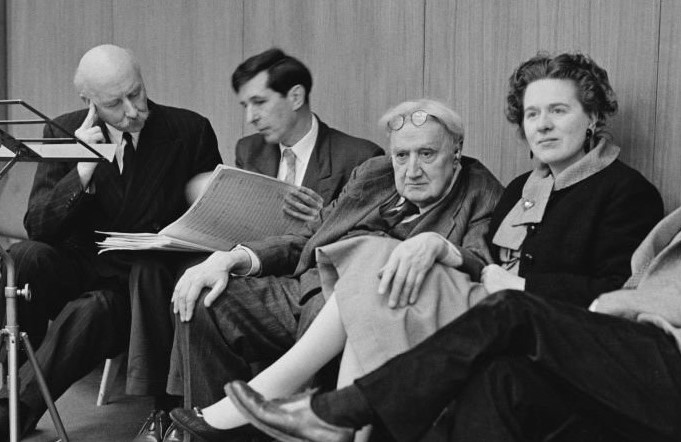
    PHOTO: Roy Douglas (with pipe) and RVW in 1953

  • Bard SummerScape: Henry VIII Opera

    Bard SummerScape: Henry VIII Opera

    Bard SummerScape once again makes history, with the first major U.S. production of Camille Saint-Saëns’ grand opera “Henry VIII.”

    A seven-week arts festival consisting of opera, dance, theater, film, music, and cabaret, Bard SummerScape is held every year on the idyllic campus of Bard College in Annandale-on-Hudson, NY.

    In common with all of Bard’s operas, “Henry VIII” is rarely staged. In fact, you’re unlikely to encounter any of Saint-Saëns’ operas other than, of course, “Samson and Delilah.” I was lucky enough to hear this one, also at Bard, in a concert performance during a festival devoted specifically to Saint-Saëns in 2012.

    This year’s fully-staged production, held at the Sosnoff Theater in the Frank Gehry-designed Fisher Center for the Performing Arts, opened on Friday. Remaining performances will take place at the following times:

    TODAY AT 2 PM
    JULY 26 AT 2 PM
    JULY 28 AT 4 PM
    JULY 30 AT 2 PM

    Livestreams will also be made available on July 26 AT 2 PM and July 29 AT 5 PM.

    Eleven of Bard’s past operas – again, many of them U.S. premieres – are now available for streaming, free, and can be accessed on YouTube through the festival’s archive at the link below.

    2022 – Richard Strauss, “Die Schweigsame Frau” (“The Silent Woman”)

    2021 – Ernest Chausson, “Le roi Arthus” (“King Arthur”)

    2019 – Erich Wolfgang Korngold, “Das Wunder der Heliane” (“The Miracle of Helen”)

    2018 – Anton Rubinstein, “Demon”

    2017 – Antonin Dvořák, “Dmitrij”

    2016 – Pietro Mascagni, “Iris”

    2015 – Ethel Smyth, “The Wreckers”

    2014 – Carl Maria von Weber, “Euryanthe”

    2013 – Sergei Taneyev, “Oresteia”

    2012 – Emmanuel Chabrier, “Le roi malgré lui” (“The King in Spite of Himself”)

    2011 – Richard Strauss, “Die Liebe der Danae” (“The Love of Danae”)

    https://fishercenter.bard.edu/explore-learn/summerscape-opera/?utm_source=wordfly&utm_medium=email&utm_campaign=2023-07-21-OperaOpeningNight&utm_content=version_A

    Arguably, the crown jewel of Bard SummerScape is the Bard Music Festival (August 4-13), two weeks devoted to a specific composer and his or her world – their contemporaries, those they were influenced by, and those they influenced. This year (its 33rd) the focus is on none other than Ralph Vaughan Williams.

    Highlights will include performances of “Job, A Masque for Dancing,” the “Sinfonia Antartica” [sic], the Symphonies Nos. 4 & 8, the Concerto for Two Pianos, the Concerto Accademico for violin and orchestra, “Flos Campi” for viola, chorus and orchestra, and a concert performance of the Falstaff opera “Sir John in Love,” alongside old favorites like “The Lark Ascending,” the “Fantasia on a Theme by Thomas Tallis,” “Five Variants of Dives and Lazarus,” and the “Serenade to Music.”

    With the composer largely neglected in the United States during his sesquicentennial year, all I can say is… it’s about bloomin’ time!

    Of course, there will be works by many other composers, as well, though all of the music will be connected in one way or another with RVW.

    The Bard Music Festival is an intensive regimen of concerts, panels, and pre-concert talks. One basically gets out of it whatever one puts into it. If total immersion is what you desire, there’s no place like Bard for a scholarly crash course. But if you prefer to cherry-pick, and just go and casually experience some worthwhile, often rarely-heard music, you can do that, too. One thing’s for certain: the lavish program book will keep you busy for days after the festival’s end. There is also always a tie-in book of scholarly essays and many recordings available for purchase.

    For more information on Bard SummerScape and the Bard Music Festival, visit here:

    https://fishercenter.bard.edu/whats-on/programs/summerscape/

    If you’re an opera lover and you’ve got a lazy Sunday afternoon or evening ahead, consider streaming one of the operas today!

    Fisher Center at Bard


    PHOTO: Still from Bard’s “Henry VIII”

  • Bard Music Fest Focuses on Rachmaninoff

    He was a visiting scholar at the Bard Music Festival in 2018, an event devoted to Nikolai Rimsky-Korsakov and “his world.” A mere blip in Taruskin’s career, but he was awarded an honorary degree from the college’s president, and the festival music director, Leon Botstein. Rachmaninoff will be the focus of this year’s festival, August 5-14. For more information, follow the link (in no way associated with Taruskin’s obituary).

    https://fishercenter.bard.edu/whats-on/programs/bard-music-festival/

Tag Cloud

Aaron Copland (92) Beethoven (95) Composer (114) Film Music (123) Film Score (143) Film Scores (255) Halloween (94) John Williams (187) KWAX (229) Leonard Bernstein (101) Marlboro Music Festival (125) Movie Music (138) Opera (202) Philadelphia Orchestra (89) Picture Perfect (174) Princeton Symphony Orchestra (106) Radio (87) Ralph Vaughan Williams (85) Ross Amico (244) Roy's Tie-Dye Sci-Fi Corner (290) The Classical Network (101) The Lost Chord (268) Vaughan Williams (103) WPRB (396) WWFM (881)

DON’T MISS A BEAT

Receive a weekly digest every Sunday at noon by signing up here


RECENT POSTS